





 buying guides
 heating
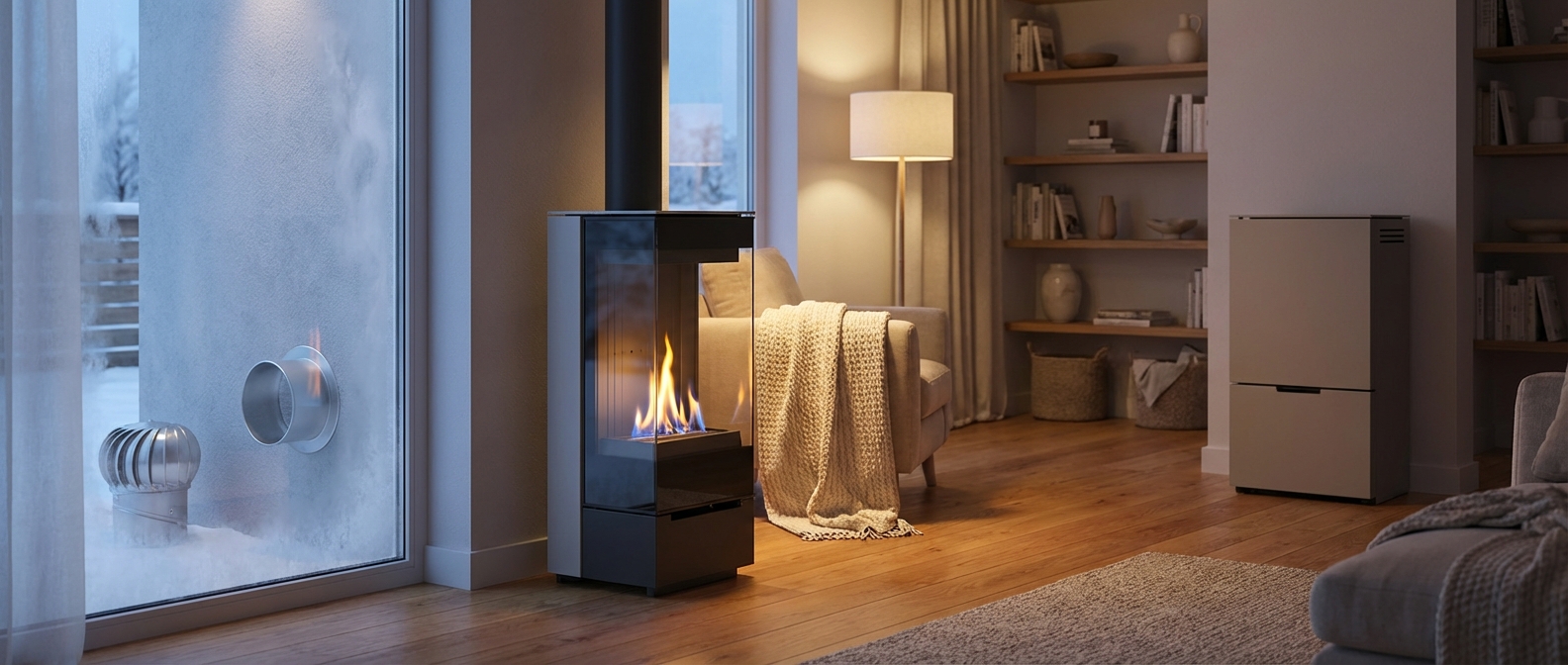
Your back bedroom runs 10 degrees colder than the rest of the house, the bonus room over the garage never settles down, and you are tired of paying to heat rooms nobody uses. In 2026, a gas stove can be a direct path to real heat in one or two rooms without ripping out your whole system.
Choosing between ventless and direct vent is a tradeoff, not a feature checklist. Ventless looks simpler to install and more efficient on paper. Direct vent looks cleaner for indoor air and more universally acceptable, but it usually costs more and forces you into venting work that can derail a "quick" project.
The stakes are bigger than a warm chair: heating upgrades in 2026 are judged on comfort, lower bills, better indoor air quality, and lower emissions, and those goals can pull in opposite directions. This guide is informed by 30+ years of HVAC experience, focused on what holds up after the novelty wears off.
If you realize a stove is not the best fit, the same seller ecosystem typically covers broader HVAC equipment: heat pumps and mini splits, ACs, gas furnaces, air handlers, coils, thermostats, refrigerants, line sets, pads, whips, and tie-down kits. For a quick sanity check, U.S.-based phone help is available at 813-885-7999 Mon to Fri, 7:30am to 5:00pm local time by branch.
You will leave with a clear way to choose ventless vs. direct vent, sanity-check safety and indoor-air implications, understand what actually drives operating cost, and know when an all-electric heat pump or mini split is the smarter move.
Ventless vs. Direct Vent Gas Stoves
Ventless and direct-vent stoves are not interchangeable installation options. They behave like two different HVAC strategies because one uses the room as part of the combustion system, and the other isolates combustion from indoor air, so "best" depends on what you're optimizing.
A ventless (vent-free) gas stove pulls combustion air from the room, burns it, then releases combustion byproducts back into the same indoor air you breathe. The upside is placement simplicity because there's no flue run to plan; the tradeoff is direct impact on indoor air and added indoor moisture, which increases condensation risk in tighter homes or rooms that already struggle with humidity (often addressed with a whole-house dehumidifier).
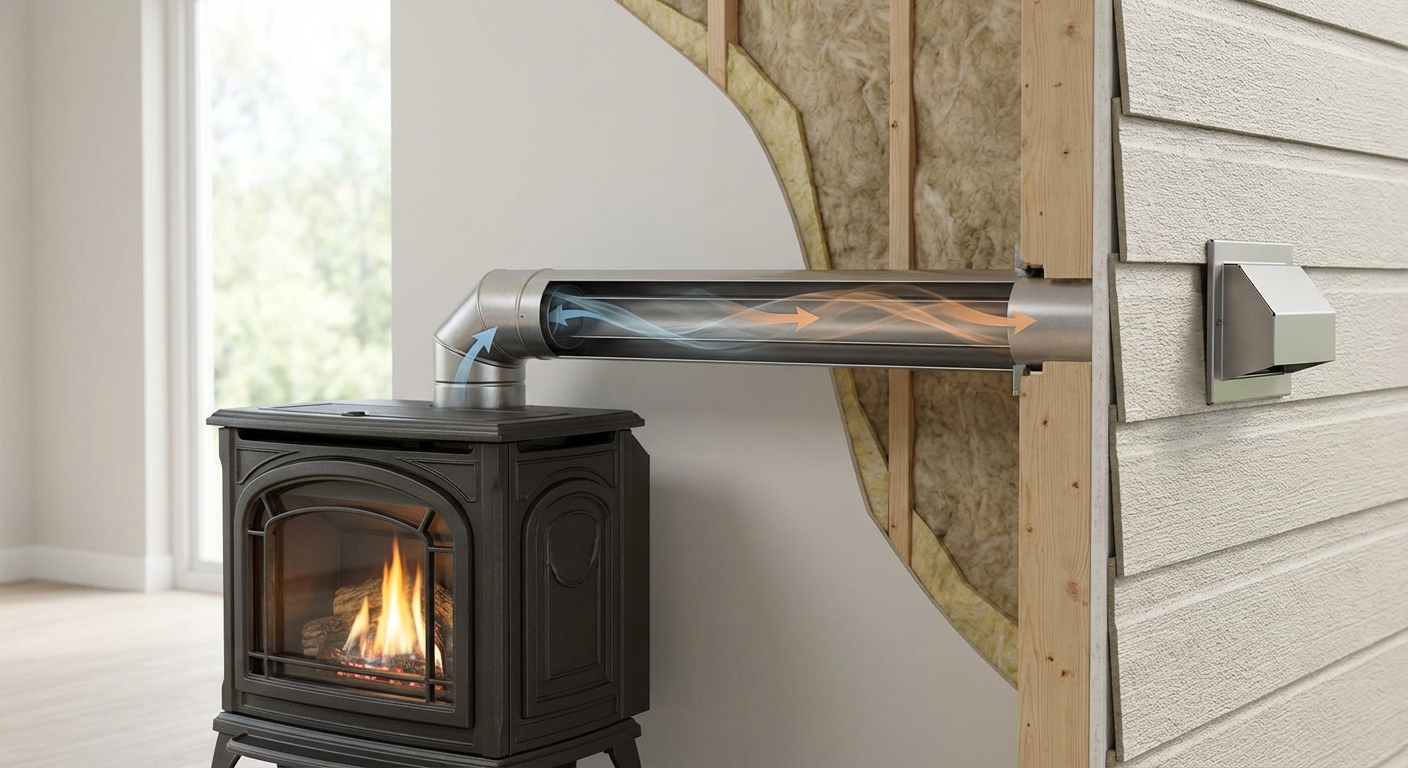
A direct-vent gas stove uses sealed combustion: it draws air from outdoors and sends exhaust back outdoors, keeping the flame system separated from the room. That isolation protects indoor air quality and limits indoor moisture loading, but it makes placement more constrained because you need a vent route to an exterior wall or the roof and the listed vent parts the manual calls for.
| Factor | Ventless | Direct vent |
|---|---|---|
| Combustion air source | Indoor room air | Outdoor air (sealed intake) |
| Exhaust destination | Stays indoors | Exits outdoors (sealed exhaust) |
| Indoor moisture impact | Higher, moisture stays in the room | Lower, moisture leaves with exhaust |
| Install complexity | Lower, no vent penetration | Higher, vent run plus termination |
| Typical use case | Simple heat where IAQ and humidity are not limiting factors | Primary-zone heat where IAQ sensitivity and predictability matter |
These appliances are covered under different ANSI standards: ANSI Z21.11.2 applies to unvented room heaters, while ANSI Z21.88 applies to direct-vent gas fireplace heaters. Marketing efficiency also gets messy because furnaces are commonly rated by AFUE, while fireplace and stove literature often cites steady-state or thermal efficiency; vent-free products often claim very high efficiency because the heat stays indoors instead of going up a flue.
If indoor air quality, humidity control, or code uncertainty is a priority, lean direct-vent and follow the appliance manual, which often specifies coaxial venting and may require rigid coaxial pipe instead of flexible. Lean ventless only when the room and intended use match the manual guidance and local rules, and you accept that the room becomes part of the combustion system.
Safety, Indoor Air Quality, and 2026 Code Considerations
That core design difference-using indoor air versus sealed combustion-drives most of the safety and approval questions in 2026. Before you compare trims or features, confirm what your jurisdiction allows and what your room can realistically support.
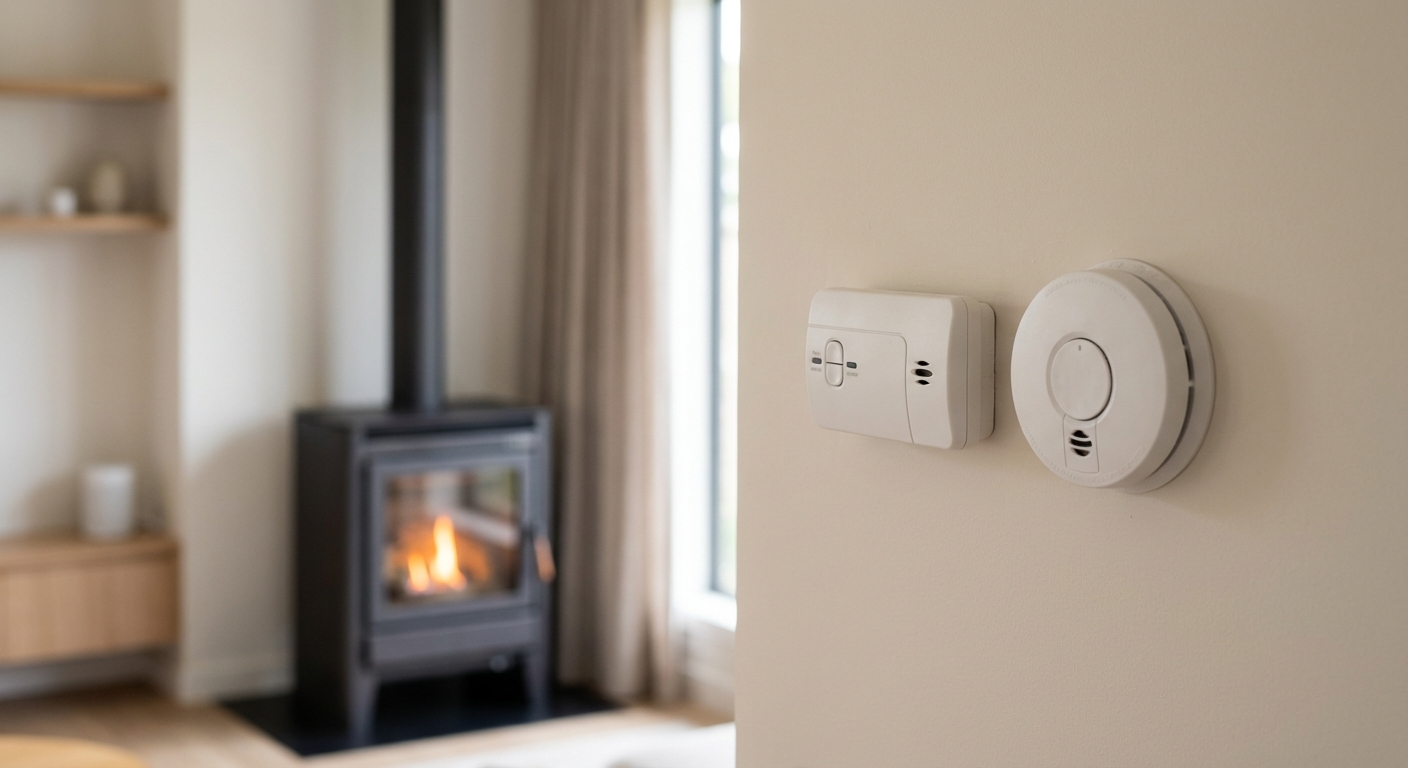
In 2026, the deciding factors are permission and indoor air quality risk management, not styling or BTU output. A heater can be listed and still be a bad fit for a tight, moisture-sensitive room or a jurisdiction that restricts unvented installs.
Carbon monoxide risk is a combustion-quality and setup problem, so treat verification as the safety tool. Demand an installer who follows the manufacturer's manual, sets the burner up for correct flame, and maintains clean air inlets and burner ports, since soot and carbon buildup degrade flame quality (see carbon monoxide leak prevention and safety checks).
Vent-free (unvented) room heaters are required to include an Oxygen Depletion Sensor (ODS) per ANSI Z21.11.2. The ODS is a listed shutoff device designed to stop gas flow when room oxygen drops below the standard's threshold; it does not validate correct gas pressure, burner adjustment, or overall indoor-air practice.
Unvented combustion adds moisture to indoor air, which can show up as fogged windows and clammy comfort complaints and can increase mold risk in tight spaces. Use the manufacturer's room volume and ventilation guidance as your go or no-go filter; if you need to add airflow, review ventilation solutions for homes without ductwork; a common combustion-air baseline referenced in guidance is 0.35 cfm per 1,000 Btu/hr of input.
NFPA 54 / ANSI Z223.1 (National Fuel Gas Code) is the baseline reference for minimum safety requirements for fuel gas piping and appliance installation, and it is typically applied through state and local code adoption and enforcement. Bedroom and bathroom rules vary by jurisdiction, so verify with the Authority Having Jurisdiction and the appliance listing notes in the installation instructions before purchasing.
- Confirm legality and location limits with your AHJ, then match those answers to the installation manual's permitted room types and required room volume/combustion air guidance.
- Verify installer deliverables: correct gas type and configuration per manual, a dedicated manual shutoff valve (unless an exception applies), and a documented combustion-air approach for the space.
- Test post-install basics: run the unit through full operation, confirm stable flame, and ensure the appliance is disconnected during any gas piping pressure test work.
If you cannot verify legal approval and manufacturer-required room volume and ventilation, choose the cleaner pathway (direct-vent) or change equipment type. Budget Heating can help you interpret manuals and compare compliant alternatives.
Sizing, Efficiency, and Operating Costs
Once you know what's allowed and what the room can tolerate, the next make-or-break variable is capacity. Correct sizing is what turns a stove from "impressive for a week" into steady, controllable zone heat.
The best gas stove experience is boring in the right way: steady room temperature and predictable fuel burn. You get that by sizing for the space you actually want to heat and by treating published BTU and efficiency claims as inputs to your math, not the answer.
For zone heating, a reliable rule-of-thumb starts around 20 BTU per square foot for average ceiling height and average insulation, then climbs as the room loses heat faster.
Most real-world rooms land in the ~20 to 35 BTU per square foot band depending on insulation, climate severity, and how much exterior wall and glass you are trying to offset. Use the high end when the space is drafty, lightly insulated, in a colder region, or dominated by exterior surfaces.
Illustrative math (not a substitute for Manual J): 1,800 sq ft × 35 BTU/sq ft ≈ 63,000 BTU.
A too-big stove rarely runs at the steady output you expected. It ramps up, overshoots the setpoint, shuts down, then repeats. The symptoms are obvious: hot-then-cool comfort swings, more on-off cycling noise, and a room that feels less comfortable even while you are feeding it a bigger BTU number.
Vent-free units (no flue losses) often advertise very high efficiency because most heat stays in the room. The practical decision still has to account for the moisture and indoor-air-quality tradeoffs you live with, not just a headline percent. Direct vent units (sealed combustion) can publish different efficiency-style metrics; focus on comparing input BTU, the heat you feel in the space, and your expected run time.
- Convert input BTU/hr to fuel units: natural gas 1 therm = 100,000 BTU; propane ≈ 91,500 BTU per gallon.
- Multiply by your local price to get $/hour.
Example: a 30,000 BTU/hr stove on natural gas uses 30,000 ÷ 100,000 = 0.30 therm/hr. At $1.50/therm, that is $0.45 per hour at full input.
Furnaces are compared using AFUE (Annual Fuel Utilization Efficiency), a seasonal efficiency metric designed for whole-home equipment. In 2026, high-efficiency gas furnaces commonly fall around 90 to 98% AFUE, with condensing models reaching ~97%+.
- Room or zone square footage (and ceiling height if it's not standard)
- Insulation and leakiness notes (drafts, exterior walls, big glass)
- Fuel type (natural gas or propane)
- Your local rate ($/therm or $/gallon)
- How many hours per day you expect to run it during cold spells
Installation, Maintenance, and Ownership
Sizing and fuel math tell you what you want; installation realities decide what you can actually do in your house. This is where direct vent's sealed-combustion advantage meets the practical constraints of vent routing, parts availability, and service access.
The easiest stove to buy is not always the easiest stove to live with. Installation pathway and long-term serviceability decide your real ownership burden, because they drive labor hours, call-backs, and whether routine cleaning is easy or a constant fight.
Direct-vent jobs are parts-driven and manual-driven. Many units require specific listed vent components, often rigid coaxial direct-vent pipe (commonly 4 inch by 6-5/8 inch), plus model-specific items like a horizontal termination kit and a wall thimble when passing through a combustible wall. If the manual limits you to a branded vent system, substitutions are not optional, and they change both cost and lead time.
Labor usually climbs when routing gets tight: needing a minimum vertical rise before a horizontal termination (12 inches is a common example), or losing allowable run length when elbows are added. Termination placement also has minimum clearance rules; in some scenarios, guidance uses 12 inches to doors, windows, or gravity air inlets, and the exact manual for your model is the final authority.
Vent-free installs are physically simpler, but they still demand disciplined setup and a room that matches the manual. Ownership stays smooth only if you keep the burner and pilot area clean; pilot cleaning is a real, recurring task on vent-free heaters.
Fuel gas code practice typically requires a dedicated manual shutoff valve for each appliance (local amendments and exceptions exist). Plan for access: a shutoff buried behind a stove you cannot slide out is a service call waiting to happen.
If equipped, ignition systems, blowers, and controls need power. A nearby 120V receptacle keeps cords out of traffic and avoids last-minute electrical work.
Routine maintenance means cleaning the burner, pilot, and ODS (low-oxygen shutoff) areas, removing soot and carbon from burner nozzles and air inlets, and checking ignition components. Common service parts include the thermocouple or thermopile, the igniter, and blowers (if equipped).
Weak or dirty pilot, delayed ignition, a soot smell or visible soot, or a noisy blower are stop-and-check signals. Shut the unit down, follow the manual's troubleshooting steps, and call a qualified service tech rather than attempting unsafe adjustments.
- Which exact vent components and terminations does this model's manual require, and are they in stock?
- Where will the termination land, and how will you verify the manual's clearance rules for that spot?
- Where will the dedicated shutoff valve be located, and can it be reached without moving the stove?
- What service access will I have to the pilot/burner area and blower (if equipped)?
When a Heat Pump or Mini Split Makes More Sense
If venting constraints, indoor-air priorities, or long run hours are pushing you away from a flame in the room, it is worth pricing the all-electric alternative. The goal is the same zone comfort you're shopping for-just delivered with a different set of tradeoffs.
Most people shopping a "gas stove" are actually shopping for zone comfort: fast heat where you sit, steadier temperatures room by room, and less indoor-air baggage than an unvented flame. A modern heat pump or ductless mini split often delivers that comfort at a lower delivered-energy cost, but only when the house and your backup plan fit.
- Long run hours: The more you heat, the more a high-efficiency system dominates operating cost.
- You want cooling too: One appliance solves two seasons.
- Electrification goals: Zone heat without adding combustion in the living space.
- Indoor-air sensitivity: No on-site burning in the room.
- Mild-to-moderate climates: Fewer hours near the system's lowest-temperature edge.
- Room-by-room control: True zoning without rebuilding ductwork.
- Limited electrical capacity: Panel and circuit constraints can turn a "cheap" unit into an expensive project.
- Backup heat needs: In extreme cold, capacity and COP drop by model, and in a power outage a mini split is off unless you have a generator or battery sized for it.
- Aesthetics and flame preference: A stove is furniture as much as it is heat.
- Short-duty supplemental heat: If you only want occasional ambiance heat, the economics swing back.
- Perfect gas-room fit: If the gas line and venting path are already ideal in one room, the simplicity matters.
COP (Coefficient of Performance) is the key lever: it is delivered heat divided by electric input at a given outdoor temperature, so a COP of 2.5 means 2.5 units of heat delivered for 1 unit of electricity paid for. Quality cold-climate systems are commonly cited around COP 2.2 to 2.8 at roughly 5°F, but it is model-dependent, so use the manufacturer's extended performance data. For apples-to-apples cost, start with 1 kWh = 3,413 BTU, then adjust by COP to convert electricity into delivered $/MMBtu.
Federal incentives can materially change payback, so treat them like specs, not assumptions. Before purchasing, verify current-year Section 25C rules and the required SEER2/HSPF2 thresholds (the efficiency metrics shown on listings and AHRI certificates) because 2026 eligibility and cutoffs are source-dependent and can change; if you're weighing a whole-home option instead, see modern gas furnaces and tax savings. A listing showing "18 SEER2" is the kind of number you will be cross-checking against those thresholds.
Example: a Gree Flexx Ultra system is shown with an 18 SEER2 rating on a retail listing, which is the exact format buyers will see when comparing models and checking program requirements.
- Decide: Do you want room-by-room comfort plus cooling, and will you run it most days during the season?
- Confirm: Do you have a practical backup plan for power outages and extreme cold (generator, alternate heater, or a stove you can run safely)?
If you answered yes to both, price one cold-climate mini split alongside the stove and compare using COP-adjusted delivered cost, not headline efficiency numbers; it can also help to review split-unit cost vs central AC when you’re deciding between ductless and whole-home approaches.
Final Decision Checklist
Your best 2026 pick is the stove that matches your room constraints, IAQ tolerance, install pathway, and day-to-day expectations, then you verify the exact model details before money changes hands.
- If you cannot tolerate added indoor moisture or combustion byproducts, choose direct vent; if you can, ventless stays on the table.
- If you can run approved venting and use manual-specified components, choose direct vent; if you cannot, choose ventless or stop.
- If you want steady, predictable zone heat, choose direct vent; if you want occasional supplemental heat, ventless can fit.
- If you need the lowest upfront installed cost, ventless usually wins; if you can fund venting labor, direct vent is feasible.
- If your layout blocks a safe vent route, choose ventless or a different heater.
- If you are already shopping electric upgrades, price a heat pump or mini split (and compare HVAC upgrades that increase home value) before committing to gas.
- If you will not follow the installation manual exactly, do not buy either type.
Before ordering, confirm the rating plate details: manufacturer name, model, gas type, and BTU input and output ratings, plus any required accessories listed in the installation manual. Plan logistics: BudgetHeating.com standard shipping is typically 3 to 7 business days, expedited parcel options are available, and in-store pickup appears at select locations during checkout; its wholesale pricing often shows about 30 to 40% discounts (varies by product and promotions). Buy from BudgetHeating.com and call (813) 885-7999 to confirm the exact model and required parts, and save your parts list before checkout.
Wrapping Up
A gas heating stove can be a practical 2026 solution for stubborn cold rooms and targeted zone comfort, but the real decision starts with how the appliance handles combustion. Ventless stoves keep installation simple and can look highly efficient on paper, yet they use indoor air and keep combustion byproducts and added moisture in the room. Direct-vent stoves cost more and require a proper vent route, but sealed combustion protects indoor air quality and delivers more predictable, low-drama comfort.
From there, the best outcome comes from the fundamentals: confirm local code and manual requirements, size the stove to the space so it does not short-cycle, and estimate operating costs using your fuel price and expected run time. If venting constraints or indoor-air priorities make gas a poor fit, a cold-climate heat pump or mini split may be the smarter path, especially if you also want cooling.
Next, choose the option that matches your room, your tolerance for moisture and IAQ impacts, and your installation pathway, then verify the exact model requirements before you buy.
 Cooling
 Learning Center
 Money Saving Tips
 Product and Brands Insights
 State by State
 HVAC Systems