




 buying guides
 cooling
 product and brands insights
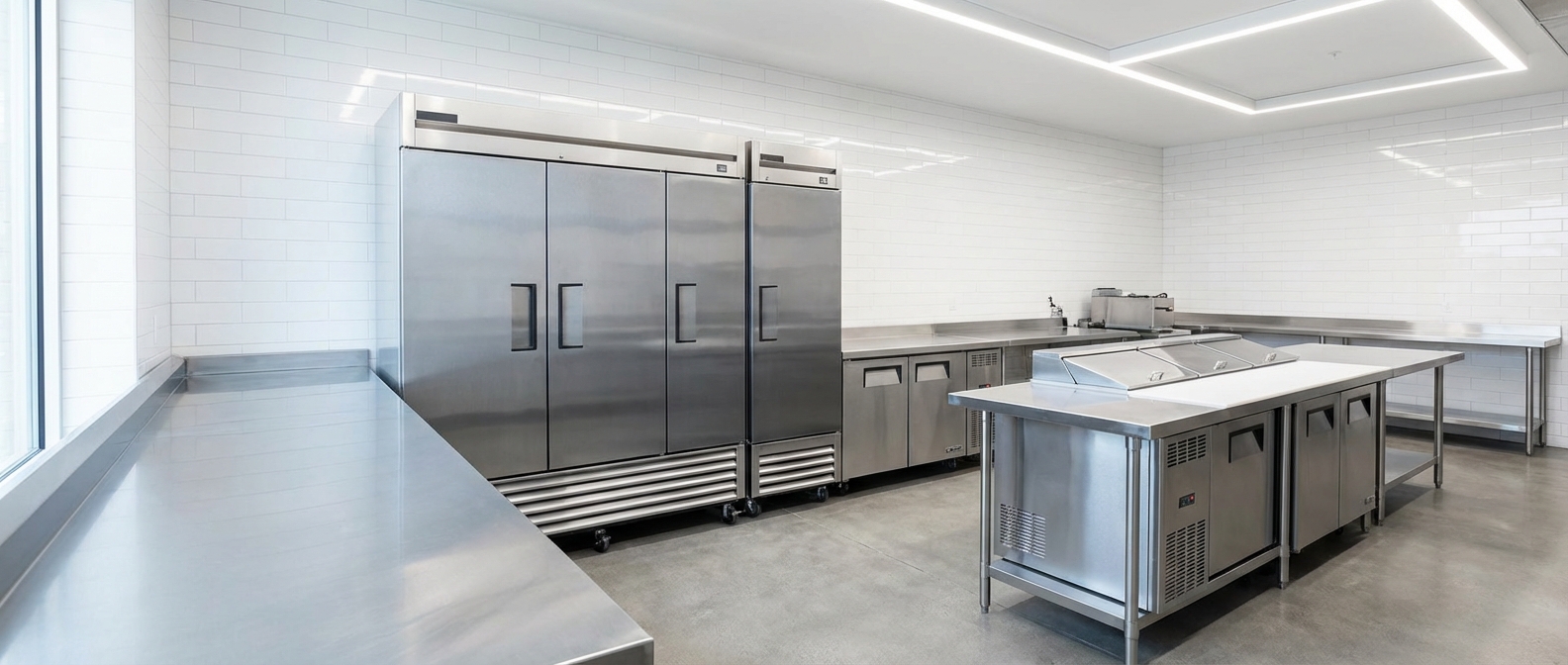
The lowest priced commercial refrigerator looks like a win until it lands in your kitchen and starts costing you in downtime, rework, and surprise constraints. A unit that blocks a pass, can't keep up with your line, or triggers a last-minute "this doesn't match our service plan" warranty realization turns a cheap purchase into a blown budget.
The friction is real: you might be replacing a dead box under time pressure, building out a new kitchen or line for 2026 volume, or standardizing equipment across multiple locations. In all three cases, "good enough" fails after delivery, when changing course is expensive. This guide resolves the tension between upfront price and what actually matters long-term: total cost of ownership (TCO), workflow fit, and serviceability.
Before you shop, lock in the warranty baseline: Atosa refrigeration includes a two (2) year parts and labor warranty on refrigerated components and parts, plus an additional three (3) years on sealed compressors (commonly five years of compressor coverage total). If you want a practical pickup option, in-store pickup is available at 6217 Anderson Rd., Tampa, FL 33634, Monday-Friday, 7:30 am - 5:00 pm EST.
Commercial refrigeration sizing and specs are a different discipline than full HVAC resources hub system planning, so heat pump tonnage and SEER2 metrics don't apply to fridges.
Use the framework in this guide to choose the right Atosa refrigeration for restaurants, delis, food trucks, and commissaries, and avoid the avoidable surprises that create downtime.
The fastest way to prevent those surprises is to start by matching the unit to the job it has to do on your floor, then validate fit, specs, and service access before you commit.
Atosa Commercial Refrigeration Lineup
The right Atosa unit is determined by job role (bulk storage vs line prep) and compressor placement, not just cabinet size. Two cabinets with similar internal volume behave completely differently on the line once you factor in where the heat exhausts, what gets blocked first by boxes or wall space, and how a tech actually reaches the service side.
Choose a reach-in refrigerator, an upright commercial refrigerator with full-height doors for accessible cold storage, when your priority is back-of-house capacity with fast grab access during service. MBF8004GR shows the archetype: a top-mount, one-door reach-in refrigerator with a stainless steel exterior, and its spec sheet lists R290 refrigerant.
What buyers overlook is compressor placement: Atosa offers bottom-mount on some uprights and top-mount on others. Top-mount exhausts heat up high, while bottom-mount shifts service access lower, changing where the unit can realistically live when the line gets crowded.
If you're trying to keep cold storage on the line without giving up aisle space, undercounter-style footprints become the practical alternative to full-height cabinets.
Choose these when footprint beats capacity: they live under counters or at the end of a line where speed matters more than bulk storage. Buyers overlook that the front and side faces are where carts, trash cans, and bus tubs pile up first, so service access can become the real constraint.
When the counter itself is the workstation, the category changes again: you need refrigeration that supports assembly, not just storage.
A prep table, a refrigerated work surface designed for ingredient staging and fast assembly on the line, belongs where hands are building plates, not where cases are stored. MSF8307GR is the example to keep in mind: a 60-inch refrigerated mega top sandwich prep table with stainless steel exterior and interior, a rear-mount compressor, and a spec sheet listing R290 refrigerant.
Rear-mount compressor placement pushes heat out the back and concentrates service access at the rear panel, so the first thing that breaks your setup is blocking that back zone with a wall, shelving, or stacked product.
On hot lines where refrigeration has to live under the cook surface, chef bases solve a different problem than a prep rail.
Choose a chef base only when the workflow demands pans and proteins directly under the cooking surface. The tradeoff is heat and grease nearby, so compressor placement dictates how easy it stays to breathe and to service.
Shortlist the category that matches the job, then sanity-check compressor placement against the exact spot it must sit, because airflow direction and service-side access decide whether the unit works on a real line.
How to Size Atosa Units for Your Kitchen
Most refrigeration "fit" failures are planning failures, not product failures. A cabinet can match the spec-sheet footprint and still force rework because door swing, caster height, and airflow clearances collide in a tight line.
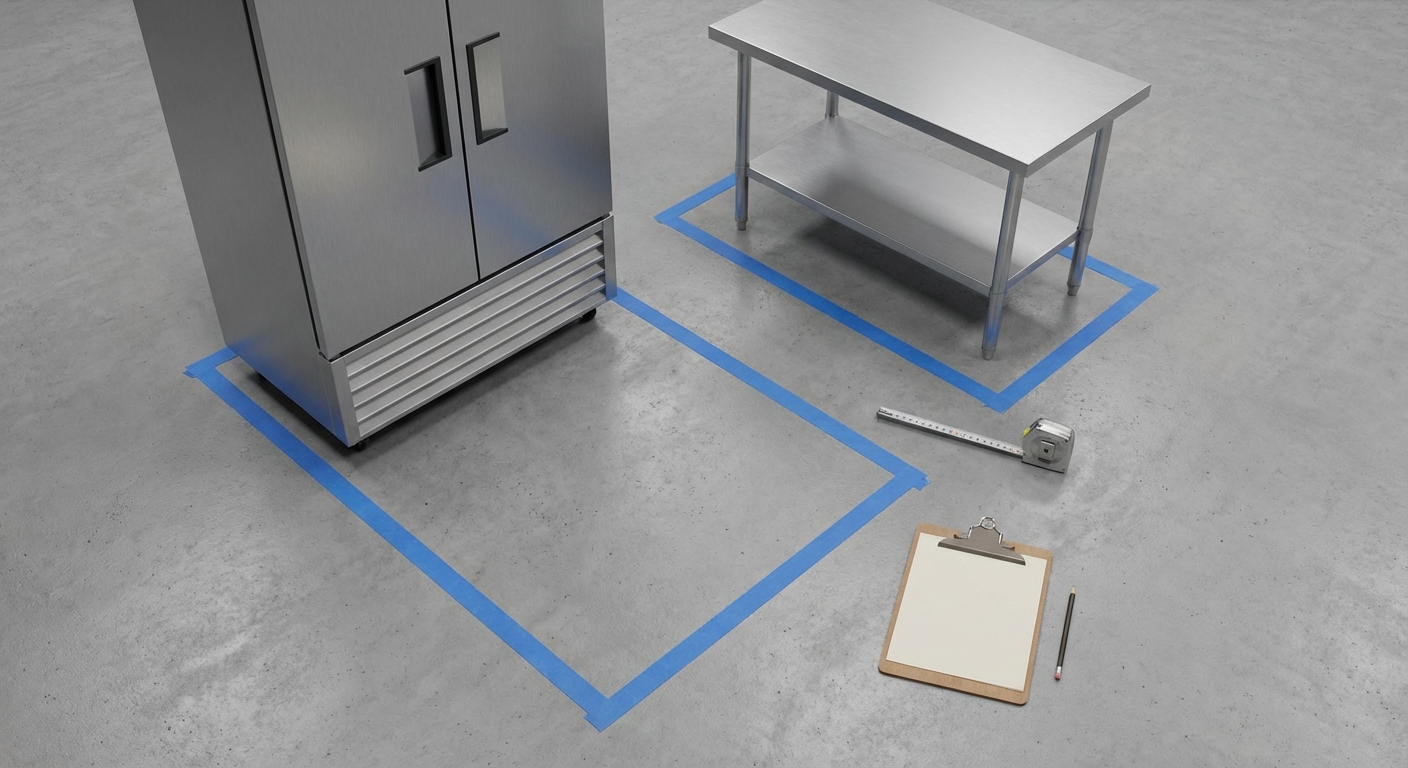
- Quantify what must stay cold, then split it into back stock versus line access. Size capacity for the product that needs immediate reach during peak, and keep slower-moving volume in storage so you don't waste prime line space.
- Map where staff stand and move, then draw door-swing arcs on the floor plan. Atosa installation guidance for walk-ins explicitly warns to ensure clearance for door swing before final placement, because a "fits on paper" box can still block an aisle or a make-line position once the door opens.
- Lock the real height: measure finished floor to ceiling and to any counters, shelves, or pass-throughs. Confirm the unit's overall height as-installed, because casters and leveling legs change clearance and can turn a tight fit into a no-go on install day.
- Protect airflow and service access: many manuals specify about 3 inches (75 mm) of clearance for adequate airflow, and they also require space to access ventilation and service panels. Measure this clearance into your footprint, not after the fact.
- Confirm electrical before delivery: read the spec plate and manual for voltage, phase, and amps, and match the plug. A NEMA plug uses standardized configurations that identify the connector design plus voltage and amperage ratings, so you can verify receptacle compatibility before the unit arrives.
Before the unit ships, verify width, depth, height (including casters), door-swing clearance, 3-inch airflow clearance, service-panel access, and the exact electrical ratings and NEMA plug type from the spec plate/manual.
Once the unit is physically viable in the space, the spec sheet becomes the filter for whether it will hold temp under load and stay serviceable over time.
Key Features to Compare in 2026
The spec sheet predicts whether an Atosa refrigerator or prep table (refrigerated base) will run stable all shift or turn into a repeat service call. Units that look identical on the outside often differ in controls, defrost strategy, materials, and refrigerant safety, and those differences show up fastest under peak load.
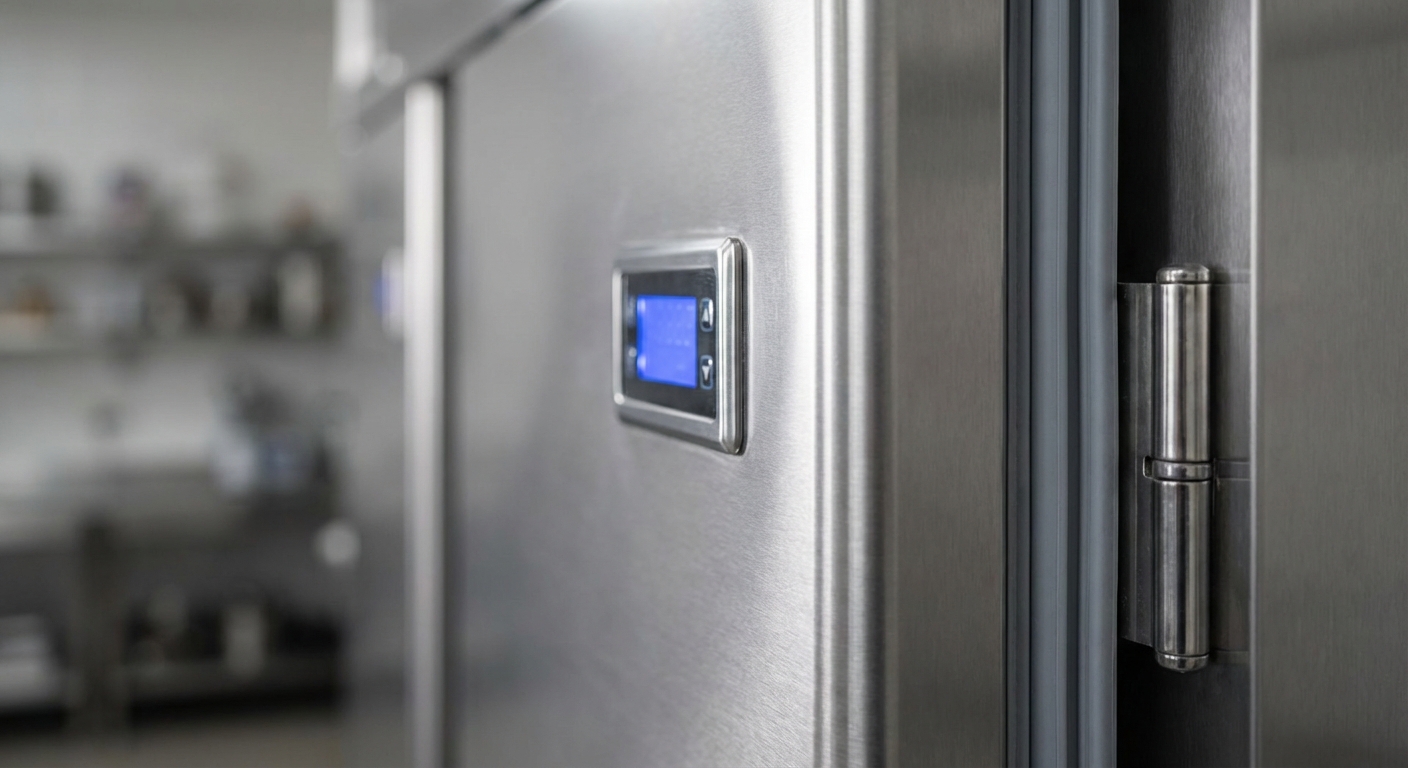
Atosa's own feature lists include both a Dixell digital controller and a mechanical (analog) controller, so you cannot assume the control type from the door badge or product family name. Verify the installed controller type in the exact unit's manual/spec sheet, because it directly affects day-to-day usability: digital controllers give you a readable cabinet temperature and precise setpoint changes, while analog thermostats are faster to glance at but offer less explicit feedback to operators during a rush.
Beyond the controller, look for an adjustable differential or hysteresis spec (how far temperature swings before the compressor cycles). A tighter differential stabilizes product temps but can increase cycling, so you want the control logic documented, not implied.
Defrost type is a performance and maintenance signal because it reveals how the unit manages frost load on the evaporator. Off-cycle defrost favors simplicity, while electric defrost adds components but gives the system a defined recovery behavior. Use the manual to confirm whether defrost is automatic or requires operator initiation, and whether the controller logs alarms or fault codes that help technicians troubleshoot quickly.
Atosa commercial refrigeration is commonly specified with R290 refrigerant in published features and model listings. R290 is propane, and it is classified as an A3 flammable refrigerant, which means service and repair require appropriate safety protocols: proper ventilation, ignition-source control, and technicians equipped to work on hydrocarbon systems.
When a stainless grade is disclosed, use it as a corrosion-resistance decision cue: type 304 stainless steel has greater corrosion resistance than type 430 due to nickel content. On delivery, verify build cues you can physically check: continuous door sealing surfaces (no gaps), hinges that don't sag under repeated openings, shelving that doesn't rack under load, and interior corners that wipe clean without trapping debris.
Do not buy on vague "efficient" language. Check for an ENERGY STAR listing or published energy data when available, because ENERGY STAR performance data represents certified products that meet current ENERGY STAR specifications.
These checks apply across the lineup, but prep tables add a second layer of decision-making: the unit has to support a specific build rhythm at the rail and on the cutting surface.
- Confirm the installed controller type (Dixell digital vs mechanical) in the exact model manual/spec sheet.
- Verify refrigerant type and service labeling, and ensure your service provider is qualified for A3 (R290) work.
- Check stainless grade disclosure (304 vs 430) and inspect door seals, hinges, shelving, and cleanability upon delivery.
- Look for published energy signals (ENERGY STAR and any kWh/day data) tied to the exact model number.
Choosing the Right Atosa Prep Table
Prep-table performance is measured in seconds per ticket, not just cubic feet. The fastest Atosa setup is the one that matches how your line builds items: where ingredients sit, where hands land, and how often someone has to break position to restock.
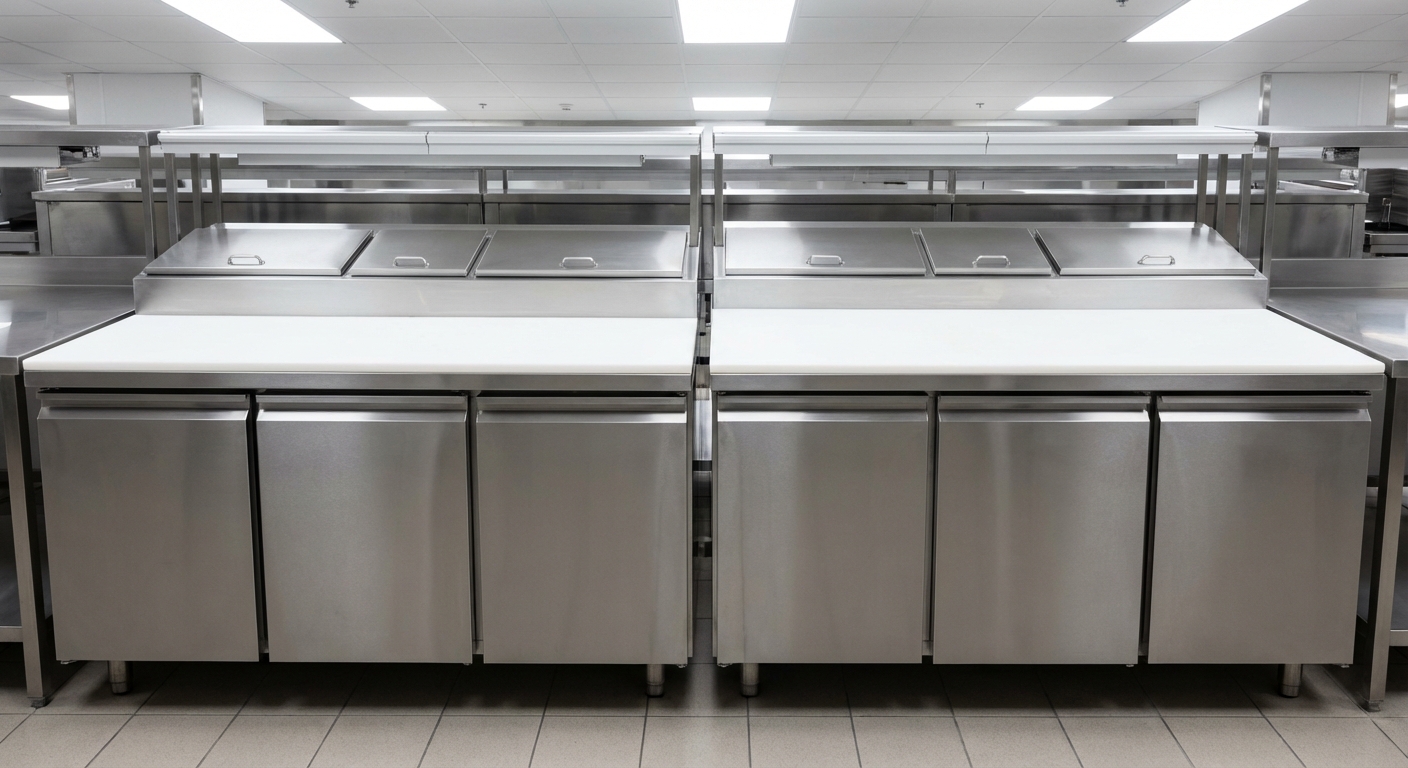
Sandwich and salad builds win when ingredients sit directly in front of the assembler and the cutting surface is the primary workspace. Pizza builds win when the workspace is the priority: stretching, saucing, cheesing, then topping, with fewer "reach-and-place" micro-motions and more surface contact.
A concrete visual: the Atosa MSF3610GR (36-5/16 inch) sandwich/salad prep table supports ten 1/6-size food pans. Ten 1/6 pans usually maps cleanly to a tight menu: core proteins, two cheeses, and a focused veg set without forcing frequent pan swaps.
Step up to a 48 inch sandwich prep table and you'll often see twelve 1/6-size food pans included as "standard." This varies by model, so treat "12 pans" as a starting assumption, then confirm the exact pan count and layout on the specific SKU you're buying.
Your service speed lives or dies at the pan rail, the ingredient strip at the top that keeps pans within one-hand reach while the other hand assembles. Atosa catalogs often call this a "pan rail" or "chrome pan rail," and reseller listings can be inconsistent (you may even see fields like "Electrical Pan Size 1/3"), so confirm supported pan sizes on the exact model, not the category name.
Choose rail covers and lids based on your rhythm. Open-rail speed is real during peaks; covers pay off when the line pauses, when you stage ahead, or when you want faster close-down without pulling every pan.
Plan boards like you plan pans: as consumables that prevent downtime. Common Atosa replacements include W0499215 (9.25 x 48 x 1/2 inch, white), W0499217 (92 3/4 x 19 1/4 x 1/2 inch, white poly), and W0499200 (about 27 1/4 x 9 1/4 x 1/2 inch, white polyethylene/HDPE). Match part numbers to your model now, then keep at least one spare board on-site.
Doors reward bulk replenishment: fewer containers, bigger footprints, and a cleaner restock cycle. Drawers reward station-level organization: faster grabs for prepped inserts and a more predictable "pull one, drop one" rhythm. If your line restocks in waves, doors stay efficient; if your line restocks continuously, drawers keep the assembler in position.
Sandwich/Salad vs Pizza Prep Tables (operator view)
Speed at peak:        Sandwich/Salad = fastest reach-and-build | Pizza = fastest surface workflow
Ingredient access:    Sandwich/Salad = pan-first priority      | Pizza = topping flow after dough work
Workspace emphasis:   Sandwich/Salad = board + rail balance    | Pizza = maximum uninterrupted surface
Restocking flow:      Sandwich/Salad = frequent pan touch      | Pizza = fewer pan swaps, larger staging
Best fit menus:       Sandwiches, salads, wraps               | Pizza, flatbreads, calzones
- What percent of peak-hour tickets are built directly at the rail versus assembled elsewhere and plated?
- Which ingredients must be one-hand reachable at all times, and which can live in the base?
- Do you restock in scheduled waves or continuously during service?
- Who owns the station during peaks: one assembler, or multiple hands rotating in?
- Where do backup pans live during rush: under the table, on a speed rack, or in a nearby lowboy?
- Which cutting board part number matches your model, and how many spares are you stocking to avoid a dead station?
Once the configuration is right, protect the investment the same way you protect the workflow: make delivery and documentation predictable, and keep service details easy to retrieve.
Ordering, Delivery, and After-Purchase Support
A refrigeration unit pays you back only if it arrives on time, intact, and documented. A clean ordering and receiving plan prevents the most expensive surprises because problems are easiest to solve before the unit is in service.
Request a quote when you are standardizing across multiple locations, placing multi-unit builds, or you need written confirmation on exactly what will ship before you commit. If the request-a-quote form gives you trouble, request a quote by emailing admin@budgetheating.com or calling 813-885-7999. Lock your internal records to the quote and final order confirmation so every reorder matches the same model and options, not someone's memory.
Plan freight like a scheduled event, not a doorstep drop. Standard shipping is typically 3-7 business days, and the trucking company will call before delivery to set an appointment window for curbside delivery, so you need staff ready to move the unit from curb to install area.
On arrival, treat inspection as standard receiving practice: check packaging and visible condition immediately, compare what showed up to your paperwork, photograph any issues, and record exceptions before you sign.
Ops continuity comes from clean documentation. File invoices, model identifiers, and serial numbers where purchasing and maintenance can find them, so adding an extra unit or ordering parts is a controlled repeat, not a fresh project.
For visibility, customers can click the "My Account / Order Status" link to track order status.
- Quote multi-unit or multi-location orders, and use admin@budgetheating.com or 813-885-7999 if the form fails.
- Staff the appointment-based curbside delivery window and plan your move-in path.
- Inspect and document condition before signing, then track everything in "My Account / Order Status."
Summary
The best 2026 Atosa choice is the one that fits your operation and shows up without preventable surprises.
That means buying the unit for the job it will perform (bulk storage, undercounter access, line assembly, or under-cook-surface holding) and treating compressor placement and service-side access as real constraints, not afterthoughts. It also means protecting install day with door-swing planning, measuring height as-installed (including casters), and honoring the 3-inch airflow-clearance baseline that manuals call for.
From there, make the spec sheet do its job: confirm whether the unit actually ships with a Dixell digital controller or a mechanical control, verify refrigerant and service readiness for A3 (R290) work, and use disclosed stainless grade cues (304 vs 430) to guide expectations and receiving inspection. For prep tables, keep the workflow standard as tight as the fit-rail capacity (such as 10 or 12 1/6-size pans) and cutting-board part planning (for example, W0499200 equivalents) decide whether the station runs smoothly or stalls mid-shift.
Finally, keep ordering and delivery clean: request a quote when you need multi-unit consistency, plan for a scheduled curbside delivery window in the typical 3-7 business day range, inspect before signing, and file model/serial documentation so parts and reorders stay controlled. If you need help or a backup channel, Budget Heating & Air Conditioning support and tracking are available via My Account / Order Status (admin@budgetheating.com, 813-885-7999).
Wrapping Up
Buying Atosa refrigeration for 2026 is less about chasing the lowest sticker price and more about avoiding the expensive surprises that show up after delivery. The right pick starts with matching the unit to its job, whether that is bulk storage, undercounter access, line prep, or under-cook-surface holding, then confirming compressor placement, airflow needs, and service-side access so the box can actually live where your layout demands.
Once the unit fits the space and the workflow, the spec sheet becomes your filter for long-term reliability and usability: verify controller type, defrost behavior, refrigerant and service readiness for R290, and build details like stainless grade and cleanability. For prep tables, details like pan-rail capacity, doors vs drawers, and cutting-board planning directly affect ticket times, while a disciplined ordering and receiving process protects you on delivery day and makes future parts and reorders predictable.
Use the framework in this guide to shortlist models, validate fit and specs against your exact kitchen plan, and move forward with an Atosa unit you can install confidently and run hard all season.
 Heating
 Learning Center
 Money Saving Tips
 State by State
 HVAC Systems