




 buying guides
Fuel Options for Home Heating & Cooling: What This Guide Covers
Fuel choice shapes comfort, monthly bills, indoor air quality, equipment life, and emissions. This guide is for U.S. homeowners, renters, landlords, DIYers, and property managers who want a clear, practical view of what fuels and systems fit their space, climate, and budget.
- Natural gas: furnaces and boilers where pipelines are available.
- Electricity: resistance heaters, central AC, heat pumps, and ductless mini splits.
- Propane: gas-like performance for rural properties without utility gas.
- Heating oil: legacy furnaces and boilers, common in the Northeast.
- Wood/biomass: stoves and pellet systems for zone or whole-home heat.
- Geothermal: ground-source heat pumps with very high heating efficiency.
- Solar-assisted: PV powering heat pumps or solar thermal preheat.
Use this guide to compare efficiency metrics and operating realities: AFUE for combustion heat, SEER or SEER2 for cooling, HSPF or HSPF2 and COP for heat pumps. Factor in local utility rates, climate, install constraints, maintenance needs, and expected lifespan to narrow options, and to understand basic installation and troubleshooting considerations before you commit.
Overview of Common Fuel Types: Strengths, Typical Uses and Where They Fit
Choosing a fuel hinges on five things we see daily: availability and infrastructure, operating cost versus efficiency, climate and comfort, environmental impact, and reliability and logistics. Delivered fuels like propane, oil, or wood offer on-site resilience. Electric systems rely on the grid unless paired with backup power.
- Combustion fuels: gas, propane, oil. Strong heat, cold climates, existing ducts.
- Heat pumps: high efficiency. Works in most climates, great for new or tight homes.
- Resistance electric: simple. Higher bills, small areas or backup.
- Biomass or wood: low fuel cost if local. Manual handling, rural settings.
- Solar-assisted and geothermal: top efficiency. Higher upfront, long-term homes.
Natural Gas, Propane and Heating Oil: How Combustion Fuels Compare
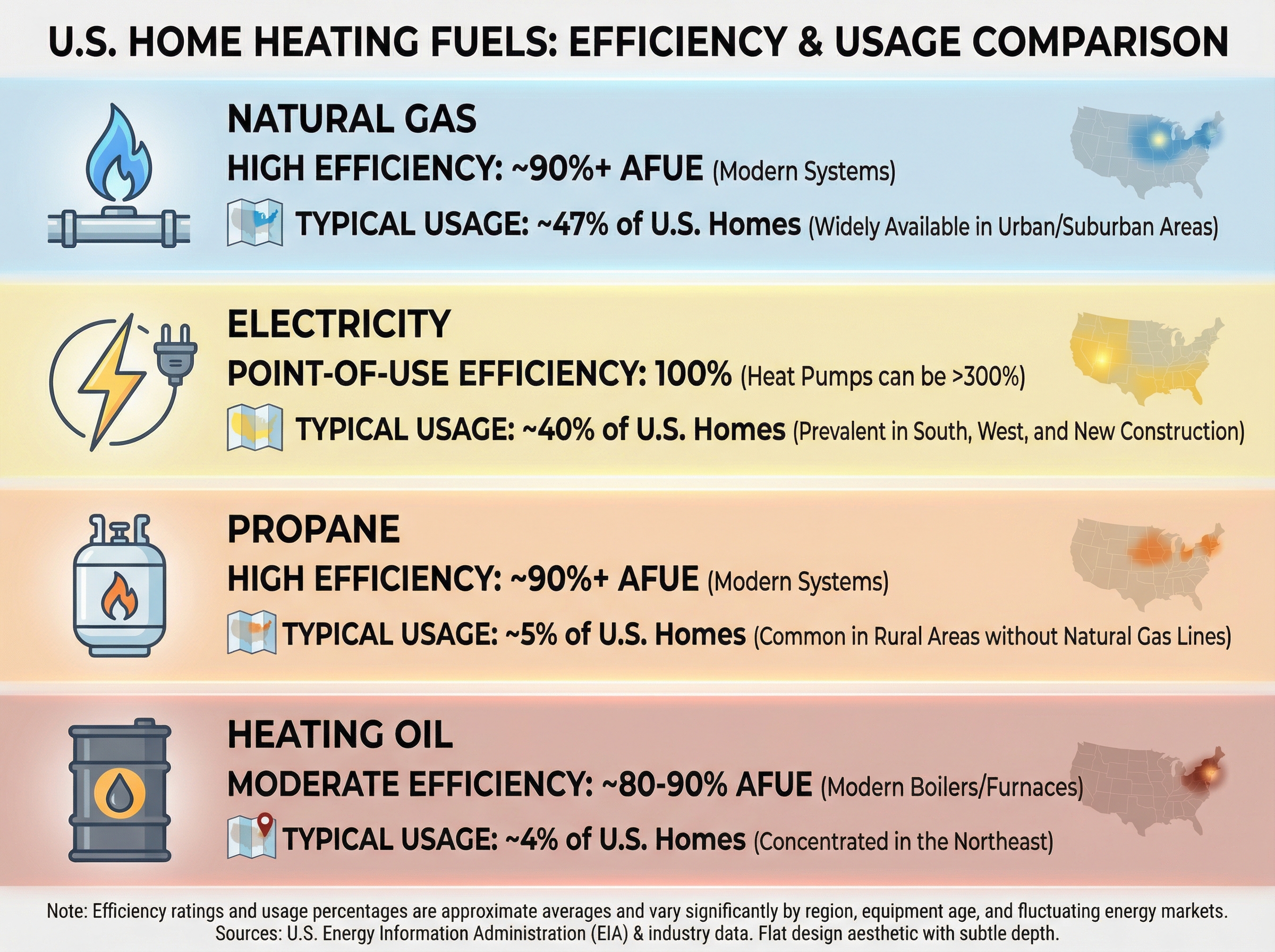
- Natural gas: serves about 48% of homes, widely available in metro areas, supports furnaces up to ~98% AFUE, delivers fast, consistent heat, and is cost-effective per BTU where pipelines exist. Tradeoffs: pipeline access and proper venting are required, CO risk exists, so sealed-combustion appliances and CO monitors are wise. Cooling still uses electricity.
- Propane: about 5% of homes, 90 to 98% AFUE, on-site storage boosts resilience for off-pipeline properties. Tradeoffs: tank placement and deliveries, higher and more volatile pricing (~$2.70 per gallon in 2023), moderate emissions. In our experience at Budget Heating (BudgetHeating.com), it is the most flexible rural option.
- Heating oil: roughly 4% of homes, mostly Northeast. Modern equipment can reach ~90% efficiency, but fuel runs higher in cost (~$4 per gallon), with higher particulates, higher GHGs, and more intensive maintenance.
- Wood and pellet: useful in rural areas and can be low cost locally, primary or supplemental, but expect higher particulates, more labor, and regular chimney care.
Electric Systems & Heat Pumps: How They Work, Why They're Efficient
Electricity is available everywhere and powers all cooling. Electric options include simple resistance heat and heat pumps. Resistance heat, like baseboards or electric furnaces, is 100% efficient at the outlet but usually costs more to run for whole-home heating. Heat pumps heat and cool in one system by moving heat with refrigerant. Think of them as a conveyor belt that relocates heat instead of making it. Modern air-source and ground-source models often deliver a seasonal COP of 2 to 4 in moderate climates, so 1 kWh in can provide 2 to 4 kWh of heat out.
Efficiency metrics: AFUE measures furnace heating, SEER or SEER2 measures seasonal cooling, HSPF or HSPF2 measures seasonal heat-pump heating, COP is an instant heat multiple. Higher ratings cut energy use for the same comfort. Quick math: savings percent ≈ 1 − (old SEER ÷ new SEER). In our experience at Budget Heating (BudgetHeating.com), variable-speed and cold-climate heat pumps hold capacity better in low temps, though very cold regions may need auxiliary heat. Operating cost depends on electric rates, your home's envelope, and SEER2 or HSPF2. Pairing with rooftop solar can materially reduce system emissions.
Regional & Regulatory Context: What Works Where and What Rules Matter
In practice, we see choices hinge on infrastructure and rules. The 2023 DOE update tightened minimums, moved to SEER2, and set different central AC baselines for the North versus the Southeast and Southwest. Split heat pumps have a nationwide minimum. Climate drives design: cold areas use gas, oil, or wood, but cold climate heat pumps are widening options; hot dry regions can use evaporative coolers; hot humid regions need strong dehumidification and airflow control. Where pipelines exist, gas is typical; rural homes rely on propane, oil, wood, or electric, with heating oil still common in the Northeast. Dual fuel systems use lockout or balance temperatures to switch at the lowest cost. Expect region specific availability as markets meet compliance, especially in hotter regions, and local codes and incentives push electrification and higher efficiency.
When a Heat Pump or Electrification May Not Be the Best Choice
We work with heat pumps every day, but they are not universal. Standard air source units lose capacity and efficiency as outdoor temps fall, noticeably below about 20 to 25 F. In these areas, dual fuel setups, a heat pump paired with a gas or propane furnace, or auxiliary electric heat can preserve comfort. Off grid or frequent outages favor on site fuels or a hybrid with a generator, since heat pumps need power. For extreme cold or remote locations, high efficiency furnaces or boilers, or wood or biomass where allowed, can be practical.
Tradeoffs to weigh: delivered fuels like propane or oil can be costlier, volatile, and tied to delivery logistics. Common misconceptions:
- Refrigerant does not need annual top offs.
- Cranking the thermostat does not heat or cool faster.
- Single stage on or off is not always most efficient.
Costs & Savings: Comparing Fuel Prices, Efficiency Upgrades and Typical Bills
- Heating baseline: a natural gas home might spend about $746 per season, with roughly ±30% swing from weather and prices.
- AFUE upgrades: replacing 60 AFUE with 80 AFUE reduces fuel use about 25%. On a $746 season that is roughly $185 saved. Moving 60 to 90 AFUE is about 33%, or around $245 per season.
- Cooling upgrades: going 14 to 16 SEER trims about 12 to 13% or roughly 675 kWh per year. In hot climates that can be about $650 to $700 annually, with 20 year totals in the low five figures. Bigger jumps, like 10 to 16 SEER, can cut 30 to 40%.
- Fuel benchmarks: natural gas about $11 per 1,000 cubic feet, propane about $2.70 per gallon, heating oil about $4 per gallon.
- From our field experience, installed costs vary widely by equipment type and ductwork. Higher SEER or HSPF pays back fastest in high load climates.
Installation, Maintenance & Safety: Practical Homeowner Guidance
Think of your system in two lanes: homeowners handle cleanliness and observation, professionals handle charged refrigerant, combustion, and live electrical work.
- Replace or clean filters routinely. Keep supply and return registers clear.
- Maintain 2 to 3 feet of clearance around outdoor condensers.
- Check thermostats and batteries, listen for unusual noises, watch for water near indoor units, and keep condensate drains clear.
- Install and maintain smoke and carbon monoxide detectors on each level and near sleeping areas.
- Hire pros for refrigerant work (EPA certified only), electrical repairs and major wiring, combustion tuning with analysis, and flue or chimney inspections.
Service intervals: furnaces, boilers, and central AC at least annually. Heat pumps twice per year, once before cooling season and once before heating. Wood and oil systems need annual chimney or vent inspections.
- Gas or propane: never DIY gas piping. If you smell gas, evacuate and call the utility.
- Oil: watch for leaks. Leave burner tuning to pros.
- Wood: burn seasoned wood and clean chimneys regularly.
- Electric: do not open high voltage compartments.
Many tasks fall under building, electrical, and environmental codes. Improper DIY can void warranties and create safety risks. Keep all commissioning and service documentation for warranty support.
Homeowner Checklist: Steps to Choose, Install and Optimize Your System
- Verify local fuel options and service capacity.
- Record current $/therm, $/kWh, $/gal and delivery fees.
- Match system to site, ducts and goals.
- Select cold-climate heat pump or backup below ~20 F, add dehumidification in hot-humid zones.
- Insist on Manual J, plus Manual S and D.
- Target SEER2, HSPF2, AFUE with AHRI match, ENERGY STAR when practical.
- Consider dual-fuel and set lockout or balance points.
- Seal or redesign ducts, or choose ductless.
- Use sealed-combustion and install CO detectors.
- Confirm panel capacity and place outdoor units to avoid snow and drainage issues.
- Choose thermostats that handle multi-stage and dual-fuel, consider zoning.
- Plan for solar pairing and future electrification.
- Compare total cost of ownership, including lifespan and maintenance.
- Check rebates, tax credits and permits.
- Vet contractors with licenses, insurance, references and commissioning reports.
- Air seal and insulate first, then re-run loads.
- Plan backup heat or power and outage behavior.
Next Steps: How to Choose, Fund and Move Forward with the Right System
Bottom line: heat pumps beat electric resistance and often rival combustion when paired with good design and cleaner power, while combustion still fits where pipeline access, resilience, or deep cold matter. Rising standards and incentives favor heat pumps. Plan smart, check local fuel prices, right size with SEER2, HSPF2 and AFUE, improve the envelope, then stack rebates. We can help you compare options.
- Get a Custom Quote: request Manual J and AHRI-rated matches.
- Talk to Our Team: U.S.-based phone support for sizing and local price checks.
- Shop Heat Pumps, Gas Furnaces, and Ductless Mini Splits, then use eligible federal, state, and utility rebates.
 Cooling
 Heating
 Learning Center
 Money Saving Tips
 Product and Brands Insights
 State by State
 HVAC Systems