









Our price:
$2,737.00
Sale price:
$2,120.00List price:
$3,251.00Our price:
$2,737.00
Our price:
$2,913.00Sale price:
$2,225.00List price:
$3,444.00Our price:
$2,913.00
List price:
$3,075.00Our price:
$2,360.00
List price:
$3,155.00Our price:
$2,430.00
List price:
$3,245.00Our price:
$2,499.00
List price:
$3,385.00Our price:
$2,599.00
List price:
$3,420.00Our price:
$2,630.00
List price:
$3,695.00Our price:
$2,845.00
List price:
$3,790.00Our price:
$2,915.00
List price:
$3,810.00Our price:
$2,930.00
List price:
$3,830.00Our price:
$2,945.00
Our price:
$3,644.00Sale price:
$3,020.00List price:
$4,053.00Our price:
$3,644.00
List price:
$3,940.00Our price:
$3,030.00
List price:
$3,999.00Our price:
$3,080.00
Our price:
$3,772.00Sale price:
$3,115.00List price:
$4,177.00Our price:
$3,772.00
List price:
$4,135.00Our price:
$3,180.00
List price:
$4,275.00Our price:
$3,290.00
List price:
$4,340.00Our price:
$3,340.00
List price:
$4,390.00Our price:
$3,380.00
List price:
$4,515.00Our price:
$3,475.00


How to Buy a Complete Air Conditioner Split System Online
Everything you need to know about choosing between electric heat strip and gas furnace configurations
A split system air conditioner separates the cooling components into two units: an outdoor condenser (which houses the compressor and condenser coil) and an indoor air handler or gas furnace (which contains the evaporator coil and blower motor). The two units connect through refrigerant lines, and the indoor unit distributes conditioned air through your home's ductwork. This two-piece design is the most common residential HVAC configuration in the United States, offering the widest range of efficiency ratings, capacity options, and brand choices.
AC with Electric Heat Strip: Best for Warm Climates
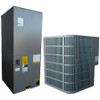
The air conditioner with electric heat strip configuration pairs an outdoor condenser with an indoor air handler that includes built-in electric resistance heating elements (heat strips). The AC condenser handles all cooling, while the heat strips provide backup heating during mild cold weather. This is the standard configuration for warm-climate states like Florida, Texas, Arizona, Georgia, and the Carolinas, where heating is needed only a few weeks per year. Without a gas line, venting, or combustion components, the electric heat strip setup is simpler to install, lower in upfront cost, and requires less maintenance than a gas furnace system.
Heat strip wattage typically ranges from 3kW to 15kW depending on the air handler size and heating demand. For most Southeast installations, a 5kW or 8kW heat strip provides sufficient backup heating. The electric heat strip operates at 100% efficiency (every watt of electricity becomes heat), but electricity costs more per BTU than natural gas in most markets, which is why this configuration is best suited to climates where heating runtime is minimal.
AC with Gas Furnace & Cased Coil: Best for Cold Winters
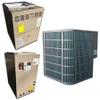
The air conditioner, gas furnace, and cased coil configuration pairs an outdoor AC condenser with an indoor gas furnace and a matching cased evaporator coil that sits on top of or alongside the furnace. The AC condenser handles summer cooling (the cased coil acts as the evaporator), while the gas furnace provides heating by burning natural gas or propane. This is the go-to configuration for the Midwest, Northeast, Mid-Atlantic, and any region with extended heating seasons where temperatures regularly drop below freezing.
Gas furnaces are rated by AFUE (Annual Fuel Utilization Efficiency). An 80% AFUE furnace converts 80 cents of every dollar of fuel into heat, while a 96% AFUE high-efficiency condensing furnace captures nearly all of it. The cost difference between 80% and 96% AFUE typically pays back within 3–5 years in colder climates through reduced gas bills. High-efficiency condensing furnaces (90%+ AFUE) use PVC venting instead of traditional metal flue pipes, which can simplify installation in some configurations.
| Feature | AC + Electric Heat Strip | AC + Gas Furnace & Coil |
|---|---|---|
| Heat Source | Electric resistance (heat strip) | Natural gas or propane |
| Best Climate | Warm (FL, TX, AZ, Southeast) | Cold winters (Midwest, NE, Mid-Atlantic) |
| Heating Cost | Higher per BTU (electric rates) | Lower per BTU (gas rates) |
| Install Complexity | Simpler (no gas line, no venting) | More complex (gas line + flue/PVC vent) |
| Upfront Cost | Lower | Higher (furnace + coil vs. air handler) |
| Efficiency Rating | 14–20+ SEER2 (cooling) | 14–20+ SEER2 (cooling) + 80–98% AFUE (heating) |
| Indoor Unit | Air handler with heat strip | Gas furnace + cased evaporator coil |
| Gas Line Required? | No | Yes |
| Venting Required? | No | Yes (metal flue or PVC) |
What's Included in a "Complete" Split System?
When you buy a complete split system from Budget Heating, the package includes all major components needed for installation. For the AC + electric heat strip configuration, you receive the outdoor condenser and the indoor air handler with factory-installed heat strips and a TXV (thermostatic expansion valve). For the AC + gas furnace configuration, you receive the outdoor condenser, the gas furnace, and a matching cased evaporator coil. All components are factory-matched and AHRI-certified as a system, ensuring rated efficiency and full warranty coverage.
Items not included (and typically sourced by your installer) are the refrigerant line set, thermostat, condensate drain components, disconnect box, and any ductwork modifications. Some Budget Heating bundles include a line set kit. Check individual product listings for exact included components.
Understanding SEER2 Ratings for Split System Air Conditioners
SEER2 (Seasonal Energy Efficiency Ratio 2) measures cooling efficiency under the updated 2023 DOE testing standard, which uses higher static pressure than the original SEER test to better reflect real-world conditions. Higher SEER2 means lower cooling costs. The federal minimum is 14 SEER2 for the Southeast and Southwest regions. For long cooling seasons (Florida, Texas, Gulf Coast), investing in 16+ SEER2 can deliver meaningful savings over the life of the system. Premium variable-speed and inverter-driven models reach 18–20+ SEER2, though these carry higher upfront costs. Read our full 2026 AC buying guide for a deeper breakdown of SEER2 standards and what they mean for your energy bill.
Refrigerant Options: R-410A, R-32, and R-454B
Split system air conditioners are available in three refrigerant types. R-410A vs R-32 is a common comparison — R-410A is the established standard, still widely available and fully supported, while R-32 (GWP 675, 68% lower than R-410A) and R-454B (GWP 466, 78% lower) are the next-generation low-GWP refrigerants being adopted by all major manufacturers. Goodman's newest split systems use R-32, while Rheem has moved to R-454B. Both are classified as A2L (mildly flammable) and require installation per current refrigerant handling codes. For new construction and complete system replacements, R-32 or R-454B systems are recommended. For condenser-only replacements where the existing indoor coil uses R-410A, staying with R-410A equipment maintains compatibility.
Sizing Your Split System Air Conditioner
Split system air conditioners are sized in tons, where 1 ton equals 12,000 BTU of cooling capacity. A general starting point is 1 ton per 500–600 square feet in moderate climates, and 1 ton per 400–500 square feet in hot, humid regions like Florida and the Gulf Coast. These are rough approximations. Accurate sizing requires a Manual J load calculation that factors in square footage, insulation, window area, orientation, duct conditions, and local climate data. An oversized system will short-cycle (turning on and off too frequently), wasting energy, increasing humidity, and causing premature wear. An undersized system will run continuously without reaching set temperature. Shop by tonnage for the gas furnace configuration: 1.5 ton, 2 ton, 2.5 ton, 4 ton, and 5 ton options are available.
Recent posts
All Articles
Why Many US Households Don't Have Air Conditioning - Causes
Why Many U.S. Households Don't Have Air Conditioning: a quick snapshot Air conditioning is not univ ...
Protect Your HVAC with Surge Protectors | Budget Heating
Protect Your HVAC with Surge Protectors: Why It Matters We view HVAC-specific surge protection as e ...
Should You Turn Off Your AC If It's Not Cooling? Quick Guide For 2026
AC Running but Not Cooling? What to Know First AC running but the house still feels warm? We see th ...
Window Upgrades to Enhance Home Energy Efficiency | Guide For 2026
Window Upgrades to Enhance Home Energy Efficiency: What to Expect Window upgrades matter because th ...
Sign up to receive exclusive deals, news, and more!
