




 heating
 learning center
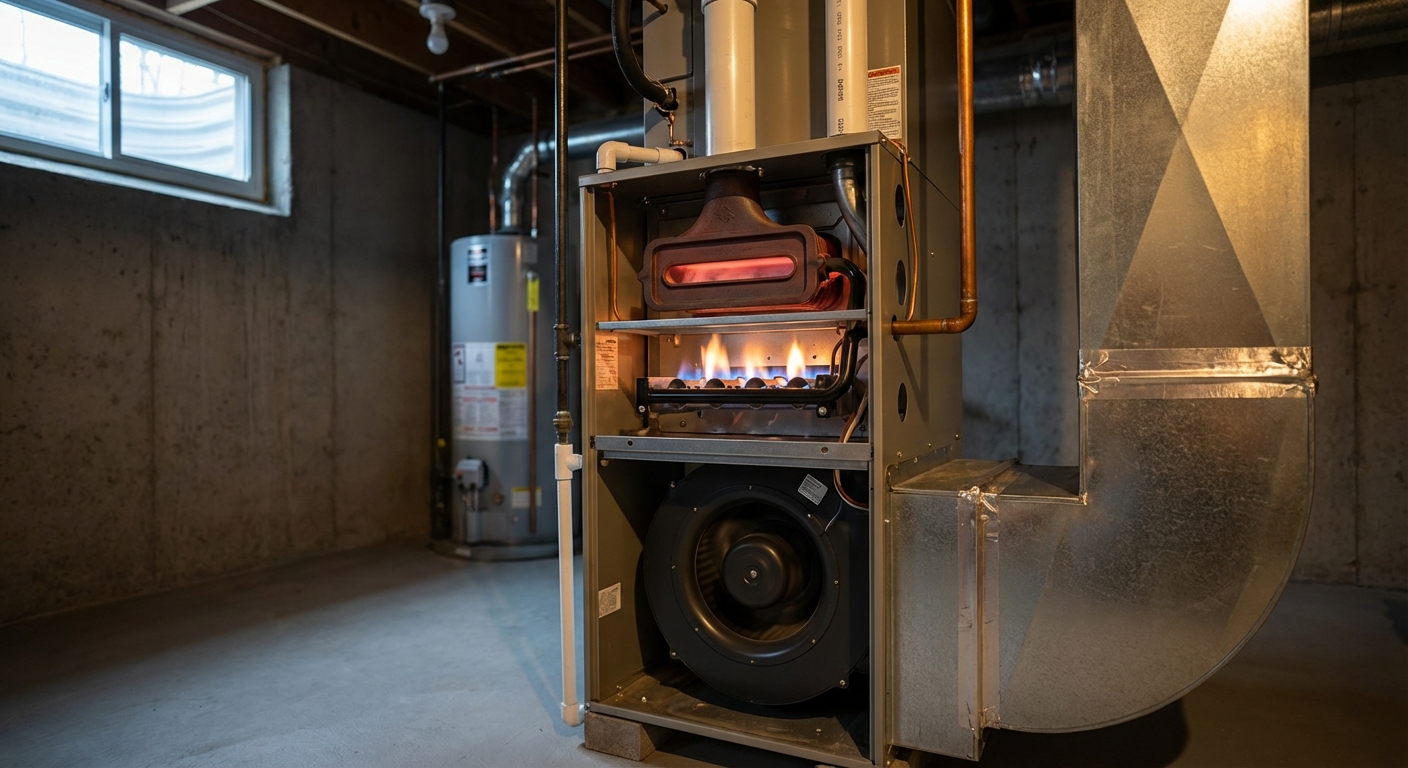
Your house feels cold even though the thermostat says it's calling for heat, your energy bill spikes, or the furnace starts running in odd bursts. That confusion usually isn't a mystery inside the walls. It's a heat-and-airflow problem playing out through your duct system.
Comfort depends on two things happening reliably: making enough heat and delivering it to the rooms. If either half slips, you get cold spots, noisy vents, short cycles, and higher operating costs, plus zero confidence when something goes wrong.
A forced-air furnace does a two-step job: it heats air using fuel and a heat exchanger, then a blower moves that warmed air through ductwork and out of your vents. If airflow is restricted or duct runs are leaky, the furnace can be producing heat while your rooms still feel underheated.
Efficiency is the other lens. AFUE (Annual Fuel Utilization Efficiency) is yearly heat output divided by yearly energy input (BTUs), expressed as a percentage, so two furnaces with similar capacity can have very different bills. A 96% AFUE gas furnace converts about 96% of fuel energy into home heat and wastes about 4%, typically flue and standby losses.
Gas furnaces make heat via natural gas combustion; electric furnaces make heat via electric resistance. Heat pumps move heat, and dual-fuel pairs a heat pump with a furnace. A furnace pushes heated air through ducts; a boiler heats water and circulates hot water or steam through pipes to radiators or radiant floors.
When you're troubleshooting comfort or comparing replacements, keep the focus on what you can measure at the registers: heat creation and air movement. AFUE is the fast shorthand for the furnace's efficiency, but it only matters if the system can actually deliver that heat through the ductwork.
Key Furnace Parts and What Each One Does
A forced-air furnace is a coordinated chain: a control signal starts the call, combustion and heat transfer create usable heat safely, and airflow delivers it through the house. Most "no heat," "weak heat," and short-cycling complaints trace back to one weak link in that chain, not a mysterious overall failure.
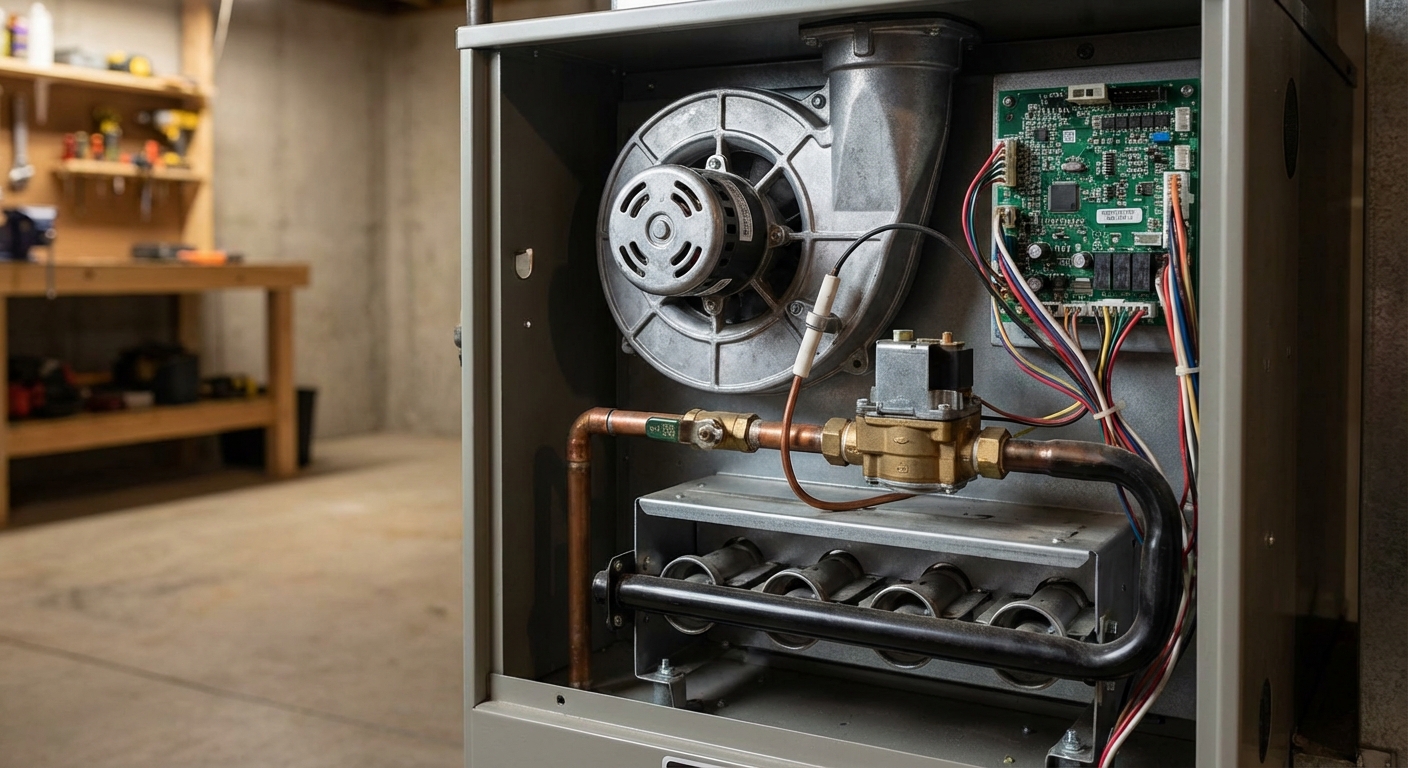
The thermostat calls for heat and signals the furnace control to start the sequence. The integrated furnace control board coordinates ignition and blower operation and enforces furnace safety controls. Limit switches are hard stops: if temperatures rise beyond safe limits, they shut the burner down to protect the furnace and the home.
The inducer starts combustion airflow and exhaust drafting before ignition. Ignition is handled by an igniter or a standing pilot, then the gas valve meters fuel on gas furnaces and the burners stabilize the flame. The heat exchanger is the safety-critical boundary that transfers heat from combustion gases into household air while keeping those combustion gases out of the airstream; cracks are treated as serious because they defeat that separation. Flue/venting carries exhaust outdoors, so vent problems show up as shutdowns and poor performance.
The blower motor moves air across the heat exchanger and into the ducts. A loaded air filter and restrictive ductwork reduce airflow, which drives high temperatures inside the cabinet and trips limits, often presenting as short cycling and lukewarm registers.
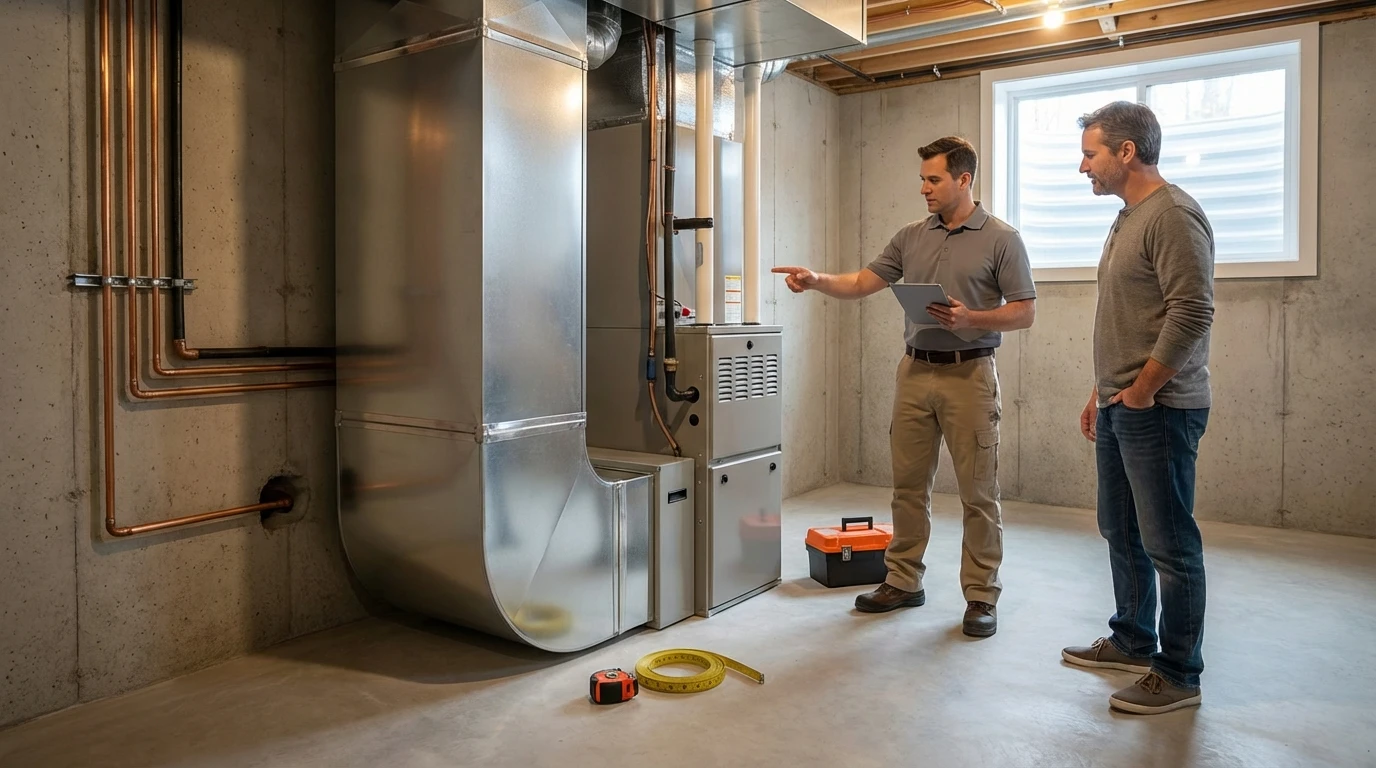
Upflow vs downflow vs horizontal furnace orientation matters: Upflow furnaces pull air from the bottom and discharge out the top, fitting basements and closets with supply ducts above. Downflow furnaces pull from the top and discharge out the bottom, common where ducts are below, including many attic or upper-level installs. Horizontal furnaces move air side-to-side, used in tight attics and crawlspaces where the cabinet must lie on its side; the return and supply connections shift accordingly.
A BTU is the energy needed to raise 1 lb of water by 1°F; furnace capacity is commonly expressed as BTU per hour (BTU/hr) on spec labels and quotes. You will often see an input BTU/hr rating plus AFUE, which tells you how much of that input becomes usable output: an 80,000 BTU/hr input gas furnace at 96% AFUE delivers roughly 76,800 BTU/hr of heat output (80,000 × 0.96). Confirm those two numbers and confirm the orientation matches your duct design before you approve a replacement.
Step-by-Step
Once those parts are in place, the "how it works" becomes a repeatable sequence the control board runs every time the thermostat calls. That sequence is why a furnace can appear to "try" to heat-starting and stopping-when it's actually failing a safety check.
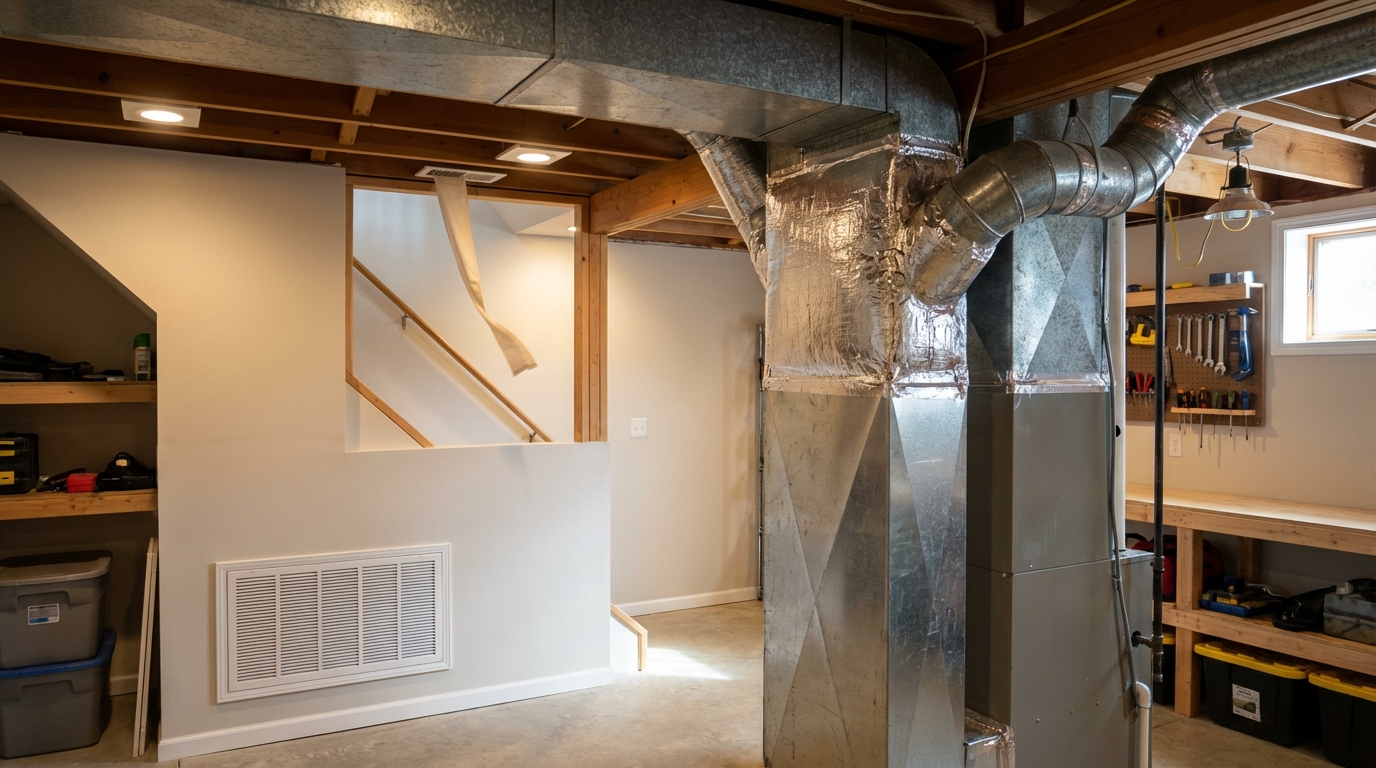
A modern gas furnace does not just turn on. Every call for heat triggers a strict safety-and-ignition sequence designed to prove proper airflow, safe combustion, and a stable flame before it delivers steady warm air. When any "proof" step fails, the control will shut the gas off, often after a short run or a few retries, which is why homeowners notice brief starts, pauses, or a fan-only run.
- Receive a thermostat call, and the signal reaches the control board to begin a heat cycle.
- Pre-check safeties (limits and rollout protection) so the furnace will not fire under unsafe conditions.
- Start the inducer motor to establish draft through the heat exchanger and vent.
- Prove draft when the pressure switch closes, confirming the inducer is actually moving air.
- Energize the igniter only after draft is proven; it will not heat until the pressure switch closes.
- Open the gas valve when the control allows fuel to flow to the burners.
- Ignite the burners as gas meets the hot igniter or pilot flame.
- Verify flame with the flame sensor: igniters typically heat for 10 to 30 seconds before the gas valve opens, and if flame is not proven within about 5 to 8 seconds the control shuts the gas valve off.
- Heat the heat exchanger as combustion runs steadily.
- Delay blower start so the exchanger warms first and the air coming from registers is actually warm.
- Move warm air through the ducts once the blower ramps up.
- Shut off gas when the thermostat is satisfied, ending the firing portion of the cycle.
- Post-purge with the blower running for a cooldown to pull remaining heat off the exchanger before everything stops.
A condensing furnace uses a secondary heat exchanger to capture more heat from exhaust, and only condensing furnaces achieve AFUE ratings above 90% (often about 90 to 98%); see 80% to 96%+ AFUE gas furnaces for context on standard vs high-efficiency models. That extra heat extraction creates condensate, so high-efficiency furnaces typically use sealed combustion, PVC venting, and a condensate drain instead of relying on metal venting alone.
A soft lockout is a temporary shutdown after safety or ignition faults; it commonly happens after multiple failed ignition attempts or when no flame is detected. A hard lockout usually follows repeated failures and, by manufacturer convention, requires a manual or extended reset to prevent endless re-tries; common triggers include flame-sensing issues, ignitor problems, gas furnace pressure when running issues, overheating, a dirty filter, and blocked vent pipes.
Normal operation sounds like inducer first, ignition, burners staying lit, then a delayed blower and steady warm airflow. If the furnace repeatedly lights then drops out, or "tries" several times without reaching steady heat, treat it as a safety-proving shutdown and schedule professional service instead of repeatedly cycling the thermostat.
Electric Furnaces, Heat Pumps, and Dual-Fuel
The same "make heat, move air" framework applies beyond gas, but the heat source changes what you should expect for operating cost and performance. That's why "electric heat" needs a more specific answer than it usually gets.
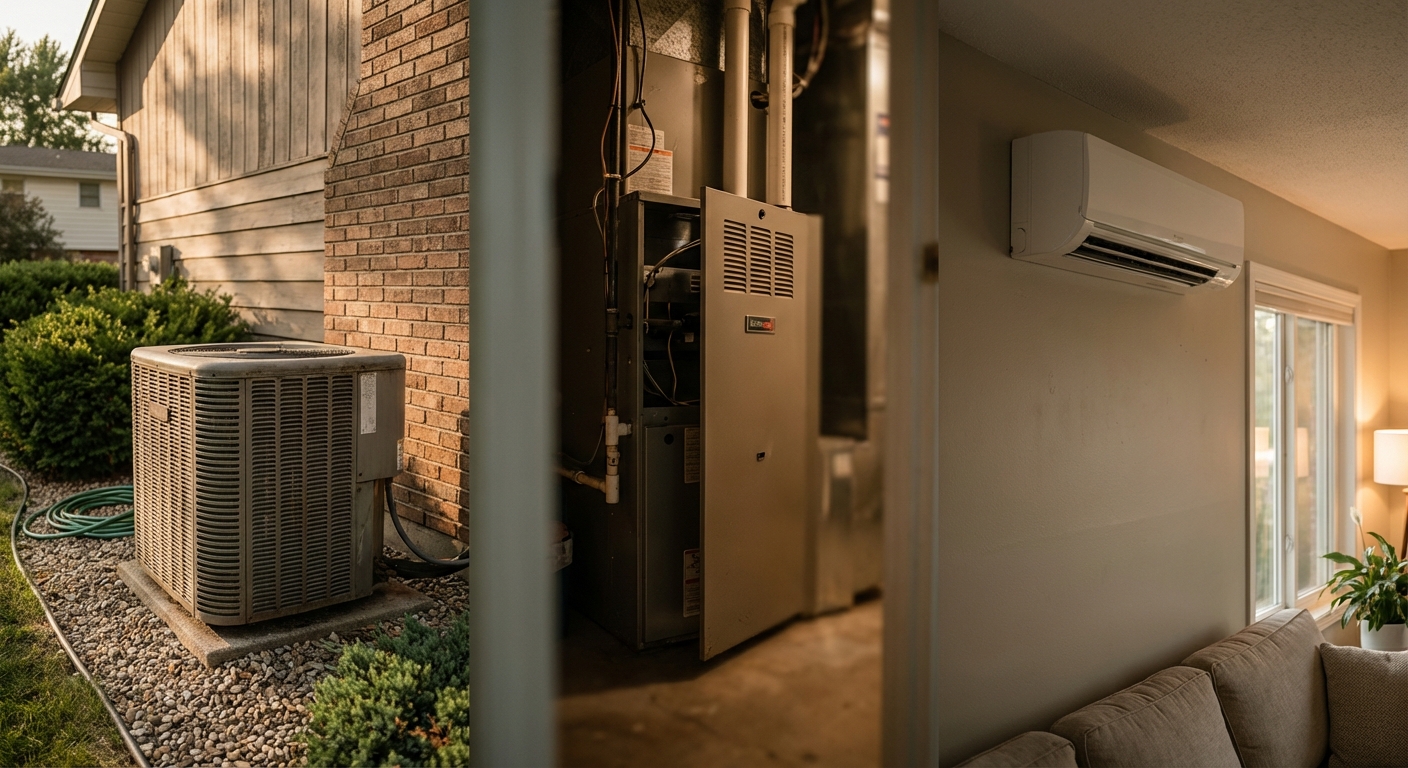
Homeowners hear "electric heat" and assume it describes a single system. In reality, it usually means one of two setups that can use the same ductwork and vents: an electric furnace (or electric air handler) that makes heat with resistance, or a heat pump that moves heat with refrigerant. The physics are different, and your operating cost follows the physics.
An electric furnace is straightforward: electric resistance elements (heat strips) glow hot, and the blower pushes that heat through the ducts. There's no combustion, so you typically avoid a flue, vent pipe, or gas line entirely. The tradeoff is operating cost: resistance heat turns electricity into heat at a fixed rate, so your bill tracks local electricity rates closely.
To compare electric-furnace specs to "BTU" numbers on other equipment, convert kW to BTU/hr. 1 kW of electric heat is approximately 3,412 BTU/hr, using BTU/hr = kW × 3,412.
A heat pump doesn't create heat with resistance during normal operation. It moves heat using the vapor-compression refrigeration cycle, and a reversing valve changes refrigerant flow direction so the same system can heat or cool. The catch is outdoor temperature: as it gets colder outside, the heat pump has less available heat to move, so heating performance drops as outdoor temperature falls, which is the real-world reason its COP declines in cold weather.
A dual-fuel system pairs a heat pump with a gas furnace and uses controls to choose the better heat source for the moment. Thermostat and changeover logic determines when the heat pump operates and when the furnace takes over, using a balance point (switchover point) that's often around 40°F. Many controls let you set that temperature so comfort and cost stay predictable.
Ask for three numbers in writing: the electric furnace's heat-strip kW (so you can convert to BTU/hr), the heat pump's SEER2 and HSPF2 efficiency ratings explained, and whether dual-fuel control with an adjustable balance point is included. If the proposal can't clearly state those, you can't accurately compare comfort or operating cost—especially when deciding between a heat pump vs a furnace for your climate.
Where Ductless Mini Splits Fit In
If the duct system itself is the limiting factor-leaks, restrictions, or rooms that never balance-changing the heat source won't necessarily fix the comfort complaint. That's where ductless approaches get considered, because they change the delivery method rather than relying on a central duct trunk to do the work.
Ductless mini-splits get picked when the duct system is the bottleneck: you want room-by-room control, or you need a clean retrofit in a house that was never built for ducts. The friction is language. A "mini-split" is not a different kind of furnace, it's a zoning and air-distribution strategy that changes how comfort is delivered.
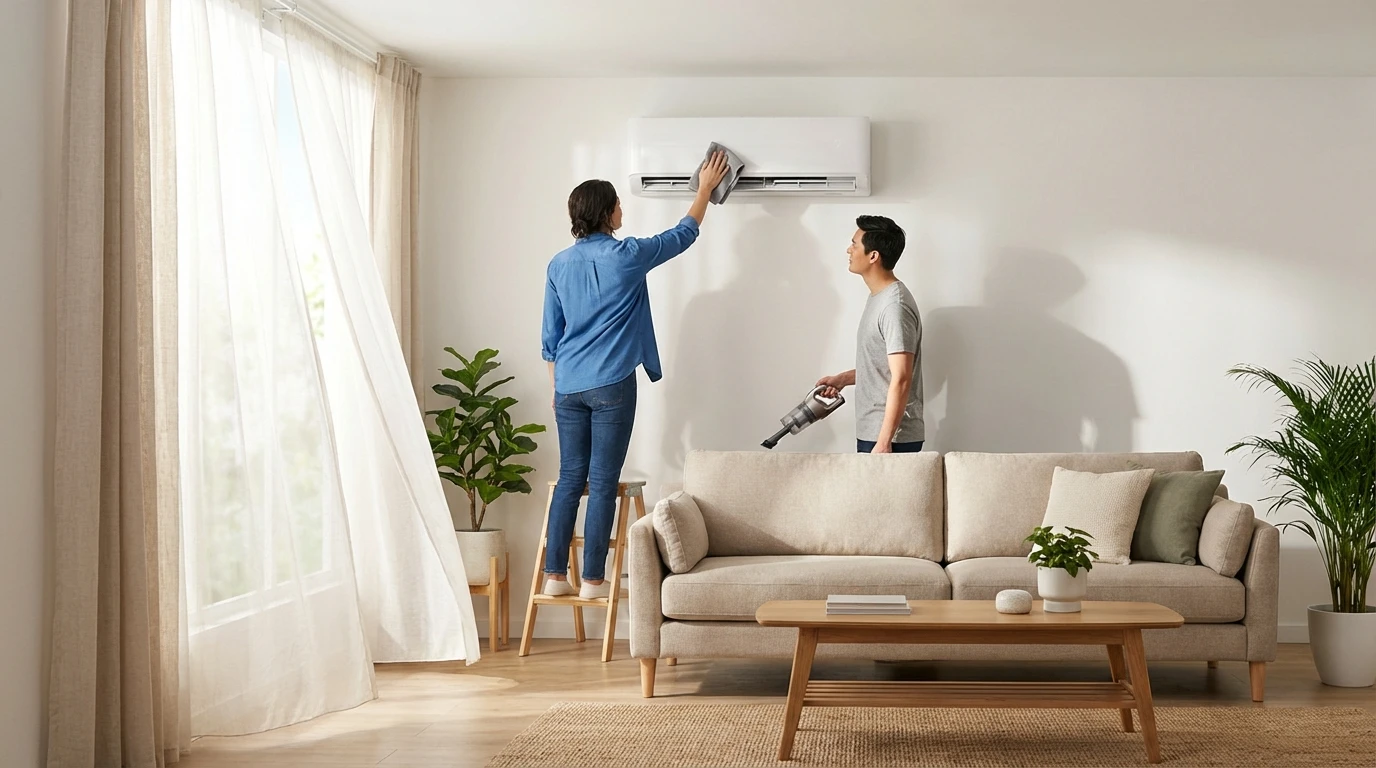
Most ductless mini-splits are heat pump systems that heat and cool by moving heat with refrigerant, commonly using inverter-driven compressors. They condition air at one or more indoor units and distribute that conditioned air without ducts, unlike a furnace that relies on a central cabinet and a duct system to push air throughout the home.
No existing ducts, additions and retrofits, hard-to-balance bedrooms over garages, and households that want different setpoints by room are the classic use cases.
Wall-mount heads solve straightforward single-room zones; floor consoles work where wall space is limited; ceiling cassettes sit in or near the ceiling and throw air outward across the room; concealed duct units hide above a ceiling and feed a short duct run for a cleaner look.
12,000 BTU/hr is approximately 1 ton of capacity, and it's commonly aimed at small to medium rooms or zones.
A typical rule of thumb often cited is roughly 400 to 600 sq ft for a 12,000 BTU/hr unit, but the right answer depends on the load and the conditions in that space.
Talk ductless in three parts: your zone-by-zone comfort goal, the capacity in BTU/hr (and tons), and the indoor head style that fits the room. "Mini-split" can be ductless or ducted, so be specific about the indoor distribution you're buying.
Efficiency, Sizing, and Maintenance
Whether the system is gas, electric, heat pump, or ductless, the most common disappointments still come from mismatched capacity and poor air delivery. That's why sizing and airflow details are where real-world comfort and operating cost are decided.
A furnace with an impressive rating on paper still delivers uneven comfort and higher bills if it's the wrong size or pushing air through leaky, restrictive ductwork. The symptoms homeowners notice, hot and cold rooms, noisy airflow, frequent on and off cycles, usually trace back to sizing and air delivery, not a "bad furnace."
AFUE is the efficiency yardstick for the furnace itself, but your lived efficiency is whatever heat actually makes it into the rooms. Leaky ductwork can cause up to about 30% heat loss in unsealed ducts, which means air you paid to heat ends up warming an attic, garage, or crawlspace instead of your living space—see this ductwork guide to optimize HVAC efficiency.
Manual J is the standard residential load calculation that uses building information, location, and orientation to size HVAC equipment. It prevents guesswork that leads to comfort problems and wasted energy.
Oversizing is not a safety margin, it increases short-cycling and wear. Short run times also worsen humidity control in mixed heating and cooling systems and can leave temperatures uneven from room to room.
Single-stage furnaces run at one output. Two-stage furnaces typically run low stage around 65% for most runtimes and high stage at 100% for peak demand, so the house sees smaller temperature swings and steadier airflow. Variable-speed blowers further smooth comfort, and blower electricity use rises as duct static pressure climbs.
Replace or clean standard furnace filters every 1 to 3 months, with the interval driven by filter type, pets, dust, and runtime. Keep supply and return vents clear so airflow stays consistent. Schedule an annual professional inspection and tune-up for reliability, and use this fall furnace prep checklist to stay ahead of seasonal issues. Call a pro for a burning smell that persists past initial dust burn-off, repeated shutdowns, unusual noises, or any CO alarm.
- Verify a Manual J-based load calculation before equipment is selected.
- Inspect ducts for leakage and restrictions, then seal and correct airflow.
- Choose AFUE and staging (single-stage vs two-stage, variable-speed blower) to match your comfort priorities.
Summary
A forced-air furnace succeeds or fails on the same two outcomes you feel at the vents: it has to create enough heat and it has to move that heat through the house.
Every heat cycle follows a proven sequence-draft, ignition, flame verification, and blower delivery-and when a safety step fails you'll often see short runs, retries, or lockouts instead of steady heat.
The heat exchanger remains the safety boundary, capacity is expressed in BTU/hr, and comfort depends heavily on correct Manual J sizing, duct leakage, and basic airflow maintenance like filter changes and clear returns.
Use AFUE to compare furnace efficiency, but keep the broader lens: gas furnaces burn fuel, electric furnaces use resistance, heat pumps move heat (with performance tied to outdoor temperature), dual-fuel systems switch sources at a balance point, and ductless mini-splits address delivery by conditioning rooms directly.
Conclusion
A furnace is not a black box, it is a repeatable system built around two outcomes you can feel at the vents: creating heat and moving that heat through the home. Along the way, key components like the control board, inducer, pressure switch, igniter, burners, flame sensor, heat exchanger, and blower work in a set safety-first sequence, and many common complaints trace back to one weak link such as restricted airflow, duct leakage, or a safety shutdown.
The article also showed how to compare options with numbers that matter, including BTU/hr capacity and AFUE for gas furnaces, kW to BTU/hr for electric heat, and how heat pumps, dual-fuel systems, and ductless mini-splits change either the heat source or the delivery method. The main takeaway is simple: efficiency ratings only pay off when the system is correctly sized and able to deliver air reliably through the ducts.
Use these basics to check filters, airflow, and duct performance, then decide what to measure or verify next before you troubleshoot further or approve a replacement.
 Cooling
 Money Saving Tips
 Product and Brands Insights
 Buying Guides
 State by State
 HVAC Systems