




 buying guides
 heating
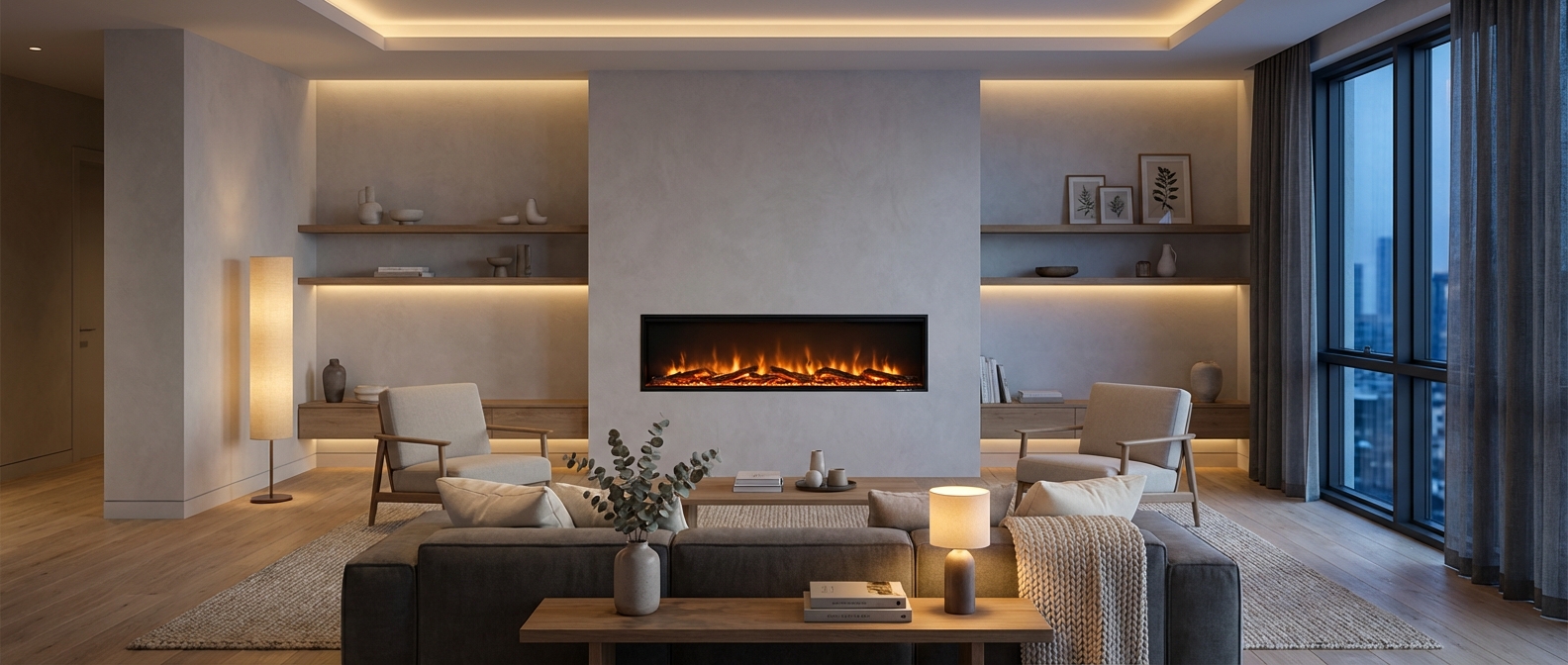
You buy an electric fireplace for the "real fireplace" look in your living room or bedroom and you want a bump in comfort, not a decorative box that leaves the room just as cold as before.
Here's the honest split: electric fireplaces win on aesthetics, instant on/off convenience, and zero combustion mess, but they lose the moment you expect them to behave like central heat. In 2026, they are an ambiance-first purchase with predictable heat limits, and shoppers still pick them because they solve the vibe problem faster than any HVAC project ever will.
Most models still ship with two heat settings: 750W on low and 1500W on high. Using the standard conversion 1W = 3.412 BTU/hr, 1500W works out to about 5,118 BTU/hr, which is why the category gets marketed as "~5,000 BTU." In plain language, that means noticeable warmth in the near field, but only modest whole-room impact once you factor in room size, drafts, insulation, and open layouts.
The tradeoff this guide resolves is simple: you're buying looks and convenience inside the hard limits of resistance heat efficiency and real installation constraints. Electric resistance heat is effectively COP ≈ 1, while heat pumps and mini splits deliver higher efficiency, with HSPF2 and SEER2 as the metrics that separate modern systems from legacy ones.
After reading, you'll make a confident buy/no-buy decision and prioritize the constraints and features that actually matter for your space.
Choose the Right Type
The right electric fireplace is determined by installation constraints first and aesthetics second. Most returns happen for three reasons: buyers assume there is a "standard size," they plan to share a loaded outlet circuit, and they trust the marketing photo instead of the spec sheet dimensions and mounting notes.
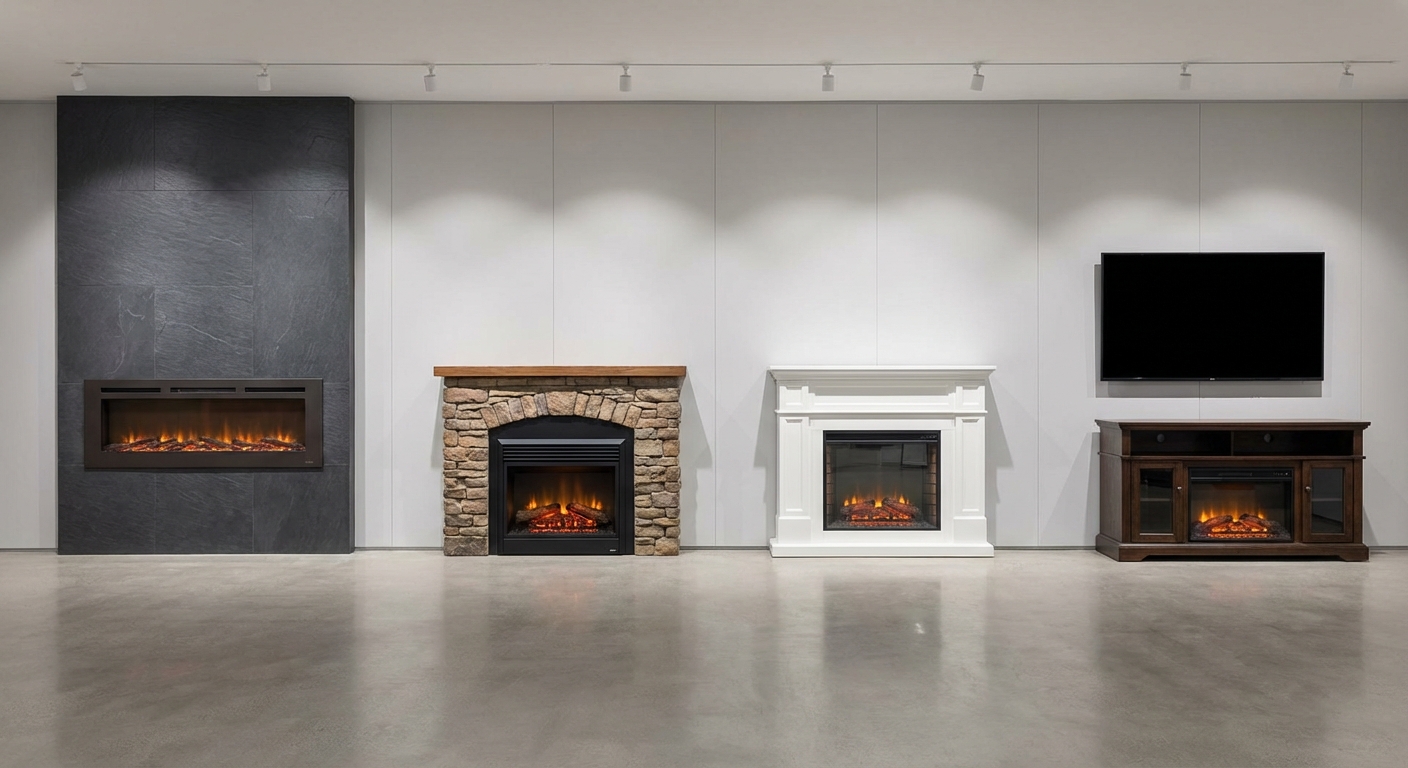
Wall-mount units win in bedrooms, apartments, and rentals because they are vent-free and typically hang like a heavy picture. The failure point is the wall, not the fireplace: hit studs where the bracket requires them, plan anchors where studs are not available, and decide how you'll route the cord without creating an obvious drop to the receptacle.
Under a TV, the friction is simple: heat rises, so your TV placement has to follow the manufacturer's guidance and "clearance to combustibles" requirements, meaning the minimum required air space between a heat-producing unit and nearby combustible materials. Treat under-TV installs as spec-sheet driven, not layout driven.
Inserts are the cleanest choice when you already have a fireplace opening and want a built-in look without reframing a wall. The gotcha is depth and opening geometry: measure inside width, inside height, and usable depth, then match those numbers to the manufacturer's required opening, not the visible glass size.
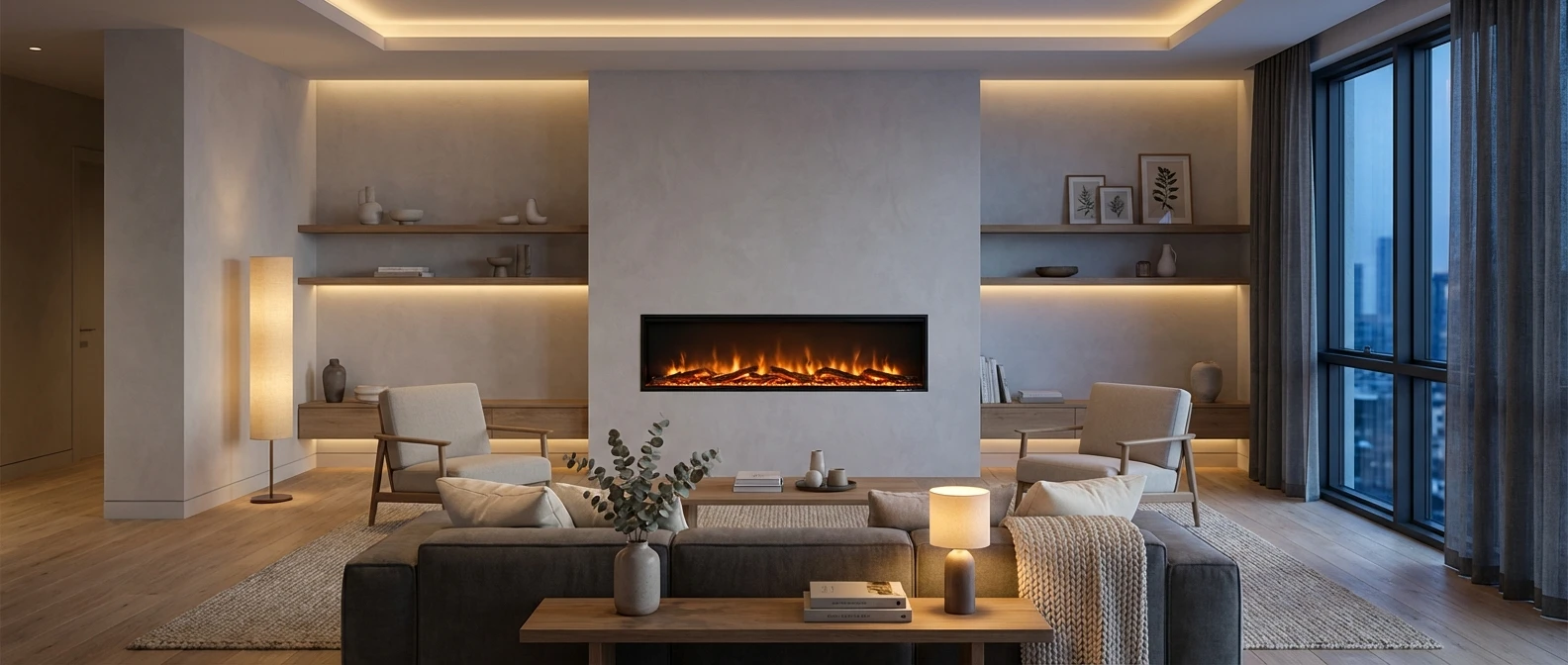
Built-in linear fireplaces fit owner-occupied living rooms and remodels where you can open a wall and finish around a unit. They fail when buyers ignore wall depth, stud spacing, and finishing tolerance, then discover the rough-in is tighter than the trim can hide. Confirm framing dimensions and service access before you commit.
Mantel packages make sense in living rooms where you want a furniture-like focal point without carpentry. The common mistake is assuming the surround is "standard size" and forgetting real footprint: it must clear doors, traffic paths, and baseboards while still landing near power.
TV stands are the safest bet for renters who want the fireplace directly under the screen with zero wall work. The return trigger is cable and airflow management: crowding the back panel or blocking intake and exhaust openings causes shutdowns and heat buildup where you do not want it.
Electric models are vent-free, so you skip a chimney, gas line, and combustion air planning. Power is the real limiter: a 1500W unit on 120V draws about 12.5A (1500 ÷ 120). Run the 80 percent continuous-load math and that number is not close to the limit on a 15A circuit, it is past it: 80 percent of 15A is 12A, and the fireplace alone draws 12.5A before anything else is plugged in. For continuous operation on high, a 1500W unit belongs on a dedicated 20A circuit, where the 80 percent limit is 16A. At minimum it must not share a 15A circuit with anything else, and it must never run on an extension cord or power strip.
Whether the fireplace is a daily-use centerpiece or an occasional one, a dedicated circuit, an electrical circuit serving a single appliance to reduce overload and nuisance tripping risk, is the clean solution. Follow the manual and bring in a licensed electrician when the circuit plan is not obvious.
Once you know which format fits your wall, opening, and power situation, the remaining decision becomes straightforward: confirm the unit physically fits and that it can run without creating electrical headaches.
- Measure the opening or wall space using the full body dimensions, not just the visible glass; there is no universal size, even if 24 to 36 inches wide and 24 to 29 inches high is a commonly referenced "typical" range.
- Plan studs, bracket holes, and anchor points before you lift the unit onto the wall.
- Route the cord intentionally so it is not pinched, stretched, or visually sloppy.
- Protect airflow by keeping intake and exhaust openings unobstructed after trim, tile, or a TV stand back panel goes on.
Verify circuit capacity and outlet sharing, then confirm fit from the spec sheet dimensions before you pick a format.
Heating Performance & Energy Costs
Electric fireplaces feel underpowered when buyers expect whole-room heating because the heater is watt-limited. The "heats a room" promise is really localized warmth plus on-and-off cycling, and the comfort you feel depends more on the room than the flame display.
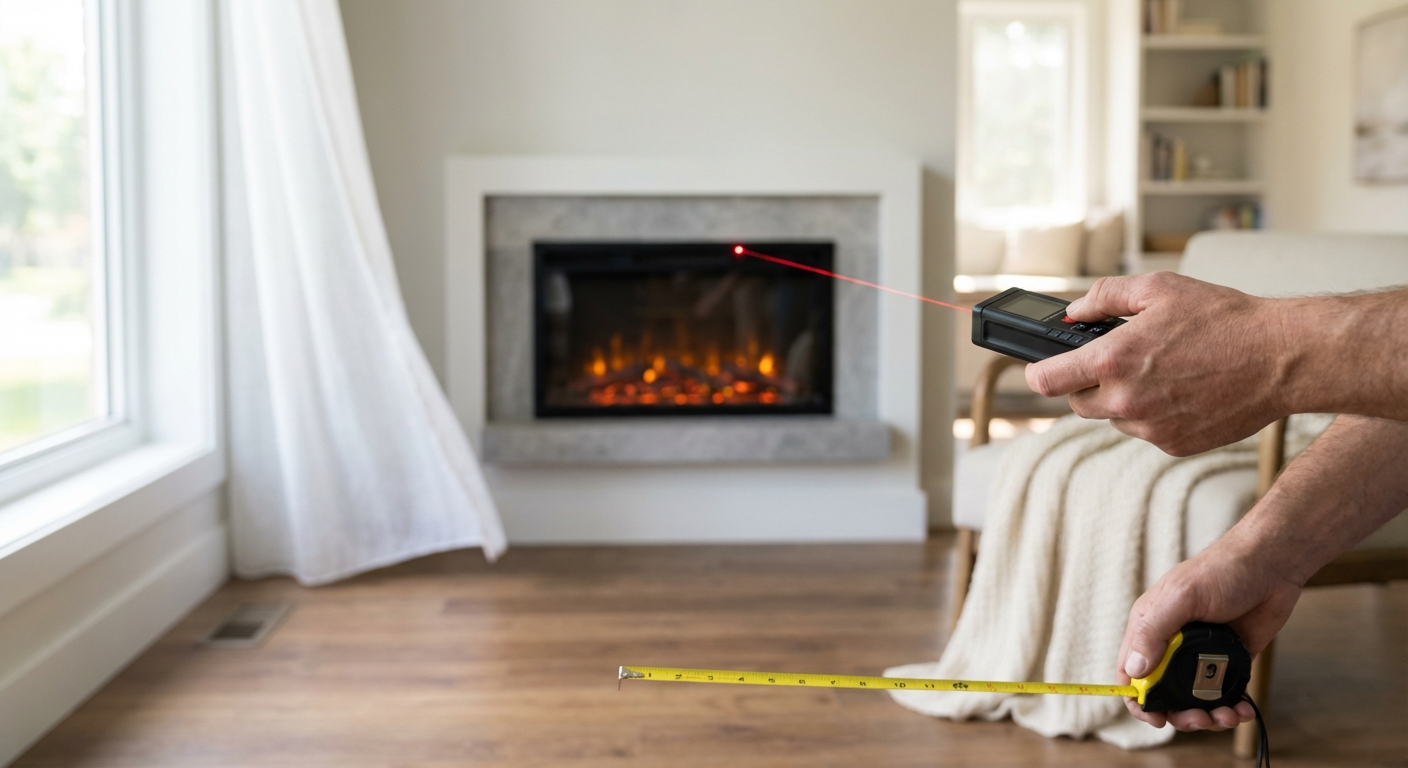
Electric fireplace heat is simple resistance heat, so the spec sheet starts and ends with watts. The conversion is fixed: 1W = 3.412 BTU/hr. That makes the common high setting of 1500W ≈ 5,118 BTU/hr, the typical "~5,000 BTU class" you see in listings (see what BTUs mean if you want to interpret heat output claims). A 750W low setting is roughly half the output, so it behaves like a mild space-warming mode rather than a "turn the room into a sauna" mode.
The reason 1500W shows up everywhere is practical: it fits on a standard 120V household circuit without immediately tripping breakers, so manufacturers converge on the same ceiling. Once you understand that ceiling, you stop expecting furnace-level performance from a plug-in appliance.
"Heats a room" usually means supplemental heat, meaning heat meant to add comfort in a space, not replace a primary whole-home system.
That definition matters when you size a unit: the same 1500W fireplace can feel great in a closed bedroom and pointless in an open living area because air volume and heat loss change fast with ceiling height, drafts, insulation quality, and doors left open. Air movement matters too: ceiling fans, return-air pulls, and hallway currents can strip away that "warm bubble" you expect near the fireplace.
Rules of thumb, not guarantees: for an average 8-foot-ceiling room, ~20 BTU/hr per sq ft is a practical target. That puts a 5,118 BTU/hr unit around ~250 sq ft in decent conditions, and less in drafty spaces. Retailer guidance commonly pushes shoppers to size heating power to room size for exactly this reason.
Thermostats and fans shape "real heat" more than the flame visuals. Built-in thermostats cycle the heating element on and off to hold a setpoint, and on many models the flames run independently, so you can keep ambiance without paying for heat. Fan noise is part of the package: more heat output usually means more fan airflow.
Use one formula: cost per hour = kW × $/kWh. On high, an electric fireplace is about 1.5 kW. At $0.18/kWh, that is 1.5 × 0.18 = $0.27 per hour. Run it 4 hours a day and you are at $1.08/day, roughly $32.40 for a 30-day month.
This is where whole-home equipment wins. Resistance heat sits at COP (Coefficient of Performance) of about 1, meaning the ratio of heat delivered to electrical energy used is essentially one-to-one. Heat pumps deliver more heat per kWh because they move heat instead of making it, and higher HSPF2 ratings indicate more efficient heat pump heating. For cooling, SEER2 is the standardized efficiency rating under updated test procedures.
Once you accept the watt ceiling and what it costs per hour, feature choices matter more than squeezing for marginal heat gains you cannot get from a 120V plug-in unit.
Set expectations by wattage first, then decide usage by cost-per-hour. A 750W to 1500W heater is a comfort tool, and it stays supplemental heat unless you step up to a heat pump solution.
Top Features to Prioritize in 2026
The "best" electric fireplace is the one you enjoy using daily. Features decide that more than headline BTUs, because regret comes from the parts you touch and see every night: flat-looking flames, awkward remotes, noisy fans, and flaky control. A lot of 2026 units already bundle the basics (remote control plus adjustable LED 3D flame effects) alongside a heater, so your job is filtering for the features that feel right in your room.
- Pick a flame system you like up close: LED flame effects, projection/holographic-style systems, and 3D water-vapor (mist) effects all exist in the 2026 market, and they look very different in person.
- Demand real brightness control: multiple flame brightness steps matter more than a single "high/low" toggle for day vs evening viewing. Adjustable flame color and brightness are commonly advertised, so verify both before you buy.
- Check ember-bed depth: a deeper ember bed reads more realistic at sofa distance than a flat printed panel.
- Validate viewing angles: some effects collapse when you sit off-center, especially in wide rooms.
- Require "flames-only" mode: running the visuals without heat is a common spec-sheet feature and it determines whether you will use it year-round.
Watch out for: "realistic" claims that only translate into more color modes. If the listing calls out flame color/brightness adjustments, confirm those settings still look natural at normal couch distance.
- Thermostat behavior: look for a unit that holds a setpoint without constant cycling.
- Multiple heat levels: at least two stages keeps the room comfortable without overshooting.
- Timer and scheduling: a sleep timer is the daily-use feature owners actually rely on.
- Remote ergonomics: dedicated buttons beat menu-diving, especially in dim rooms. Remote control is commonly bundled alongside adjustable flame features, so treat it as a baseline, not a premium add-on.
Watch out for: remotes that require perfect aim. If the same spec sheet that touts an LED 3D flame also gives you a tiny, finicky remote, day-to-day use suffers.
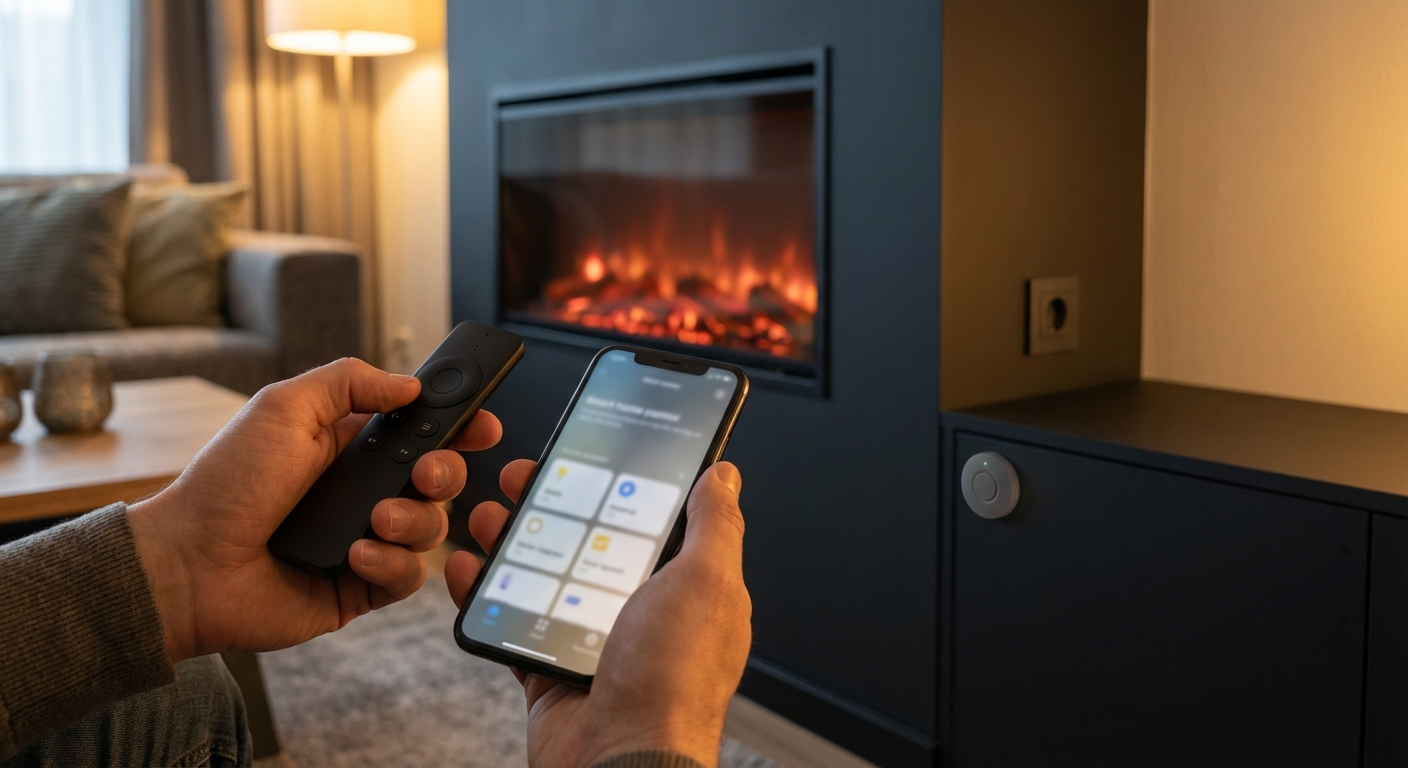
- Voice support: many smart controllers advertise Amazon Alexa and Google Assistant integration for voice control.
- Wi-Fi band requirements: plan on 2.4 GHz, not 5 GHz. Several smart controllers explicitly require 2.4 GHz Wi-Fi only.
- Phone compatibility: confirm the system supports iOS and Android, and that it uses a specific app you are willing to keep installed.
- Automation hooks (if you care): some ecosystems also advertise IFTTT-style integrations for routines beyond basic on/off.
Watch out for: "smart" that still forces the remote for core settings like heat level or thermostat setpoint. If you’re weighing programmable vs. smart thermostats, the same rule applies here: the app must control the basics.
- Fan sound in heat mode: if it blows warm air, it has a fan, and that fan becomes the dominant sound in quiet rooms.
- Flame-mechanism noise: projection systems and some other effects can add a constant motor whir that you notice most at night.
- Vibration/buzz: lightweight housings can buzz against a mantel, trim, or a TV stand surface.
Watch out for: "silent" claims. If it moves air or spins a mechanism, it makes noise, so prioritize designs that keep mechanical sounds out of the seating area.
- Overheat protection: automatic shutoff on unsafe internal temperatures is mandatory.
- Tip-over protection for portable units: UL-listed portable heaters must pass a tip-over test simulating the most severe tip-over orientation.
- Correct certification language: for fixed and location-dedicated electric room heaters, UL 2021 is the relevant safety standard (effective May 6, 2018), so you want clear, specific listing language.
- Safer front surfaces: prioritize cool-touch glass or guarded fronts in high-traffic rooms with kids and pets.
Watch out for: vague "tested for safety" wording without a recognizable certification reference or without explicitly calling out tip-over and overheat protections.
Prioritize the handful of features you will notice every day: a flame system you genuinely like (with usable brightness control and flames-only operation), controls that behave predictably, and smart features that improve comfort and energy management on your network (often 2.4 GHz Wi-Fi). Treat UL-aligned safety certification language and tip-over protection as a requirement, not a bonus.
Budgeting Your Purchase
The purchase price is rarely the true cost. Finish work and electrical readiness decide the real budget, and they are the difference between a clean built-in look and a heater you never run on high.
Use format as your first budget lever because it dictates how much "room finish" you are buying with the unit. Mantel-package electric fireplaces commonly land around $500 to $750 at retail (typical band, varies by size and features). Wall-mount and insert models usually stay in the "few hundred to about a thousand" range when you do not need cabinetry. Built-in linear units are where budgets jump because you are paying for size, cleaner trim options, and higher feature tiers (better flame media, longer viewing windows, more control options).
Most disappointments trace back to underfunding the non-glamorous work: power and finish. Electrician labor commonly runs $65 to $130 per hour, and small projects often total $205 to $646. Even simple tasks add up: replacing an outlet averages about $230 (range $137 to $319). In some markets, journeyman rates run about $60/hr, and a rule-of-thumb budget is $100 per installed 15A outlet.
Beyond electrical, a built-in look usually means framing, drywall, trim, and paint. If you skip that line item, the unit can be "affordable" and still look unfinished, or be stuck on a shared circuit you do not trust at full output.
If your goal is measurable comfort (more rooms, longer hours, lower ongoing cost), redirect the budget to a heat pump or mini split. As a reference point, high-efficiency residential HVAC systems are the territory where a system purchase starts acting like a real heating plan instead of decor. Rebates and financing exist, vary by location, and can swing the economics hard in favor of a heat pump.
If you are shopping HVAC equipment directly, request a custom quote selling at wholesale prices with factory warranties and U.S.-based technical support.
The budgeting decision is really the same tradeoff from the start of this guide: pay for ambiance and simplicity, or pay for comfort per dollar over time with higher-efficiency equipment.
Buy electric when you are buying ambiance plus occasional warmth. Buy heat pumps or mini splits when you are buying comfort per dollar over time (see this mini-split buying guide if you want the deeper path).
Final Buying Checklist + Next Steps
Most buying mistakes are preventable. This final checklist is what separates a smooth install from an expensive return, because the failures happen at handoff moments: the spec sheet vs the real wall opening, parcel limits vs a long box, and missing paperwork when the installer is standing there waiting.
- Measurements and fit verification: Confirm the unit's overall width/height/depth and, for inserts or built-ins, the rough-in opening dimensions plus required ventilation gaps. Field-measure the actual rough-in location and compare it line-by-line to the exact model's spec sheet before ordering.
- Power and placement confirmation: Match your power plan to the unit's electrical requirements and the outlet location (circuit capacity, plug type, cord reach). Confirm placement assumptions you can't "fix later" on install day: stud layout, blocking, and clearance to trim or adjacent finishes.
- Feature must-haves: Write down the non-negotiables you will use weekly (control method, heat behavior, display preferences, included mounting or trim pieces). If a must-have is optional or sold separately, add it to the cart now to avoid a stalled install.
- Delivery plan and receiving readiness: Plan for standard shipping timelines and choose expedited only when you can receive it. Parcels are commonly capped around under 150 lbs, max 108 in length, and under 165 in length plus girth; oversize cartons can be refused and can trigger dimensional-weight pricing and surcharges.
- Post-purchase setup and documentation: Save the spec sheet, manual, order confirmation, and packaging photos in one folder. Know where help lives: Budget Heating lists order tracking and common delivery issues in its FAQ and Order Status tools, so you can resolve problems quickly without guessing.
On BudgetHeating.com, standard shipping typically runs 3 to 7 business days, with expedited parcel options available. A Fast Track shipping option is also offered, which is useful when you are coordinating an installer and a tight delivery window.
If you need help after checkout, look for support under the retailer's FAQ, order tracking, returns, and warranty pages. Budget Heating directs customers to use the "My Account / Order Status" link for tracking and maintains support resources designed for post-delivery issues.
Keep the priorities straight: honor the watt limits and your power plan, respect format constraints and rough-in reality, and account for hidden costs like accessories and delivery handling. That is how you get the "real fireplace" look and the predictable comfort bump you came for-without expecting central-heat performance from a 750W to 1500W appliance.
Wrapping Up
Electric fireplaces in 2026 are best understood as an ambiance-first upgrade that can add a real, predictable comfort bump, as long as you respect the watt ceiling. Most models top out at 1500W, about 5,118 BTU/hr, which is great for near-field warmth and smaller, tighter rooms, but not a replacement for central heat in open or drafty spaces.
The smartest purchases come from getting the constraints right first: choose the format that fits your wall or opening, confirm clearances and airflow, and plan power so you avoid shared-circuit trips. From there, prioritize the features you will actually use, like convincing flames with brightness control, flames-only mode, reliable thermostat behavior, and safety certifications that are clearly stated.
Now, measure your space, verify your circuit plan, and compare spec sheets side by side, so you can pick the electric fireplace that fits your room and expectations the first time.
 Cooling
 Learning Center
 Money Saving Tips
 Product and Brands Insights
 State by State
 HVAC Systems