




 cooling
 learning center
 money saving tips
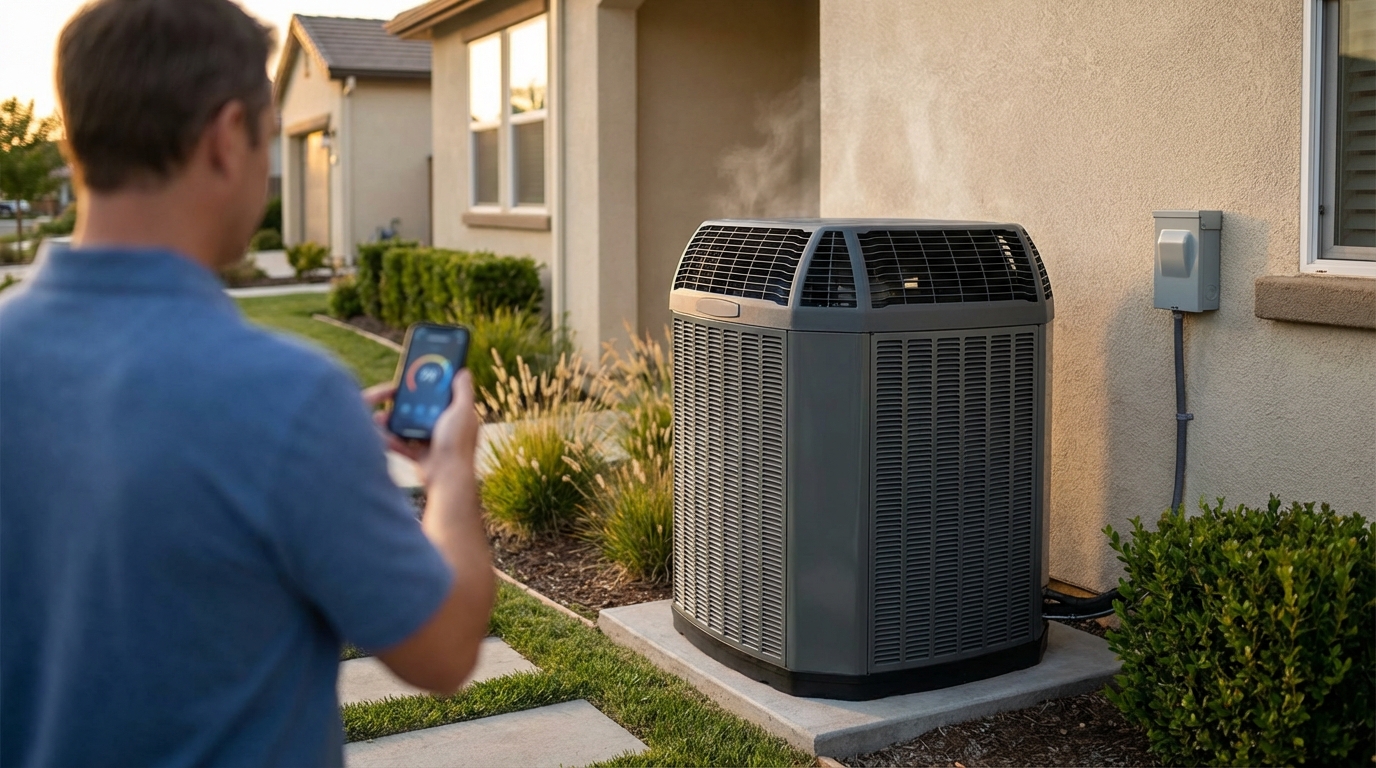
Summer bills climb, the outdoor box keeps running, and every service call feels like paying rent on an old machine. The real decision is simple: keep repairing what you have or upgrade, and first confirm whether the outdoor unit is the cost driver instead of chasing small fixes indoors. The outdoor condenser is where most of the power-hungry work happens, so its condition and how well it fits the rest of the system directly shape what you pay per month.
Most confusion starts with the word "condenser." "Condensing unit" typically refers to the outdoor unit, and the outdoor condensing unit typically houses the compressor, condenser coil, and outdoor fan-the parts that draw the big watts and set system pressure. The condenser coil is the outdoor heat-exchanger coil that dumps indoor heat to outside air during cooling, so when it is dirty and can't shed heat efficiently, head pressure rises and operating cost goes up.
Heat pumps don't change the stakes, they just flip the job: in a heat pump split system, the outdoor coil acts as a condenser in cooling mode, and the cycle reverses via a reversing valve. By the end, you'll know which levers actually cut total cost, efficiency ratings that matter, correct sizing and matching, maintenance that protects performance, and upgrade choices that reduce lifetime spend.
The Money-Saving Physics
Your summer utility bill is largely the price of moving heat outdoors. Every time the system runs, you are paying for the outdoor unit to push heat into outdoor air, and how efficiently it rejects that heat determines how many kWh it takes to get the same indoor temperature.
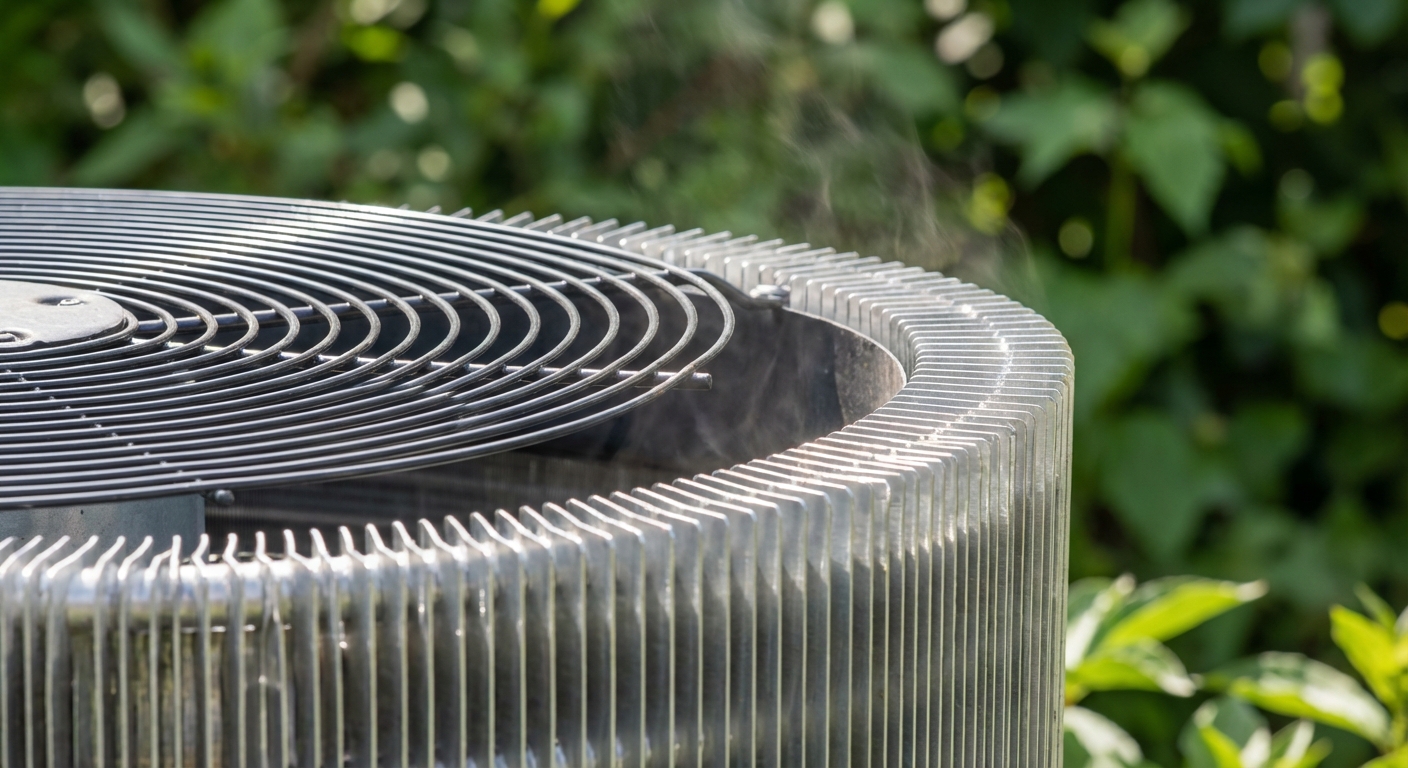
Three levers drive the outdoor unit's power draw: the coil, the compressor, and the fan. Heat rejection gets easier when the outdoor coil can transfer heat effectively and the fan can move enough air across it, because the refrigerant can dump heat with less strain.
Real-world friction is airflow. Dirt and debris reduce airflow and heat exchanger effectiveness, and practitioners consistently tie dirty condensers to higher head pressure and higher operating cost. Even modest airflow losses typically reduce efficiency and capacity, and the penalty can be larger when fouling is severe.
Compressor control matters because the system spends a lot of time at part-load. A single-stage compressor runs full tilt or not at all; two-stage and inverter-driven designs spend more hours at reduced output, which cuts cycling losses and usually reduces kWh for the same comfort.
Fan motor choice is the other part-load swing factor. PSC motors are simple and cost-effective, but they are not variable-speed, so airflow control is coarse and part-load efficiency suffers. An ECM motor is a brushless DC motor with electronic controls that can vary speed, which lets the system dial in airflow instead of blasting it.
Use SEER2 for comparison shopping because it ties directly to seasonal operating cost. SEER2 replaced SEER effective Jan 1, 2023, and the test uses higher external static pressure, 0.5 in. w.c. vs 0.1 in. w.c. under the older SEER test, so the rating better reflects real installed airflow resistance (for example, a SEER2-rated R-32 package unit).
Assumptions: a 3-ton system, $0.14 per kWh, and 2,100 equivalent full-load cooling hours per year. Using the cited savings example under those assumptions, moving from 10 SEER to 15 SEER2 saves about $350 per year, while moving from 13 SEER saves only about $110. Run your own numbers with annual kWh = (BTU/hr x hours) divided by (SEER x 1,000), then multiply by your rate. Savings scale directly with tonnage, and note that legacy SEER and SEER2 are not the same scale, so 15 SEER2 is roughly equivalent to 15.8 SEER. Swap in your own kWh rate to scale the dollar impact up or down.
Rated performance assumes the system is properly matched as a tested combination. Your decision tool is simple: use SEER2 plus your cooling hours and kWh price to sanity-check payback before you shop (check rebates for high-efficiency systems and other retailers publish SEER2 specs for side-by-side comparisons).
Efficiency numbers, however, only translate into lower bills when the equipment operates in the conditions the rating assumes. That puts sizing and system matching ahead of spec-sheet comparisons.
Right-Sizing Saves the Most
Correct capacity selection saves more money than chasing a slightly higher efficiency rating, because sizing errors force the system to operate in its least efficient modes: too many starts, too much run time, or both.
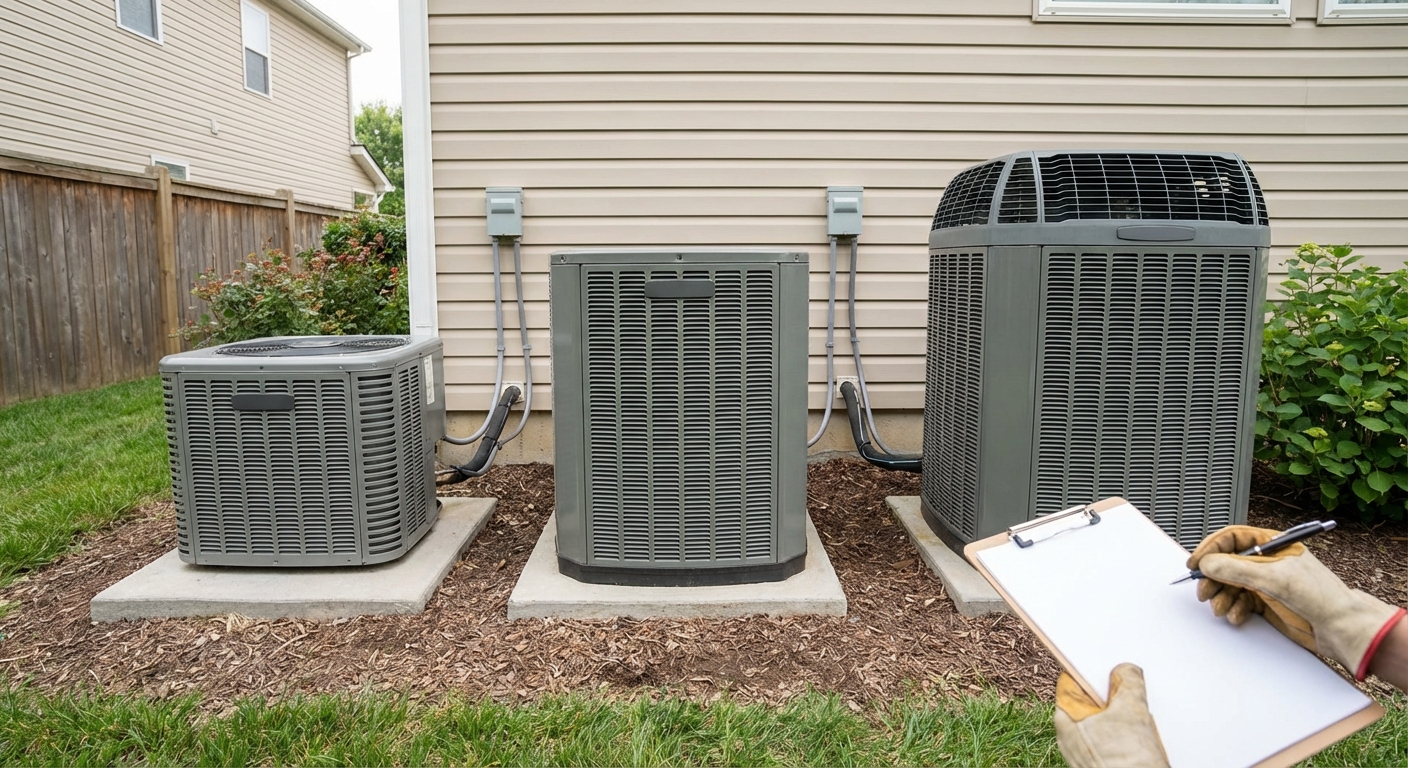
Oversizing increases short cycling. Those quick on-off bursts feel "powerful," but reduced runtime decreases latent moisture removal, which worsens indoor humidity control even while the thermostat number drops. You also pay for wasted starts: every cycle spins up the compressor and fans, then shuts them back down before the system can settle into stable, efficient operation.
Undersizing has the opposite symptom and the same outcome: higher bills and more complaints. When the equipment is too small, it runs long hours and still cannot pull the house down to setpoint during design conditions, leaving rooms warm when outdoor temperatures peak. Continuous operation also exposes duct losses and hot attic gains for longer periods, so the system spends more time fighting heat that never needed to enter the house in the first place.
"2 ton vs 3 ton condenser vs 4 ton condenser" is the result of the load, not a rule-of-thumb per square foot. Climate design temps, insulation levels, window performance, infiltration, and duct losses can swing the load dramatically, which is why ACCA's Manual J load calculation exists: it uses building, climate, and duct inputs to calculate a home's heating and cooling loads so equipment is sized correctly. That cost control shows up as fewer comfort complaints and callbacks, better humidity control, and less wasted runtime.
Then lock the performance in with an AHRI matched system, meaning the indoor and outdoor models are a certified combination tested and rated together for SEER2/EER2/HSPF2. If a quote swaps coils or air handlers outside the certified pairing, the "rated" efficiency is no longer the one you are buying.
Before you accept any tonnage recommendation, ask for the Manual J result and the AHRI match reference for the exact indoor-and-outdoor model numbers on your quote.
Sizing and matching set the ceiling for performance, but day-to-day condition decides how close you get to that ceiling. This is where maintenance stops being optional and starts being operating-cost control.
Maintenance That Pays Back
Cheapest kWh is the one you do not waste. Basic outdoor-unit maintenance keeps heat rejection efficient and avoids the high-ticket failures that dominate total cost of ownership.
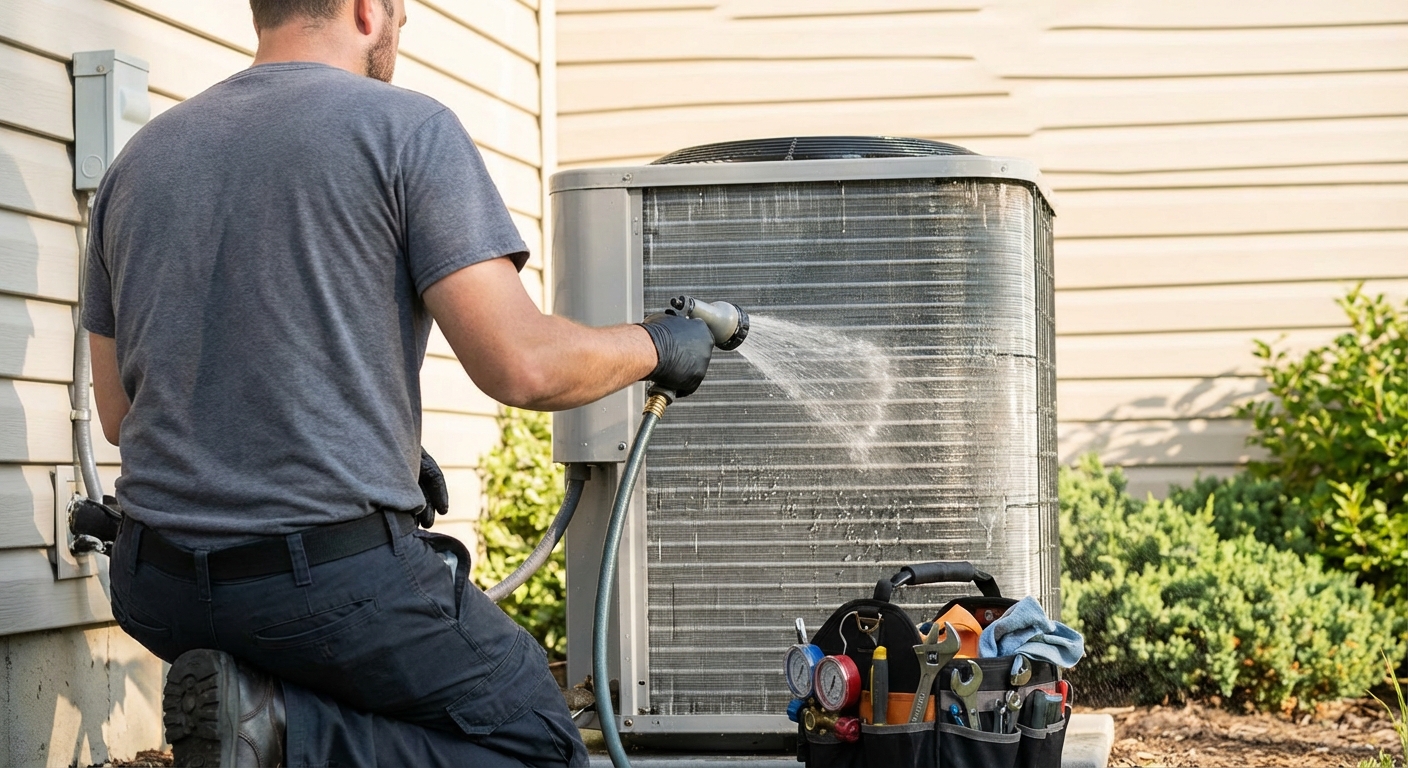
A dirty outdoor coil and restricted airflow force the condenser to run at higher pressures and for longer cycles. That extra stress accelerates electrical wear items, and it compounds into compressor wear, because the system spends more hours running hotter and harder.
Performance loss is usually modest when fouling is light (often under 5%), but severe blockage can drive much larger efficiency and capacity degradation.
- DIY-safe: Kill power at the outdoor disconnect, then clear leaves and lint from the cabinet and coil face to protect airflow and runtime.
- DIY-safe: Maintain clearances and keep the unit level so vibration and oil-return issues do not turn into fan or compressor problems.
- DIY-safe: Change indoor filters on schedule; it is an indoor habit that prevents system-wide airflow restriction.
- Technician-only: Verify refrigerant charge. Low charge significantly reduces cooling and heating capacity; proper verification uses superheat and subcooling against manufacturer commissioning specs.
- Technician-only: Perform electrical inspection (capacitor, contactor, wiring, fan motor amps) to catch heat and arcing damage early.
Do not handle refrigerant yourself. Federal rules govern refrigerant handling and leaks must be addressed promptly.
Central AC and heat pump outdoor units commonly run about 10 to 15 years, and well-maintained systems are often cited up to around 20. The most common outdoor-side failures are capacitor and contactor wear, fan motor issues, and compressor failure.
This week: clear the coil area and verify the unit is level. Before peak season: schedule a technician visit for charge verification and an electrical check.
When maintenance is no longer keeping breakdowns-and repair costs-under control, the cost question shifts from tune-ups to equipment choices. That's when upgrade paths matter, because the outdoor unit you choose determines both how the system runs and what it costs to run (including what is involved in installing a central air conditioner).
Upgrade Paths That Cut Bills
When repair costs start stacking up, or your current setup is far behind modern efficiency, the biggest bill cuts usually come from changing the system type, not just swapping the outdoor unit. The right upgrade is operating-cost math plus how you actually use the home, because utility rates, climate, and room-by-room habits can flip the "best" choice.
Replacing an old AC with a modern heat pump outdoor unit is the lowest-cost play when your heat is electric resistance, or when your electricity rate and climate let the heat pump run efficiently. Heat pumps commonly deliver about 2 to 3 times the heating efficiency of furnaces in many conditions, which translates to roughly a 50 to 60% reduction in heating energy demand, but the dollar savings depend on local utility prices.
Modern ductless mini splits commonly land around 20 to 30 SEER2, with examples around 25 SEER2 in the 12,000 BTU class. The catch is upfront complexity, but the payoff is fewer run hours because you condition occupied rooms only (a targeted approach similar to mini splits vs portable AC units decisions). Simple math: cooling a 1,600 sq ft home for 8 hours is 12,800 sq ft-hours; cooling two rooms totaling 600 sq ft for 6 hours is 3,600 sq ft-hours, a 72% drop in conditioned area-hours, and energy use trends the same direction.
Dual fuel (heat pump plus gas furnace) wins when neither fuel is always cheapest. Your "balance point" is the outdoor temperature and utility-price combo where gas heat costs less per delivered BTU than the heat pump, so controls switch to gas only when the math says to.
Refrigerant is now a compliance and resale-risk decision. R-410A has a GWP of about 2,088, while R-32 is substantially lower and is being promoted as a replacement as the EPA's AIM Act drives the transition. R-32 is an A2L refrigerant, an ASHRAE safety class for mildly flammable, lower-toxicity refrigerants, and the practical implication is simple: newer equipment, codes, and contractor handling are designed and listed around A2L.
Choose your path by pricing your heating fuels (electricity vs gas), being honest about zoning needs, and matching the equipment to your climate, then use a rebate center to sanity-check the net cost.
Even the best upgrade choice won't deliver its promised savings if it's bolted onto the wrong indoor components. The outdoor unit has to operate as part of a system, which is why indoor pairing belongs in the same cost conversation.
Don't Ignore the Indoor Side
The outdoor unit only delivers its rated efficiency and comfort when the indoor side is paired correctly. A mismatched furnace or air handler, indoor coil, metering device, or control strategy quietly strips away capacity, efficiency, and dehumidification, which is where the savings you paid for are supposed to show up.
Indoor pairing is measurable: the air handler or furnace must move the right airflow across the correct indoor coil, and the coil has to be approved for that outdoor unit as part of the certified pairing. Get this wrong and you change how hard the compressor works, how cold the coil runs, and how well the system pulls moisture. The pairing looks different for a heat pump plus air handler (all-electric airflow and staging), a straight-cool AC matched with a furnace plus evaporator coil, and a dual-fuel setup where the thermostat is part of the equipment package.
Typical evaporator airflow targets run about 350 to 450 CFM per ton. In hot, humid climates, designing closer to ~350 CFM per ton improves comfort by prioritizing moisture removal, but only when the coil, blower settings, and duct static pressure are set up to support it.
A TXV generally handles varying conditions better than a fixed orifice. If the metering device is wrong for the coil and outdoor unit, you lose capacity, efficiency, and dehumidification where it matters: at real indoor loads, not brochure conditions.
The thermal balance point is where heat pump output equals the home's heat loss. The economic balance point is where the heat pump and backup heat cost the same. Dual-fuel systems switch from the heat pump to the furnace at the economic balance point to keep energy bills low, which requires correct thermostat and control-board logic.
- Require the quoted airflow target (CFM per ton) and the installer's plan to set and verify it.
- Confirm the indoor coil and metering device type (TXV vs fixed orifice) matches the outdoor unit.
- Specify the dual-fuel control strategy and the economic balance point setting, in writing.
Conclusion
The opening question-repair or upgrade-gets easier when you treat the outdoor condenser as the cost driver it often is. Your cost drops when the outdoor unit is efficient (SEER2 savings math), the capacity is right-sized with a Manual J, the system is correctly paired (airflow in the 350-450 CFM/ton range plus compatible metering and controls), and maintenance stays tight with coil cleanliness, airflow verification, and superheat/subcooling charge checks.
The complication is simple: rated numbers and rebates only hold if the exact match is documented. Use the public AHRI Directory and its "Verify Certificate" feature to confirm the AHRI Certified Reference Number, authenticity, and the ratings listed. Find the reference number on the certificate or request it from your installer, then confirm the matched models in the directory. Check incentives on ENERGY STAR and DSIRE, and review air conditioner rebates and federal tax credits; eligibility commonly depends on ratings, AHRI match, region, and installation requirements. R-410A systems will be serviceable for years, and an A1 system cannot be retrofitted to A2L refrigerants because there are no drop-in options.
- Confirm the AHRI reference number and ratings in the AHRI Directory before you pay.
- Screen rebates on ENERGY STAR and DSIRE, then verify your exact eligibility rules.
- Diagnose first, then repair if the issue is contained; replace when failures are major or repeat.
- Decide with refrigerant constraints in mind, not sales pressure.
Wrapping Up
Air conditioner condensers can make or break your monthly energy costs because the outdoor unit does the heaviest, most power-hungry work of moving heat outside. When the condenser coil is clean, airflow is strong, and the compressor and fan are designed for efficient part-load operation, the system can deliver the same comfort with fewer kWh. That is also why SEER2 matters, it is a practical way to compare seasonal operating cost, but only when the equipment is installed and operating as intended.
The biggest savings come from getting the fundamentals right: proper sizing based on a Manual J load calculation, an AHRI-certified indoor and outdoor match, and maintenance that keeps performance from drifting, especially coil cleanliness, airflow, and correct refrigerant charge. If repair bills keep stacking up, upgrade options like modern heat pumps, ductless systems, or dual-fuel setups can lower total costs, as long as refrigerant and system compatibility are part of the decision.
Next, confirm whether your current condenser is driving costs, then use sizing, matching, and maintenance checks to decide whether a targeted repair or a well-specified replacement will save you the most.
 Heating
 Product and Brands Insights
 Buying Guides
 State by State
 HVAC Systems