




 buying guides
 hvac systems
 money saving tips
In 2026, furnace+AC replacement quotes vary by thousands because two projects that sound identical are rarely the same scope.
The frustration is real: one contractor prices a quick equipment swap, another bakes in comfort and performance fixes like duct repairs, venting changes, and electrical cleanup. The cheap number looks good until airflow, sizing, or utility connections force expensive rework after the install.
The national installed baseline for replacing a split-system central AC plus a gas furnace is about $11,590 to $14,100, with many 2,000 to 2,500 sq ft homes near about $13,430.
Prices vary most by equipment type and efficiency, correct sizing, ductwork condition or changes, and the electrical, gas, and venting scope. Even the bill of materials matters, since many install plans assume line sets, pads, whips, thermostats, coils, and refrigerants are either included or extra.
You will use this guide to separate equipment cost from scope, interpret what each quote includes or excludes, and estimate your own project before you sign.
If you are considering a complete HVAC system direction like a heat pump split, dual fuel, or ductless, use the same scope-first approach.
Average Cost to Install a Furnace and AC Unit in 2026
Your price tier is driven more by scope than by the sticker on the box. For a furnace plus central AC installed in 2026, planning ranges break into three bands: budget replacements at about $6,000 to $10,000, mid-range upgrades at about $10,000 to $18,000, and high-end full projects at about $18,000 to $30,000+ (ranges commonly used for 2026 estimating, including 2026 manufacturer price increase guidance).
| Tier | Installed 2026 band | Typical real-world scope | Most common scope triggers that push price up |
|---|---|---|---|
| Budget replacement | ~$6,000-$10,000 | Like-for-like swap using existing ducts and electrical, basic thermostat, standard permit/disposal allowances | Duct leakage issues, undersized returns, damaged flue/venting, line-set or drain corrections |
| Mid-range upgrade | ~$10,000-$18,000 | Higher-efficiency match-up, better controls/thermostat, line-set work, minor duct fixes and balancing | Meaningful duct modifications, electrical corrections at the disconnect/panel, premium efficiency jumps that require more setup time |
| High-end full project | ~$18,000-$30,000+ | Major ductwork changes, electrical upgrades, zoning/controls, premium-efficiency equipment, design-level airflow work | Full duct replacement, adding ducts to new areas, multi-zone controls, significant electrical scope |
Two "replacements" can be thousands apart because one quote quietly includes corrections the other ignores: duct fixes, electrical scope beyond a basic disconnect, upgraded controls, and verified startup work. A quote that includes commissioning, the documented startup/testing process that verifies airflow, refrigerant charge, and controls, protects the efficiency you're paying for. If your proposal doesn't spell out airflow targets (CFM per ton) and how they'll be measured, you're not comparing apples to apples on comfort, delivered efficiency, or callback risk.
Ductwork is the line item that turns a simple changeout into construction. Standalone ductwork installation averages about $2,000 to $3,000 in common cost guides. Replacing ductwork alongside a new HVAC system typically runs about $3,500 to $12,000 because the job expands into demolition, re-routing, sealing, and re-balancing. Even "adding ductwork" to an upgrade (new run to a room, finishing a space, fixing chronic hot/cold zones) can lift total project cost to about $6,820 to $12,350 on average, which is why a quote can jump tiers without any dramatic equipment change.
Equipment-only pricing omits the cost drivers that make the system perform: labor, permit/code steps, startup/testing, and the materials that connect everything (refrigerant lines, electrical whip/disconnect work, condensate management, venting adjustments, and disposal). As a reference point, an equipment-only 80,000 BTU, 80% AFUE furnace is often listed around $1,400 to $1,800 without installation.
That equipment-only number is useful for shopping, but it is not a proxy for installed cost because it excludes the contractor scope that determines safety, legality, and whether the system actually hits its rated performance.
Place your quote into the right tier by checking for three scope flags: (1) ductwork beyond minor sealing and balancing, (2) electrical work beyond a basic disconnect hookup, and (3) zoning/controls or premium-efficiency changes that require documented startup testing. Scope first, then judge whether the price is reasonable inside that tier.
Once you've identified the tier you're really shopping in, you can pressure-test bids by separating the equipment price from the job conditions and corrections that make that equipment work as intended.
Equipment Cost Breakdown
Before labor is even discussed, equipment selection sets the ceiling and floor of your project cost.
| System type | What you are buying (equipment-only) | What pushes the equipment budget up |
|---|---|---|
| Furnace + AC split system | Gas furnace, outdoor AC condenser, indoor evaporator coil | Higher cooling efficiency tiers, upgraded furnace features, and larger tonnage |
| Heat pump split system | Outdoor heat pump, indoor air handler or coil, often electric backup heat | Efficiency tier, staging (single vs two-stage), and cold-climate capability |
| Dual-fuel system | Heat pump plus a gas furnace | Two major pieces of heating equipment instead of one |
| Ductless mini-split | Outdoor unit plus one or more indoor heads | Zone count and head types (pricing bands come later) |
A dual-fuel system pairs an electric heat pump with a gas furnace and switches between them based on temperature or operating cost settings, which changes both equipment mix and the way you budget for heating.
Listing examples show how fast pricing moves even at the same size: a 3-ton SEER2 heat pump can be listed far above or below another "3-ton" option depending on product tier. Those are both "3-ton" systems, but they are not the same product tier.
SEER2 is the updated seasonal cooling efficiency rating for HVAC equipment, with higher numbers generally indicating lower electricity use for the same cooling output, so the same tonnage can have very different lifetime cost.
For a capacity-based comparison, a 2.5-ton SEER2 heat pump is a useful mid-size reference point where price shifts can track tonnage more than premium features.
An AHRI-matched system is a specific pairing of outdoor unit and indoor coil/air handler that is certified together for its published efficiency and capacity ratings-if the match changes, the numbers you're comparing may not apply.
That is also why you cannot compare "equipment-only" to "installed" pricing: one AHRI-rated listing shows $9,334.40 total price with installation, which bakes labor and job conditions into a number that is not an equipment baseline.
By Jan 1, 2026, new installs must use low-GWP refrigerants such as R-454B or R-32, so the equipment you can buy new will increasingly cluster around those platforms. R-410A systems can still be serviced in 2026, but leak repairs may cost more as supply tightens, so refrigerant type becomes a real ownership-cost line item, not trivia.
When comparing quotes, force every bid to list system type, tonnage, SEER2 tier, and AHRI match status.
From there, it helps to zoom in on the furnace side of the system, because heating efficiency upgrades often change venting and drainage scope in a way that shows up quickly in installed price.
Furnace Installation Costs in 2026
Furnace price swings come from efficiency tier and sizing, not from the brand badge alone. AFUE (Annual Fuel Utilization Efficiency) is a percentage that indicates how efficiently a furnace converts fuel into usable heat over a typical year, so moving from 80% to 90%+ changes both your operating cost and the install scope.
A 90% AFUE furnace costs about $1,000 to $1,200 more than an 80% AFUE furnace on average, and 96% AFUE can save roughly $250 to $400/year vs 80% (fuel savings move with your run-time and gas rates). The catch is scope: 90%+ "condensing" furnaces add PVC venting, a condensate drain (often with a neutralizer), and typically a dedicated combustion-air intake, so the installed price rises even if the furnace cabinet price looks close.
Orientation matters, too: swapping an upflow gas furnace is simplest when the replacement matches the existing upflow layout and vent/drain routing.
BTU (British Thermal Unit) is a measure of heat energy used to describe furnace heating capacity and heating-load needs, and sizing it correctly prevents short-cycling and overspending. Common furnace inputs include 60k/80k/100k/120k, with a rule-of-thumb of about 25 to 35 BTU/sq ft in moderate climates. Oversizing doesn't just add equipment cost; it can waste about 20% to 35% more gas annually through short cycling and higher losses.
Single-stage furnaces are the budget baseline at roughly $5,500 to $7,500 installed. Two-stage models cost more because they run at a lower "first stage" most of the time for steadier temperatures (a 100,000 BTU option is commonly offered as two-stage in real quotes).
Variable-speed (ECM) blowers are the big jump: they typically add about $1,000 to $2,000 over a single-stage install, putting a variable-speed furnace in the range of roughly $6,500 to $9,500 installed. Figures near $13,000 to $14,000 describe complete furnace plus AC projects, not a furnace alone, which is consistent with the $11,590 to $14,100 national baseline earlier in this guide. You're paying for tighter airflow control across ducts and filters (including the blower motor), which directly shows up as quieter, more even comfort, not a marketing feature.
- Demand the heat-load basis for the selected size (inputs and resulting (BTU) recommendation).
- Require a written venting plus combustion-air plan, including materials and routing, and a condensate drain/neutralizer plan for 90%+ (AFUE) equipment.
Even with the right equipment selected, most quote surprises show up in the labor lines-especially when access, duct conditions, and utility connections force more site work than a basic "swap" assumes.
What Drives Labor Costs
Labor cost is where "same equipment" bids stop being comparable. The swing lives in "site work" lines that add hours, access time, and trades coordination: ducts, refrigerant piping, electrical capacity, venting, and water management. Treat your quote like a scope document: vague verbs ("as needed," "bring to code") hide risk; measurable scope ("replace 18 ft of trunk," "add 12x12 return") pins responsibility.
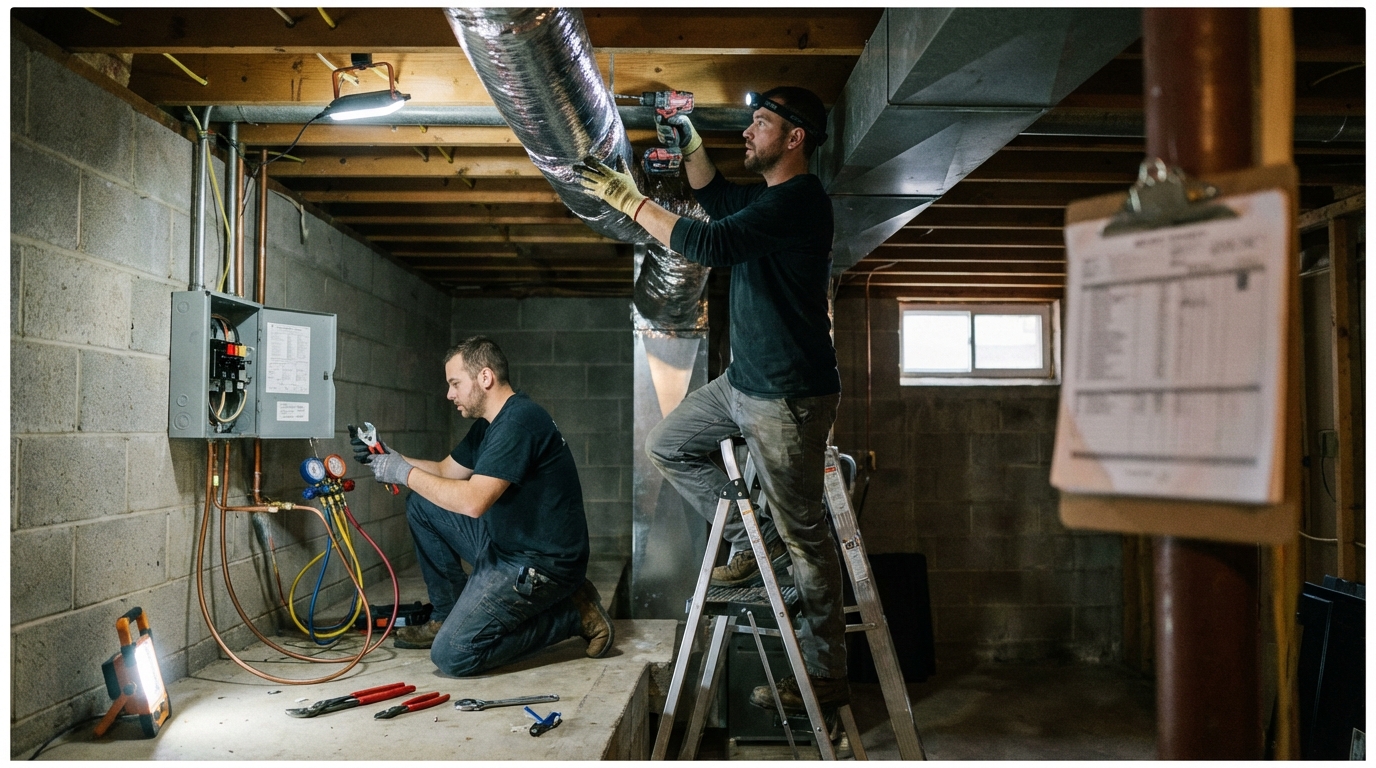
Look for quantities and locations. "Reconnect to existing" signals a simple swap; "replace plenum," "resize trunk," "add return(s)," or "cut in new return drop with grille" signals duct redesign work. The friction is access: attic/crawlspace constraints turn "minor repairs" into sheet metal fabrication and sealing time. Only compare bids after the duct scope names what gets replaced, what gets sealed, and where returns are added.
Replacing a refrigerant line set-the insulated copper tubing (liquid and suction lines) that connects the indoor coil/air handler to the outdoor condenser or heat pump-often costs more than homeowners expect because routing and wall/attic access drive labor. Typical pricing runs about $500-$800 for a standard run; complex runs reach about $1,200; urban installs often land $800-$1,200. Quotes should state "reuse existing (line set)" versus "replace," plus the planned route and any line-hide or drywall work (including small parts like a bi-flow liquid-line filter drier where required).
Electrical is the other hidden variable: disconnect, whip, breaker changes, and load calculations for higher-MCA equipment. If your quote mentions "panel/service upgrade," validate locally before signing. Directional examples in CAD: a 100A to 200A service upgrade commonly runs about CAD $2,500-$4,500, and comprehensive service work is often CAD $3,000-$5,000.
Permits and inspections are not paperwork filler; they define who closes the job. HVAC replacement permits commonly run about $50 to several hundred dollars, while new furnace/AC permits often run about $250-$1,500. Disposal and removal also get "forgotten" on quotes, so require a line that includes haul-away of old equipment and materials. For gas work, scope should explicitly call out any gas line adjustments and venting changes, not a blanket "modify as required."
- Quantify duct scope: "What sections are replaced vs sealed, and how many returns are added and where?"
- Specify refrigerant piping: "Reuse or replace (line set), what route, and what wall/attic access work is included?"
- Define electrical responsibility: "Is a new disconnect/breaker included, and what triggers a panel or service upgrade in my home?"
- Confirm combustion changes: "Any gas line sizing changes or venting material/routing changes included in this price?"
- List closeout items: "Who pulls permits, schedules inspections, manages condensate drain/pump, and handles disposal?"
If your labor scope is high mainly because ductwork is compromised-or because you want zoning without rebuilding the duct system entirely-an equipment change can sometimes be a cost-control move, not an upgrade for its own sake.
Cheaper Alternatives
Mini-splits are the fastest way to cut cost when ducts are the problem, not the equipment. They beat a full furnace plus central AC replacement when you have no usable ducts, you're conditioning an addition or garage, or you want room-by-room comfort with true zoning instead of one thermostat running the entire house. The catch is that "more zones" and "specialty indoor units" quickly turn a simple install into a controls-and-labor job.
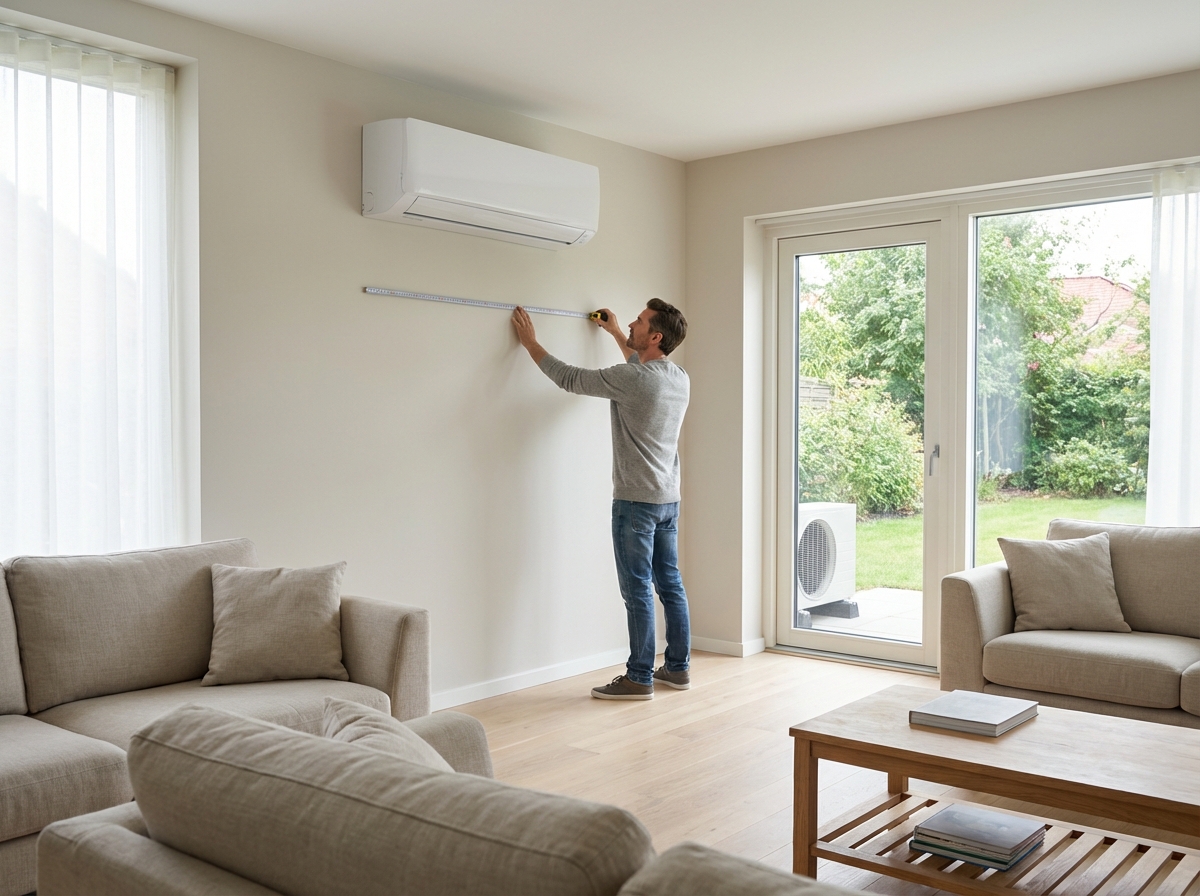
In 2026, installed ductless mini-splits run roughly $2,000 to $14,500 depending on zones, brand, and job complexity. A 12,000 BTU single-zone wall-mount is the entry case: commonly $2,000 to $7,000 installed, with a basic single-zone averaging about $3,000. Multi-zone systems (typically 2 to 4 indoor heads) are the cost jump because every added zone adds refrigerant lines, wiring, and setup time. Ceiling cassettes are a specialty choice that shifts labor toward ceiling access and condensate routing versus a standard wall head.
| Configuration | Quick sizing example | What drives complexity |
|---|---|---|
| Single-zone wall mount | 12,000 BTU, 1 indoor head | Shortest line set, simplest controls |
| Multi-zone | 1 outdoor unit, 2 to 4 indoor heads | More line sets, more penetrations, more commissioning |
| Ceiling cassette | One zone with a cassette indoor unit | Ceiling work and drainage details drive labor |
Mitsubishi is typically positioned as premium/high-efficiency; LG is a common mainstream option. MRCOOL sits in the budget-friendly DIY lane, largely because many of its kits use sealed, pre-charged line sets that avoid field charging.
DIY realistically covers mounting the indoor head, setting the outdoor unit, and running the line-set cover. Refrigerant work is the hard line: EPA Section 608 certification is legally required for technicians who maintain/service/repair/dispose of equipment that could release refrigerants. Electrical final connections and proper startup checks are also where DIY projects usually end.
Choose mini-splits when you need zoning or you don't have solid ducts; choose a central replacement when ducts are in good shape and whole-home distribution is the priority.
Whichever direction you choose, keeping the total in check comes down to the same two levers you saw in the opening quotes: aligning efficiency to budget and forcing clarity on scope so "small" add-ons don't become expensive surprises.
How to Lower Your Total Cost
You don't control the market price, but you can control incentives and scope clarity. Homeowners lose money by missing credits, picking the wrong efficiency tier for their budget, or accepting vague scopes that turn into change orders.
One incentive is gone: the federal Energy Efficient Home Improvement Credit (25C) covered 30% of qualifying costs, with an annual cap around $3,200, including up to $2,000 for heat pumps, but it ended for property placed in service after December 31, 2025. Systems installed in 2026 do not qualify, so budget around state, utility, and local programs instead.
Use timing as a shopping tactic: ask for pricing and install windows during slower weeks to widen contractor availability. Then decide if you're paying for performance you won't use by moving up or down an efficiency tier (SEER2/AFUE). If shoulder-season comfort matters, dual-fuel can be a strategic middle ground.
For cash flow, Budget Heating supports financing through Sezzle and Affirm (approval depends on the provider). Verify rebate eligibility before you lock equipment: Budget Heating's rebate eligibility checker checks eligibility based on inputs like ZIP, utility, equipment type, and efficiency.
- Confirm sizing basis (load calc, not rule-of-thumb).
- Demand an itemized scope (duct, electrical, permits, removal).
- Verify the AHRI match for the exact outdoor/indoor pair.
- Require commissioning and startup documentation in writing.
- Lock lead times for equipment and install dates.
That discipline is what keeps a "budget replacement" from drifting into a high-scope total-especially when duct repairs, venting and condensate details, electrical corrections, and commissioning requirements are either included up front or discovered late. Use the rebate checker, then insist on an itemized quote for the exact matched system you intend to install so you can compare bids on scope, not just on a headline price.
Wrapping Up
Furnace and central AC installation costs in 2026 can look wildly inconsistent because the real driver is scope, not just the equipment label. While many full replacements land around the $11,590 to $14,100 baseline, your total moves up or down based on ductwork condition, electrical and venting requirements, refrigerant line decisions, efficiency choices, and whether the contractor includes proper permitting and documented commissioning.
The most important takeaway is to compare bids like-for-like by forcing clarity: confirm sizing from a load calculation, verify the exact AHRI match, and require an itemized breakdown that spells out ducts, electrical, condensate management, permits, disposal, and startup testing. That is how you avoid the "cheap" quote that turns expensive after the install.
Before you sign, place your project in the right price tier, line up any incentives you qualify for, and ask each contractor to put the full scope in writing so you can choose with confidence.
 Cooling
 Heating
 Learning Center
 Product and Brands Insights
 State by State