




 buying guides
 heating
 product and brands insights
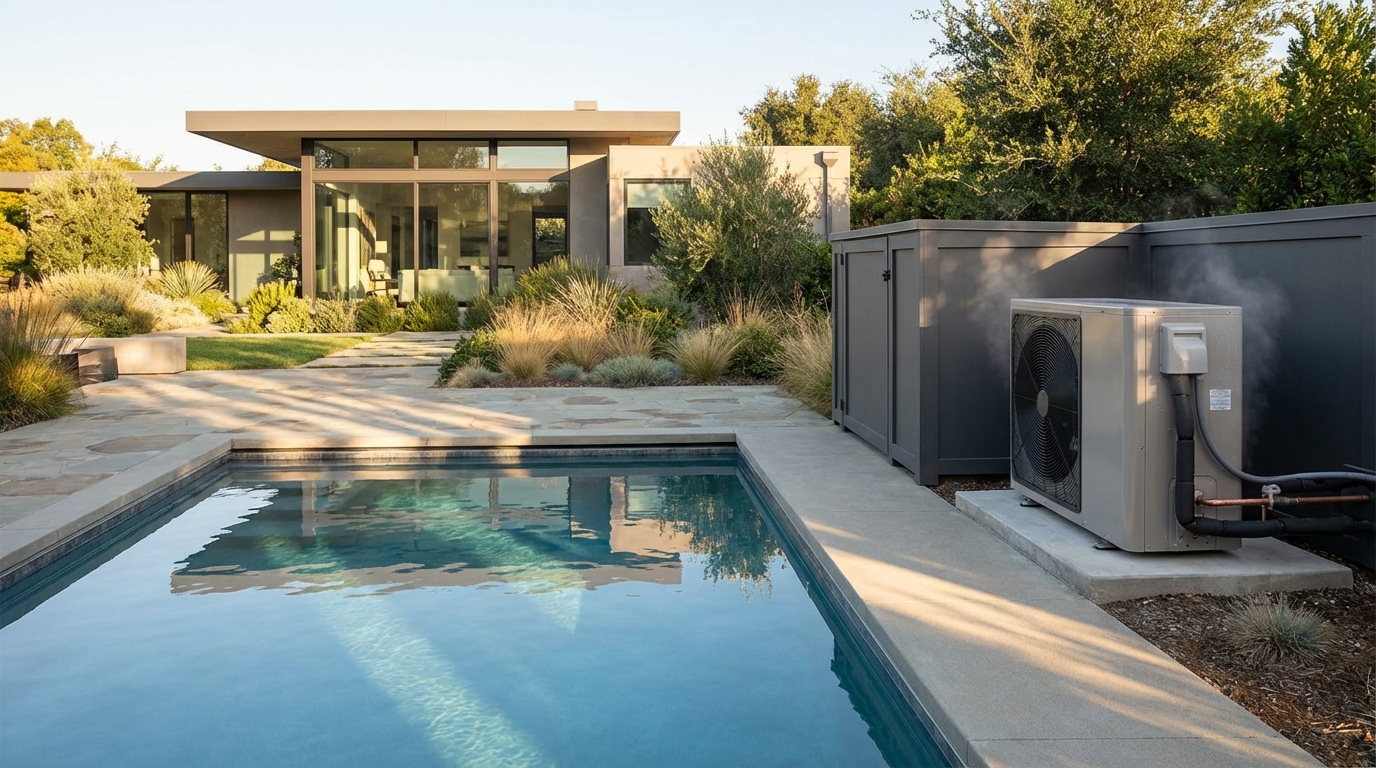
You're shopping for a pool heat pump online and every product page throws the same buzzwords at you: "fixed-speed," "heat & cool," "inverter," plus efficiency and cost claims that don't look anything like what your neighbors pay.
A pool heat pump isn't "making" heat like gas; it moves heat from outdoor air into your pool water. That's why it's the right tool for owners who want lower operating cost and steady season extension in moderate conditions, not instant hot-water recovery in cold snaps. Published operating-cost estimates commonly land around $50 to $100 per month for a heat pump versus roughly $150 to $500 per month for gas examples, and the spread comes straight from local electric and fuel prices plus weather and run time.
Capacity is listed in BTU/hr, meaning how many BTUs the unit delivers each hour, so a bigger BTU/hr number translates to faster heat-up under the same conditions. Those "same conditions" matter because output and efficiency are higher around about 80°F air, while many spec sheets show derate and/or lockout behavior near about 50°F low ambient.
Use fixed-speed, heat & cool, and inverter as decision categories first, then compare ratings tested under ANSI/AHRI Standard 1160, which ties performance numbers to defined air and water conditions so you can compare like-with-like instead of chasing a headline.
You'll finish with a clear technology pick, a practical read on ratings, and the confidence to shop on real performance instead of spec-sheet hype. That starts with understanding why the same unit can feel completely different across the season.
How Pool Heat Pumps Work
The same pool heat pump can feel powerful in July and slow in October, even if the nameplate BTU rating never changes. Real-world performance is dominated by what the weather supplies and what the pool surface gives back to the air, not the brochure number tested at standardized conditions.
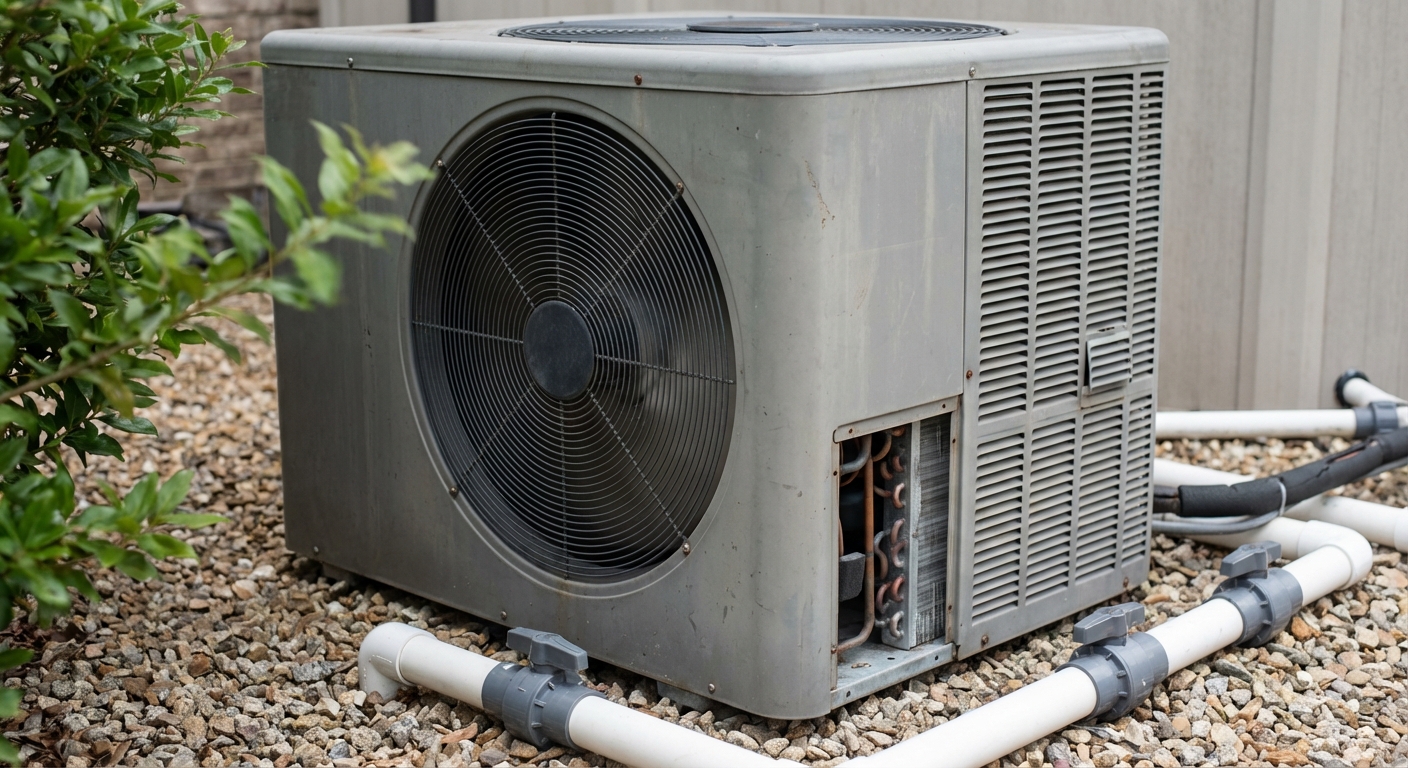
Its fan pulls outdoor air across the evaporator so the refrigerant can absorb heat; the compressor raises that heat to a more useful temperature; then the hot refrigerant passes through a water heat exchanger that transfers the energy into your circulating pool water. The heat-transfer path is: air → refrigerant (evaporator/compressor) → water heat exchanger → pool water. Pool heat pump efficiency is typically expressed as COP rather than home HVAC metrics like SEER2/HSPF2.
COP (coefficient of performance) is heat output divided by electrical energy input under specific conditions, so it rises in warm, humid air and falls in cold, dry air. In normal backyard use, COP commonly lands around 2.0 to 5.0 depending on the unit and conditions, which is why your electric cost per degree swings by season. Humidity matters because moist air carries more usable heat into the refrigerant loop than dry air at the same dry-bulb temperature, so shoulder-season heating takes longer even if the days feel pleasant.
Evaporation heat loss is the heat energy lost as water evaporates from the pool surface, and it's typically the largest outdoor heat-loss pathway. Outdoors, evaporation often represents roughly 50 to 70% of total heat loss, with many references citing about 70%. Wind exposure accelerates evaporation, so an uncovered, breezy pool can lose heat fast enough that the heat pump spends most of its runtime just treading water, especially overnight.
The operational lever that moves the needle is simple: cover the water when you're not swimming, then schedule longer, steadier runtimes in cooler months so the unit isn't chasing a moving target. Judge performance by what you can observe: overnight water-temperature drop (covered vs uncovered) and your kWh used to regain that loss the next day. Electrical availability is the final constraint; if your panel can't support the heat pump's circuit, runtime strategy won't matter until the power is there.
Technology Breakdown
That season-to-season swing is exactly why the technology choice matters: different compressor and control approaches change how tightly the unit holds temperature, how often it cycles, and how it sounds while doing it.
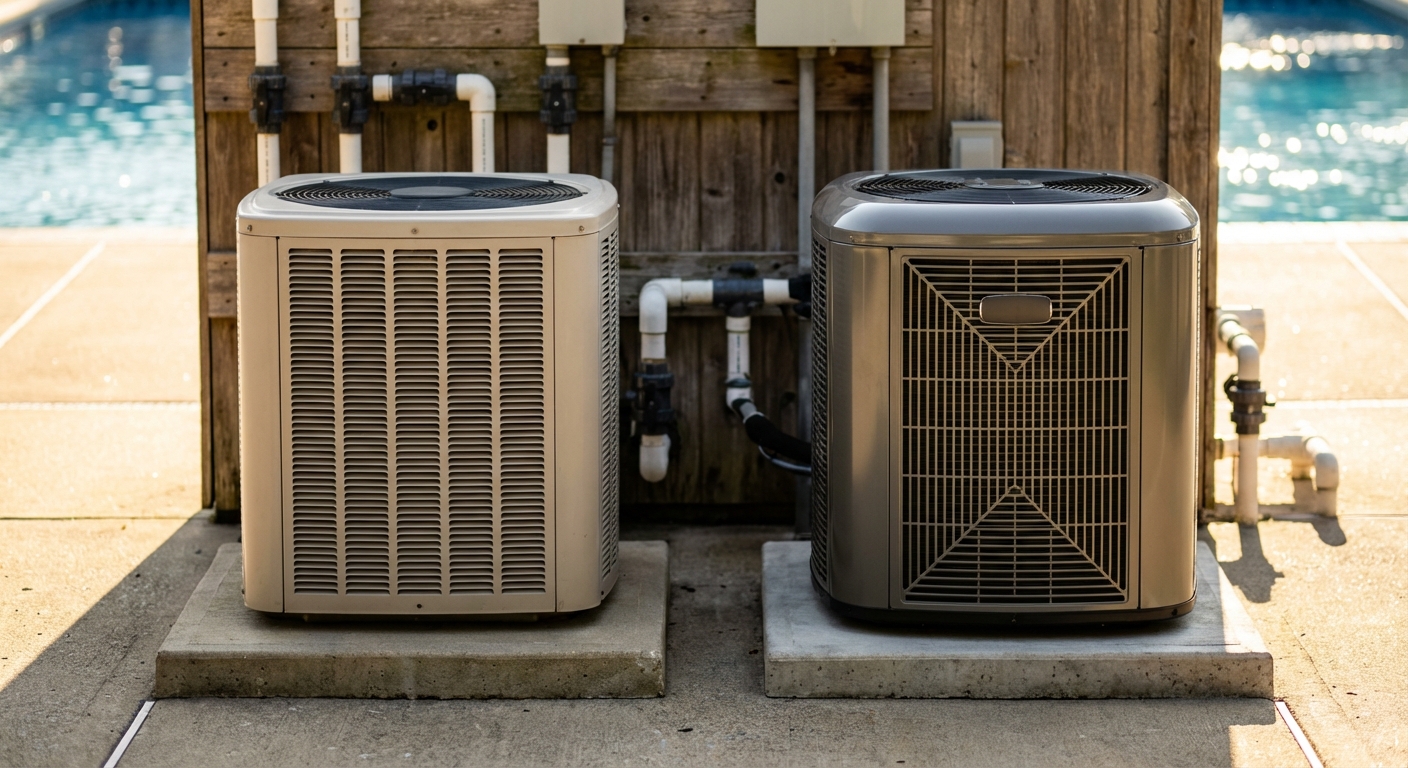
The "best" pool heat pump technology is the one that matches how you actually use the water: how tight you want the setpoint to hold (comfort stability), how much cycling sound you will tolerate (noise profile), what run patterns you expect day to day (operating pattern), and whether you need active cooling rather than just more warm weeks.
Fixed-speed units use a single-stage compressor that runs at one speed, so the operating pattern is straightforward: full output when it's on, zero when it's off. The tradeoff is livability. Because the unit has to wait until water temperature drifts far enough from the setpoint to call again, you typically feel wider temperature swings than a modulating design, especially when surface losses spike. That same on/off behavior also concentrates noise into noticeable start-stop events and repeats them as demand rises.
An inverter compressor is controlled by an inverter drive that varies speed to match the heating or cooling load instead of running only at full speed on/off. Buyer outcome: steadier water temperature and less cycling, because the unit can stay running at a lower output once it's near setpoint. Noise follows the same logic. A unit that can loaf at part-load is typically quieter in real use than one that keeps restarting at 100%. The misconception to kill: "inverter" does not mean instant heat. It means controlled output that reduces overshoot and undershoot, not a shortcut around physics.
Heat and cool models add the ability to actively lower pool temperature. They do it with a reversing valve, which reverses refrigerant flow so a heat pump can switch between heating mode and cooling mode, letting you intentionally pull heat out of the water during extreme heat instead of simply shutting the heater off. Specs vary, but some listings cite a max cooling-mode ambient around 115°F, and a max non-operating circulated fluid temperature around 120°F. Heat pump systems cannot provide simultaneous heating and cooling; they switch modes.
Best-fit guidance: Pick fixed-speed when budget and simplicity outrank tight setpoint control. Choose inverter when you swim in shoulder season, hate temperature hunting, or want lower perceived noise during long runtimes. Choose heat and cool when hot-climate temperature management is a real requirement, not a nice-to-have. Distributors like Budget Heating will list whether a model is fixed-speed, inverter, or heat and cool; confirm in the spec sheet before you buy.
Your technology choice sets the comfort and control profile; sizing determines whether you can actually hit and hold your setpoint in the months you care about.
Sizing & Selection
Most "this heat pump didn't work" stories are sizing and expectation failures, not equipment defects. Get the sizing inputs right and you get "set it and forget it" water. Get them wrong and the unit runs all day while the pool still feels behind.
Write down two numbers before you look at models: your setpoint (the water temperature you will actually maintain) and the months you expect to swim. Then pull the typical overnight and daytime air temperatures for those months, because heat pump output drops as ambient air cools and the pool loses heat faster in cooler, windier conditions. This is why a unit that looks fine on paper for July can disappoint in May and September.
If you do not already have volume, calculate it. For a straight-walled rectangular pool, gallons = average length × average width × average depth × 7.5.
Heat-up energy is the one-time load to get from today's water temperature to your setpoint. Use: water weight = gallons × 8.34 lb/gal, and BTUs needed = (gallons × 8.34) × ΔT.
If you care about how fast it heats, turn that into a rate: divide the heat-up BTUs by your target heat-up hours to estimate the BTU/hr (heating capacity rate) you want available during that recovery window.
Total requirement is not one number. It is heat-up energy plus ongoing surface heat loss. Surface loss is the daily load that fights you every hour, and it spikes with wind exposure and cooler air. A cover changes the math more than most equipment upgrades because it directly cuts the evaporation-driven loss that dominates outdoor pools.
Oversizing is often beneficial for heat pumps because capacity drops as ambient air cools. A larger size class reduces runtime, recovers faster after cool nights, and makes shoulder-season swimming feel effortless instead of marginal. Heat and cool models earn their keep in hot climates where you need to actively limit peak water temperature, not just add heat.
Checklist to compare two candidate models in the same target size class:
- Rated BTU/hr at your lowest expected swim-season air temperature (not just a warm-day rating)
- Any published performance data versus air temperature and water temperature
- Minimum operating temperature and defrost strategy
- Electrical requirements (circuit sizing and breaker limits per nameplate)
- Warranty terms and parts availability
Have these five inputs ready before you request a quote or compare models: pool volume (gallons), ΔT to setpoint, swim months plus typical air temps, wind exposure level, and your cover plan. When you request a custom quote from Budget Heating, provide those five inputs so the recommendation is anchored in reality.
Installation, Electrical Requirements, and Operating Costs
Good sizing on paper still fails if the install chokes airflow, misses the required flow range, or underestimates electrical work. This is where "operating cost" claims either line up with your bill or fall apart.
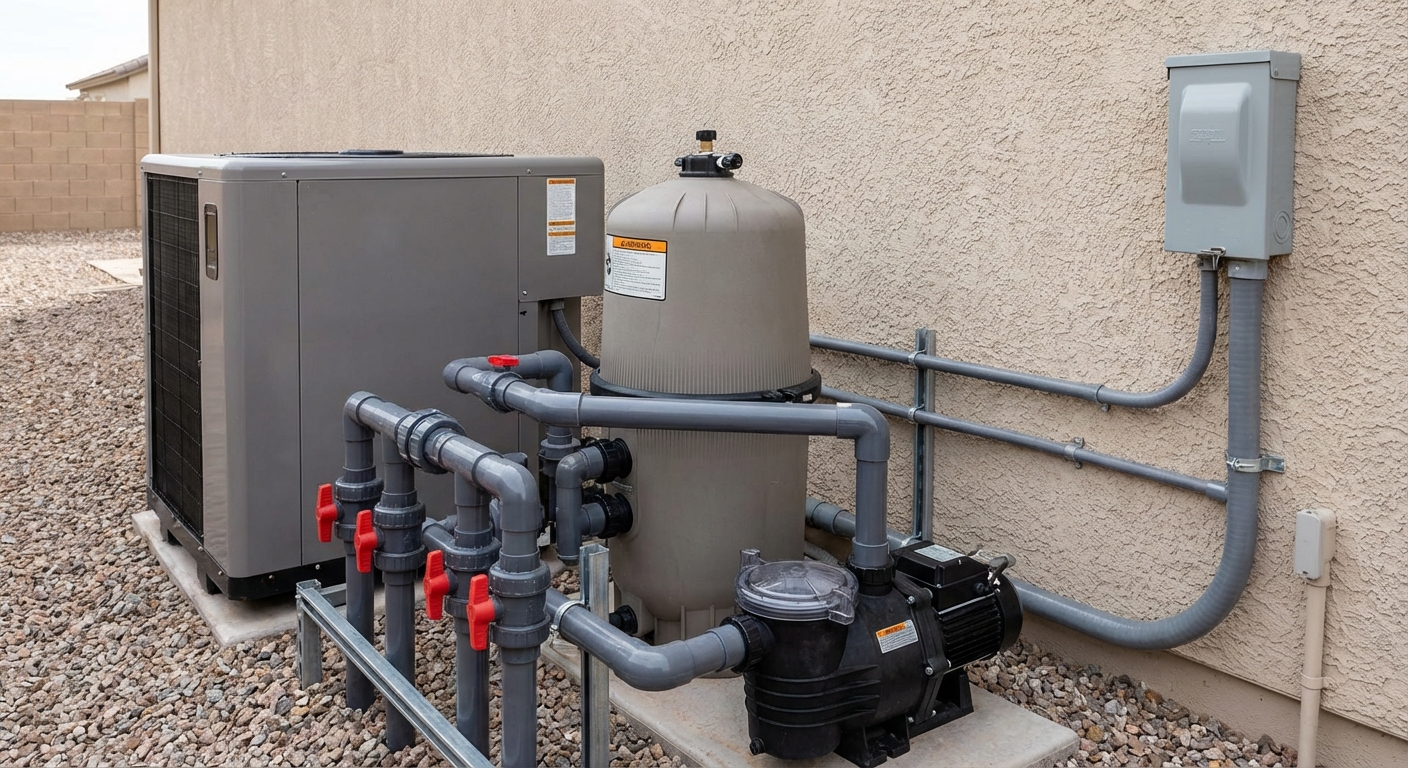
Most "surprise costs" on a pool heat pump install come from electrical provisioning and from making the equipment pad layout support the unit's airflow and water flow requirements, not from the unit's sticker price. Many pool heat pump units are 208/230V single-phase (model-dependent), and that single detail can drive whether you need a new circuit, disconnect, or panel work.
Heat pumps only perform to spec when the coil can breathe. Budget for a stable equipment pad, keep the discharge side from blowing into fences or shrubs, and follow the manufacturer's clearance dimensions so recirculated air does not drag capacity down in the real world. Noise is also placement-dependent, so aim the fan discharge away from bedrooms and tight courtyards.
Plumbing has to stay within the manufacturer's minimum and maximum flow range (GPM). If your pump can exceed that range, or if you want easier service isolation, a bypass loop is commonly recommended so you can limit flow through the heat exchanger without strangling the rest of the system.
Budget the electrical from the nameplate and manual. MCA/MOCP are the values you use: Minimum Circuit Ampacity and Maximum Overcurrent Protection define the correct wire sizing and breaker or fuse protection. Many manufacturers also require code-compliant disconnects and call out NEC/CEC compliance and HACR-type protection where applicable. Pool equipment also carries requirements that outdoor HVAC equipment does not: NEC Article 680 governs equipotential bonding of the heater and surrounding pool equipment, plus GFCI protection where required. Confirm your installer is pricing bonding and GFCI, not just the circuit and disconnect.
Use the same math every time: electrical input (kW) ≈ BTU/hr ÷ 3412 ÷ COP, because 3412 Btu equals 1 kWh. Then cost/hr = kW × $/kWh. Example: 100,000 BTU/hr at COP 5.0 gives kW ≈ 100,000 ÷ 3412 ÷ 5.0 = 5.86 kW. At $0.20/kWh, cost/hr = 5.86 × 0.20 = $1.17 per hour. Your real drivers are $/kWh, runtime, and ambient conditions that change COP and capacity; inverter units reduce cycling in many scenarios, which improves steadiness and often lowers real-world consumption.
Before you buy or schedule installation, confirm three manual items in writing: MCA/MOCP, required GPM range, and clearance and airflow guidance. If you're ordering through Budget Heating, download the installation manual before purchase, then ask your installer to quote electrical scope, bypass hardware, and pad or relocation work against those exact requirements.
Buying Checklist + Common Questions
At this point you know what you're buying (fixed-speed, inverter, or heat & cool), what size class you need, and what the install must support. The last step is making sure the paperwork matches the listing so there are no surprises after checkout.
Most post-purchase frustration disappears when you verify a handful of spec-sheet and warranty details before checkout. The catch is that noise, corrosion resistance, and control wiring are site- and model-dependent, and warranties often hinge on documented water chemistry and installation compliance. Treat the PDFs as the product, not the marketing page.
- Download the warranty PDF and confirm what's covered (parts, compressor, heat exchanger), what requires registration, and what voids coverage (water chemistry logs, approved installer, required clearances). Manufacturer terms vary widely; some HVAC examples run up to roughly 10-year registered limited compressor/parts coverage, so verify the pool model's actual warranty document.
- Confirm service clearances in the installation manual and measure your pad for panel access, plumbing unions, and winterization drain points.
- Find the published dBA rating and the measurement distance, then pace that distance from your planned location to the nearest bedroom and property line.
- Ask the seller for the test standard or conditions used for the rating, and get nighttime operating expectations in writing if neighbors are close.
- Titanium and cupronickel heat exchangers are commonly referenced corrosion-resistant options; verify the exact material in the spec sheet, not the listing title.
- Confirm the manual's water chemistry limits and keep them in-range, because warranty coverage often depends on documented chemistry compliance.
- Many heaters support external control via a "fireman switch" style dry-contact interface for coordinated pump and heater shutdown timing, but it's model-dependent. Automation commonly uses dry contact (fireman switch) or RS-485 on supported systems.
- Confirm the exact terminals, voltage requirements, and any required relays in the installation manual before you buy.
- Make a cover part of the plan you will actually follow, especially overnight and on windy days, and confirm it fits your shape and steps so it gets used.
How fast will it heat up? Use the spec sheet's heating output (BTU/hr) at the rated conditions and have the installer estimate hours for your pool volume and your typical temperature increase. Get that estimate tied to a specific model and a realistic starting water temperature.
Is overnight operation reasonable? Yes if the published dBA rating at its stated distance works for your lot, and your schedule matches local noise rules. Set a timer window and confirm the heater supports external enable/disable or automation control.
What's the cheapest way to extend the season? Use a cover consistently, run heating during the warmest part of the day, and tighten your setpoint discipline so you're not reheating unnecessary losses.
Before checkout, download three documents: the spec sheet, the installation manual, and the warranty PDF. Verify the noise rating distance, the heat-exchanger material, and the automation interface (fireman switch or RS-485), then confirm performance ratings under ANSI/AHRI Standard 1160 so the fixed-speed, heat & cool, and inverter labels translate into real, comparable numbers.
Wrapping Up
Buying a pool heat pump gets much easier once you separate marketing labels from what actually drives results. A heat pump moves heat from the air into your water, so capacity and efficiency change with weather, humidity, and especially evaporation, which is why the same unit can feel strong in midsummer and slow in shoulder season. Focusing on COP, realistic BTU output at your expected temperatures, and ratings verified under ANSI/AHRI 1160 helps you compare models on equal ground.
The right choice is a match between technology, sizing, and installation realities: fixed-speed for straightforward budget heating, inverter for steadier temperature and less cycling, and heat and cool when hot weather makes active cooling valuable. Pair that with a consistent cover habit, correct airflow clearances, proper GPM through the exchanger, and electrical planning based on MCA and MOCP, and the operating cost story starts to align with your utility bill.
Now, gather your pool volume, target setpoint, swim months, and site constraints, then use the spec sheet, manual, and warranty PDF to confirm the exact model you are about to buy.
 Cooling
 Learning Center
 Money Saving Tips
 State by State
 HVAC Systems