




 cooling
 hvac systems
 learning center
Should You Air Condition Your Garage? What to Know Before You Start
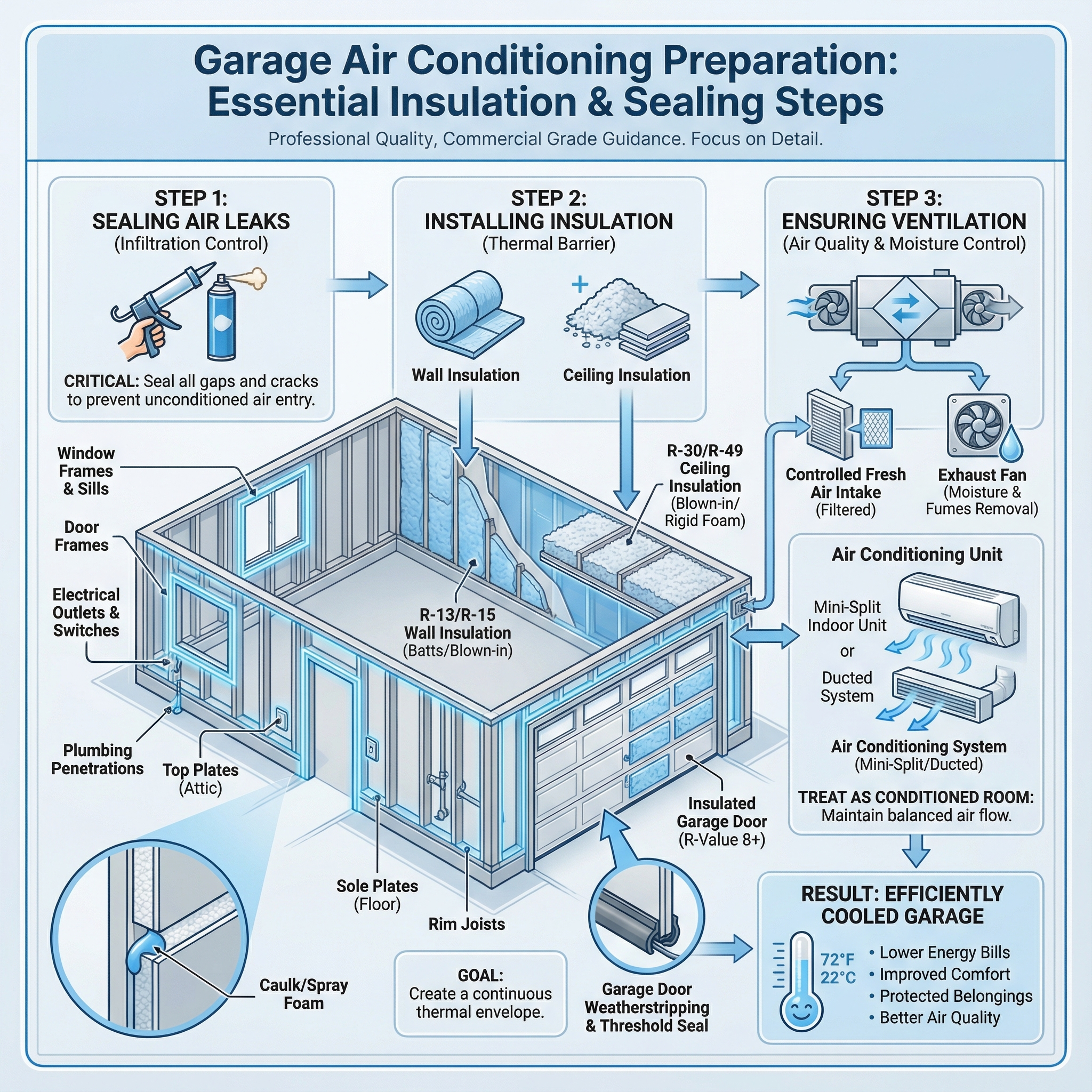
Garages are not built like living rooms. They are often thin on insulation, full of air leaks, hit with heavy sun, and exposed to vehicle exhaust and stored chemicals, so quick stick-on fixes rarely work. To make cooling worthwhile, treat the garage as a true conditioned space. Start by tightening the envelope: add insulation to walls and ceiling, seal gaps around outlets and penetrations, and upgrade weatherstripping on the entry and overhead doors. Think of it like putting a lid on a cooler before adding ice.
Safety and ventilation come next. Include carbon monoxide detection, and plan an exhaust strategy for times when a car is running or when paints and solvents are in use. Finally, expect real project scope: proper equipment sizing, a dedicated electrical circuit, smart condensate routing, and potential permits or HOA approvals. Done right, you get stable temperatures and better air quality. Done loosely, you get an undersized unit fighting heat and fumes without real comfort.
Step 1: Assess Needs: Size, Use, Insulation and Venting
Start with a focused checklist before choosing equipment, so sizing and features match the real-world load.
- Define goals: parking only, workshop, gym, office or mixed use. Estimate occupied hours and how often the overhead door will open.
- Measure the space: floor area and ceiling height. Typical footprints are about 240 sq ft for a 1-car, 400 sq ft for a 2-car, 600 sq ft for a 3-car. Taller ceilings increase capacity needs.
- Identify climate: hot humid, hot dry, mild or cold. Decide early if you need year round heating, since that can change the system type you select.
- Inspect the envelope: note which walls and the ceiling are insulated, whether the garage door is insulated, and check weatherstripping on overhead and entry doors. Mark gaps or penetrations that behave like unplanned vents.
- Set target conditions: pick realistic temperature goals and aim for roughly 40 to 60 percent relative humidity.
- Efficiency vs envelope: in hot climates, higher efficiency equipment often pays off. For mild or sporadic use, prioritize sealing and insulation before spending on top tier SEER.
How to Choose: Portable Air Conditioners, When They Work and When They Don't
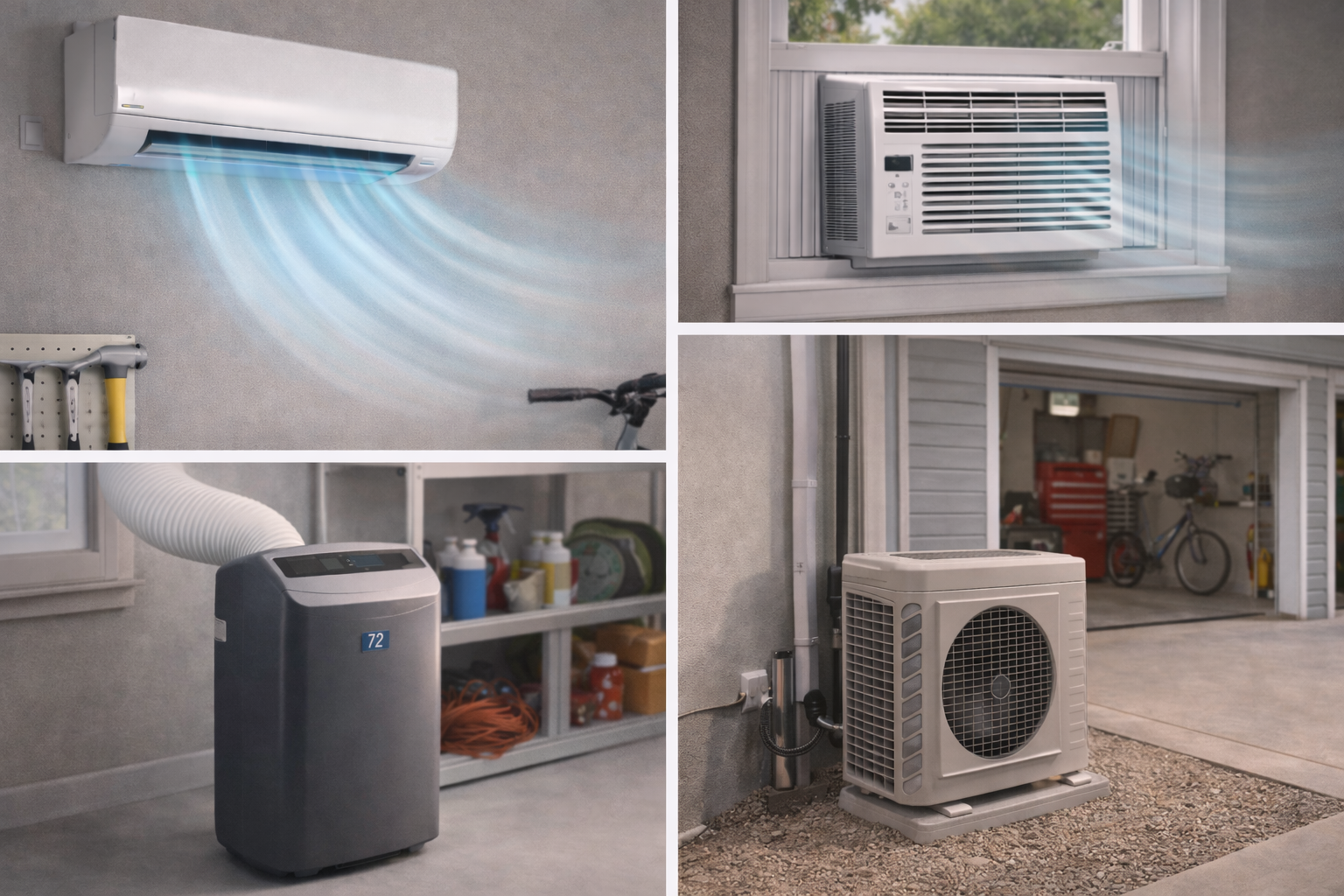
Portable ACs are a last resort, lower cost option. They make sense for short heat waves, renters who cannot alter the building, or spot cooling a small enclosed room. They are a poor long term solution for garages. Understand the negative pressure issue: single hose units exhaust indoor air outside, which makes the room pull in hot, dusty, or humid air through gaps, undermining cooling. Dual hose models perform better, but still lose efficiency at the window kit compared with through the wall or ductless systems. Confirm electrical compatibility. Many need a dedicated circuit, so check amperage and plug type. Plan venting and condensate management. Poor venting increases load and run time.
Ductless Mini Split Heat Pumps: The Best Performing Option for Most Garages
For most garages, a dedicated single zone inverter driven ductless mini split heat pump gives the best blend of comfort, efficiency, and quiet operation. It delivers cooling in summer and heating in winter, so one system handles year round control.
Why it feels better: inverter and variable speed compressors modulate like a light dimmer, not a basic switch, which means steadier temperatures, better moisture removal, quieter cycling, and lower energy use than single stage units. Many modern models add low ambient cooling and strong latent control, helpful in hot climates and in workshops with variable heat loads. In our experience at Budget Heating (BudgetHeating.com), these traits matter most in garages where usage changes hour to hour.
How it works: the mini split refrigeration cycle moves heat. In cooling mode the indoor coil absorbs heat from the room, refrigerant carries it outdoors where the condenser releases it. In heating mode a reversing valve changes direction so the outdoor unit gathers heat from outside air and delivers it indoors.
- Choose a single zone inverter heat pump with solid low ambient cooling and high ambient performance.
- Prioritize strong dehumidification and quiet indoor operation.
- Look for smart controls and current refrigerant options to future proof the investment.
- Efficiency ratings: SEER is the older seasonal test. SEER2 is the updated method that yields slightly lower numbers but a truer comparison across today's systems.
Sizing Your System: BTUs, Load Factors and Quick Rules of Thumb
Start with simple BTU-per-square-foot rules as a baseline, then tune for your space. As a quick guide: about 9,000 BTU handles roughly 240 sq ft, 12,000 BTU covers about 400 sq ft, and 18,000 BTU serves about 600 sq ft. We use this as a starting point, not the finish line, because the building and climate push the load up or down.
Adjust for visible conditions:
- Increase capacity for high ceilings, poor insulation, leaky doors or windows, and intense sun exposure.
- Decrease capacity if insulation is excellent, air sealing is tight, and the space is well shaded.
Apply climate multipliers next:
- Hot humid regions: add 10 to 30 percent cooling capacity and aim for long, steady run times to manage moisture.
- Mild coastal: subtract 10 to 20 percent from cooling capacity.
- Cold regions with heat pumps: add about 25 percent to heating BTUs.
Avoid oversizing. Short cycles cool the air but do not run long enough to remove humidity, like a sponge that never gets time to soak. Right-sized equipment dehumidifies better and feels more comfortable at the same thermostat setting.
When a Solution Isn't Right: Common Mistakes, Tradeoffs and Alternatives
We see the same pitfalls in garage conditioning. Here are situations where common choices miss the mark, plus smarter alternatives.
- Myth: Bigger AC is better. Reality: oversizing short cycles, leaves air clammy, and wastes energy.
- Myth: Lowering the thermostat cools faster. Reality: it only increases run time and cost.
- Myth: Refrigerant needs annual top off. Reality: low charge means a leak that must be repaired.
- Myth: Set and forget. Garages are dusty, so filters and coils need more frequent attention.
- Myth: Tie the garage into the home system. Codes typically prohibit shared returns due to fumes and carbon monoxide risk.
- Very cold climates: heat pump only can struggle. Add gas heat or supplemental electric heat for backup.
- Humid regions: evaporative coolers underperform. Use a ductless mini split or refrigerant window/through the wall unit.
- Frequent use garages: portable or window units are a poor long term fit. A ductless mini split is the better workhorse.
- High latent loads: pair cooling with a dedicated dehumidifier for stable comfort.
- Low budget or temporary needs: window or through the wall units can be the sensible stopgap.
Other Cooling Options: Evaporative Coolers, Ventilation Fans and Dehumidifiers
Evaporative coolers use a fan to draw air through wet media. As water evaporates, it absorbs heat, like sweat evaporating off your skin, lowering air temperature while raising humidity. They can be very energy efficient in dry climates. In humid regions they usually backfire, because they add moisture that can worsen comfort and promote rust or mold on stored items.
Ventilation is about safety and air quality. A dedicated exhaust fan creates negative pressure, removes vehicle exhaust and solvent or paint fumes, and draws in make up air. A CO detector is essential when engines run. Moisture control is equally important. In our experience, many garages need a standalone dehumidifier or equipment with strong latent capacity to prevent rust, protect vehicles, wood and electronics, and stop mold. Stable temperature and humidity preserve tools and stored goods.
Combined Heating & Cooling: Garage A/C Plus Heat - What to Pick
From decades in the field, when a garage needs both cooling and heat, an inverter heat-pump mini-split usually wins. It covers both seasons efficiently, runs quietly, and modulates like a dimmer, which keeps temperatures steady instead of blasting on and off. In very cold climates, heat-pump output drops as outdoor temperatures fall, so plan backup heat to meet design conditions, either electric resistance or a gas furnace. Right-size capacity and favor equipment with modulation or staging, since oversized heaters in leaky garages tend to short-cycle, wasting energy and creating uneven temps. If backup will run often, size it to carry the full load, and let the heat pump handle milder hours.
Installation, Electrical, Efficiency Standards, Costs and Maintenance
Plan the install before you buy: choose an indoor location with good air sensing and service clearance, set the outdoor unit on a pad or wall brackets with required clearances, route condensate to a drain or pump, and confirm lineset length and elevation are within manufacturer limits. Always have the final refrigerant charge verified.
Efficiency minimums: Northern regions about 14 SEER or 13.4 SEER2. Southeast and Southwest under 45,000 BTU per hour about 15 SEER or 14.3 SEER2. Split heat pumps nationwide about 15 SEER or 14.3 SEER2. Compare like to like, SEER to SEER and SEER2 to SEER2. Many mini splits cluster near 14 to 15 SEER, premium models hit 17 to 20, and ENERGY STAR units use about 8 percent less than non certified new models.
- Questions for contractors: Manual J load calc, latent load strategy, exact SEER2, EER2, HSPF2 or COP at your design conditions, indoor and outdoor sound levels, condensate plan, electrical needs, permits, warranty. In our experience at Budget Heating (BudgetHeating.com), asking for a Manual J early prevents oversizing.
- Permit and electrical checklist: verify panel capacity, a dedicated circuit and breaker, outdoor disconnect, any GFCI or AFCI requirements, and who handles permit applications and inspections.
Costs and payback: moving from very low efficiency to modern equipment can trim cooling energy by 30 to 35 percent. A SEER 14 to SEER 16 upgrade often adds 300 to 800 dollars with paybacks from roughly 1.3 to 13 years, depending on climate and run time.
- Homeowner maintenance: replace filters every 1 to 3 months, keep debris 2 feet from the outdoor coil, use Wi Fi scheduling and moderate setpoints, and use dry mode when helpful.
- Pro maintenance: annual service to verify refrigerant charge, electrical integrity, temperature split across the coil, dehumidification, and secure condensate drainage.
- Safety: de energize before service, avoid refrigerant handling without certification, mind electrical hazards, maintain CO detection and clear flammables.
Conclusion: Pick the Right Garage Cooling Solution and Work with a Pro
Button up the envelope first, then pick a dedicated system sized correctly. For most, a ductless mini split heat pump is the best long term choice, with through the wall or window units and portables as lower cost alternatives. Correct sizing and code compliant installation protect comfort, efficiency, and safety.
We know the decision is not simple, especially with garages that see big swings and mixed use. We work with garages every day, from single bays to full workshops, and can match equipment to your use and budget.
Next, get a qualified contractor to run a Manual J, verify electrical capacity and permitting, and install to code to maximize comfort and minimize long term operating costs. Our team can coordinate and supply the right equipment.
- Get a Custom Quote
- Talk to Our Team by phone
- Shop Ductless Mini Splits
 Heating
 Money Saving Tips
 Product and Brands Insights
 Buying Guides
 State by State