




 heating
 hvac systems
 money saving tips
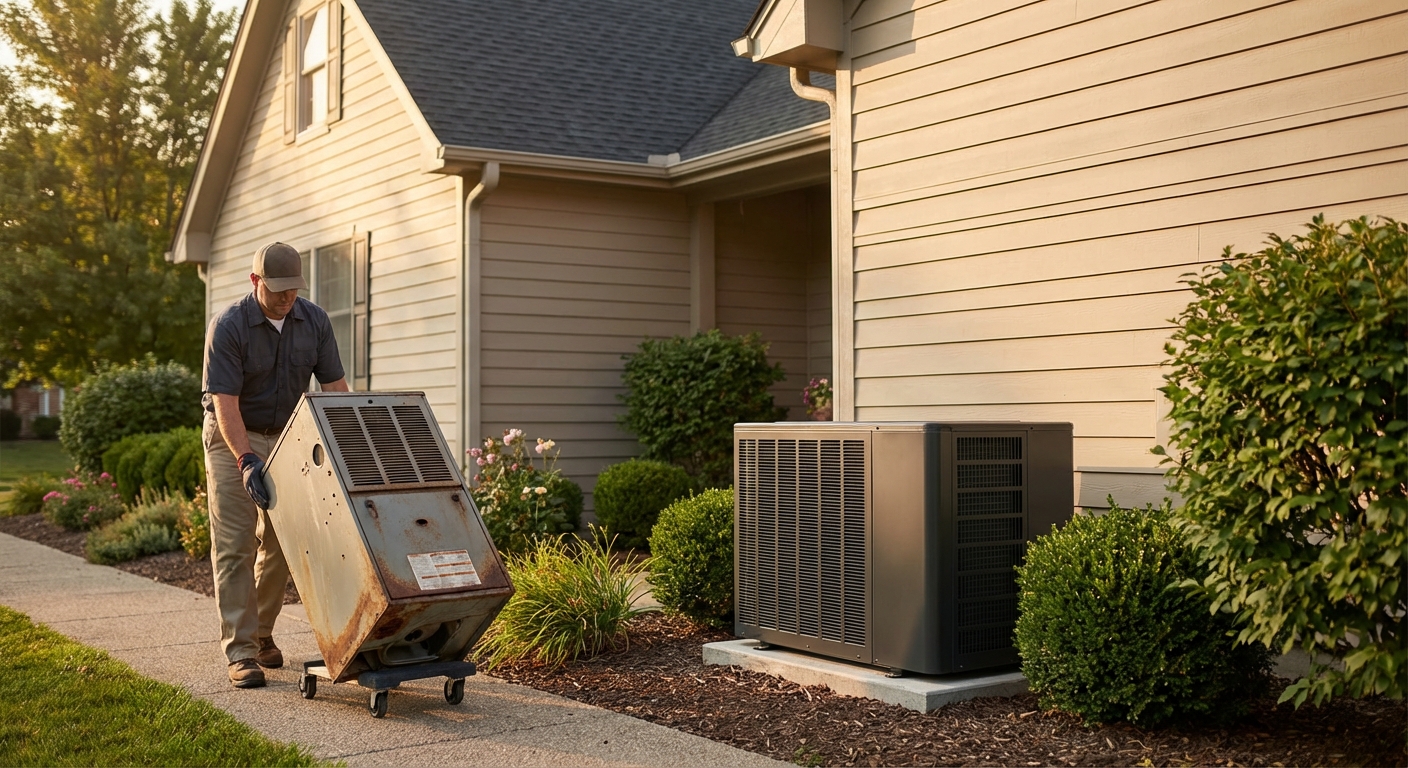
Your furnace doesn't fail politely. It quits on the first cold snap, the quote lands higher than you expected, and you're still living with the same problems: rooms that swing hot to cold, dry heat, and loud on-off cycling.
What makes the heat-pump decision feel risky is the gap between the slogan and the practical questions. You hear "heat pumps are the future," but you're wondering what happens in real winter weather, whether your electrical panel can support the switch, and if "electric heat" means the same expensive, toasty-then-cold feel you've had with resistance heaters.
The tradeoff is straightforward: an upfront change in equipment and planning versus long-term control over comfort and operating costs. Switching from a gas furnace to an electric heat pump is not a trendy gadget swap. It's a move toward one system that runs both seasons and gives you flexibility as energy prices and fuel choices shift.
An air-source heat pump (ASHP) moves heat between outdoor and indoor air via a refrigeration cycle, which is why it can heat and cool. It moves heat rather than creating it the way electric resistance does, and the same system provides both heating and cooling. Success comes down to four decisions: ducted vs ductless, sizing, efficiency and refrigerant readiness, and the installation path including how incentives affect the project.
Gas Furnaces vs. Heat Pumps
A 96% gas furnace can still cost more to run than a heat pump because "efficiency" is measured differently and the equipment delivers heat differently. Homeowners mis-compare these systems by treating AFUE, HSPF2, and BTU labels as interchangeable, then wondering why bills and comfort do not match the brochure.
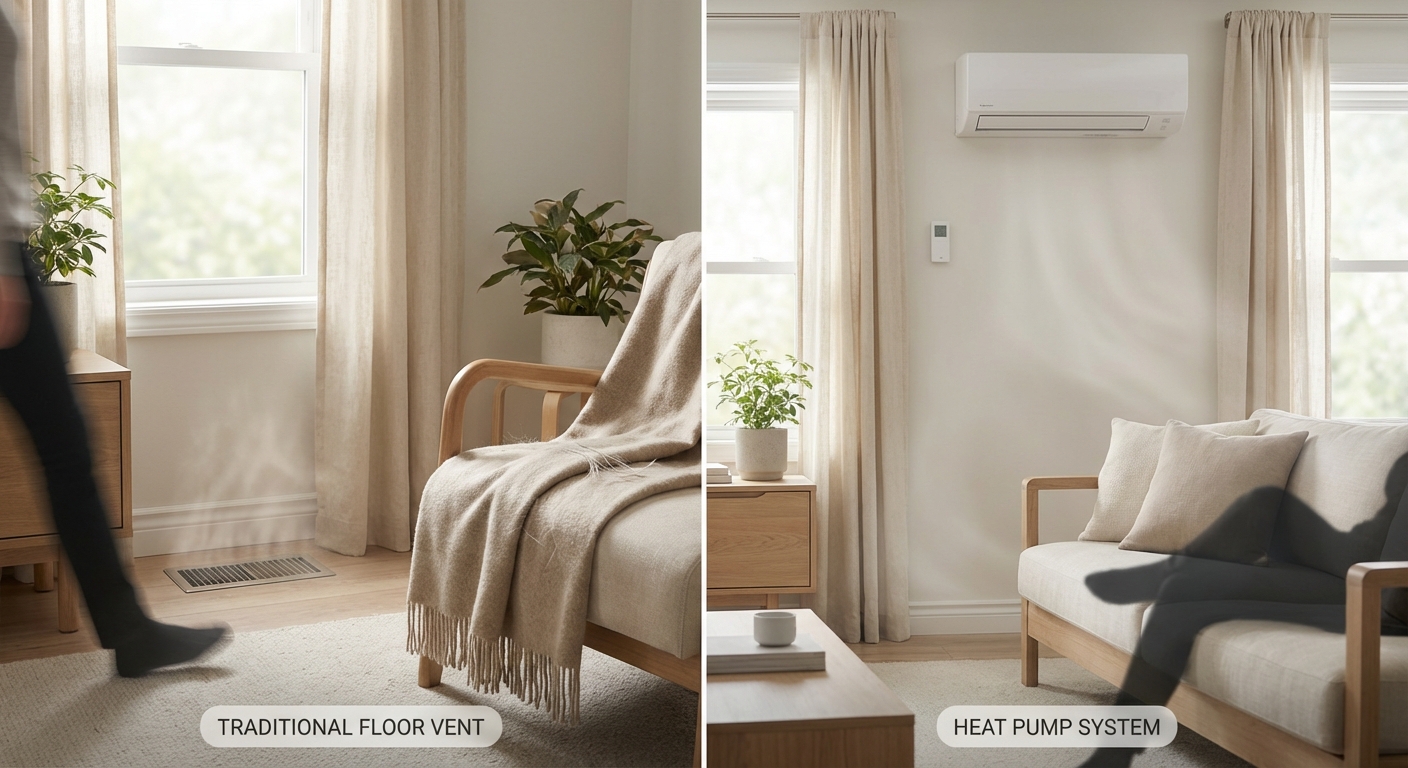
AFUE is straightforward: if a furnace is 96% AFUE, 96% of the fuel's energy becomes heat in the home over a season. The Goodman GM9S96 is rated up to 96% AFUE; 80,000 BTU input models are available in upflow/horizontal configurations, and it is a useful illustration of how gas equipment is labeled, not a recommendation.
Heat pumps use seasonal ratings because their output changes with outdoor temperature. HSPF2 is seasonal heating efficiency, and you can convert it to an approximate seasonal COP by dividing HSPF2 by 3.412. If a heat pump is HSPF2 8.0, the seasonal COP is about 2.35, meaning it delivers about 2.35 units of heat for every unit of electricity used across the season.
Furnaces are marketed by fuel input (BTU/hr), not heat delivered. An 80,000 BTU input furnace at 96% AFUE delivers about 76,800 BTU/hr of heat at steady-state. Heat pumps are commonly sized in tons; one ton equals 12,000 BTU/hr, so 3 tons is 36,000 BTU/hr of heating capacity at a given condition.
Two-stage and variable-speed furnaces run longer on low fire, then step up when the thermostat needs it. You feel warmer supply air and short bursts of higher airflow when the second stage hits. Inverter-driven ASHPs aim for steady output: longer runtimes, smaller temperature swings, and less of the hot-then-cool cycle that triggers frequent thermostat calls.
All-electric wins when winters are moderate, electricity is priced favorably versus gas, and you value even temperatures over hotter supply air. Dual fuel still makes sense when the climate is very cold, fuel prices swing year to year, or an existing gas furnace is in good shape and you want the heat pump for shoulder-season efficiency.
- Compare your local electric rate (per kWh) to gas cost (per therm) and prioritize the lower cost per delivered heat.
- Decide what you want to feel: hotter bursts (staged gas) or steadier temps (inverter heat pump).
- Plan for climate: if deep-freeze weeks are common, price a dual-fuel balance-point setup instead of forcing one system to do everything.
Once you have a clear comparison on cost, capacity labels, and comfort expectations, the remaining question is fit: how the equipment connects to your home's airflow and room-by-room needs. For a deeper look at heat pump vs gas furnace tradeoffs, and which is right for your climate, use those guides to sanity-check your assumptions.
Choosing the Right Electric Heat Pump
A heat pump feels like an upgrade or a headache based on configuration fit, not the logo on the outdoor unit. Ductwork quality, how many comfort zones you need, and whether you are conditioning an addition determine what "right" looks like in your house.
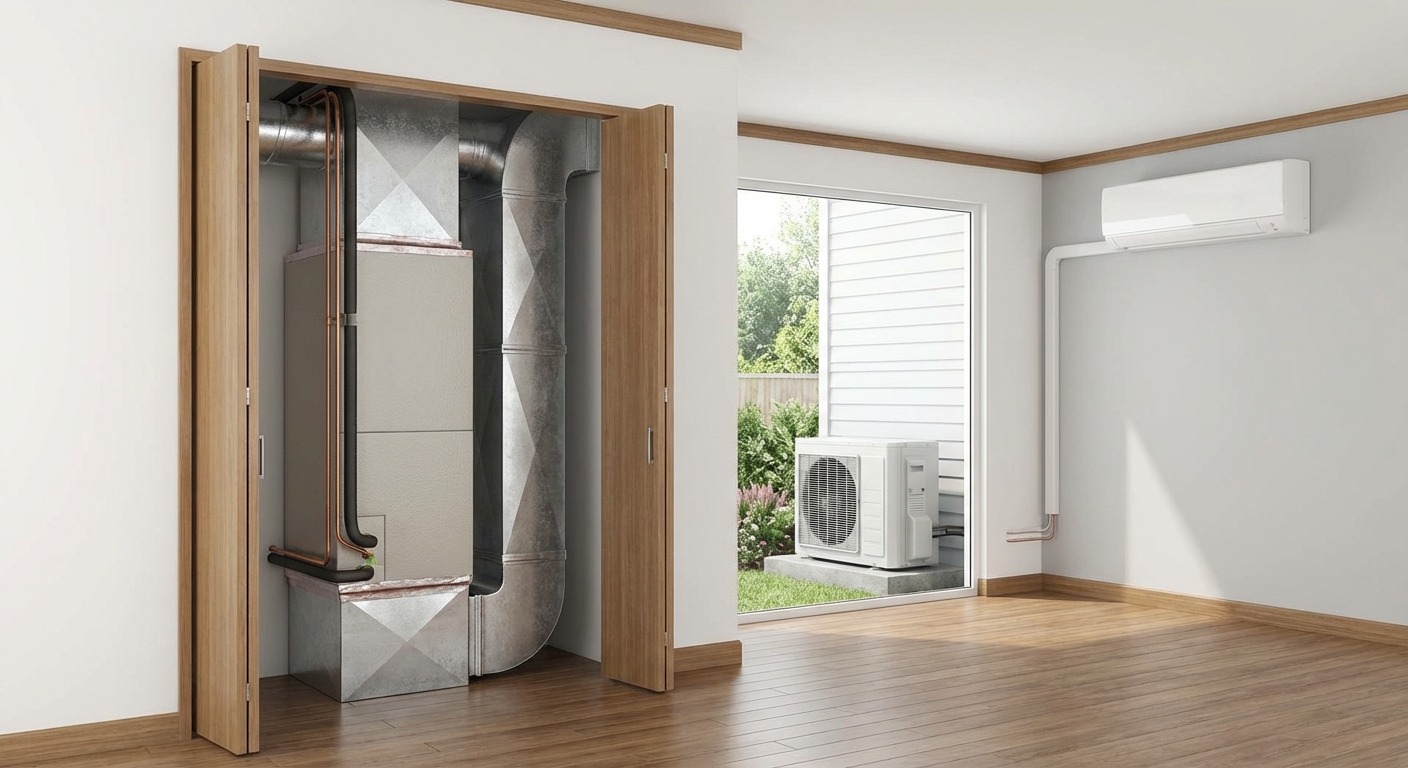
Ducted split heat pump systems pair one outdoor unit with an indoor coil and either a furnace cabinet or an air handler. If your ducts already deliver even airflow, this is the cleanest whole-home swap because it keeps one thermostat and one distribution system. The catch is that weak, leaky, or undersized ducts do not get fixed by a new heat pump, so a "simple replacement" can lock in the same hot and cold rooms.
A heat pump paired with a furnace and coil is common in dual-fuel or transitional upgrades where the furnace stays in place and the outdoor unit changes. It preserves familiar ducted heating performance while adding heat pump operation when conditions make sense for your setup.
Ductless mini-splits shine in homes without ducts and in problem areas like finished basements, bonus rooms, and additions where extending ductwork is expensive. Recognizable options include a Mitsubishi mini split, an LG mini split system, an MRCOOL DIY mini split, or a ceiling cassette mini split for a cleaner look.
Single-zone mini-splits solve one-space comfort with the simplest layout: one outdoor unit, one indoor unit. Multi-zone mini-splits connect two or more indoor units to one outdoor unit, and manufacturers enforce limits on capacity allocation and line-set length and elevation. Those constraints drive where heads can go and how well each room performs when multiple zones call at once.
Many manufacturers require installation as an AHRI-matched system for proper operation and/or warranty qualification; inverter systems often must be paired only with approved indoor units. This is why "I found a cheaper air handler online" often turns into control faults, poor modulation, or a warranty dispute. Budget Heating & Air Conditioning carries heat pumps, furnaces, air handlers, and coils, which makes it easy to build the right matched combination instead of guessing.
- Confirm ducts: Solid ducts and whole-home comfort needs point to a ducted split or heat pump plus furnace/coil.
- Identify zones: One problem room favors single-zone ductless; several rooms without ducts favors multi-zone.
- Flag additions: Additions and converted spaces often justify a dedicated ductless zone even if the main house is ducted.
- Insist on matching: Request the AHRI match and approved indoor-unit pairing before you buy.
For a recognizable example of configuration constraints, MRCOOL DIY Hyper Heat is marketed for colder climates and is compatible with specific indoor options (for example, OuttaSight air handlers) depending on model.
Configuration sets the layout, but sizing is what determines whether that layout feels quiet and steady or underpowered and erratic once the weather turns.
Heat Pump Sizing Made Simple
The fastest way to make a heat pump feel powerful, quiet, and efficient is to size it correctly. Oversizing is not a safe bet. Bigger equipment often performs worse in real homes because it cannot run long enough to stabilize temperature and moisture, so you pay more and feel less comfortable.
In HVAC, 1 ton equals 12,000 BTU/hr. A 3 ton system is roughly 36,000 BTU/hr of capacity. Homeowners feel that number as runtime: correctly sized equipment runs longer, steadier cycles that smooth out temperature swings and control humidity instead of blasting on and shutting off.
The Manual J load calculation is the method used to determine a home's heating/cooling needs and correctly size equipment. It stops rule-of-thumb sizing from dictating your comfort, and it gives you a defensible capacity target instead of a sales-driven tonnage jump.
Oversized heat pumps short cycle, creating uneven room temperatures, louder on-off operation, weaker dehumidification, and higher wear from frequent starts. Undersized systems run constantly, struggle in design weather, and leave you chasing setpoints, especially in far rooms.
Matched combinations also matter at this stage: if the coil, air handler, and outdoor unit are not an AHRI-approved pairing, the rated numbers you are paying for are not the numbers you will get.
Practical sizing snapshots: 2 ton is often used for smaller homes and condos; 3 ton often fits the mid-size home category; 4 ton is common in larger homes and open plans. A 12,000 BTU mini split is typically sized for a single room or single zone, not an entire floor—use a mini split sizing BTU calculator to sanity-check the numbers.
Even perfect tonnage fails when ducts are undersized, leaky, or starved for airflow.
- Request the Manual J result and the recommended tonnage from it.
- Confirm the exact indoor and outdoor model numbers are an approved matched combination before you buy.
When sizing is defensible and the system is properly paired, the final product choice comes down to current rating standards and the refrigerant platform you will be living with.
What to Look for in 2026-Ready Systems
A heat pump can look "high efficiency" on a product page and still be the wrong 2026 purchase if it is quoted on the wrong rating standard or built on a refrigerant you are trying to avoid. "2026-ready" shopping comes down to two items you can verify in writing: modern efficiency ratings (SEER2 and HSPF2) and the refrigerant platform listed on the data plate or submittal.
SEER2 is the current rating language for heat pumps and AC equipment, replacing legacy SEER starting January 1, 2023.
SEER2 values are typically about 4 to 5% lower than legacy SEER due to updated DOE test procedures. The equipment did not suddenly get worse; the yardstick changed, so compare SEER2 to SEER2.
A 15+ SEER2 heat pump with two-stage or variable-speed performance is a strong baseline for many regions because it clears minimum compliance and leaves room for real-world installation losses.
Use federal minimums as your compliance backstop: heat pumps move to 14.3 SEER2, and split-system heat pumps must meet 7.5 HSPF2.
The AIM Act directs the EPA to phase down HFCs (such as R-410A) by 85% over 15 years beginning in 2022. Newer systems commonly transition to lower-GWP refrigerants like R-32 or R-454B, and retailers such as Budget Heating & Air Conditioning increasingly label refrigerant type clearly. Expect A2L handling requirements to be a practical installation and servicing reality.
Cold-climate capability means the system maintains usable capacity and efficiency as outdoor temperature drops, not just that it can "run" in the cold. A COP of at least 1.8 at -15°C is a useful benchmark for cold-climate-focused equipment. If your winter design temps are extreme, your panel capacity is tight, or fuel economics favor backup, dual fuel can pencil out.
- SEER2 at or above 14.3; practical target: 15 SEER2
- HSPF2 at or above 7.5 for split systems
- Refrigerant explicitly stated (R-32 or R-454B vs. R-410A)
- Cold-climate datapoint shown: COP ≥ 1.8 at -15°C (if relevant to your region)
Once the model meets your efficiency and refrigerant requirements on paper, the outcome depends on execution: installation quality, electrical readiness, and documentation.
Installation, Rebates, and Buying Smart
The smartest equipment choice still fails if the installation pathway is wrong. The decision between a contractor-installed ducted job and a DIY-friendly ductless mini split drives project risk, timeline, and warranty outcomes as much as the model number on the box.
You pay for commissioning, not just labor. A competent contractor sets airflow, verifies refrigerant performance, and documents startup so the system runs to spec instead of merely turning on. The friction is that "close enough" installs create noisy ducts, comfort complaints, and callbacks. Require startup documentation and keep it with your equipment records.
DIY-friendly systems are different because the refrigerant connection is simplified: some 24,000 BTU DIY ductless mini split heat pump systems use Quick-Connect pre-charged line sets that eliminate the need for vacuum pumps or refrigerant charging, unlike conventional installs that require evacuation and vacuum.
DIY convenience does not remove the hard parts: electrical circuit and disconnect, correct mounting, condensate routing, and permits/inspections where your jurisdiction requires them.
"Complete HVAC system" means you have every major component and the install-critical accessories: outdoor unit, indoor unit (air handler/coil where applicable), line set if needed, electrical disconnect and whip, pad or stand, and thermostat or controls if required.
Keep the AHRI match confirmation (certified pairing) on file; it is commonly used for rebates, tax credits, and warranties.
IRS Section 25C, which covered 30 percent of qualifying costs with the heat pump credit capped at 2,000 dollars per year, ended for property placed in service after December 31, 2025. State, utility, and local programs are the remaining incentive path, and most still require AHRI documentation. Incentives reduce net cost, but they do not change sizing or installation requirements.
- Confirm the matched system and save the AHRI documentation.
- Verify electrical capacity, disconnect location, and permit needs.
- Plan your documentation: photos, serial numbers, and startup/service records; use a licensed installer where required.
- Collect incentive paperwork before you start and keep itemized invoices.
Next Steps
A successful switch is a disciplined sequence, not a product purchase: choose the right configuration, size it correctly, verify modern efficiency and refrigerant readiness, then execute installation and documentation. Done correctly, that sequence directly addresses the concerns that make the decision feel risky-real winter performance, electrical capacity planning, and avoiding the hot-to-cold swings that come from poor sizing or short cycling. Heat pumps already solve the headline problem by delivering heating and cooling in one system, but most "bad heat pump stories" trace back to capacity labels that weren't translated, mismatched equipment, or paperwork that undermined warranty support. Lock in the match, trust the Manual J result, and treat SEER2 and the refrigerant platform as simple read-the-label checks.
- Confirm your Manual J results and use them to choose the correct size heat pump or furnace.
- Pick the configuration that fits your house and ducting.
- Verify the system is properly matched.
- Choose your installation path and document it for warranty.
- Capture applicable incentives, then order.
If you're planning delivery, Budget Heating & Air Conditioning typically processes and ships orders within 2-3 business days after receipt of order/payment (excluding weekends/holidays), and in-store pickup may be available at select locations during checkout. For a quote, call and have your name plus a phone number or email ready so a sales rep can follow up.
Wrapping Up
Switching from a gas furnace to an electric heat pump is less about chasing a trend and more about choosing a system that can deliver steadier comfort and year round heating and cooling. The real comparison starts with understanding the labels, AFUE versus HSPF2 and SEER2, and translating capacity correctly so operating costs and expectations line up with how the equipment actually performs.
The outcome hinges on getting the fundamentals right: pick the configuration that fits your home, whether ducted, ductless, or dual fuel, size it with a Manual J load calculation, and confirm an AHRI-matched indoor and outdoor combination. From there, focusing on 2026-ready specs like modern ratings and the right refrigerant, plus solid installation, electrical readiness, and documentation, is what turns a good heat pump choice into a reliable long term upgrade.
Now, take the next step by gathering your utility rates and load calculation details so you can confidently narrow down the right system for your home.
 Cooling
 Learning Center
 Product and Brands Insights
 Buying Guides
 State by State