




 learning center
 money saving tips

Ventilation Basics
Ventilation type determines where air comes from, where it leaves, and what it costs you. Every CFM (cubic feet per minute) you move is also a pressure decision, and pressure decides whether air travels through a designed grille or through rim joists, attic bypasses, and garage leaks.
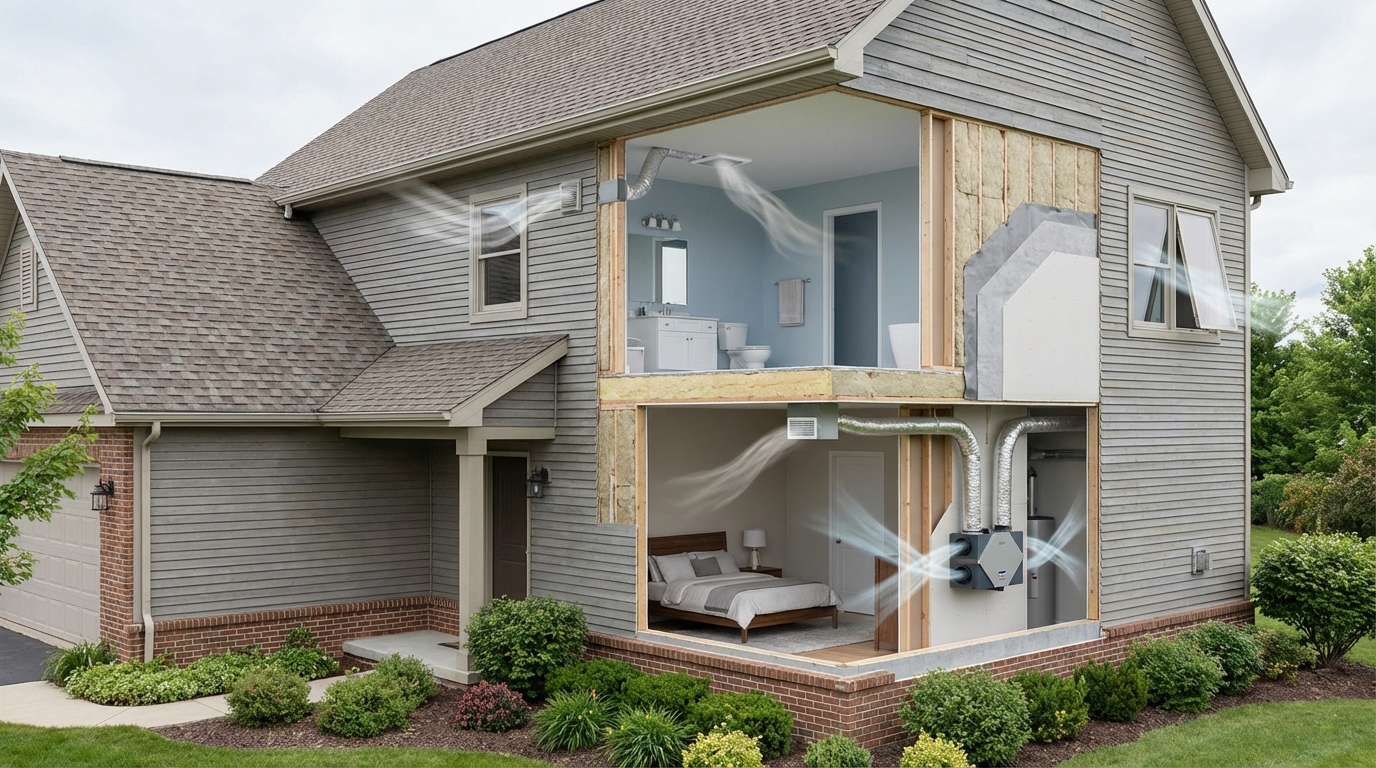
That pressure framing is the thread that ties the rest of the guide together: sizing and controls determine how long you run ventilation, recovery determines how expensive that air is to condition, and your HVAC layout determines whether the air actually reaches the rooms that need it.
Uncontrolled leakage has historically done most of the "ventilation" work in many homes, but it's weather-driven, not need-driven. Wind and stack effect spike flows when you least want them (cold nights, hot afternoons), which increases conditioning load, comfort complaints, and moisture problems. Drafts are not free ventilation; they are unmanaged air exchange through the worst pathways—and a big reason attic ventilation affects home energy efficiency.
| Approach | Pressure impact | Where air moves | Humidity and condensation risk | Combustion safety |
|---|---|---|---|---|
| Natural infiltration/ventilation | Weather-driven, unstable | Cracks and bypasses both directions | Unpredictable wetting and drying | Can worsen depressurization events |
| Exhaust-only | Depressurizes | Outdoor makeup air infiltrates through leaks | Pulls humid air through assemblies in cooling season | Backdraft risk for atmospherically vented appliances |
| Supply-only | Pressurizes | Air enters at known points, exits as exfiltration | More susceptible to condensation in cold surfaces | Usually reduces backdrafting, but check venting |
| Balanced ventilation | Near-neutral | Controlled supply and controlled exhaust | Reduces pressure-driven moisture transport | Stabilizes pressure around combustion zones |
In an exhaust-only setup, makeup air is pulled in through leaks to balance what the fan removes. Infiltration (air entering) must balance exfiltration (air leaving), so the house will find replacement air wherever it can. The big catch is combustion: depressurization hinders natural draft from vented combustion appliances and can backdraft flue gases; around -5 Pa can create backdrafting at the vent hood for atmospherically vented equipment. Sealed combustion largely eliminates that failure mode.
Supply-only systems improve where air enters, but they still push air out through walls and ceilings. That outward flow can load cold cavities with indoor moisture in winter, which is why supply-only ventilation makes houses more susceptible to condensation problems.
Balanced ventilation intentionally matches supply and exhaust so the house runs close to pressure-neutral. That choice limits pressure-driven infiltration, protects comfort, and keeps large exhaust events from dragging air through the building enclosure.
Decision lens: the tighter the home (ACH50 context), the more pressure management becomes the main design constraint. The leakier the home, predictability is the first problem. Sanity-check flows: many bath fans move roughly 50-110 CFM, while many range hoods are 150-400+ CFM, and the common rule of thumb for gas cooking is about 1 CFM per 100 BTU of burner input, so a 60,000 BTU range points toward roughly 600 CFM, which is above the makeup-air threshold discussed later.
Once the pressure strategy is clear, efficiency comes down to delivering the right amount of outdoor air on purpose, instead of letting runtime and fan sizing drift into "always on" (and choosing the right ventilation components for the approach).
Right-Sizing Ventilation for Efficiency
Efficiency comes from controlling ventilation minutes, not chasing "more airflow." Most ventilation energy waste shows up when a system runs longer than necessary, or runs hardest when outdoor conditions make that air expensive to condition.

Right-sizing starts with a whole-house target you can defend. ASHRAE 62.2 is the recognized method for setting a whole-house ventilation rate using practical inputs like conditioned floor area and number of bedrooms, with an infiltration credit approach where applicable. The point is not the math; it's picking a target that's tied to the house, then controlling runtime to meet it.
ASHRAE 62.2 separates whole-building ventilation from local intermittent exhaust in kitchens and bathrooms (per HVI/CEC summaries). Operationally, that distinction matters: your baseline system is there to manage day-to-day pollutant load across the home, while kitchen and bath fans are for short, high-intensity events.
When those jobs get blended, the common mistake is oversizing a "whole-house" fan and leaving it on continuously to cover everything. That wastes energy and creates comfort problems you feel immediately: winter dryness, humidity swings, and drafts from excessive outdoor air.
Controls fix the oversizing and 24/7 runtime problem without compromising the target. Timers are the blunt, reliable tool for bathrooms and other predictable uses. Humidity sensors cut wasted runtime by shutting off once the moisture event is actually over. Occupancy-based controls prevent ventilation during empty-house hours when it delivers the least value, and smart-home HVAC integration can coordinate those controls across the system.
For variable homes, demand-controlled ventilation (DCV) is the most precise approach: it uses CO2, occupancy, or real-time measurement to modulate ventilation so delivered airflow (CFM) tracks need instead of a clock.
Duty-cycling is intermittent ventilation engineered to hit the same average airflow target over time with less continuous runtime. Done correctly, it meets the average requirement while reducing energy and wear, but it also changes thermal comfort, energy consumption, and operational costs, so the schedule has to match the home's tolerance for short bursts of outdoor air.
- Pick a whole-house target using ASHRAE 62.2 inputs.
- Choose controls (timers, humidity, occupancy, or DCV) that minimize runtime while meeting that target, including smart thermostat automation where it fits.
- Verify it actually runs as intended, including spot fans for kitchen and bath events.
Right-sized airflow and smart controls reduce how much outdoor air you have to condition; recovery is what reduces the cost of conditioning the air you still need to bring in.
Max Efficiency with Balanced Ventilation
If you want controlled fresh air without paying the full heating and cooling cost, you need recovery. Balanced ventilation already gives you predictable supply and exhaust; adding a recovery core trims the conditioning penalty by exchanging energy between outgoing and incoming air.
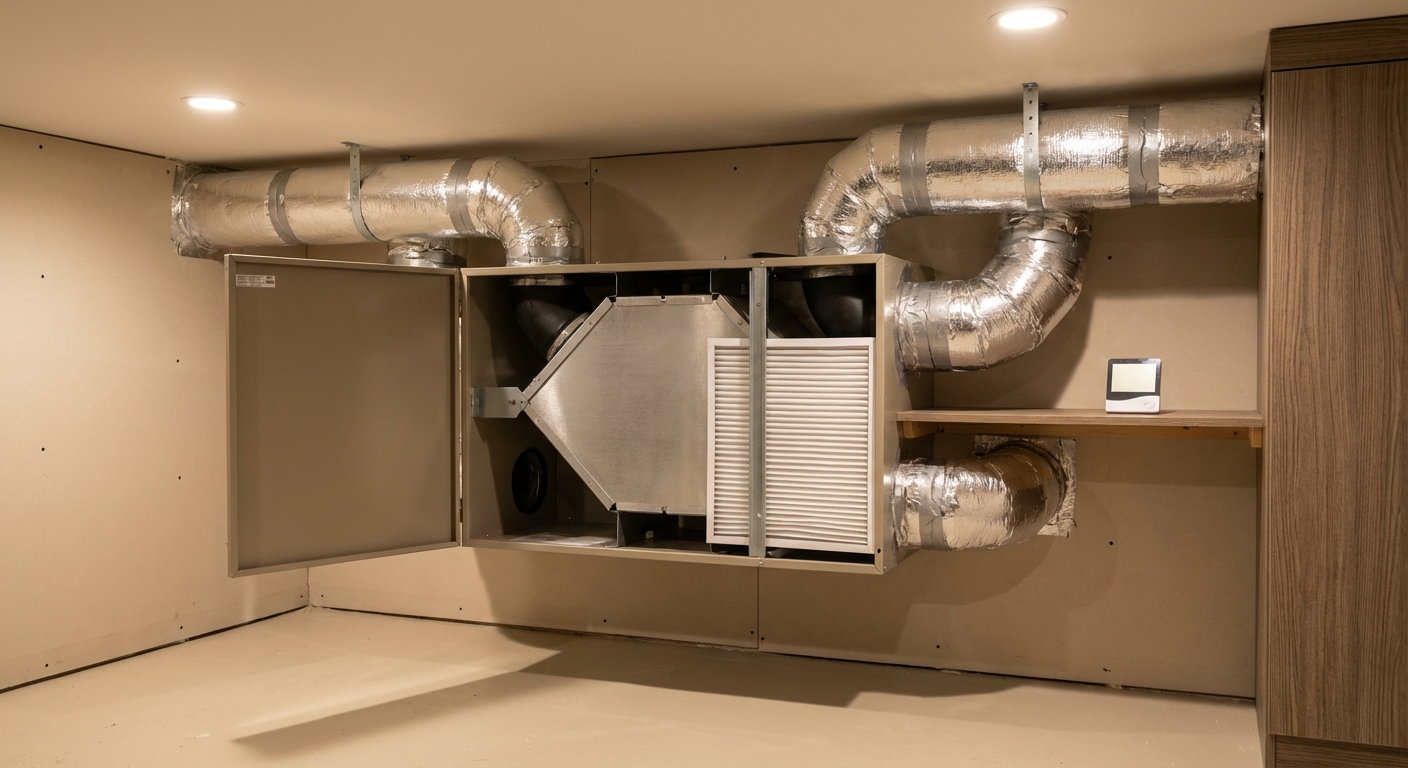
An HRV (Heat Recovery Ventilator) transfers heat from the exhaust stream to the incoming airstream, but it generally does not transfer moisture. An ERV (Energy Recovery Ventilator) transfers heat plus some moisture, which reduces both temperature and humidity loads your HVAC system would otherwise have to handle.
Effectiveness is real, but not absolute. ERVs commonly recapture about 40 to 80% of the energy in exhausted air, and manufacturer-reported performance varies by temperature, humidity, and airflow conditions.
The selection problem is moisture control, not marketing. If indoor air feels dry all winter or you run high occupant density, an ERV's moisture transfer helps stabilize comfort while still recovering heat.
Use this practical rule of thumb: ERVs suit both hot, humid climates and dry, cold ones, for opposite reasons. In hot, humid weather that same moisture-transfer mechanism works in your favor, because the core moves moisture from the incoming humid outdoor air into the drier outgoing exhaust stream, so an ERV lowers the latent load your AC has to remove. An HRV transfers heat only, which means supply air arrives at full outdoor humidity and the cooling system absorbs all of it. Reserve HRVs for cold climates where indoor humidity runs high and you want to exhaust that moisture rather than recycle it.
MERV (Minimum Efficiency Reporting Value) is the common filter rating system, and it measures a filter's ability to trap particles from about 0.3 to 10 microns. HVAC professionals generally recommend MERV 8 to 13 for home use because it captures meaningful fine particles without turning the ventilator into a restriction.
The friction point is pressure drop: higher MERV increases resistance, which can reduce delivered airflow if the fan and duct system are not designed for it.
Comfort and IAQ targets center around roughly 30 to 50% indoor relative humidity. Below that band, winter dryness complaints spike; above it, surfaces reach condensation conditions more easily and mold risk rises. An ERV helps resist winter overdrying and summer stickiness, but it does not replace dedicated humidification or dehumidification when loads are high.
- Choose HRV vs ERV based on your humidity reality, not your equipment wish list.
- Specify MERV 8 to 13 filtration with pressure drop and airflow delivery in mind.
- Verify the system actually delivers the design airflow while keeping indoor RH in the 30 to 50% band.
Even the best recovery unit cannot fix poor distribution. Whether ventilation is efficient in practice depends on how your HVAC system moves air when there is no heating or cooling call.
Ventilation Strategies by HVAC Setup
Your HVAC distribution either makes ventilation cheap-or makes it messy. The deciding factor is simple: can your system move and mix air effectively when there is no heating or cooling call? If it cannot, ventilation still happens, but it lands in the wrong rooms, at the wrong time, with higher fan energy and more comfort complaints.
Ducted heat pumps with an air handler are the easiest setups to integrate because the ductwork already reaches the whole house. The catch is runtime: ventilation can be scheduled when the heat pump is idle, so you need controls that either (a) pulse the air handler only when ventilation runs or (b) coordinate ventilation with blower operation. Do not default to a "continuous fan" setting that just spins air without a distribution purpose, especially if bedroom doors stay closed.
Fan energy is the make-or-break detail. Variable-speed ECM blowers cut fan energy by up to 75% versus older PSC motors (ENERGY STAR-cited). That shifts the cost-benefit toward using short, controlled blower support for mixing, instead of avoiding the blower entirely because it is expensive to run. If you are sourcing an ECM-equipped air handler or compatible controls, request a complete HVAC system quote that includes the ventilation strategy and its control logic.
Dual fuel (heat pump plus gas furnace) adds mode-change friction. Avoid strategies that create unexpected pressure or drafts when the system switches equipment. Keep ventilation and blower control tied to a single "ventilation enable" schedule, and confirm the blower speed used for ventilation is reasonable in both modes so the house does not feel different depending on which heat source is active.
High-efficiency gas furnaces are commonly sealed combustion, so your ventilation planning is about distribution and fan watts, not combustion air theory. Treat the furnace blower like any other air handler: intermittent, intentional mixing beats continuous fan operation.
Ductless mini splits vs traditional ducted HVAC move indoor air but do not deliver outdoor air. Homes built around mini splits need dedicated whole-house ventilation, not an assumption that the mini split is "bringing in fresh air." When doors are closed, each head conditions its own zone, so dedicated ventilation and clear transfer paths matter even more.
Whole-house ventilation can be integrated with dedicated ventilation ducts or tied into existing return pathways, but both approaches fail without airflow pathways and control. Use door undercuts or transfer openings so rooms can "see" the central return; in a ducted system, rooms and hallways function as large, low-resistance return pathways when you give air a way back.
Install balancing dampers and use controls that prevent unintended over-ventilation when the HVAC is not calling. Without dampers and coordinated runtimes, you end up ventilating the easy-to-reach areas while bedrooms stagnate behind closed doors.
- Choose the distribution strategy first (how air reaches closed rooms).
- Select the ventilation device that fits that distribution.
- Set controls and dampers so ventilation runs only when distribution is actually working.
Because distribution, recovery, and controls all depend on real-world airflow, the final step is not another equipment choice; it is confirming the system performs as designed after installation.
Implementation Checklist
If you didn't measure airflow and confirm controls, you don't know what you built. Ventilation upgrades only save energy when performance is verified because real installs drift from the design: leakage paths stay open, ducts leak into attics, grilles add restriction, and controls default to the wrong runtime.
- Air-seal first. Use blower door testing to quantify enclosure leakage and chase the big leaks before you pay to move and condition more air.
- Confirm duct quality. Test duct tightness and fix leakage and insulation; ENERGY STAR guidance commonly targets total duct leakage of 4 CFM25 per 100 sq. ft. of conditioned floor area or less.
- Measure delivered fan flows. Verify actual CFM at bath, kitchen, and whole-house terminals; a flow hood or flow pan is the recommended method for bath fans, with anemometers and rough plastic-bag methods also used.
- Commission controls. Set and verify timers, sensors, and automation so runtime matches the design intent, not factory defaults.
Oversized exhaust fans buy you noise, drafts, and higher heating and cooling load from over-ventilating.
Running the HVAC blower continuously without a strategy wastes fan energy and can move pollutants and humidity to rooms you were trying to protect.
Ignoring makeup air for large kitchen exhaust is a code and load problem: many codes require makeup air when kitchen exhaust exceeds about 400 CFM (IMC 505; IRC referenced in guidance), and that intentional replacement air changes heating and cooling loads—especially during home renovations and HVAC upgrade planning.
Conclusion
The winning plan is controlled airflow you can measure and manage: designed ventilation beats random leakage, right-sizing with smart controls cuts runtime, and balanced ventilation with recovery avoids the worst heating and cooling penalty. Those same themes show up again during installation-efficiency falls apart when ventilation is bolted onto the wrong HVAC setup (mini splits need dedicated ventilation) or left uncommissioned, creating paper performance. Start with a blower door test, which quantifies airtightness and commonly reports ACH50.
- Measure tightness with a blower door (ACH50).
- Pick a ventilation strategy sized to the home and control plan.
- Verify installed airflow and commissioning results.
- Check utility efficiency rebates, HEAR (income-qualified), and state/local programs, and buy HVI-Certified fans that meet ENERGY STAR ventilating-fan criteria plus AHRI-certified ERV/HRV equipment.
- Purchase the matched equipment and controls.
Budget Heating & Air Conditioning is the straightforward place to create a shopping list before you buy certified ventilation and HVAC equipment and get planning support that matches your system.
Wrapping Up
Energy-efficient ventilation starts with intention: choose a pressure strategy that keeps air moving through designed pathways, not through random leaks. From there, efficiency comes from right-sizing to a defensible target like ASHRAE 62.2 and using controls that limit runtime, while still handling kitchens and bathrooms as short, high-load events.
For many homes, balanced ventilation paired with heat or energy recovery offers the best mix of comfort and operating cost, especially when HRV vs ERV selection matches your humidity reality and filtration is chosen with airflow and pressure drop in mind. Just as important, the system has to fit your HVAC setup and actually reach the rooms that need fresh air, which is why commissioning, airflow measurement, and duct and enclosure testing are where real performance is won or lost.
Take the next step by measuring what your home is doing today, then set a clear ventilation target and verify the installed results match the plan.
 Cooling
 Heating
 Product and Brands Insights
 Buying Guides
 State by State
 HVAC Systems