




 buying guides
 heating
 money saving tips
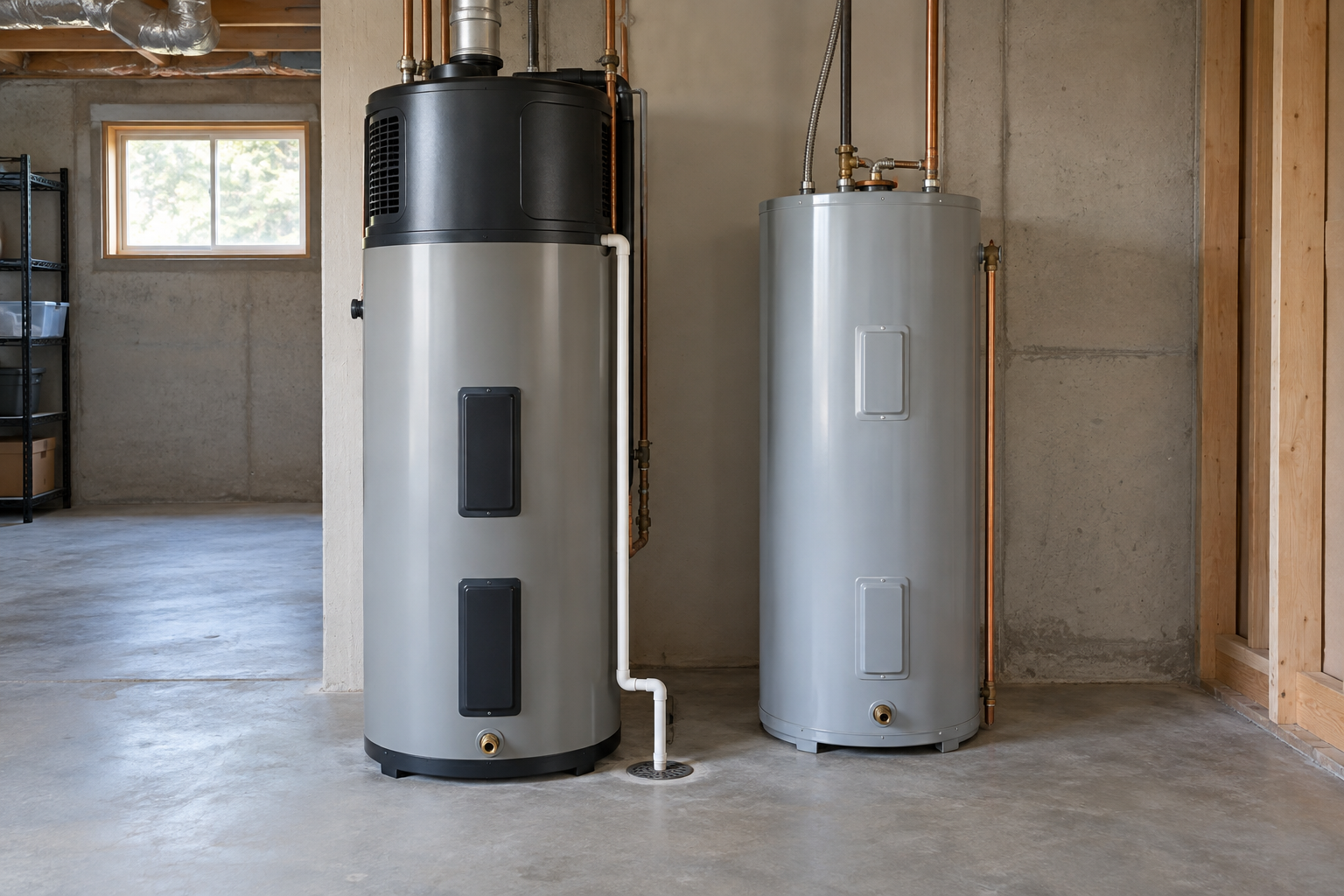
Air passing through a hybrid heat pump water heater gives up heat before cooler air leaves the unit. A conventional electric tank uses resistance elements immersed in the water instead; it does not draw heat from the room. Depending on its design and settings, a hybrid can also use resistance elements. That makes airflow, room temperature and condensate drainage part of the hybrid's placement decision, beyond the space occupied by its tank. The chosen heater's electrical requirements and the hybrid's operating mode also matter when planning for hot-water recovery.
How each heater works, and why modes matter
An electric tank water heater passes current through elements immersed in the tank; those elements heat the water directly. A hybrid electric water heater uses electricity to run a heat pump that transfers heat from air into the stored water. Its resistance elements provide another way to heat water when the model's controls call for them.
The selected operating mode affects how the hybrid does that work. Heat-pump-focused operation relies primarily on air as the heat source. A mode that brings on resistance elements can replenish hot water differently, while electric-only operation bypasses the heat pump. Available modes and the circumstances in which elements run differ by model. For example, Rheem describes High Demand mode as using its hybrid's heat pump and electric elements to respond to demand. The mode selected for everyday use therefore matters when comparing hot-water performance, not just the word "hybrid" on the unit.
Space and placement: tank footprint is only the start
Both types need a location that accommodates the tank, piping, electrical connections and access for service. A heat pump also needs an unobstructed path for air entering and leaving its intake and exhaust. Its footprint on the floor alone cannot establish whether a location will work. Check the chosen unit's height against the ceiling and the route through doorways, then allow the installation clearances its manufacturer specifies.
An enclosed closet is the clearest example of the difference. A conventional electric tank does not need closet air to heat water, although it still needs its specified installation and service space. A heat pump cannot simply be enclosed behind the same door: the particular model must permit an airflow arrangement for that space, such as approved openings or ducting. ENERGY STAR's installation guidance addresses the free air and ventilation these units need; the selected model's instructions determine the acceptable arrangement.
Airflow clearance is more than a measurement between the heater and a wall. A nearby shelf, stored boxes or a closed door can obstruct the intended air path even where the tank itself fits. Before choosing a location, identify where the intake will draw air from, where the cooler exhaust will go and whether those paths remain open during normal use.
What placement does to the room
Because a hybrid removes heat from ambient air, it discharges cooler air and can cool and dehumidify the space while its heat pump runs. In a conditioned room, that cooling can add to the home's heating load when heat is needed. In a garage or other unconditioned area, the practical effect depends on the temperature there and the unit's permitted operating conditions. A resistance-only tank does not cool room air as part of heating water.
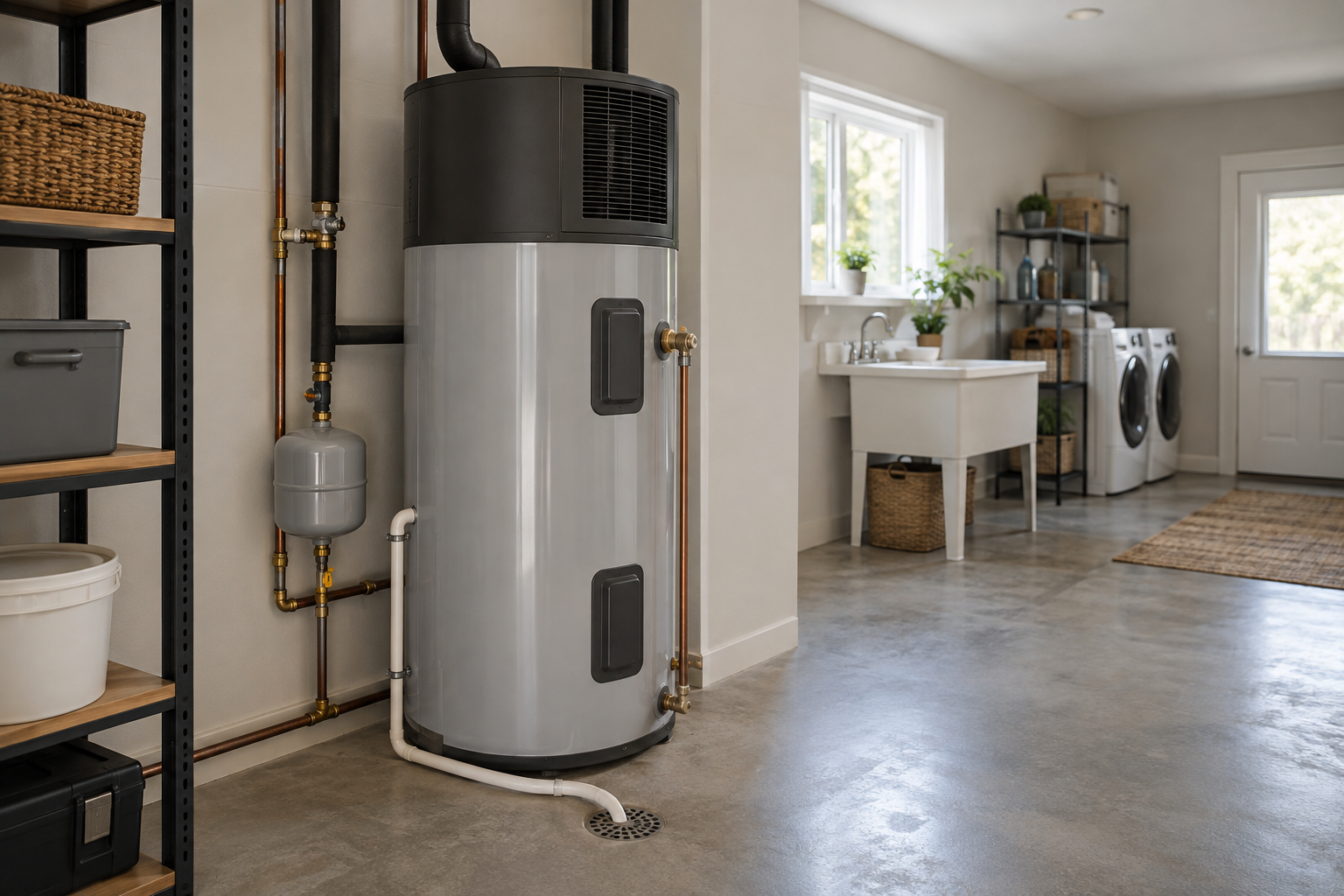
Surrounding temperature can also affect a hybrid's operation and hot-water recovery. For an example of a model-specific limit, Rheem specifies a 37–145°F ambient operating range for its XE50T10H45U1. That range is not a rule for other hybrids; the location must suit the model being installed.
Heat-pump operation also produces condensate. Plan a permitted drainage route when choosing the location; a condensate pump may be needed if there is no suitable gravity drain. The A. O. Smith HPTU-50N specification, for instance, calls for a pump when a suitable drain is unavailable. A conventional electric tank has no heat-pump condensate, though it still needs the plumbing and leak-protection provisions applicable to its installation.
Electrical needs: compare nameplates, not heater labels
Both heaters need a supply that matches the selected unit, not merely one labeled "electric water heater." Compare its specified voltage, current or circuit rating, breaker and dedicated-circuit instructions with the existing installation. A hybrid has a compressor and may have backup resistance elements; its electrical requirements depend on how that particular heater is built. Replacing a resistance tank with a hybrid does not automatically make the existing circuit suitable.
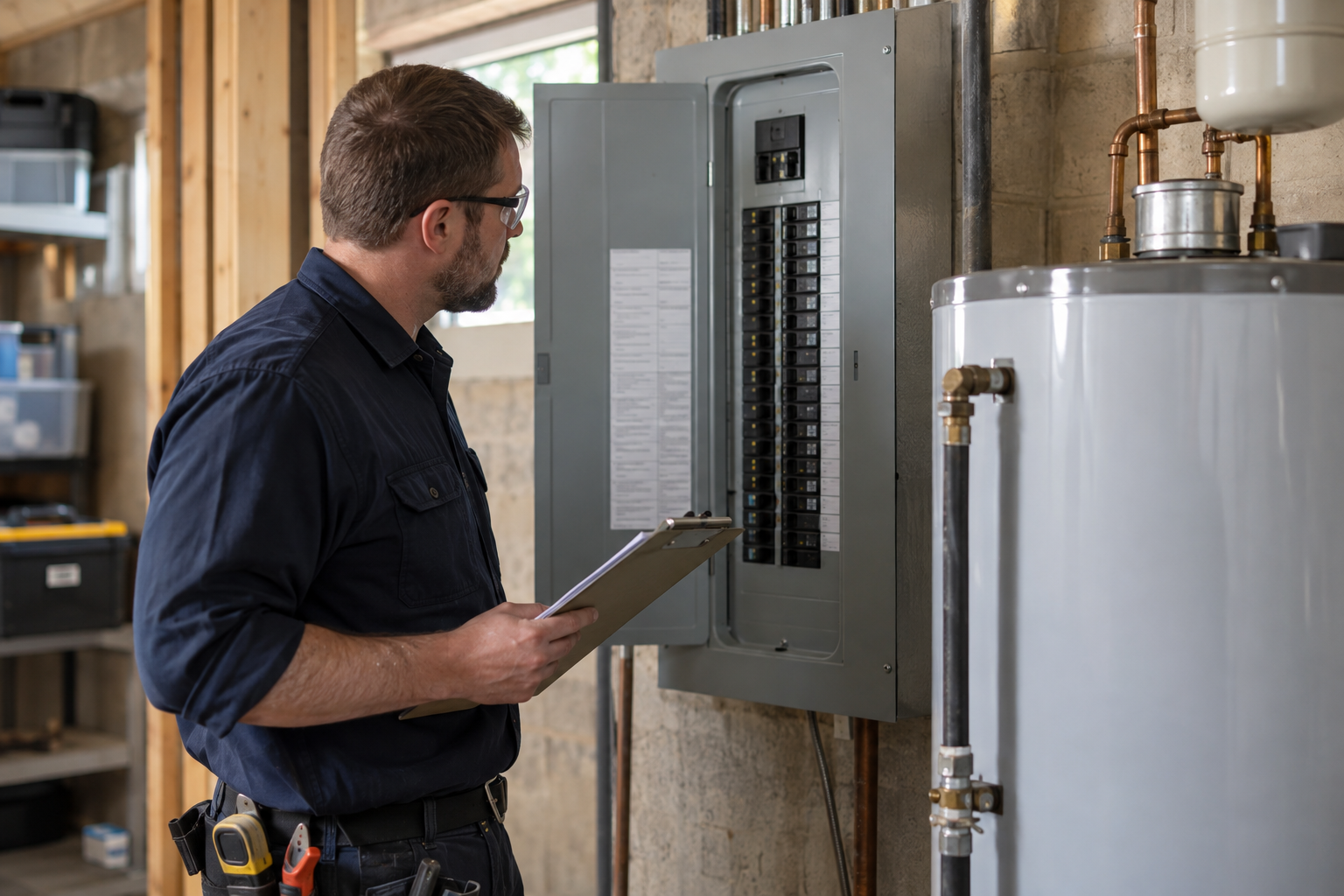
Even among hybrids, an operating mode is not a substitute for checking the electrical specification. The A. O. Smith HPTU-50N specification calls for a 208/240-volt, single-phase, 30-amp supply. Those figures describe that model, not every heat pump water heater or every mode in which one might run. The selected heater's nameplate and installation instructions govern its supply and circuit protection.
For a replacement, have the existing wiring, breaker and installation assessed against those instructions before assuming they can be reused. The circuit's condition and configuration matter as well as its breaker label. Where an electrical change is needed, the installer should confirm the applicable local requirements rather than size a circuit by analogy with the old tank.
Recovery after heavy use: capacity does not tell the whole story
Two performance figures answer different questions. Recovery rate describes how quickly a heater replenishes hot water at a stated temperature rise. First-hour rating estimates delivery during the first hour starting with a fully heated storage tank; it includes water already stored as well as water heated during that hour. Equal tank capacities therefore do not guarantee equal delivery through a cluster of showers.
A hybrid's recovery depends partly on how it is operating. Heat-pump-focused operation and resistance-assisted operation can replenish the tank at different rates; surrounding-air conditions can also affect heat-pump performance. A conventional electric tank's performance depends on its own elements and tank design. Neither heater type is automatically the faster choice across all models and settings.
For repeated draws close together, compare the candidates' first-hour ratings, then their recovery figures at the same stated temperature rise. For a hybrid, check which operating mode the published figure represents and whether that is the mode you intend to use. A first-hour rating helps estimate the initial period of heavy use; recovery becomes increasingly important when demand continues after much of the stored hot water has been drawn. Actual results also depend on incoming water temperature and the pattern of use.
Which type fits your installation?
A hybrid is a practical fit where its specified air path, ambient conditions, condensate drainage and electrical supply can all be accommodated. Where a tight enclosure or lack of a suitable drain makes those provisions difficult, a conventional resistance tank may be simpler to place. Make the final comparison using the particular units' dimensions, installation instructions and hot-water ratings, not tank capacity alone. Budget Heating's electric tank water heaters category is a starting point for examining that option.
 Cooling
 Learning Center
 Product and Brands Insights
 State by State
 HVAC Systems