




 cooling
 learning center
Why Choosing the Right Air Conditioner Matters for Comfort, Bills, and Longevity
Choosing the right air conditioner shapes how evenly a home cools on the hottest days, what shows up on the power bill, how well humidity is tamed, how clean the indoor air feels, and how long the equipment lasts. In our field work, we have seen most comfort complaints trace back to the initial choice, not the thermostat setting. We treat sizing and selection like tailoring a suit, measure carefully so the fit is right, not guessed.
A simple, structured process keeps you on track. Start with a load calculation to set the correct capacity for the home, the goal is steady run time, not short cycling. Choose the system type that matches the building and comfort goals, for example ducted central, ductless for room by room control, or a heat pump for efficient heating and cooling. Compare efficiency ratings in the context of climate and runtime, higher efficiency cuts operating costs only when paired with the right size. Insist on quality installation, proper airflow, charging, drainage, and controls often matter more than brochure specs. Finish with regular maintenance, clean filters and coils protect air quality, stabilize humidity, and extend reliability year after year.
Step 1: Assess Your Home’s Cooling Needs: Size, Insulation & Sun Exposure
Before picking equipment, map the load your home places on a system. With 30+ years in HVAC, we start with goals and data, then validate with a Manual J.
- Clarify comfort goals and budget, including target temperatures and humidity.
- Note your climate zone and any local code requirements.
- Measure conditioned square footage and ceiling heights in each room.
- Count windows by room, record size, orientation, shading, and glazing type.
- Document insulation levels in attic, walls, and floors.
- Assess air leakage, for example drafty doors or recessed lights.
- List occupancy by room and internal heat gains from lighting and appliances.
- Record sun exposure and exterior shading from trees or overhangs.
- Request a professional Manual J room by room load calculation.
Manual J is the tape measure for cooling load, matching equipment to the home, not square footage alone. Recalculate after air sealing, new windows, or added insulation, since envelope upgrades reduce required capacity.
Types of Air Conditioners: Central, Ductless Mini‑Split, Window & Portable: Which Fits Your Home?
Match the system to your space and load. Here is how to choose:
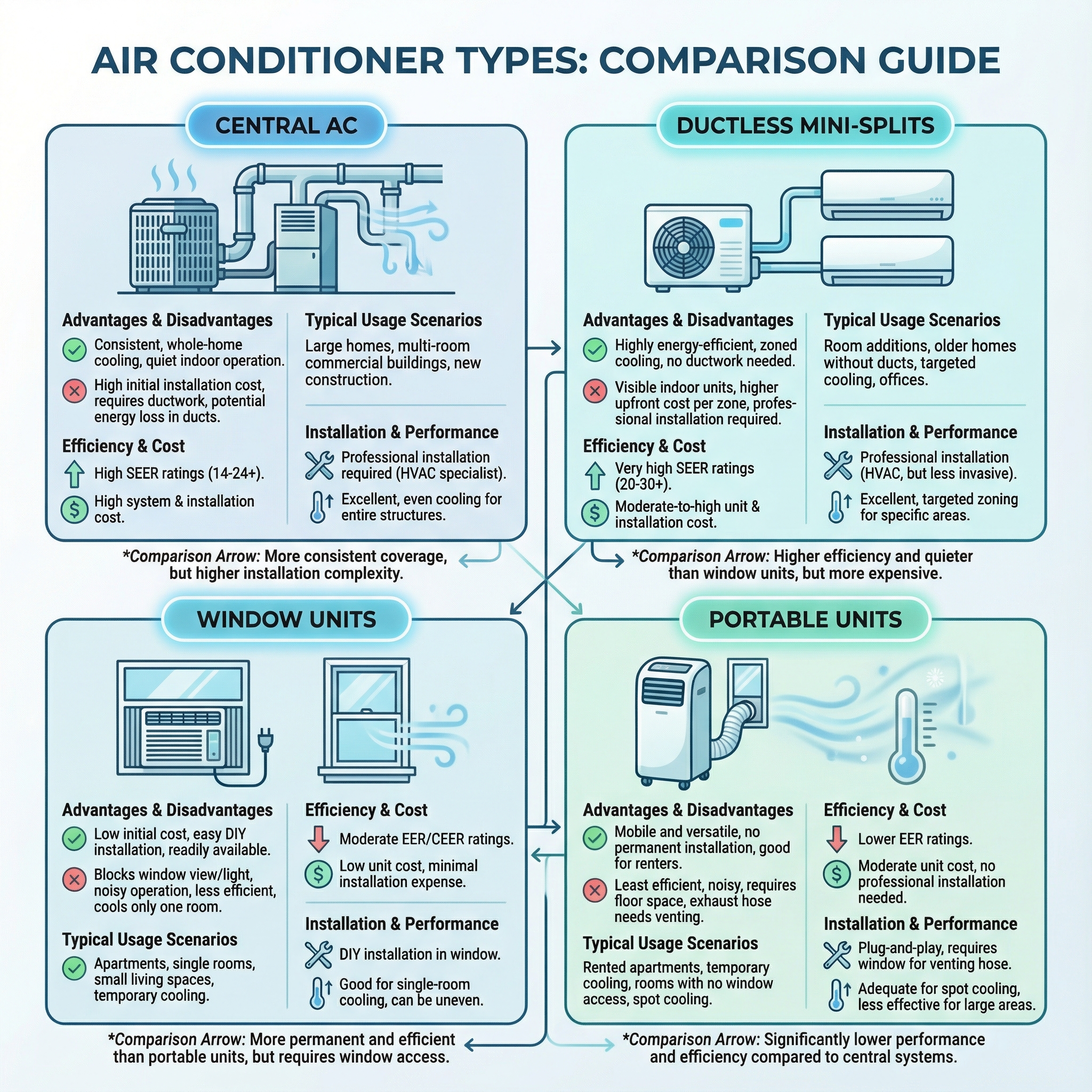
- Central split: Best for whole‑home cooling when you have ducts. An indoor air handler connects to an outdoor condenser. Duct condition and airflow are critical to performance.
- Ductless mini‑split: Ideal for homes without ducts or for zoning rooms, additions, and garages. One outdoor unit can serve multiple indoor heads.
- Window units: Affordable, single‑room cooling for seasonal or rental use. Expect more noise and some window impact.
- Portable units: Temporary room cooling where window installs are not practical. Usually less efficient due to exhaust and room air losses.
- Heat pump options: Choose a heat pump version if you want both cooling and heating in one system, central or ductless.
Variable‑speed and inverter technology act like cruise control, smoothing output for steadier temps and better dehumidification. In our experience at Budget Heating (BudgetHeating.com), these systems feel noticeably more comfortable. Correct sizing via Manual J, quality installation, and tight ducts make the difference.
Maintenance, Safety, and What You Can Do Yourself vs. Call a Pro
Routine care keeps systems efficient and avoids bigger repairs. Here is how to divide the work safely.
- What homeowners can do: Replace or wash air filters every 1 to 3 months. Vacuum supply and return grilles. Keep 2 to 3 feet of clear space around the outdoor unit, remove leaves and gently rinse the coil with a garden hose from the inside out. Check thermostat settings and schedules.
- Safety musts: We advise turning off power at the disconnect or breaker before working near equipment. Never open or modify the refrigerant circuit. Do not pressure wash coils. Leave any gas valve or burner work to licensed professionals.
- Call a professional for: Refrigerant charging or leak checks, electrical diagnostics or repairs, deep cleaning of indoor coils and blowers, condensate drain and pump service, and comprehensive seasonal tune-ups.
When a Given System Isn’t the Best Choice: Climate, Codes and Refrigerant Tradeoffs
Not every high efficiency setup fits every region. Since 2023 the DOE uses SEER2, EER2 and HSPF2. Minimums differ by region, the North has lower baselines, the Southeast and Southwest are higher, and the Southwest adds EER2 requirements. Matching those rules to climate is key, otherwise comfort or peak performance can suffer.
- Hot humid areas: A single stage high SEER2 unit that is slightly oversized can short cycle, leaving indoor humidity high. A better fit is two stage or variable speed cooling with strong dehumidification control, or pairing with a dedicated dehumidifier.
- Southwest deserts: A model with great SEER2 but modest EER2 can struggle during 110 F afternoons and may not meet the regional EER2 minimum. Prioritize high EER2, even if SEER2 is a bit lower.
- Cold winters: Standard heat pumps can lose capacity near or below freezing and lean on electric strip heat. Choose a cold climate rated heat pump with documented low temperature performance and plan for backup heat.
Refrigerant transition: manufacturers are moving from R‑410A to lower GWP A2L options like R‑32 and R‑454B. Always confirm local code acceptance and installer readiness. In areas still adopting A2L provisions, rapid switching can add cost or delay. Where permitted, a compliant R‑410A system may be the practical interim, or plan an A2L install with proper safety measures.
Energy Efficiency Explained: SEER, SEER2, EER2, ENERGY STAR and Real‑World Savings
SEER measures seasonal cooling efficiency in a lab. SEER2 uses the DOE 2023 M1 test with higher external static pressure, closer to real ductwork, so the same unit typically scores lower numerically. Do not compare SEER to SEER2 one to one. EER2 shows full-load efficiency at 95°F, helpful for very hot afternoons.
Market guide: ENERGY STAR central ACs start around 15.2 SEER2, and certain tax credits often require about 17 SEER2, sometimes with a minimum EER2. In our experience at Budget Heating (BudgetHeating.com), those thresholds can unlock valuable rebates.
- Savings: moving from entry SEER2 to 15.2 can cut cooling use about 10 to 15%. Jumping to 17 SEER2 lands roughly 20 to 30%, depending on climate and runtime.
- Climate tips: hot, long seasons target 17+ SEER2 with strong EER2. Mixed climates 15.2 to 16 SEER2. Mild or short seasons, modest SEER2 is fine.
Common Buying and Sizing Mistakes (and How to Avoid Them)
After decades in HVAC, we see the priciest mistakes come from myths. Avoid these:
- Bigger is not better: oversized systems short cycle, leave rooms clammy, create hot spots, and waste energy, like a car stopping every block.
- Cranking the thermostat to 60 does not cool faster; it only runs until that setpoint and risks overshooting comfort.
- Refrigerant is not a consumable; if you need a recharge, there is a leak that must be located and repaired first.
- Closing vents rarely saves money; it raises static pressure, worsens duct leakage, reduces airflow, and can freeze coils.
- Brand alone cannot fix design; ductwork, sizing, charge, airflow, and commissioning drive real performance.
- Highest SEER is not always best value; weigh climate, utility rates, run hours, and realistic payback against higher upfront cost.
Upfront Cost vs Lifetime Operating Cost: Expected Savings, Paybacks & Incentives
Think in life-cycle terms: purchase, installation, energy, maintenance, and repairs over 10 to 15 years. In our experience, the lower utility spend from a right-sized, higher SEER2 system often outweighs a higher purchase price, especially in hot climates with long cooling seasons.
- Upgrading from older 13 SEER to ENERGY STAR level ~15.2 SEER2 typically trims cooling bills about 17 percent.
- Moving to ~17 SEER2 lands near 20 percent savings.
Those percentages translate into faster paybacks where AC runs many hours, but in cooler regions the payback can be modest. Routine maintenance reduces breakdown risk and can recover lost efficiency, which protects savings and equipment life. Replacing aging, low SEER equipment with a correctly sized higher SEER2 unit often lowers total 10 to 15 year ownership cost. Incentives, where available, can shorten payback by offsetting upfront spend, but usage and local utility rates drive the core math.


Installation Quality, Contractor Vetting and Warranty Considerations
Performance and warranties hinge on workmanship and proof. Treat the install like a documented project, not a handshake. In our experience, these are the non negotiables:
- Ducts: test, seal, and insulate. Verify duct capacity matches equipment. Use Manual S to confirm sizing to ductwork, check blower CFM per ton and external static pressure.
- Installation quality: nitrogen purged brazing, deep vacuum to manufacturer spec with a micron gauge, new filter drier, and refrigerant charged by weight. Capture commissioning data: supply and return temps, superheat, subcooling, static pressure, CFM, and controls setup.
- Electrical and placement: correct breaker and wire size, disconnect, clearances, condensate management, and proper line set size and routing.
- Controls and zoning: thermostat compatibility, zoning dampers, and safeties.
- Future proofing: refrigerant type and parts availability.
- Improve the envelope before upsizing.
- Rebates, incentives, and permits: confirm eligibility and inspections.
- Vetting: licensing, insurance, Manual J, S, and D, plus AHRI matched certificate.
- Apples to apples bids with model numbers and scope.
- Warranties and acceptance: confirm terms, who registers, keep all docs, and sign a final commissioning checklist.
Next Steps: Get a Load Calculation, Compare Quotes, and Protect Your Investment
The best AC choice aligns system type, capacity, efficiency, and installation with your home and budget. Start with a proper Manual J load calculation. Choose the right category for your space based on ducts, climate, and zone needs. Prioritize SEER2 and EER2, and consider variable speed when comfort and humidity control matter. Request multiple detailed quotes that spell out equipment, scope, warranty, and commissioning, and weigh life cycle cost along with the bid. Protect performance with routine maintenance.
Whether you are replacing a tired unit or planning a remodel, we can help you size, compare, and select with confidence. Our U.S.-based technical team has 30+ years in HVAC and has supported over 200,000 orders online.
- Get a Custom Quote: send your project details for Manual J assisted sizing and a matched equipment list.
- Talk to Our Team: call our U.S.-based specialists for brand-neutral advice and real phone support.
- Shop Air Conditioners, Heat Pumps, and Ductless Mini Splits at wholesale pricing, many items ship free, financing with Affirm.
- Have bids already? Share them for an apples-to-apples comparison before you decide.
 Heating
 Money Saving Tips
 Product and Brands Insights
 Buying Guides
 State by State
 HVAC Systems