




 learning center

When Should You Start Thinking About Purchasing a New Furnace?
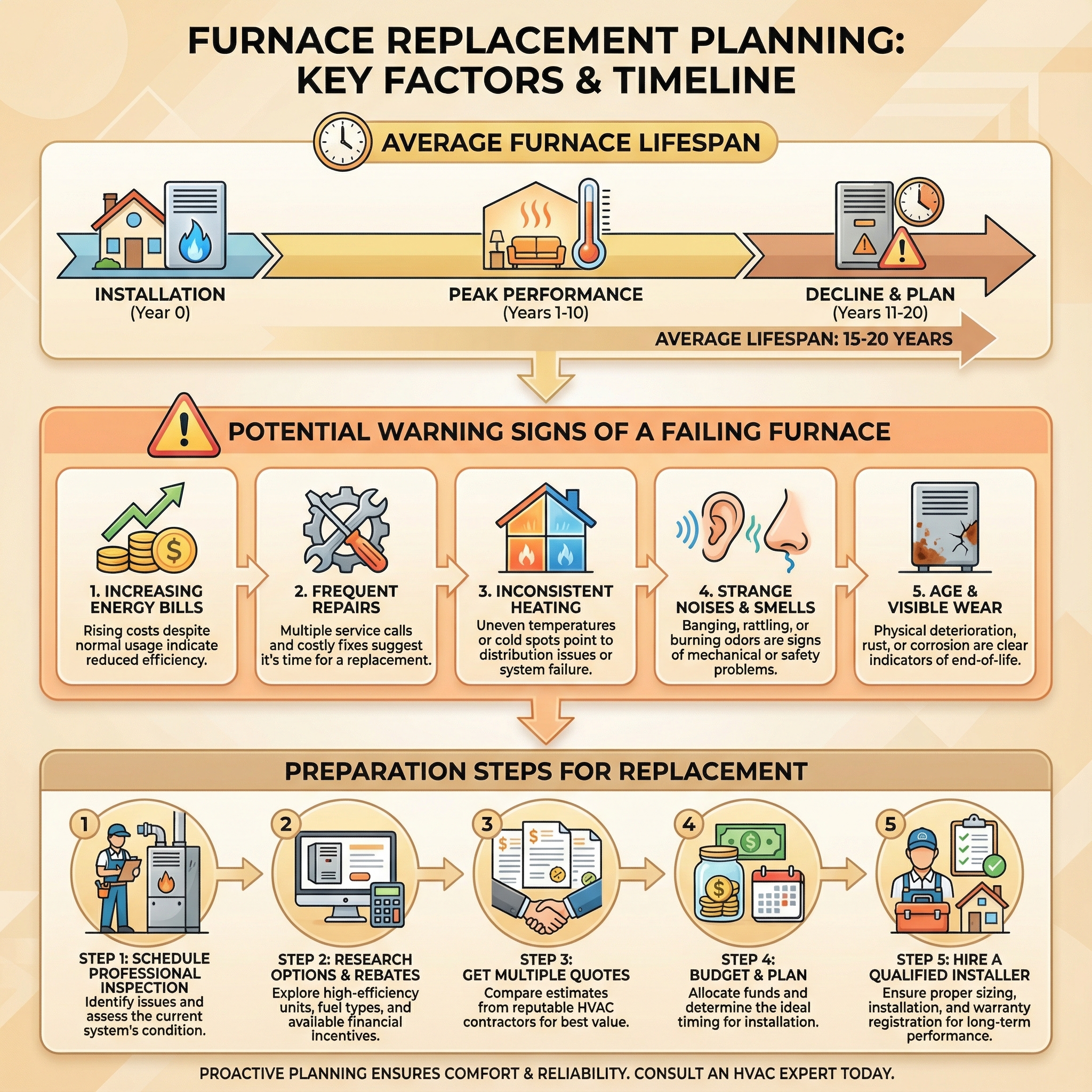
Think about a new furnace before it fails, the way you replace tires before a blowout. Most units deliver 15 to 20 years of service. As yours nears that window, watch for rising energy bills, uneven rooms, repeated repairs, or safety issues. We recommend planning 6 to 12 months before heating season and roughly 1 to 2 years before expected end of life. That timeline lets you weigh repair versus replacement, compare high efficiency models, schedule proper load calculations and quotes, and capture off season pricing and incentives. Proactive planning helps you avoid a midwinter emergency, when choices are limited, costs are higher, and the result may not be the best fit for your home or budget.
How Long Do Furnaces Typically Last: Age, Wear, and When to Start Shopping
Most furnaces last 15 to 20 years. Around year 15, start planning to replace even if it runs, because wear rises, efficiency fades, and the risk of a cold weather failure grows.
- Efficiency: Older 80 percent AFUE units waste fuel. Modern condensing models reach 90 to 99 percent AFUE and often cut fuel use while improving comfort.
- Repairs: If one repair nears 50 percent of a new system, replacement is usually the better value.
- Performance: Uneven rooms, longer cycles, or new noises signal end of life, especially with spotty maintenance.
Planning ahead lets you pick the right size and features on your terms, not during an emergency.
Key Signs Your Furnace Is Nearing the End of Its Life (Safety & Performance Red Flags)
When a furnace is fading, safety comes first. In our field work, the most serious failures involve combustion, which can create carbon monoxide. Treat the following as urgent and arrange immediate inspection:
- Yellow or flickering burner flame instead of steady blue
- Soot on burners, inside the cabinet, or at registers
- Exhaust odors or any CO alarm activation
- Frequent lockouts, booming starts, or new rattles
- Rust, water streaks, or poor draft at the vent
If a cracked heat exchanger or other major combustion defect is found, replacement is often the only safe option. Repeated performance issues after years of light maintenance usually point the same way.
Solid care can extend life: annual professional tune ups, routine filter changes, proper clearances, adequate combustion air, and correct vent sizing or PVC routing with condensate management on condensing models. Keep CO detectors on each floor and near bedrooms, and have gas pressures, temperature rise, and CO levels checked regularly.
Energy Efficiency & Sizing: AFUE, BTU, SEER2/HSPF2 and When to Consider a Heat Pump
AFUE shows how much fuel becomes heat over a season. Older non-condensing furnaces are often 70 to 80% AFUE. Modern condensing models reach 90 to 99% by pulling extra heat from flue gases. BTU output should align with the calculated load to avoid short cycling and wasted energy.
We look at the whole system since the furnace cabinet and blower also serve cooling. SEER2 and EER2 rate cooling, and HSPF2 rates heat pump heating. An ECM or variable-speed blower cuts electrical use and smooths airflow, helping SEER2-compliant coils perform as designed. Matching indoor and outdoor components preserves efficiency ratings and keeps options open for a future air conditioner or heat pump.
- Not ideal: planning an all-electric home. Alternative: a heat pump with HSPF2-rated indoor equipment.
- Not ideal: replacing like-for-like oversized BTU. Alternative: select right-sized equipment verified with Manual J/S/D.
- Not ideal: pairing a new SEER2 outdoor unit with an old blower. Alternative: upgrade the furnace or air handler for a matched system.
Cost Considerations: What to Budget for a Furnace Replacement
Exact prices vary, and we see wide swings because every home is different. Installed cost is driven by what you buy and what it takes to install it safely and correctly.
- Efficiency rating and furnace size
- Installation complexity and access
- Duct or vent changes, plus gas or electrical upgrades
- Permits and inspections in your jurisdiction
- Regional labor rates and climate
Budget for the life cycle, not just day one. Use AFUE to estimate fuel use, combine with your local fuel price, then project 15 to 20 years and add routine maintenance. Compare the premium for higher efficiency to annual savings to find a payback horizon. Finally, subtract any incentives and rebates mentioned earlier to reach your net cost.
Common Mistakes Homeowners Make When Deciding to Replace a Furnace
Deciding when to replace a furnace can feel tricky. In our experience at Budget Heating (BudgetHeating.com), planning beats panic every time, and a few common myths tend to derail good decisions.
- Waiting for a total breakdown: Emergency swaps often cost more, limit choices, and can leave you without heat during the coldest weather.
- Chasing the lowest upfront price: A bargain unit with poor AFUE can drive higher monthly bills. Look at lifetime cost, not just the sticker.
- Skipping professional sizing and install: Proper design and setup, including Manual J, S, and D, prevent short cycling, uneven rooms, noise, and early wear. An oversized furnace is like shoes two sizes too big, you can walk, but not comfortably.
- Assuming timing does not matter: Buying in early fall often means better availability and promotions, without rush fees.
- Ignoring early warning signs: Rising bills, frequent repairs, strange noises, and comfort issues are cues to evaluate replacement before failure.
Plan ahead, compare total ownership costs, and work with a qualified pro to match the furnace to your home.
How Regional Climate and Regulations Affect When and What to Replace
Heating needs are local. In cold or mountain climates, high AFUE furnaces or cold-climate heat pumps pay off. Mixed-humid areas need balanced heating and cooling and careful right sizing. In hot-dry regions, avoid oversizing the furnace, favor strong blower performance and good duct design. Altitude derates gas input, so sizing and venting change. Start with a Manual J that includes insulation, windows, duct leakage and sun. Regulations matter too: DOE lifts most gas furnaces to 95% AFUE on 12/18/2028, and SEER2/HSPF2 since 2023 require matched systems and sometimes TXVs. Southern regional AC minimums limit legal pairings. Permits cover combustion air, venting, condensate and CO alarms, with some cities nudging electrification. Federal 25C credits through 2032 plus utility rebates can cut net cost. In our experience at Budget Heating (BudgetHeating.com), checking incentives early often reshapes the decision.
Homeowner Checklist: How to Prepare, Evaluate Quotes, and Vet Installers
Use this quick plan to decide whether to repair or replace, and to buy with confidence.
- Decide if it is time: At 15 to 20 years, begin planning. If a major repair is over about 50 percent of a new system, or breakdowns are frequent, prepare for replacement. Watch for uneven heat, short cycling, high bills not tied to fuel prices, and any safety flags like CO alarms or burner instability. Try to plan before peak season.
- Clarify goals: Comfort, budget, target efficiency, and noise priorities.
- Require Manual J, S, and D: Ask for a room by room Manual J load calculation, Manual S to match equipment output to that load, and Manual D to verify duct sizing and airflow. Think tailor, not off the rack.
- Inspect ducts: Test static pressure and leakage, seal and insulate where needed, and confirm adequate return air and proper sizing. Commissioning should verify airflow, temperature rise, and CO.
- Quotes and vetting: Get written Manual J, S, D with model numbers. Confirm permits, insurance, installer certifications, and that commissioning will include static pressure, gas manifold pressure, temperature rise, and CO. Compare parts and heat exchanger warranties, plus any labor coverage.
- After install: Register warranties, keep manuals and commissioning reports, record filter sizes and change intervals, and schedule a first year tune up.
Next Steps: Get Quotes, Schedule an Inspection, and Plan Your Purchase
If you are weighing when to start thinking about purchasing a new furnace, move from research to action before peak heating season. Here is a concise path:
- Schedule a professional inspection to document current condition and any safety issues.
- Request a Manual J load calculation to right size the new furnace for your home.
- Obtain 2 to 3 written bids that list model numbers, efficiency, scope, warranties, and timelines.
- Confirm lead times and target a shoulder season install date when possible.
- Check incentives using your regional_or_regulatory_context, then align with the homeowner_checklist to finalize permits and accessories.
Decide Before a Crisis: Plan, Compare, and Replace on Your Schedule
Plan before a breakdown. If your furnace is 15 to 20 years old, or you see rising bills, frequent repairs, loud operation, corrosion, a yellow or unstable flame, or hard to find parts, start comparing repair costs to the installed price of a higher efficiency unit and the next 10 years of fuel savings. Begin 6 to 12 months ahead, ideally 1 to 2 years before failure, to avoid rushed choices and to align with 2028 AFUE changes and SEER2 cooling matches.
You are not alone in this decision. With 30 plus years in HVAC and 200,000 orders fulfilled, our team can right size your system and schedule replacement on your terms.
- Get a Custom Quote
- Talk to Our Team, U.S.-based phone support
- Shop Furnaces
- Ask about rebates and Affirm financing
 Cooling
 Heating
 Money Saving Tips
 Product and Brands Insights
 Buying Guides
 State by State
 HVAC Systems