




 cooling
 learning center
What Size Air Conditioner Do I Need for a 1,500 Sq Ft Ranch? Quick Answer
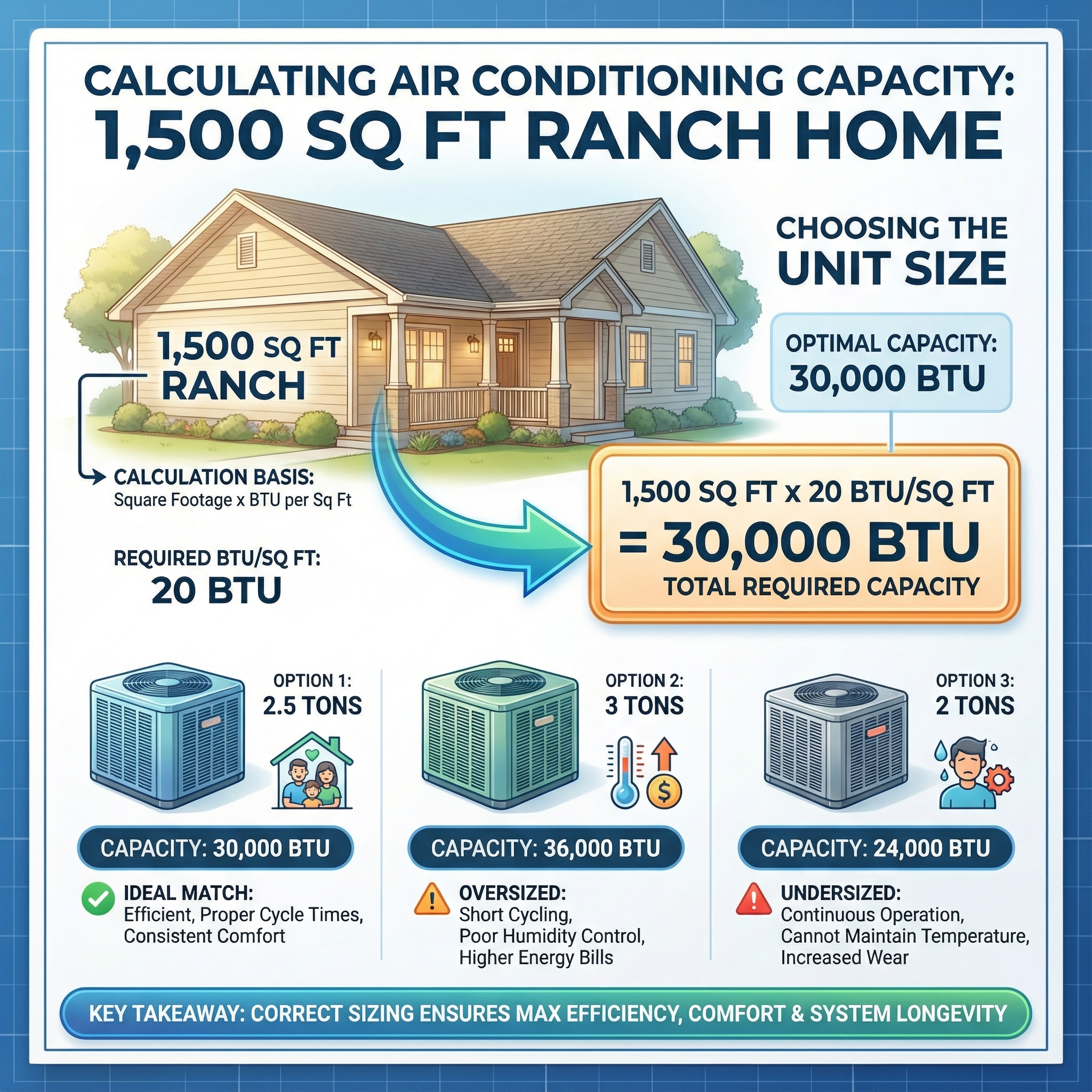
A practical baseline is the BTU per square foot rule of thumb: plan about 20 BTUs for each square foot. For a 1,500 sq ft ranch, that works out to roughly 30,000 BTUs, about 2.5 tons. In our day to day sizing, this is the starting point we use. Think of capacity like choosing a bucket for a spill, undersized overflows, oversized is sloppy. Use this baseline to frame your choice, then fine tune to the specifics of the home.
How Air Conditioner Capacity Is Measured: BTUs vs Tons (and What Those Numbers Mean)
When we size cooling, we look at capacity, the rate at which heat is removed, in BTU per hour. Spec sheets often list tons. One ton equals 12,000 BTU/h, so 2 tons is 24,000 BTU/h and 3 tons is 36,000 BTU/h. Capacity is the bucket size. SEER or SEER2 is efficiency, how much electricity it takes to deliver that cooling, and it does not change the required BTU or tons.
For context, a 1,500 sq ft ranch typically falls under 45,000 BTU/h. Rule-of-thumb ranges you may see, about 18-25 BTU/ft², translate to roughly 27,000-37,500 BTU, about 2.25-3.1 tons.
Simple Rule of Thumb: Typical BTU and Ton Guidelines for a 1,500 Sq Ft Ranch
For a well insulated, average load 1,500 sq ft ranch, a 2.5 ton central AC, roughly 30,000 BTU, is a very common starting point. Many similar homes land between 2.5 and 3.0 tons once sun exposure, window area, duct quality, ceiling height, and climate are considered. Think of sizing like shoe fit: too big or too small both feel wrong.
Oversizing causes short cycling, poor dehumidification, temperature swings, more noise, higher wear, and extra cost. Undersizing forces long run times and creates hot spots. Right sizing delivers reliable cooling, manageable bills, even comfort, and better humidity control. In our experience at Budget Heating (BudgetHeating.com), a correctly matched, well installed and routinely maintained system typically provides about 15 to 20 years of service.
Key Factors That Change AC Size for a Ranch Home (ceiling height, insulation, windows, sun exposure, occupancy, climate)
From what we see in the field, even with the same square footage, ranch homes can need very different AC sizes. Here is how to self-check where yours lands:
- Climate: hotter, more humid regions demand more capacity per square foot. Cooler or drier climates need less.
- Insulation and air sealing: tight attics, insulated walls, and low leakage let you stay at or below baseline. Drafty shells push size upward. Think of a cooler with a snug lid compared to one left cracked open.
- Windows and sun exposure: large south or west glass, minimal shading, or skylights add solar gain. Efficient glazing and shades pull requirements down.
- Ceiling height and layout: vaulted or 9 foot ceilings increase volume. Open plans and long single story runs typically raise airflow needs and cooling load.
- Occupancy and internal gains: add about 400 to 600 BTU for each person beyond two. Busy kitchens, lighting, and electronics also add heat.
Ductwork and Installation Considerations for a Ranch Layout
In ranch homes, capacity only turns into comfort when ducts and commissioning are right. From our field installs, undersized or leaky ducts can wipe out a correctly sized AC. Have ducts checked for size, layout, leakage and balance; permits and a professional Manual D are typical when modifying runs.
- Electrical and placement: confirm panel, breakers and wiring meet amp draw, and verify indoor and outdoor clearances.
- Commissioning: set design airflow, confirm refrigerant charge, balance the system, and commission thermostats and controls.
- Safety and certified work: shut off power at the breaker and outdoor disconnect. If the air handler shares a gas furnace, use CO detectors. Major electrical, gas and refrigerant tasks belong to certified technicians.
Why a One-Size-Fits-All Rule Can Be Wrong (When to Adjust Up or Down)
Skipping a Manual J is the classic misstep. Common myths: square footage sets the size, bigger is better, and a 1,500 sq ft ranch always needs 2.5 tons. In reality, insulation, window area and orientation, ceiling height, and climate drive the load.
Size down in milder climates with excellent insulation, tight air sealing, and good shading, often 2 to 2.5 tons. Size up in hotter, sunnier areas or homes with poor insulation, lots of west or south glass, or tall ceilings, sometimes 3 to 3.5 tons. Oversizing hurts comfort and humidity and wears parts.
Rules of thumb are poor fits for high-performance builds, complex additions or multi-zone layouts, or homes with unusual internal gains. Better options include a full Manual J, variable-capacity equipment, zoning, or ductless mini splits.
Example Sizing Calculation for a 1,500 Sq Ft Ranch (Step by Step + Manual J Basics)
Here is a quick screen to frame expectations, then why a Manual J is the authority.
- Step 1: Confirm conditioned area. Exclude garages, unconditioned attics, and unfinished basements.
- Step 2: Screening estimate. A typical 1,500 sq ft ranch with average insulation and double pane windows in a moderate climate often falls under 45,000 BTU/h, so review equipment that aligns with that category.
- Step 3: Recognize what shifts the load. Roof color, shading, orientation, and appliance or occupancy gains can move the number meaningfully.
- Step 4: Run a Manual J. It formally includes conditioned square footage, insulation values, window sizes and orientation, local climate data, infiltration, internal gains, and occupancy. These inputs can change a napkin estimate by a notable margin.
Insist on a professional Manual J load calculation, and consider Manual D for duct design. Manual D sizes ducts to deliver each room's required airflow using layout, friction rate, and available static pressure, which prevents hot or cold rooms and noise. Once Manual J sets the tonnage for this 1,500 sq ft home, verify the selected model's ratings match the calculated load and the sub 45,000 BTU/h planning note.
Choosing the Right System Type: Central Air, Ductless Mini Split, Window, or Portable
Match the system to the space and comfort goals:
- Central air: Best for whole homes with ducts. Quiet, even temperatures, strong dehumidification. Pairs well with two stage or variable speed compressors and zoning dampers, but higher installed cost.
- Ductless mini split: No ducts needed. Built in room zoning and usually variable speed for precise temps and enhanced dehumidification. Great for additions or older homes. Higher cost per room and visible indoor heads.
- Window AC: Low upfront price for a single room. Louder, blocks a window, limited efficiency and control options.
- Portable AC: Easiest to move and install, but least efficient and noisiest. Modest moisture removal.
Verify equipment meets current regional SEER2 and, where applicable, EER2 minimums. Check utility rebates, tax credits, and warranty terms, which often vary by rating and system type.
Estimated Costs: Units, Installation, and Running Costs (Central vs Ductless vs Window)
When you compare bids for central, ductless, or window units, the big cost drivers are size in tons and efficiency rating in SEER or SEER2. Upfront equipment and install costs rise with both. Your ongoing electric bill is mostly governed by efficiency and local electricity rates.
Quick primer: SEER and SEER2 measure seasonal efficiency, like miles per gallon for cooling. Most models in this home range sit in the mid teens. Each step from about 14 up toward 20 typically trims seasonal cooling use by roughly 6 to 7 percent per step. Expect price jumps to track that efficiency step. For example, a 16-SEER model can run about $1,500 more than a comparable 14-SEER model, though premiums vary by brand and market. Payback depends on your kWh rate, total cooling hours in your climate, and how long you will own the home. In our experience at Budget Heating (BudgetHeating.com), that math often favors a modest step up.
Regulations matter too. Since 2023, minimums by region are roughly: North 13.4 SEER2, Southeast 14.3 SEER2, Southwest 14.3 SEER2 with EER2 requirements. Some federal incentives require at least 17 SEER2 and specific EER2, so check local rules.
Right sizing is key. Correct tonnage avoids paying for capacity you will not use and helps you capture the full benefit of an efficiency upgrade. For many homes, proper sizing plus a moderate SEER step is the best value across system types.
Next Steps: How to Get an Accurate Quote and What Info to Provide Your Contractor
Treat a 2.5 ton unit as a starting estimate for an average, well insulated 1,500 sq ft ranch, then confirm with a professional Manual J and a duct inspection. To get a firm price, ask contractors for the Manual J report, AHRI matched equipment specs listing capacity and SEER2, a written scope for any duct changes, and at least two itemized bids with model numbers and total installed price.
Comparing bids can feel overwhelming. Our team can help you review AHRI matches and price the package correctly, backed by 30+ years of HVAC experience.
- Get a Custom Quote
- Talk to Our Team by phone for quick guidance
- Shop Central AC and Heat Pumps
 Heating
 Money Saving Tips
 Product and Brands Insights
 Buying Guides
 State by State
 HVAC Systems