




 cooling
 learning center

What Size Air Conditioner Do I Need? A Quick Overview
Choosing the right size AC is critical for comfort, humidity control, energy use, and equipment life. After 30+ years sizing systems in all kinds of homes, we see two common mistakes: undersized units that run nonstop and still feel warm, and oversized units that short cycle, leave rooms clammy, and wear out faster.
This overview shows how to get in the ballpark, then refine. We explain BTUs and tons (12,000 BTU per ton), share quick rules of thumb for typical spaces, walk through simple room-by-room calculations, and scale up to whole-home sizing. You will also learn what factors raise or lower the load, such as insulation, window area and orientation, ceiling height, occupancy, duct location, and local climate.
Use these steps in order: start with a quick estimate, check it against room measurements, roll those into a whole-home view, then confirm when a professional Manual J load calculation is the right move. Think of it like choosing the right size jacket: close enough feels okay, but the proper fit performs better all day.
Why AC Sizing Matters: What Happens If You Oversize or Undersize
In our decades of field work, we see comfort and durability rise or fall with sizing. The right capacity keeps temperature and humidity in balance. An undersized unit runs almost nonstop, struggles on the hottest days, and its parts wear out sooner. An oversized unit starts and stops in short bursts, wastes energy, and does a poor job removing moisture. In hot, humid regions, steady, moderate run times are critical because dehumidification matters as much as cooling.
Avoid the urge to buy a larger unit just in case. Oversizing is the most common mistake, and it leaves rooms cool but clammy while shortening compressor and blower life through rapid cycling.
Watch for these red flags:
- Water around the indoor unit
- Iced coils
- Frequent breaker trips
- Burning smells
- Abnormal noises
If you notice any of the above, turn the system off and have a licensed technician inspect it before you restart.
BTU vs. Tons: How AC Size Is Measured (Simple Conversion)
When we talk about AC size, we mean cooling capacity. It is measured as BTUh, British Thermal Units per hour, or in tons. One ton equals 12,000 BTUh. In everyday sizing work, we start with a BTU estimate for the space, then convert to tons with a simple formula: BTU ÷ 12,000 = tons. Quick example: 1,200 square feet multiplied by a planning rule of 25 BTU per square foot is about 30,000 BTU. Divide 30,000 by 12,000 and you get roughly 2.5 tons. Using this conversion lets you translate product specs into real capacity needs and compare options on equal footing.
Step by Step: How to Calculate AC Size for One Room (What to Measure)
Start with the room: measure length and width to get square footage, then write down ceiling height. Rooms taller than 8 ft usually need more capacity per square foot, and big openings to adjacent spaces add effective volume.
- Climate and humidity: hotter, more humid areas push capacity upward. Milder or drier climates can lean lower.
- Insulation and windows: note attic and wall insulation, plus window type, single or double pane and any low E coating. A better envelope lowers required BTU.
- Windows and sun exposure: count windows, record sizes, and note orientation. South or west facing rooms often need an upward bump.
- Room use and occupancy: kitchens, gaming rooms, or spaces with many people and electronics add heat, so adjust higher.
Think of each factor as a dimmer that nudges the estimate up or down from your area baseline. In our experience at Budget Heating (BudgetHeating.com), these notes often change a selection by one size. Use this as a solid preliminary estimate, and for precise whole home sizing rely on a professional Manual J.
How to Size a Central Air Conditioner: Tonnage, Codes & Regional Rules
Most homes land between 1.5 and 5 tons, roughly 18,000 to 60,000 BTUh. A 2,000 square foot home might start near 3 tons, but climate and construction can shift that. Hot, humid regions need extra capacity for moisture control versus milder, drier zones.
In our experience at Budget Heating (BudgetHeating.com), the right path is an ACCA Manual J load calculation. It factors square footage, ceilings, insulation, windows and orientation, occupancy and solar gain, then Manual S picks equipment and Manual D sizes ducts, often required by code.
Know the rules too. Since 2023, SEER2 replaced SEER, and DOE minimums differ between Northern and Southern or Southwestern states. Capacity breakpoints like 45,000 BTU per hour can change which minimum applies. Verify your model meets the load and your region's SEER2 minimum.
Refrigerants are shifting under the AIM Act, moving from R-410A to lower GWP A2L options like R-32 and R-454B, so installs must follow updated safety standards. Bottom line, determine the load, select matching equipment, and confirm compliance before you commit.
Quick Rule of Thumb: Square Footage to BTU (Fast Screen)
For a quick plan, we use a conservative square-foot rule: total conditioned square footage × about 25 BTU per ft². Measure only the spaces you intend to cool, and if possible list area by room or zone so the math is not padded by unused spaces. Example: a hot, sunny 1,000 ft² home lands near 25,000 BTU. Treat this as a screen, then adjust up or down for climate, insulation, windows, and air leakage. Final sizing should account for those details, not just floor area.
Factors That Change the Calculation: Ceilings, Insulation, Windows, Sun & More
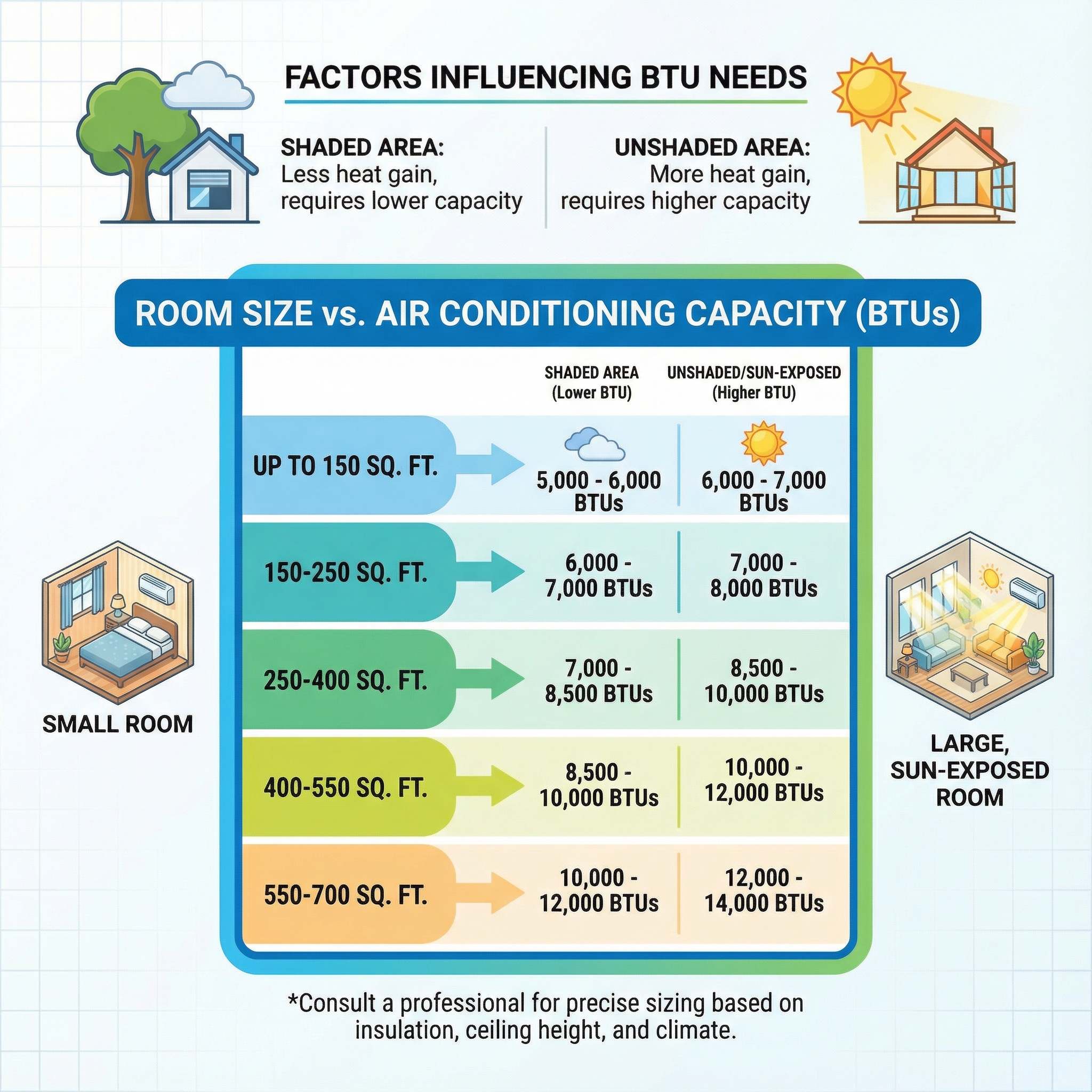
Square-foot rules are a starting point, not the finish line. In the field we see load shift based on how much heat a space gains or holds, like adding or removing blankets. Here is when to nudge your estimate up or down.
- Push the estimate higher: ceilings above 8 feet, thin or missing insulation, many or large windows, single pane or leaky frames, strong east or west sun, dark roofs, hot humid climates.
- Also push higher: more occupants, frequent cooking, servers or gaming PCs, refrigerators, and lots of lighting or electronics.
- Lean lower: shaded or north-facing windows, high performance glass, tight construction with good air sealing and insulation, light roofs, mild dry climates.
- Spaces with few people and minimal plug loads can also justify a lower number.
Windows, orientation, local humidity, occupancy, and appliances each change sensible and latent load. When several heat adders stack together, size up slightly. When most are mitigated, size down carefully.
When to Use an Online BTU Calculator: Tradeoffs, Limitations & Common Mistakes
We treat online BTU calculators as a first pass, helpful for a single room with typical construction, average insulation, standard ceiling height, and modest windows. Think of them like a paper map that shows direction, not every turn. For whole homes or anything atypical, use them only to screen options, then refine with measured factors and a professional Manual J.
- Plan on a Manual J if your home has multiple zones, unusual construction, open concept layouts, or you are replacing a whole system.
- Not ideal for high ceilings, large glass, heavy sun, or humidity concerns. A room by room Manual J, duct evaluation, and dehumidification load check work better.
- Not ideal when ducts are borderline, leaky, or restricted. Duct design review is the better path.
- Buying on price alone leads to poor comfort and higher long term cost.
- Undersizing to save money raises energy use and shortens equipment life.
- Bigger is not better. Oversizing short cycles and reduces dehumidification.
- One size for every room is wrong. Kitchens, bedrooms, and living rooms differ.
- Simple square foot rules ignore ceiling height, insulation, and solar gain.
When comparing bids, ask for the recommended size, assumptions, and whether climate, insulation, ceiling height, windows, occupancy, duct design, and dehumidification were included. If sizes differ a lot, request each contractor's calculations.
Inverter, Split and Window ACs: Sizing Differences, SEER & Sleeve Sizes
Inverter mini splits modulate output to match the load, while conventional split systems and many window or through-the-wall units cycle on and off. Sizing is about capacity in BTU or tons, not efficiency. Typical room benchmarks: bedrooms 6,000 to 10,000 BTU, living rooms or open areas 12,000 to 18,000 BTU, large open-concept zones 24,000 BTU or more. Once size is correct, SEER determines operating cost. SEER, the Seasonal Energy Efficiency Ratio, reflects seasonal kWh per unit of cooling. Modern systems often start around 13 to 14 SEER, many solid choices are 14 to 16, and premium models reach about 21 to 25. Newer 14 to 15 SEER gear typically uses about 20 percent less energy than older 10 SEER units. Rule of thumb: about 7 dollars per additional SEER point per month versus a 13 SEER baseline. Examples: upgrading a 9 to 16 SEER 3 ton can save roughly 514 dollars per year, while 14 to 17 SEER is closer to 66 dollars per year. Window and through-the-wall picks are often limited by the sleeve opening, so fit can dictate capacity. Determine tonnage first, then weigh SEER, local rates and incentives for the best life cycle cost.
Next Steps: Shopping, Installation Considerations and When to Call an HVAC Pro
Start with a quick screen: plan roughly 20 to 30 BTU per square foot, lower for cooler climates, good insulation and lower ceilings, higher for hot, sunny homes, poor insulation and tall ceilings. Bump sizing for large window areas, busy kitchens and more occupants, reduce for heavy shading and high performance insulation. Measure your spaces and note insulation, windows, ceiling height, sun and occupancy, then refine. For whole home or complex projects, have a pro run a Manual J for precise, code compliant sizing.
- Maintenance: check filters monthly, replace every 1 to 3 months, keep vents clear, maintain 2 to 3 ft around the condenser, gently rinse the outside coil.
- Safety: shut power off before cleaning, wear gloves and eye protection, avoid bending fins and harsh chemicals.
- Call a pro for: load calculations, refrigerant work (EPA 608), line sizing, brazing, evacuation, airflow setup and commissioning, electrical diagnostics, combustion venting and CO protection, inside cabinet work, duct sealing and permits.
Bottom line: start with square footage, finish with proper design and commissioning for comfort and efficiency. If this feels like a big decision, it is, and getting it right protects performance and warranties. We have 30+ years in HVAC and guide you from selection to startup.
- Get a Custom Quote
- Talk to Our Team by phone for real technical guidance
- Shop Heat Pumps with wholesale pricing, many items ship free, financing with Affirm
 Heating
 Money Saving Tips
 Product and Brands Insights
 Buying Guides
 State by State
 HVAC Systems