





 heating
Geothermal Heating & Cooling: What This Guide Will Help You Decide
Geothermal, also called ground-source, uses the earth's steady temperatures to move heat in or out of a building. It does not create heat, it transfers it, like a conveyor belt for warmth and cooling. That difference is the source of its efficiency and the reason upfront costs can trade for long-term savings. This guide sets clear expectations for homeowners and small builders, weighing installation price, operating costs, comfort, and lifespan, so you can compare heat transfer to heat generation and judge if geothermal fits your site, climate, and budget.
How Geothermal Systems Work: The Basics in Plain English
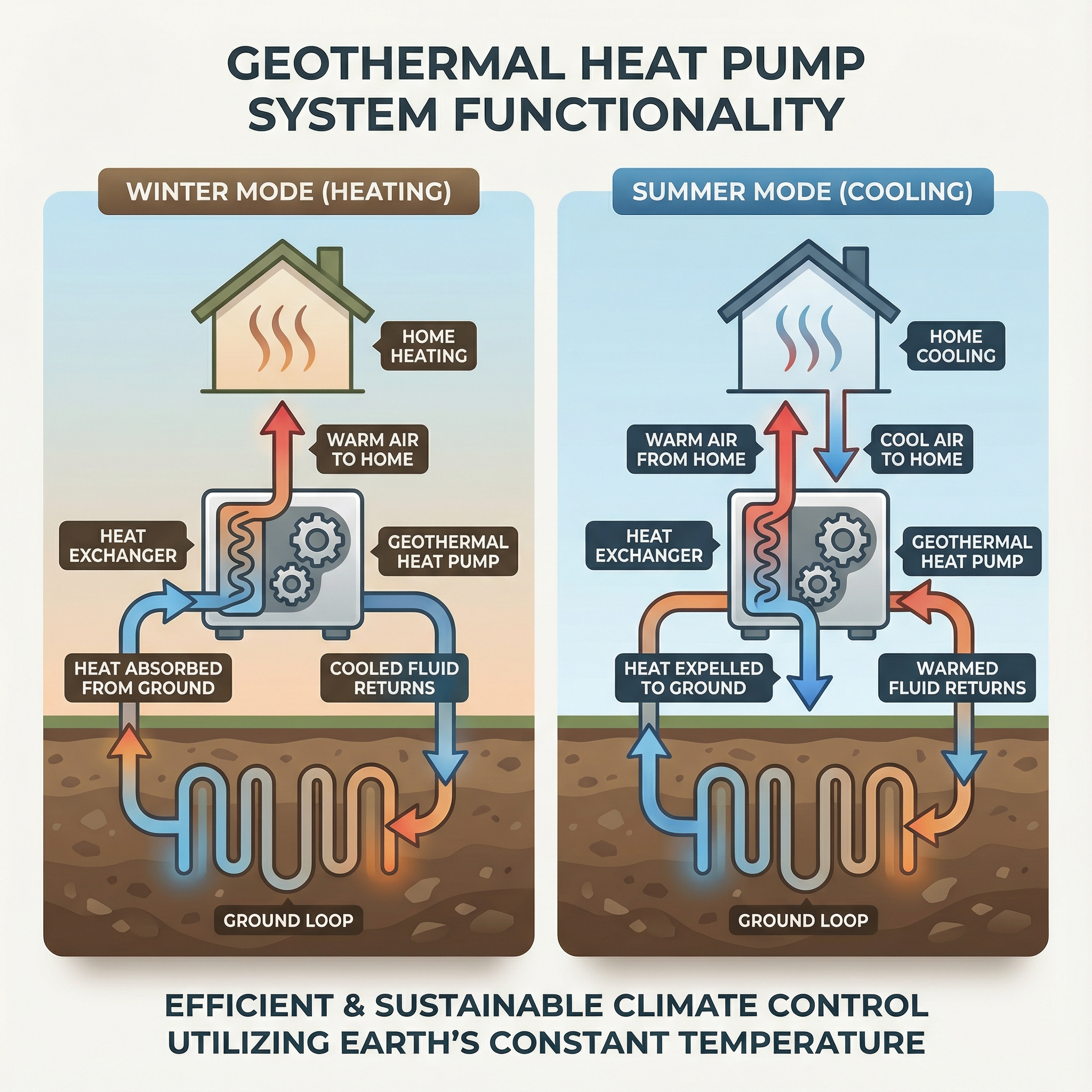
Think of a geothermal heat pump as a refrigerator that can run either way. A buried loop trades heat with steady ground temps, feeding an indoor heat pump. The compressor moves refrigerant through evaporator and condenser, and a reversing valve flips flow for heating or cooling. Air handlers or hydronic coils deliver comfort. Because it moves heat, not makes it, efficiency holds in extremes. From decades of installs, we see indoor units, with fewer moving parts and no weather, stay quiet, steady, and reliable for years. Water to water units and desuperheaters can assist domestic hot water or pools. Per dollar, it often removes more kWh than some supply upgrades.

Types of Geothermal Systems: Closed Loop, Open Loop, Pond, Vertical & Horizontal
Geothermal systems center on the ground loop and the heat pump it feeds. In closed loop designs, we bury a continuous pipe filled with water or antifreeze that circulates in a sealed circuit, like a long radiator tucked into the earth. Open loop, sometimes called standing column, draws usable groundwater and returns it to a discharge well or outfall, and it requires proven water quality and quantity plus stricter permitting.
Horizontal closed loops need ample yard space and dig friendly soils. Vertical bores suit tight lots or rocky sites and minimize surface disruption. Pond or lake loops sink coils below the surface when a permanent, adequately sized water body is available. Loop field sizing must match the building load. Undersize and comfort suffers. Oversize and costs rise without real gain.
Typical Installation Cost Ranges: What Homeowners Actually Pay
Installed pricing is easiest to compare per ton, an apples-to-apples metric. In our experience, air-source heat pumps often land near $3,000 per ton installed. That puts typical totals around $6,000 to $9,000 for 2 to 3 tons, $12,000 for 4 tons, and about $15,000 for 5 tons.
Geothermal systems trend higher before incentives, commonly starting around $5,000 per ton and reaching $8,000 to $9,000 per ton. That translates to roughly $15,000 to $27,000 for a 3 ton job, and $20,000 to $45,000 for 4 to 5 tons.
Quotes cluster toward the high end when drill depth increases, loop type gets more complex, regional labor rates run high, or the lot is tight and access is limited. If two bids are close on capacity, use the per-ton figures above to benchmark whether the install numbers are in the expected lane.
When Geothermal May Not Be the Best Choice: Honest Tradeoffs and Alternatives
In our field experience, geothermal shines where loads are high or weather is extreme. It is less compelling in mild climate homes with short runtimes. It also fits owners who will stay long term, especially in new builds or major renovations. If you plan to sell soon or have a very small, low load home, the math is tougher. Site constraints can matter too, although vertical bores mean a big yard is not required. Remember, systems heat and cool, and a backup heater is not always needed when the loop is sized correctly.
- Tight budgets or mild loads: choose a high efficiency air source heat pump.
- Cold snaps or existing gas infrastructure: consider a hybrid system, furnace plus heat pump.
Cost Breakdown: Equipment, Loop Field, Drilling, and Labor, Where the Money Goes
Think of a geothermal project as a pie. The biggest slice is usually the ground work, trenching or drilling. In our experience at Budget Heating (BudgetHeating.com), loop field work is the largest line item. Rig mobilization and bore footage can dominate on tight lots or hard rock, and can make some sites infeasible. The main downside is the high upfront cost.
- Indoor heat pump: the inside unit, sized by tonnage.
- Ground loop materials: HDPE pipe, grout, and antifreeze.
- Pumps and flow center: circulators, flush ports, and insulation.
- Drilling or trenching: rig time, footage, excavation, backfill, and yard repair.
- Labor and permits: design, set, flush, startup, and inspections.
Equipment and labor make up most of the remaining spend.
Operating Efficiency & Energy Savings: COP, EER and Real World Bill Reductions
Geothermal heat pumps are rated in cooling by EER and in heating by COP under AHRI and ISO test conditions. Because homeowners know SEER, a SEER equivalent is often shown for apples to apples comparisons. Premium geothermal packages reach roughly SEER equivalent 30, and in our field experience most real installs land in the high teens to high 20s.
What it means for bills: higher EER or SEER equivalent cuts kWh. Moving from SEER 15 to SEER equivalent 30 roughly halves cooling electricity. In practice, geothermal trims combined heating and cooling energy about 20 to 60 percent, with dollar savings commonly around 1,200 dollars per year depending on climate and runtime.
There is also a carbon benefit: using electricity to move heat reduces on site combustion and shrinks household emissions. Regulatory note: federal SEER minimums apply to air source systems, not geothermal, so incentives typically hinge on EER, COP and ENERGY STAR tiers.
Incentives, Rebates & Tax Credits That Cut the Upfront Price
The biggest price reducer is the Federal Residential Clean Energy Credit (IRC 25D), a 30% tax credit for qualifying residential geothermal systems, and ENERGY STAR requirements apply. That credit directly lowers your net installed cost and shortens payback. Many states and utilities also add rebates or offer low interest financing, which can stack with the federal credit for a meaningful first cost offset.
Eligibility is document driven. Many programs require ENERGY STAR qualified units and an AHRI certificate that matches the exact equipment combination installed. Some also require certified installers or adherence to IGSHPA or CSA standards. Local drill permits, groundwater rules, and code inspections can affect both eligibility and timing. In our experience at Budget Heating (BudgetHeating.com), lining up permits and AHRI paperwork early keeps incentives on track.
Maintenance, Safety & Expected Lifespan: What Ongoing Ownership Really Looks Like
Monthly homeowner checks: filter, thermostat, condensate, look and listen. Book yearly pro service, about $150 to $300. Leave refrigerant, electrical, loop and antifreeze handling, hydronic plumbing, and ductwork to licensed pros. Refrigerants and loop fluids (propylene glycol or methanol/ethanol) are hazardous, prevent spills and dispose properly. Watch moisture that can grow mold, and note the heat pump has no CO risk, though fuel appliances still need CO alarms. Sound ducts and controls preserve efficiency. Lifespan: indoor unit 15 to 25 years, buried loop often 50+.
Is Geothermal Worth It For You? Key Takeaways and Next Steps
Geothermal tends to win for owners staying long term, homes with higher heating or cooling demand, new builds or major renovations, and where incentives sweeten the math. Simple payback commonly falls in the 3 to 15 year range, shorter in favorable cases and longer if loads or utility costs are low. Once you are past payback, the ground loop keeps working for decades, so 20 plus year cumulative savings can be substantial. Real world snapshots help set expectations: a Virginia homeowner might save about $1,450 per year, and one client paid back the premium in about 6.5 years and saved roughly $33,533 over 18 plus years.
Every property is different, and this is a big decision. The smartest next step is a site specific quote and lifecycle comparison that factors incentives, utility rates, building envelope upgrades, and competing HVAC options. Our team can run the numbers with you.
- Get a Custom Quote
- Talk to Our Team, phone support available
- Shop Geothermal Heat Pumps
 Cooling
 Learning Center
 Money Saving Tips
 Product and Brands Insights
 Buying Guides
 State by State
 HVAC Systems