




 product and brands insights

Gas Furnace or Heat Pump: what's the practical difference for your home?
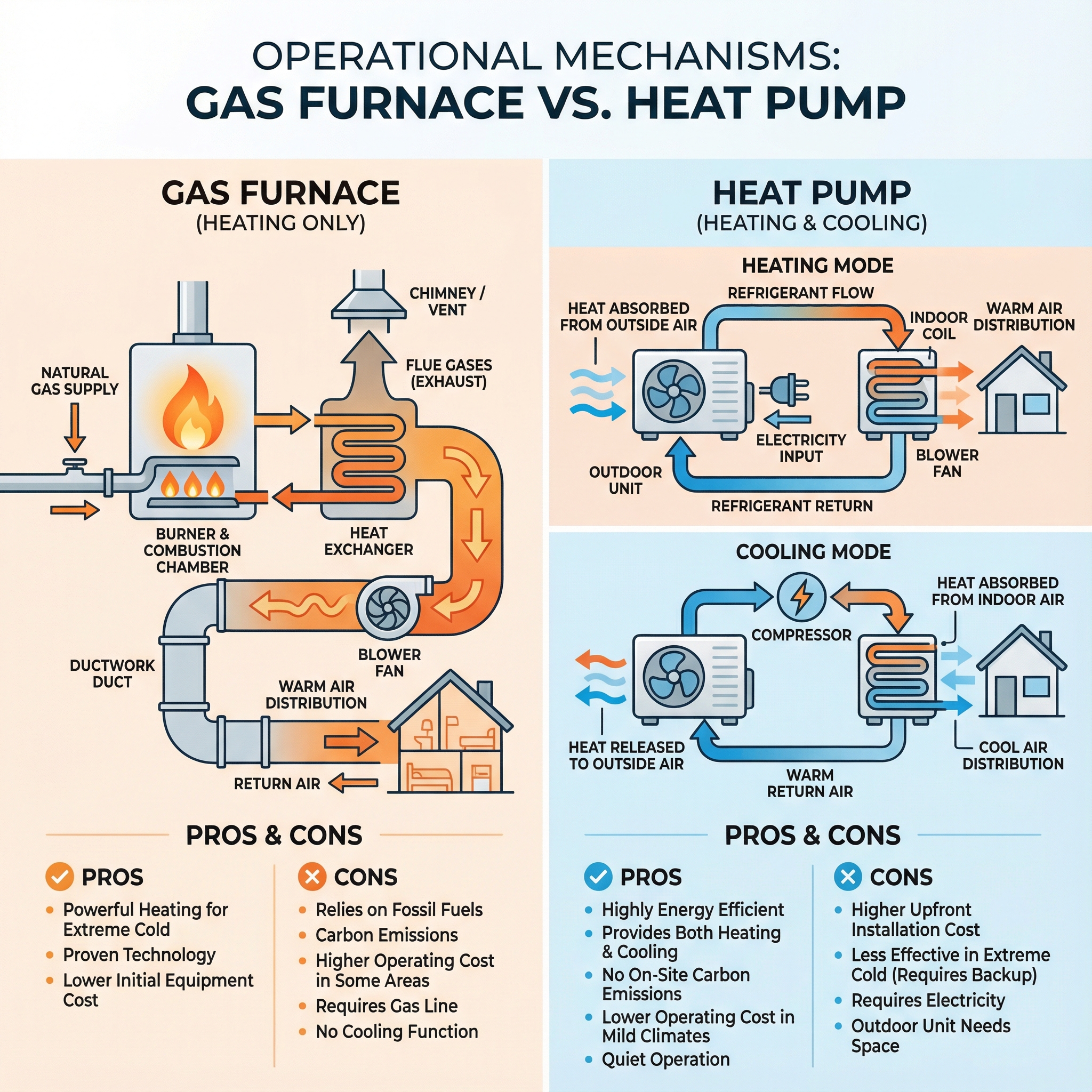
Choosing between the two affects comfort, monthly energy bills, indoor air quality, and equipment lifespan. A gas furnace burns natural gas or propane to produce high temperature heat inside the home. A heat pump uses electricity to move heat from outdoors to indoors, rather than creating it, and it also serves as your central air conditioner in warm weather.
The core difference is heat transfer versus heat generation. Moving heat is inherently efficient: in mild to cool weather many heat pumps deliver about two to three units of heat per unit of electricity, while furnaces are limited by the energy in the fuel they burn. Furnaces excel at very hot supply air and steady output in deep cold. Because a furnace combusts fuel, proper venting and filtration matter, whereas heat pumps avoid on site combustion entirely. Typical lifespans are about 15 to 20 years for furnaces and 12 to 15 for heat pumps, depending on climate and maintenance.
How a Heat Pump Actually Works: components, cycle and why it is electric
Think of a heat pump as a two way refrigerator. A sealed refrigeration cycle absorbs heat at one coil and releases it at the other. The compressor raises the refrigerant's pressure and temperature, then that hot refrigerant rejects heat at the condenser coil. After a metering device, pressure drops, the refrigerant gets cold, and it absorbs heat at the evaporator coil. That loop is what moves heat.
In cooling mode, the indoor coil is the evaporator and the outdoor coil is the condenser. In heating mode, a reversing valve changes refrigerant flow so the outdoor coil becomes the evaporator and the indoor coil becomes the condenser. Fans on each side move air across the coils to pick up or shed heat efficiently.
- Compressor
- Reversing valve
- Outdoor coil and fan
- Indoor coil and blower
- Refrigerant piping and metering device
It is electric. The compressor and fans run on electrical power to move heat, and there is no on site fuel combustion. That is why one system can both heat and cool using the same components.
Key Efficiency Metrics: COP, SEER/SEER2, HSPF/HSPF2 and AFUE: what the numbers mean
Ratings are like MPG. COP shows heat moved per kilowatt; in mild weather many heat pumps run near 3, about 300% effective efficiency. SEER and SEER2 rate seasonal cooling; SEER2, new in 2023, reads lower than SEER. HSPF and HSPF2 rate seasonal heating for heat pumps, higher is better. AFUE is for gas furnaces; modern condensing models reach 90 to 98.5%. Since 2023, split heat pumps must meet about 14.3 SEER2 and 7.5 HSPF2, and AC minimums vary by region. Going from SEER 14 to SEER 20 can cut cooling energy about 30%. Moving from 80% to 95% AFUE trims gas roughly 16%. Entry near minimums, mid tier high teens, premium variable speed 20+ SEER. Choose above the minimum for measurable savings, and use HSPF/HSPF2 or COP for heat and AFUE for furnaces; SEER alone is not enough.
Operating costs: comparing fuel, electricity and real world bills
Monthly heating costs are a three-way equation: your local energy prices (electricity in $/kWh versus gas in $/therm), how much heat your house needs as the weather swings (heating degree days), and the efficiency of the equipment doing the work (AFUE for furnaces, HSPF/COP for heat pumps). Think of it like miles per gallon intersecting with fuel price and miles driven.
Heat pumps tend to win when rates favor electricity and the climate is milder, and they bring a bonus where gas is unavailable or costly because they avoid fuel delivery and combustion venting expenses. In our experience at Budget Heating (BudgetHeating.com), two similar homes on different utilities can see very different bills for that reason. If natural gas is inexpensive and readily available, a high-AFUE furnace often minimizes total cost, and furnaces usually carry lower upfront equipment costs when gas service and ducts are already in place, though monthly fuel spend can be higher. Watch for older, low-AFUE furnaces, even around 56% in legacy cases, since they can drive bills up dramatically.
Environmental impact, regulations and available incentives
Heat pumps avoid on-site combustion, so they cut household fossil fuel use immediately. Their carbon advantage grows as the power grid adds more renewable generation. Policy is moving the same direction. Federal programs often offer tax credits for qualifying high efficiency heat pumps. Many states and utilities add rebates, which can materially improve lifetime cost, sometimes covering a portion of equipment and installation.
Local codes are shifting too, with some cities limiting new gas hookups and air districts pushing ultra low NOx furnace requirements. The AIM Act is driving a transition to lower GWP A2L refrigerants, which influences model availability and installer training.
To find incentives, review federal tax credit guidance, your state energy office, and your electric or gas utility rebate portals.
Performance by Climate: when furnaces beat heat pumps (and vice versa)
In mild to moderate winters, a heat pump is often the lowest cost way to heat. In long, sustained subfreezing climates, a gas furnace wins because it makes heat independent of outdoor temperature. From decades of field work, we see standard air source heat pumps lose capacity as the thermometer drops, so deep cold typically requires backup heat, either electric strips or a dual fuel furnace. Cold climate models narrow this gap and let the pump carry shoulder seasons while the furnace covers the worst nights.
- Where each excels: southern and coastal regions favor heat pumps; some northern areas still find furnaces practical.
- Not the best choice: very high electric rates with limited panel capacity, a furnace may be smarter. No gas and frequent polar snaps, consider a cold climate heat pump with auxiliary electric. Ducts in poor shape, look at ductless heat pumps or hydronic heat.
- Myths and gotchas: gas is not always most efficient; judge heating by HSPF or COP, not SEER. Heat pumps both heat and cool. Comfort issues usually trace to sizing or setup. Combustion adds CO risk that heat pumps avoid. Do not buy on price alone, and plan routine maintenance for either system.
Installation costs, lifespan and replacement considerations
If gas and ducts already exist, a furnace is usually the lower upfront install. Costs rise if you must extend gas piping or modify venting for a condensing model. Heat pumps may need panel upgrades, dedicated circuits, and outdoor pad or clearance prep, which affects labor. A heat pump can replace both furnace plus AC in one project, or serve as ductless mini splits where no ducts exist.
Lifespan is comparable overall, with furnaces sometimes lasting longer when paired with a separate AC. New AFUE rules could change furnace choices and venting paths. In our experience at Budget Heating (BudgetHeating.com), smooth projects start with confirming refrigerant line routing, condensate management, outdoor clearances, and flue type. Always request itemized quotes with model numbers and make sure permits are pulled for rebate eligibility.
Maintenance, troubleshooting and common issues (including reversing valve noise)
Routine care keeps comfort steady. Furnaces need annual combustion and venting checks. Heat pumps run year round, so schedule annual service or biannual visits, one before cooling and one before heating. Keeping filters and coils clean improves indoor air quality and prevents efficiency losses. Heat pumps avoid on site combustion and the direct CO risk associated with gas furnaces.
- Homeowner tasks: replace or clean filters, keep returns and registers clear, maintain clearance around outdoor units, gently rinse debris from outdoor fins, test CO and smoke detectors, do visual checks.
- Professional only: combustion testing and venting work, refrigerant charge or leak checks, electrical diagnostics, gas or vent repairs.
- Call now: gas odor, CO alarm, icing that will not defrost, persistent leaks, repeated breaker trips, or a reversing valve clunk or rattle that persists when switching modes.
Sizing, home type and practical homeowner checklist before you pick equipment
From years of field installs, this step-by-step checklist consistently leads to systems that perform well and cost what they should:
- Match climate: mild or moderate winters favor heat pumps. Very cold, prolonged freezes favor furnaces or dual fuel.
- Tighten the house first: air sealing and insulation lower loads and can justify smaller, cheaper equipment.
- Verify infrastructure: duct condition, electrical panel capacity, gas availability, and a suitable outdoor location.
- Right-size and document: insist on Manual J for loads, Manual S for selection, and Manual D if ducts need design. Have annual operating costs modeled with your local rates, not rule-of-thumb sizing.
- Compare efficiency: think of SEER2, HSPF2, and AFUE like MPG. For heat pumps, look for inverter or variable speed. For furnaces, check staging or modulation.
- Comfort and noise: quick hot blasts from furnaces versus steady heat from heat pumps. Review sound ratings and humidity control.
- Cooling and outages: a heat pump can consolidate heating and cooling. Consider backup power where outages are common.
- Maintenance plan: replace or clean filters every 1 to 3 months, keep outdoor units clear, and schedule annual or biannual service.
- Warranty and service: confirm expected lifespan, parts and labor coverage, and response times.
Which is right for your home? Actionable next steps
There is no single better option, the right system depends on climate, local energy prices, insulation and duct quality, and your budget and sustainability goals. In mixed or cold regions, consider a dual fuel setup or a purpose built cold climate heat pump so each technology runs where it is strongest.
We know this is a big decision and you want to get it right. Have a qualified contractor run a Manual J load calculation, compare modeled operating costs with your utility rates, check rebates and tax credits, and improve air sealing and insulation before you choose equipment.
Our team can turn those numbers into a short list of matched systems at wholesale pricing, then coordinate specs with your installer. We have 30+ years of doing this online and real U.S.-based phone support.
- Get a Custom Quote
- Talk to Our Team by phone for fast, no-pressure guidance
- Shop Heat Pumps & Gas Furnaces
- Ask about free shipping zones and financing with Affirm
 Cooling
 Heating
 Learning Center
 Money Saving Tips
 Buying Guides
 State by State
 HVAC Systems