




 cooling
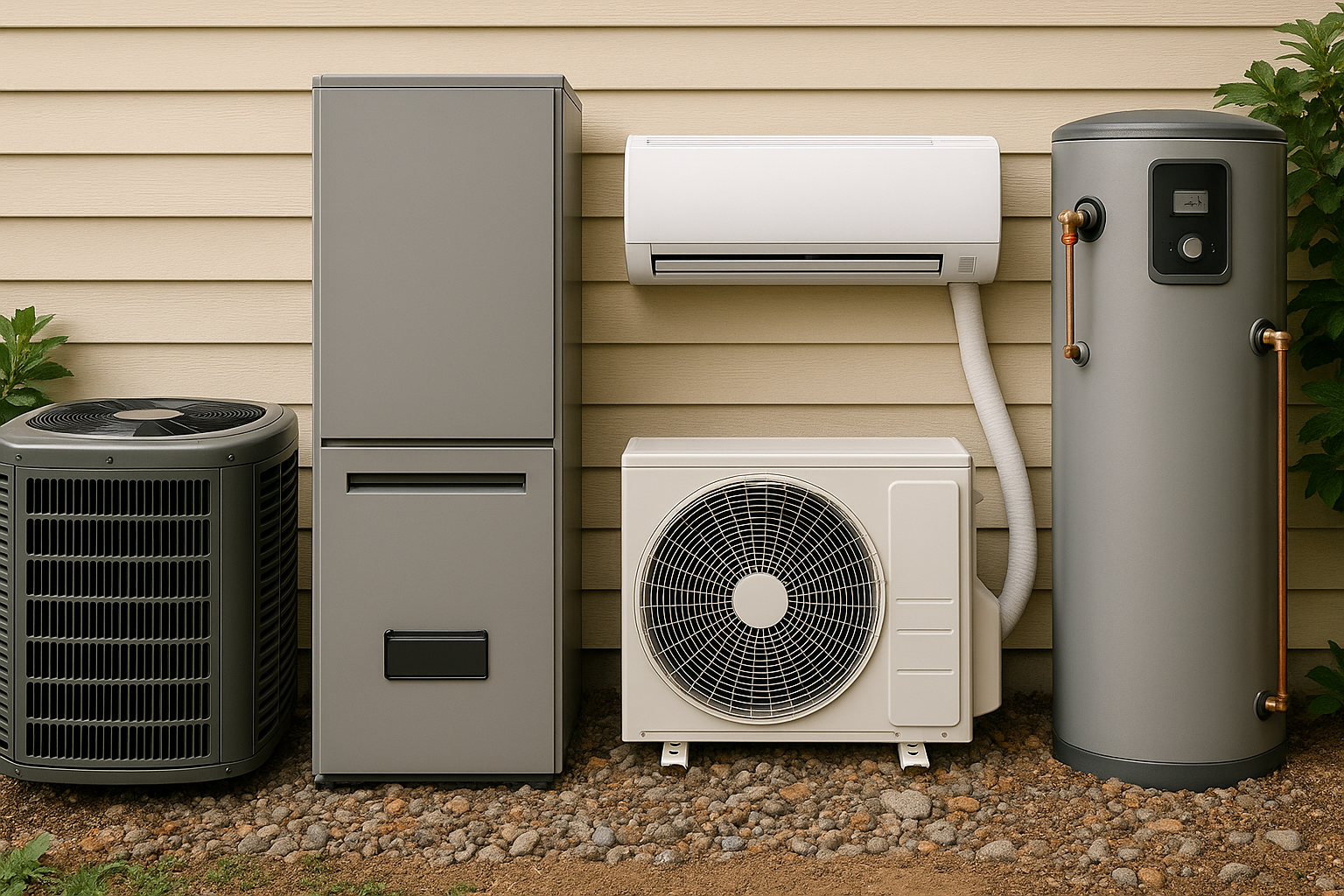
Your home's comfort depends on the right heating and cooling system. Split systems, heat pumps, packaged units, ductless mini-splits, and furnaces all solve the same problem differently. Understanding how each works, what they cost, and where they excel helps you make smart decisions when building, renovating, or replacing worn-out equipment.
Central Air Conditioning Systems
Central AC dominates residential cooling across America. An outdoor condenser unit contains the compressor and condensing coil. Inside, an evaporator coil sits in the ductwork above your furnace or air handler. Refrigerant circulates between these components, absorbing heat indoors and releasing it outside.
Split systems separate the components. The outdoor unit connects to the indoor unit via refrigerant lines running through walls. This design works for most homes with existing ductwork. Installation costs $3,500-$7,500 for a complete system depending on tonnage and efficiency ratings.
Single-stage compressors run at 100% capacity whenever they're on. These budget-friendly units cost $2,800-$4,500 installed for basic Goodman or Amana models. They work fine but cycle on and off frequently, creating temperature swings of 2-4°F.
Two-stage compressors operate at 65% capacity most of the time, ramping to 100% only on the hottest days. This reduces cycling, improves humidity control, and cuts energy use by 15-20%. Mid-range Carrier and Ruud systems with two-stage operation run $4,200-$6,800 installed.
Variable-speed systems modulate from 25% to 100% capacity in small increments. Lennox and Trane premium models maintain temperature within 0.5°F, run whisper-quiet, and achieve 18-20 SEER2 efficiency. Expect to pay $6,500-$9,500 installed. The energy savings take 10-15 years to recover the higher cost.
Heat Pump Systems
Heat pumps look identical to air conditioners but work in reverse for heating. In cooling mode, they remove heat from your home. In heating mode, they extract heat from outdoor air (even at freezing temperatures) and pump it inside. One system handles year-round comfort.
Air-source heat pumps dominate the residential market. They pull heat from outdoor air, working efficiently down to 40°F. Modern cold-climate models maintain full capacity at 5°F and keep running to -15°F. Goodman 16 SEER2 heat pumps cost $4,200-$6,500 installed for 3-ton systems.
The efficiency advantage over electric resistance heat is huge. A heat pump with 9 HSPF2 delivers $2.67 worth of heat for every dollar of electricity. Electric furnaces or baseboard heaters deliver exactly $1 of heat per dollar spent. In moderate climates, heat pumps cut heating costs by 50-65% compared to electric resistance.
Dual-fuel systems pair a heat pump with a gas furnace. The heat pump handles temperatures above 30-35°F. When it gets colder, the furnace takes over. You get heat pump efficiency most of the year plus gas backup for extreme cold. Popular in the Midwest and Northeast. Complete dual-fuel installations run $6,500-$10,500.
Geothermal heat pumps tap stable underground temperatures. Buried loops circulate fluid that exchanges heat with the earth. These systems achieve 300-400% efficiency but cost $15,000-$30,000 installed including ground loop installation. Payback takes 10-20 years but they last 25+ years and need minimal maintenance.
Gas Furnace Heating Systems
Gas furnaces burn natural gas or propane to create heat. A heat exchanger warms air that your blower distributes through ductwork. They pair with central air conditioners in traditional split systems, providing reliable heating where natural gas is available and affordable.
Efficiency is measured by AFUE (Annual Fuel Utilization Efficiency). An 80% AFUE furnace converts 80 cents of every gas dollar into heat, venting the remaining 20% up the chimney. These cost $1,200-$2,200 installed and work fine in mild climates where heating demand is modest.
Mid-efficiency furnaces reach 90-92% AFUE. They cost $1,600-$2,800 installed. The efficiency bump saves $100-200 annually on gas bills for typical homes. Good middle ground between budget and premium options.
High-efficiency condensing furnaces achieve 95-98% AFUE. They extract so much heat that exhaust gases cool below 140°F, causing water vapor to condense. This requires PVC venting instead of metal chimneys. Installation runs $2,400-$4,200. Annual savings of $250-400 on heating make payback happen in 5-8 years.
Single-stage furnaces run at full blast until reaching temperature, then shut off. Two-stage models run at 65% most of the time, ramping to 100% only when necessary. Variable-speed furnaces modulate output continuously. The upgrade from single to two-stage costs $400-800 and dramatically improves comfort.
Electric Furnaces and Air Handlers
Electric furnaces use resistance heating elements like giant toasters. Air passes over hot coils, warming before distribution through ducts. They cost less upfront ($800-$1,800 installed) but have high operating costs unless electricity is very cheap.
Air handlers are essentially electric furnaces without heating elements. They contain the blower and evaporator coil, working with air conditioners or heat pumps. When paired with a heat pump, optional backup heat strips provide emergency heat if the heat pump fails or during defrost cycles.
Electric heat makes sense in three situations. First, mild climates where heating demand is minimal (think coastal California or southern Florida). Second, as backup heat for dual-fuel systems. Third, when extending existing electric ductwork to additions where running gas lines isn't practical.
Operating costs tell the real story. Electric resistance heat costs $1,200-$2,400 annually for a 2,000 sq ft home in cold climates. A 95% AFUE gas furnace with $1.50/therm gas costs $800-$1,200 for the same heating. A heat pump with 9 HSPF2 costs $600-$900. Do the math before choosing electric heat.
Ductless Mini-Split Systems
Mini-splits eliminate ductwork entirely. An outdoor compressor connects to one or more indoor air handlers mounted on walls or ceilings. Refrigerant lines and control wiring run through a 3-inch hole. Each indoor unit operates independently, creating zones with individual temperature control.
Single-zone systems work perfectly for room additions, converted garages, sunrooms, or anywhere without existing ducts. A 12,000 BTU unit (enough for 400-550 sq ft) costs $2,200-$3,800 installed. Mitsubishi and Daikin lead the market with whisper-quiet operation and excellent efficiency.
Multi-zone systems connect multiple indoor units to one outdoor compressor. You can cool bedrooms while leaving living areas off, or maintain different temperatures in each room. A three-zone system serving 1,200-1,500 sq ft runs $6,500-$11,000 installed depending on brand and BTU capacity.
Efficiency beats traditional systems. Quality mini-splits achieve 20-25 SEER2 in cooling mode and 10-12 HSPF2 heating. They're heat pumps, so one system handles year-round comfort. Variable-speed inverter compressors run continuously at low speed rather than cycling on and off.
The downside is aesthetics. Indoor units mount visibly on walls or ceilings. Some people love the modern look. Others hate having equipment on display. Recessed ceiling cassettes blend better but cost $400-800 more per unit and require ceiling access for installation.
Packaged HVAC Units
Packaged systems contain all components in a single cabinet installed outside or on the roof. All-in-one convenience works great for homes without indoor space for equipment, commercial buildings, or manufactured homes. One unit handles heating, cooling, and air distribution.
Packaged air conditioners include the AC components plus an electric heating coil or gas furnace. Gas/electric packages pair AC with a gas furnace in one unit. These cost $4,500-$8,500 installed including ductwork connections. Goodman and Rheem dominate this market segment.
Packaged heat pumps combine heating and cooling in one outdoor unit. They work like split-system heat pumps but with everything contained in a single cabinet. Pricing runs $5,200-$9,500 installed. Popular for commercial applications and homes without attic or basement space.
The advantage is simplicity. One unit, one installation point, one service call location. The disadvantage is noise. All mechanical components sit outside, potentially creating sound near windows or patios. Quality units like Carrier and Trane models with sound-dampening insulation minimize this issue.
Commercial buildings use packaged rooftop units (RTUs) almost exclusively. These large units sit on flat roofs, serving entire buildings or zones. Sizes range from 3 tons to 25+ tons. Maintenance is easier because technicians access everything from the roof rather than crawling through buildings.
Hybrid Heating Systems
Hybrid systems intelligently switch between heat pump and furnace based on outdoor temperature and fuel costs. A control system monitors conditions and automatically selects the most efficient heating source. You get heat pump savings during mild weather plus gas backup for cold snaps.
The switchover point is programmable, typically set at 30-35°F. Above this temperature, the heat pump runs. Below it, the gas furnace takes over. Smart controls can factor in current electricity and gas prices, choosing the cheaper option automatically.
Complete hybrid system installations cost $7,000-$11,500 depending on equipment quality and complexity. The upfront premium over standard systems pays back through lower operating costs. In cold climates with expensive electricity and cheap gas, savings reach $400-700 annually.
Carrier Infinity and Lennox iComfort systems lead the hybrid market with sophisticated controls. Budget-friendly options from Goodman and Amana provide the basics without premium features. All use standard heat pump and furnace components, just adding control logic to switch between them.
Radiant Heating Systems
Radiant systems warm objects and people directly rather than heating air. Hydronic radiant uses hot water circulating through tubing installed in floors. Electric radiant runs resistance cables or mats under flooring. Both create comfortable, even heat without blowing air around.
Hydronic systems excel at whole-home heating. A boiler heats water to 85-140°F. Tubing embedded in concrete floors or attached under wood floors circulates this water. Heat radiates upward, warming the room from the floor up. No cold spots, no drafts, no noise.
Installation costs are high. Retrofitting existing homes runs $15-$25 per square foot including tubing, manifolds, and boiler. New construction costs $8-$15 per square foot since tubing installs before pouring concrete. A 2,000 sq ft home needs $16,000-$35,000 for complete hydronic radiant.
Operating costs are excellent. Radiant systems run at lower temperatures than forced air, cutting energy use by 15-30%. Pairing a hydronic system with a condensing boiler achieves 95% efficiency. Comfort is unmatched. Floors stay warm (75-85°F), eliminating cold feet and creating spa-like bathrooms.
Electric radiant works for bathrooms, kitchens, or small areas. Mats cost $10-$20 per square foot installed. Operating costs are high because it's resistance heat, but for a 50 sq ft bathroom used occasionally, annual costs are only $30-60. Popular retrofit option for tile installations.
Boiler and Radiator Systems
Boilers heat water, sending it to radiators or baseboard convectors throughout your home. Steam boilers (older systems) create steam that rises through pipes. Hot water boilers (modern systems) circulate water at 120-180°F. Both provide steady, comfortable heat.
Cast iron radiators are classic. Hot water or steam enters at the top, radiating heat as it cools. They hold heat long after the boiler shuts off, providing consistent warmth. Old radiators work fine with new boilers. Replacement radiators cost $300-$800 each.
Baseboard convectors mount along walls at floor level. Finned tubes inside the covers allow hot water to pass through, creating convection currents that circulate warm air. They're quieter and less obtrusive than radiators. Installation runs $400-$1,200 per room.
Modern boilers achieve 85-98% efficiency. Standard models cost $3,500-$6,500 installed. Condensing boilers reach 95-98% efficiency, costing $5,500-$9,500 installed. High efficiency pays back in 4-8 years through fuel savings. Boilers last 20-30 years, longer than forced air furnaces.
The major limitation is cooling. Boilers provide heat only. Adding central AC requires separate ductwork installation, costing $8,000-$15,000. Mini-splits offer a better solution for cooling when you already have boiler heat, running $6,000-$12,000 for a multi-zone system.
Window and Portable AC Units
Window units slide into window openings, cooling single rooms. Self-contained systems include compressor, condenser, evaporator, and fan in one chassis. They're cheap ($150-$800), easy to install, and require no professional help. Perfect for apartments or supplemental cooling.
Capacity ranges from 5,000 BTU (small bedroom) to 24,000 BTU (large living room). A 12,000 BTU unit handles 450-550 sq ft, costing $350-$600. Look for Energy Star models with 12+ EER for the best efficiency. Modern inverter units run quieter and save energy compared to older models.
Installation takes 15-30 minutes. Secure the unit, extend accordion panels to fill the window opening, and plug it in. Some jurisdictions require brackets or straps for units in high windows. The main hassles are storing units in winter and dealing with reduced natural light.
Portable AC units sit on the floor, venting hot air through a window kit. They're more flexible than window units since you can move them between rooms. But efficiency is lower (8-10 EER typical) and they take up floor space. Prices run $300-$700 for 10,000-14,000 BTU units.
Neither window nor portable units heat effectively. Some have heat pumps rated for mild temperatures (above 45°F), but they're not primary heating sources. Use them for cooling supplemental to your main HVAC system or in homes where central air isn't practical.
Evaporative Coolers (Swamp Coolers)
Evaporative coolers work by evaporating water, which absorbs heat and lowers air temperature. A fan pulls outside air through wet pads, cooling it by 15-40°F before blowing it into your home. They use 75% less electricity than refrigerated AC but only work in dry climates.
Relative humidity must stay below 50% for effective cooling. Arizona, Nevada, New Mexico, and parts of California and Texas are prime territory. Humid regions like the Southeast see minimal benefit because air already saturated with moisture can't absorb much more water vapor.
Portable evaporative coolers cost $150-$600 and cool single rooms. Whole-house units mount on roofs or through walls, cooling 1,000-3,000 sq ft. Installation runs $2,500-$6,500 including ductwork. Operating costs are incredibly low, around $20-$40 monthly versus $150-$300 for central AC in hot climates.
Maintenance involves replacing pads annually ($30-$80) and cleaning the reservoir monthly during cooling season. Water usage is significant, adding $30-$60 monthly to bills. You must leave windows cracked to allow moist air to escape, which some people dislike for security reasons.
The cooling feels different from AC. Evaporative systems create a fresh, outdoor breeze feeling rather than the cold, dry air from refrigerated systems. Temperatures run 75-85°F inside when it's 95-105°F outside. Comfortable but not as cold as AC.
Choosing the Right System for Your Home
Climate drives the decision. Cold regions benefit from gas furnaces or heat pumps with gas backup. Hot humid areas need robust AC with good dehumidification. Moderate climates can use heat pumps alone. Dry hot climates might consider evaporative cooling for savings.
Existing infrastructure matters. Homes with ductwork can use central systems. No ducts? Mini-splits make more sense than spending $10,000-$18,000 installing ductwork. Older homes with radiators might keep boiler heat and add mini-splits for cooling.
Budget constraints affect choices. Basic split systems cost $4,000-$6,500 installed. Premium systems with all the features run $8,000-$12,000. Mini-splits fall in between at $6,000-$10,000 for whole-house solutions. Consider total cost of ownership including energy bills, not just purchase price.
Fuel availability and costs tip the balance. Natural gas at $1.20/therm makes gas furnaces attractive. Propane at $3.50/gallon (equivalent to $2.45/therm) changes the math toward heat pumps. Electric rates below $0.12/kWh favor heat pumps. Above $0.18/kWh, gas heating looks better.
Zoning and Smart Controls
Zoning systems divide your home into areas with independent temperature control. Motorized dampers in ductwork open and close based on thermostats in each zone. You can keep bedrooms cool at night while raising temperature in unused areas.
Two-zone systems cost $1,800-$3,500 to add to existing ductwork. Three to four zones run $2,800-$5,500. You need a compatible HVAC system (not all work with zones) and properly sized equipment. Savings of 20-35% are common since you're not heating or cooling empty spaces.
Mini-splits provide built-in zoning since each indoor unit operates independently. This is one of their biggest advantages over central systems. You get zone control without adding dampers, panels, or complex controls.
Smart thermostats learn your schedule and adjust automatically. Ecobee and Nest models cost $200-$350 installed. They connect to WiFi, allowing control from anywhere via smartphone. Remote sensors detect occupancy, directing heat or cooling to occupied rooms.
 Heating
 Learning Center
 Money Saving Tips
 Product and Brands Insights
 Buying Guides
 State by State
 HVAC Systems