




 cooling
 learning center

What Size Room Will a 6,000 BTU Air Conditioner Cool? Quick answer
A 6,000 BTU room or window AC is built for small spaces. We size this class for about 150 to 250 sq ft, and up to roughly 300 sq ft in ideal conditions such as good insulation, shaded exposure, and low occupancy. Choosing the right size drives comfort, energy cost, and humidity control. When the capacity matches the room, you get steadier temperatures, better moisture removal, and quieter, more efficient operation. Oversize or undersize it and you lose all three. Below we outline when 6,000 BTU fits and when to step up.
BTU Basics: What '6,000 BTU' Means and the Simple Rule of Thumb
BTU measures how much heat an AC removes per hour. We size spaces with a simple guide: about 20 BTU per square foot. By that math, a 6,000 BTU unit fits roughly 150 to 250 sq ft under average conditions, and many tables land between about 168 and 247 sq ft. That keeps the unit in its sweet spot rather than struggling or idling.
- Better humidity control, air dries to a comfortable level instead of feeling clammy.
- Quieter operation, the unit runs steadily instead of revving up and down.
- Fewer short cycles, which improves efficiency and comfort.
- Typically matches common window openings and standard 115V circuits.
How to Calculate Room Size for a 6,000 BTU Unit: Step-by-Step
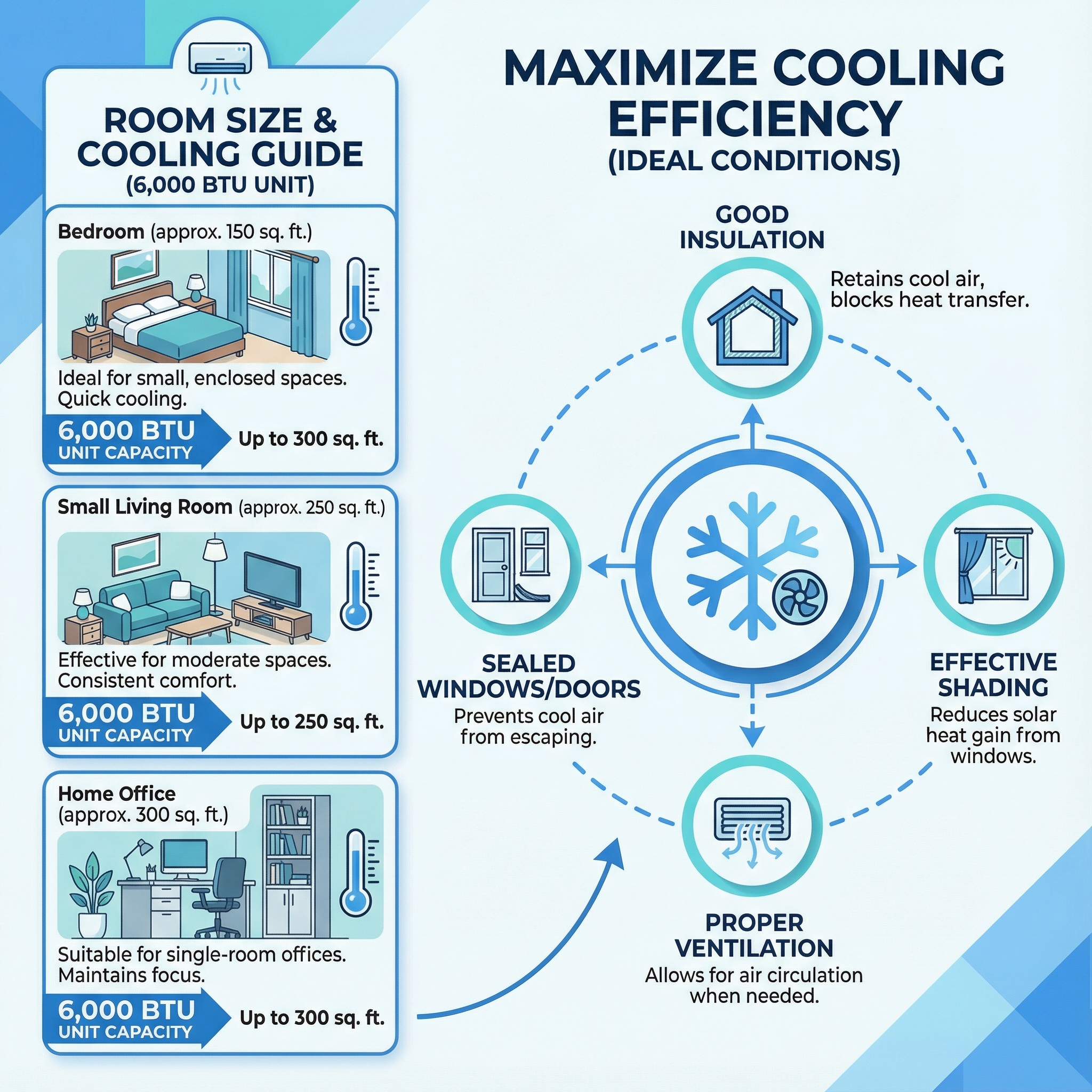
Use this quick checklist to estimate whether a 6,000 BTU window AC suits your room.
- Measure length and width. Multiply to get square footage. For irregular rooms, break them into simple shapes and add the areas.
- Apply the baseline: total square feet × 20 BTU, then compare your result to 6,000 BTU to gauge fit.
- Adjust for real-world factors: taller ceilings, strong afternoon sun, weak insulation, extra occupants, or heat-producing appliances all increase the needed capacity. Shaded rooms with good insulation and light use may need slightly less.
- Think of sun exposure like a car in direct light, interior surfaces soak heat quickly.
- Verify logistics: confirm the electrical circuit can handle the unit and the chassis fits the window opening.
- Plan maintenance: easy filter access and clear airflow help performance. If unsure, request a Manual J from a licensed contractor.
Operating Cost & Savings: What Upgrading Efficiency Means for a Small AC
For a 6,000 BTU room AC, what you pay to run it comes down to CEER and how many hours it actually runs. In our field experience, moving from an older roughly 10-SEER or low-CEER unit to a 13-SEER or similar CEER level cuts operating cost by about 20 to 25 percent. Premium CEER models go further, since they pull fewer kWh to hold the same setpoint.
A quick way to frame it: if that small AC costs $100 over a summer, a 13-level unit often brings it to about $75 to $80. Step up again with a premium CEER and the bill drops more. Features like eco or auto fan cycling stack additional savings by trimming compressor and fan runtime for the same comfort, like easing a faucet to keep the same rinse with less water used.
Limitations & Tradeoffs: When a 6,000 BTU AC Is NOT the Right Choice
A 6,000 BTU unit suits small, low-load rooms. It will struggle once heat gain climbs.
- Hot, humid, top-floor, or sun-heavy rooms: step up to 7,000-8,000 BTU, even 9,000-10,000 if loads are heavy.
- Multiple closed rooms: small units cannot move air around corners. Use separate units or a small ductless mini split.
- Poor insulation or kitchens: consider 8,000-10,000 BTU to handle leakage and cooking heat.
Common mistakes: guessing, using only square feet, assuming one unit cools multiple rooms, and over or undersizing. Oversizing short cycles with poor dehumidification. Undersizing runs nonstop and still feels warm. Fix by measuring and factoring climate, sun, insulation, and occupants.
Energy & Power: CEER, Watts and What Efficiency Means for a 6,000 BTU AC
For room and window ACs, efficiency is rated by CEER, not SEER. Think of CEER as miles per gallon for a plug-in AC: the higher the CEER, the fewer kilowatt-hours and watts it needs to deliver the same cooling. When you compare 6,000 BTU units, make CEER your first filter. ENERGY STAR Most Efficient targets in the 6,000-7,999 Btu/h range are about CEER 14.85 for louvered models or 13.5 for non-louvered. In our experience at Budget Heating (BudgetHeating.com), hitting those marks translates to lower power use versus baseline units.
Real-World Examples: Rooms Where a 6,000 BTU Unit Works Best
A 6,000 BTU air conditioner is a compact window or portable unit that plugs into a standard 115 V outlet and fits most common window openings. It is designed for small, contained rooms where you want steady, quiet cooling.
- Bedroom, about 10 × 12 to 12 × 14 ft, roughly 120 to 168 sq ft.
- Home office, up to 12 × 14 ft if the door stays closed.
- Nursery or guest room, around 100 to 150 sq ft.
- Open-adjacent nook, 180 to 200 sq ft when airflow is clear, not a separate closed room.
In our experience at Budget Heating (BudgetHeating.com), this size shines where people sleep or work quietly, keeping temperatures even without overloading a circuit or overpowering the space.
Safe Installation & Maintenance: Getting the Most Life and Efficiency from a 6,000 BTU AC
Safe setup boosts performance. Use the manufacturer window kit, fasten the chassis firmly, and set a slight outward tilt so condensate drains outside, like a gutter guiding rain. Plug into a properly grounded outlet (most 6,000 BTU units run on 115 V / 15 A). Keep the condenser side clear so heat can discharge freely.
- Unplug the unit before any cleaning.
- Clean or replace the air filter monthly to maintain airflow and cooling output.
- Keep the condenser side clear of obstructions to protect efficiency and the motor.
- For electrical or refrigerant, sealed-system problems, call a licensed technician.
Placement & Practical Tips: Where to Install and How to Maximize Performance
Once size and efficiency are set, placement does the heavy lifting. From decades of installs, these tweaks pay off.
- Indoor: mount high on an interior wall, keep 4 to 6 feet of clear throw, avoid sun and heat sources.
- Outdoor: choose a shaded, ventilated spot with 12 to 24 inches side clearance, raise 4 inches above grade, keep away from dryer vents.
- Airflow and controls: aim toward the largest open area, use swing for even coverage, keep sensors out of sun and drafts.
Conclusion: Should You Buy a 6,000 BTU AC for Your Room? Quick Checklist & Next Steps
A 6,000 BTU AC is a small room solution, ideal for about 150 to 250 sq ft and sometimes up to 300 sq ft in ideal conditions. You will get the best results by measuring accurately, making sensible adjustments, choosing a high CEER unit, and installing and maintaining it correctly.
We know sizing can feel uncertain, especially with sunny rooms or older insulation. If you want a sanity check, our team can walk your space with you over the phone and match the right unit.
- Measure: length times width to confirm square footage.
- Adjust for conditions: sunlight, insulation quality, ceiling height, occupants, and heat sources.
- Check fit: confirm window or sleeve dimensions and available electrical outlet.
- Select high CEER models for lower operating cost.
- Plan install and upkeep: level mount, clear airflow, clean filter regularly.
- Get a Custom Quote: send room size and conditions, we will size and spec the right 6,000 BTU options.
- Talk to Our Team: call our U.S. based support for real sizing help from HVAC pros.
- Shop 6,000 BTU ACs: browse in stock units at wholesale pricing made accessible.
 Heating
 Money Saving Tips
 Product and Brands Insights
 Buying Guides
 State by State
 HVAC Systems