




 buying guides
 cooling

Types of AC Systems: A Complete Guide: What This Guide Covers
Air conditioning options run the gamut, from whole home central systems to single room units and advanced variable refrigerant and geothermal designs. This guide is written for homeowners, landlords, and small business operators choosing equipment for houses, condos, apartments, and light commercial spaces such as offices or retail suites. We also include a brief note on automotive AC for comparison only, since vehicles use the same refrigeration cycle but different hardware.
We explain where each system type fits, how it impacts comfort, noise, installation, and energy use, and what that means for upfront cost and long term value. You will see how ducted central splits, packaged units, ductless mini splits, heat pumps, VRF setups, and window or portable units differ in capacity, controls, and maintenance needs. Our perspective comes from decades of hands on HVAC work, selecting and supporting equipment across a wide range of climates. By the end, you will have a clear framework to match a system to your building, local weather, budget, and maintenance preferences.
How Air Conditioning Works: Core Components and the Refrigeration Cycle
AC does not make cold, it moves heat. The refrigerant loop is the courier carrying heat from indoors to outdoors.
Key components: compressor drives refrigerant and raises pressure. The AC condenser coil rejects heat outside as vapor becomes liquid. The expansion device drops pressure to create a cold mix. The evaporator coil absorbs indoor heat as refrigerant boils, and the blower moves cooled air through the ducts.
Why it matters: weak compressors cut capacity and raise bills. Dirty condensers spike pressures. Blocked expansion devices or low charge cause icing. Matted evaporator coils choke airflow. Knowing this cycle clarifies performance differences and common repairs.
Classification by Installation: Central Ducted, Split Systems and Packaged Units
Central ducted split systems place the condenser outside and the air handler inside, delivering whole home comfort through existing ducts. Packaged rooftop or ground units combine all components in one cabinet, a smart fit when indoor space is tight but ducts are available. Ductless mini splits serve homes without ducts or for additions. Room or portable units handle single spaces. In our experience at Budget Heating (BudgetHeating.com), matching the install style to the building saves headaches and money.
Heat pumps fit within these categories. A heat pump is essentially an air conditioner that can reverse the flow of heat to provide heating, so in cooling it behaves like standard AC. They come as split or packaged systems and can be a single solution for year round comfort.
- Evaluate ductwork: check condition and sizing, seal or replace if leaky or poorly routed.
- Shortlist by home: ducted where usable ducts exist, ductless where none, room units for spot needs.
Ductless Mini Splits and Zoning: Pros, Cons and Best Uses
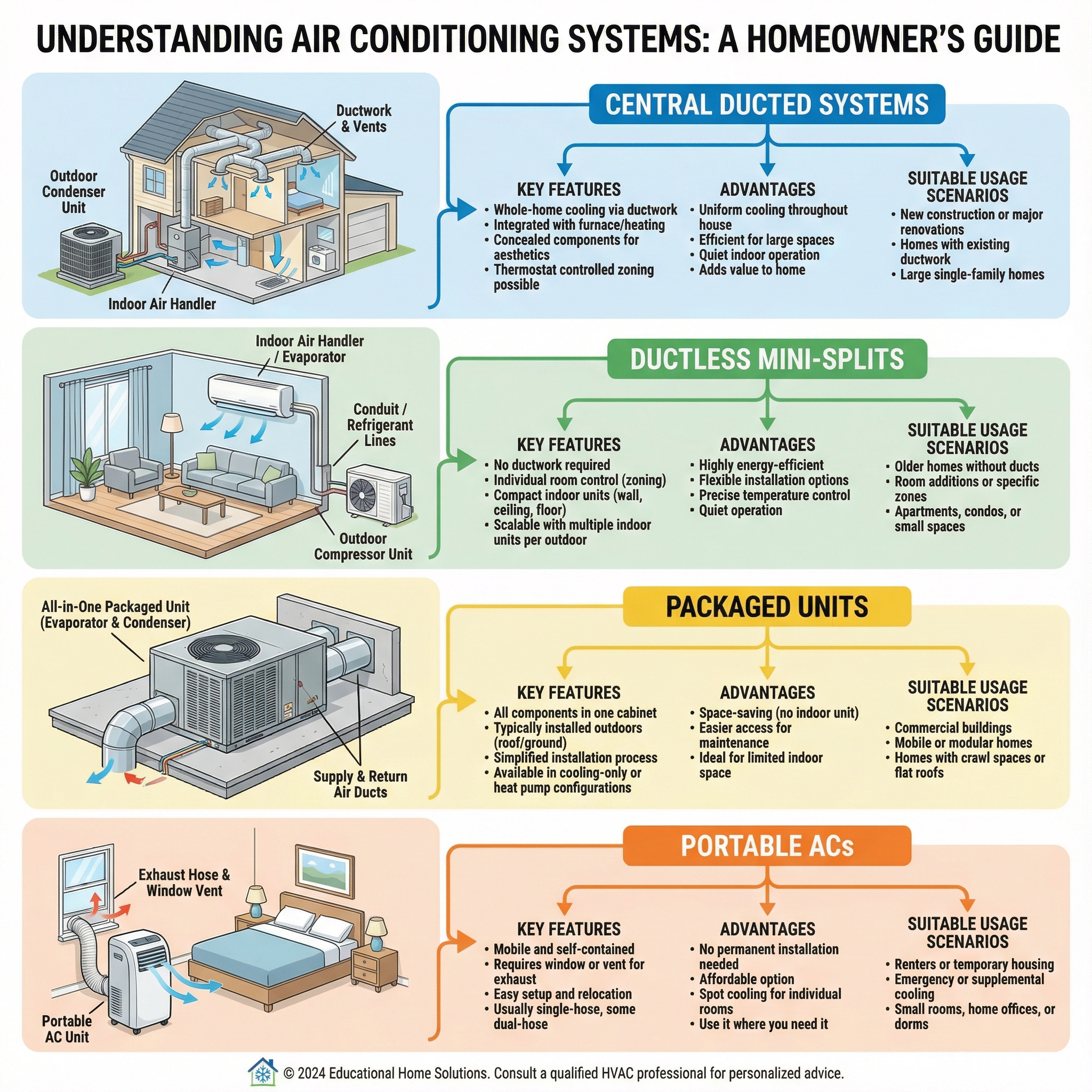
Ductless and multi zone systems shine in retrofits and targeted comfort control. Each room gets its own setpoint, and variable speed operation matches output to the actual load. It feels like giving every room its own light switch instead of one whole house switch. That precision delivers room by room comfort and cuts wasted cooling.
- Pros: Minimal disruption in homes without ducts, quiet operation, high part load efficiency, strong control flexibility with true zone level temperature and scheduling.
- Cons: Wall mounted heads change the look of a room, multiple filters to clean, lineset and condensate routing can limit placement, per room costs add up compared with a single ducted air handler.
- Best uses: Older homes, additions, garages or sunrooms, upstairs rooms that run hotter, home offices or guest rooms with different schedules.
Homeowner checklist: plan controls and zoning early, choose multi zone mini splits or a zoned ducted layout to match real room usage. Also address air quality and humidity, consider integrated filtration or dedicated dehumidification in high humidity regions or for allergy concerns.
When an AC Type Might Not Be the Best Choice: Tradeoffs, Limits and Common Mistakes
- Very cold climates: some heat pumps lose capacity at low temps. Plan electric or gas backup heat, or choose a cold-climate model. In certain homes a furnace as primary heat makes more sense.
- No existing ductwork: adding ducts is invasive and costly. Ductless mini splits avoid the remodel. Window or portable units install fast but run less efficiently and usually have shorter life.
From what we see most: refrigerant is not a routine top-off, a low charge means a leak. Oversizing drives short cycling and poor humidity control. Thermostat myths linger, big setbacks are not magic. Never block supply or return vents.
Window and Portable ACs: When to Use Them (and Basic Repair Tips)
Window, through-the-wall, and portable units are best for single rooms, rentals, or short-term cooling. They have the lowest installation barrier and, in our experience, typically last 5 to 10 years when maintained.
- Filters: Clean or replace monthly in heavy use. Gently vacuum dust from coil fins.
- Condensate: For portables, empty the tank or confirm the drain hose flows. For window units, keep a slight rear tilt so water drains outside.
- Air path: Keep vents clear. Straighten portable exhaust hoses and seal the window kit to prevent hot air leaks.
- Power: Use a dedicated outlet, avoid extension cords, and press the plug reset if it trips.
- Stop and call a pro: repeated breaker trips, ice on coils, a non-spinning fan, loud buzzing, or burning smells.
Energy Efficiency & Ratings: SEER/SEER2, EER/EER2, HSPF and Regulatory Minimums
SEER and SEER2 show seasonal cooling per unit of electricity, like mpg for your AC. SEER2 replaced SEER in 2023. EER and EER2 rate a single high temperature point. For heat pumps, HSPF covers heating efficiency.
Minimums vary by region: split central AC uses region specific SEER2, the Southwest requires EER2, and split heat pumps have national minimums. DOE updates for window ACs raise efficiency. Refrigerants are shifting from R-410A to lower GWP A2L, and codes plus disposal rules affect installs. Match ratings to climate and size: humid needs dehumidification, dry favors higher EER2, cold needs cold climate heat pumps with strong HSPF. Get a professional load calculation, then pick SEER2 and EER2 that fit your budget. In our experience at Budget Heating (BudgetHeating.com), right sizing beats chasing labels.
Costs and Savings: Installation, Operating and Lifetime Economics
In our experience, what you pay upfront and over time varies with home size, existing ductwork, incentives, installation complexity, and how many hours the system runs. Efficiency directly reshapes the power bill. Replacing a SEER ~10 cooler with SEER 15 can cut cooling energy about 37 percent. In high-load climates that can be roughly $1,500 to $2,200 per year, depending on runtime and electricity price.
Think of total cost of ownership like a car: sticker price matters, but fuel and upkeep decide the real spend. Evaluate:
- Equipment and installation after incentives.
- Electricity over expected run hours.
- Routine maintenance and likely repairs across the lifespan.
- Noise and equipment placement for comfort and neighbors.
- Pre-install items: electrical panel capacity, condensate routing, clearances.
- Credible proposals from vetted HVAC professionals, apples-to-apples on scope and efficiency.
Maintenance, Safety and Common Repairs: DIY vs Professional Work
From decades in HVAC, safe homeowner upkeep is straightforward: replace filters monthly, keep 2 feet clear around the outdoor unit, gently hose the outdoor coil, flush the condensate line with vinegar, seal obvious duct leaks with mastic or foil tape, and program the thermostat. After install, verify performance and set a maintenance plan. Lifespans: central, packaged, and ductless 10 to 20 years, room units 5 to 10.
Always de-energize equipment. Leave to licensed pros: refrigerant circuit work, high voltage, load and duct design, and furnace combustion. Refrigerants can injure, A2L types are mildly flammable, and EPA 608 certification is required. Schedule tune-ups twice per year. Call a technician for odd smells, hissing, water leaks, icing, or tripped breakers.
Summary & Recommendations: Best AC Types by Use Case and Next Steps
AC choices fall into clear groups: central or packaged, ductless or VRF, room or portable, heat pumps, geothermal, evaporative, and PTAC or chilled-water. The best results come from correct sizing, professional installation, and regular tune-ups. Get 2 to 3 proposals, require a load calculation and documented performance checks. Verify credentials and weigh efficiency against upfront cost.
Ready to move forward? With 30+ years in HVAC, our team will size, compare, and quote by phone or online.
- Get a Custom Quote
- Talk to Our Team, U.S.-based phone support
- Shop Central AC, Ductless Mini Splits, and Heat Pumps
- Wholesale pricing, fast shipping, Affirm financing
 Heating
 Learning Center
 Money Saving Tips
 Product and Brands Insights
 State by State
 HVAC Systems