




 cooling
 learning center

Why Consider a Ductless Mini Split Air Conditioner?
Ductless mini split air conditioners are typically heat pump based, which means they move heat rather than generate it. That heat transfer principle is the core distinction: resistance heaters and gas burners create heat, while a mini split relocates it, into the space when heating and out of the space when cooling.
Think of it like a refrigerator: it pulls heat from one side and releases it on the other, using far less energy than making new heat from scratch.
This guide explains how mini splits work, what to compare such as sizing, efficiency, installation, comfort features, and total costs, and the practical steps to buy and maintain the right system.
From decades of hands-on work with heat pumps, we have seen the same pattern hold true across applications: moving heat is inherently more efficient than generating it. Understanding that difference sets the right foundation for choosing a ductless mini split with confidence.
What a Ductless Mini Split Is: Components and How It Works
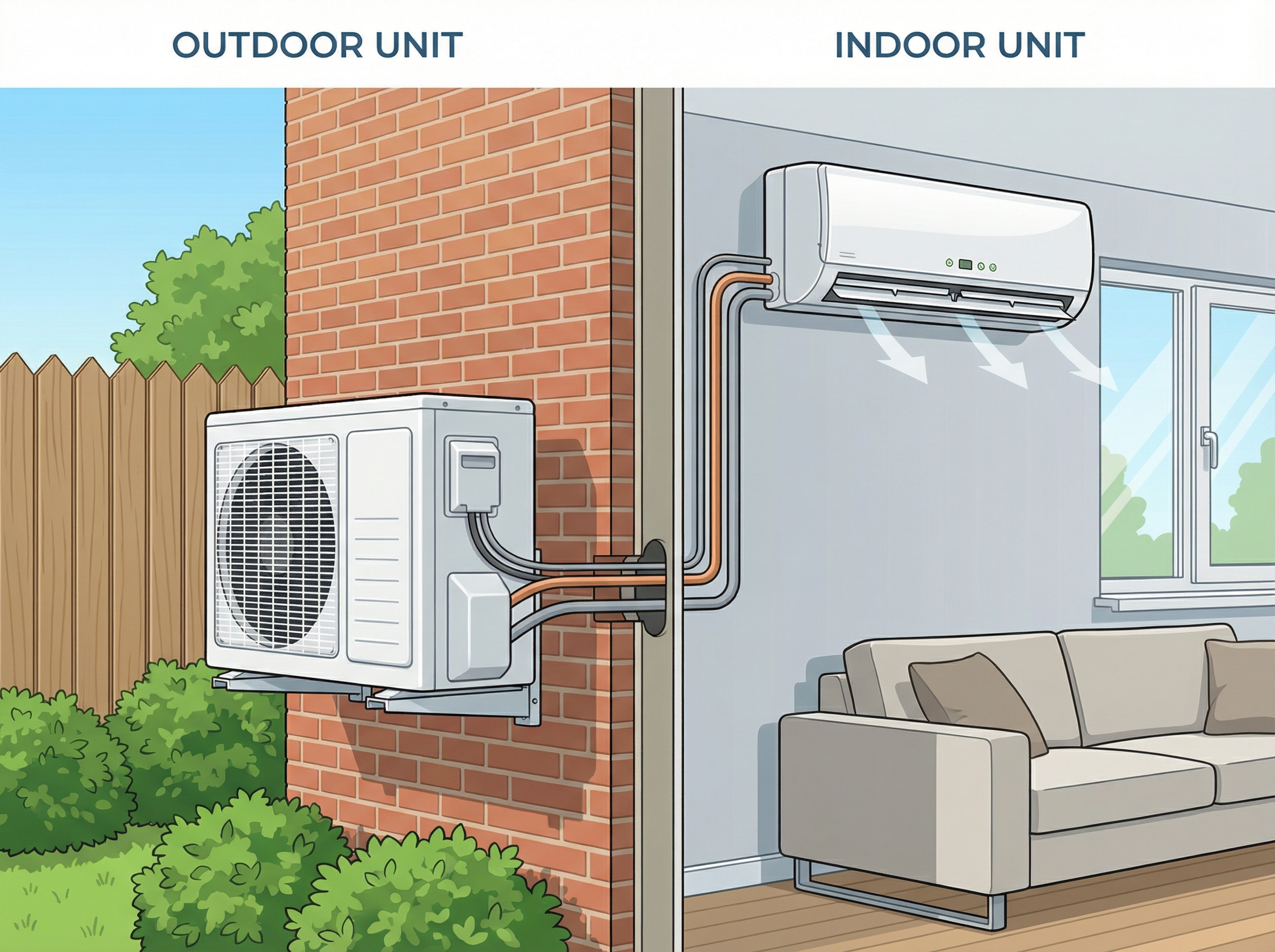
A ductless mini split pairs an outdoor unit with one or more compact indoor heads to deliver room by room conditioning. Core parts include the outdoor compressor and condenser, indoor evaporator heads, a refrigerant line set, and a controller. Heads can be wall, ceiling cassette, or floor mounted. The slim line set carries refrigerant between units and often a control cable, so no ductwork is required.
The system runs a closed refrigeration cycle. In cooling, the indoor coil evaporates refrigerant, absorbing heat from room air. The compressor raises pressure and temperature, then the outdoor coil condenses the refrigerant, rejecting that heat outside. In heating, a reversing valve redirects flow so the outdoor coil becomes the evaporator and the indoor coil becomes the condenser, sending heat indoors. The valve simply shifts which coil handles evaporation and which handles condensation.
Modern mini splits use inverter, variable speed compressors that modulate output across a wide range. Think of a dimmer switch instead of an on off light, the compressor ramps up for quick pull down, then slows to match the load for better part load efficiency, quieter operation, and steadier temperatures. In our field work, we consistently see this improve comfort.
Common refrigerants are R-410A and, increasingly, R-32. Compare these when choosing equipment.
Primary Benefits: Efficiency, Zoning, Quiet Operation and Better Indoor Air
Mini splits deliver efficiency first. Because many models pair heat-pump design with inverter compressors, they commonly cut cooling energy use compared with older central systems. Zoning is built in. Each indoor head is independently controllable, so you condition only the rooms you use. It is like giving each space its own volume knob, turning comfort up or down without forcing the whole house to follow.
Sound levels stay low on both the indoor and outdoor sides, which makes these systems a natural fit for bedrooms and home offices. Ductless operation can also help indoor air quality, since there are no long duct runs to collect dust or leak unfiltered attic air into the airstream.
One outdoor unit can serve one or multiple rooms, and indoor units come as wall-mounted, ceiling cassette, or floor consoles to fit tight spaces. Convenience features many buyers appreciate include Wi-Fi or smart control, advanced filtration, and dehumidification modes. Compared with window or portable units, mini splits are typically quieter, more efficient, and can heat and cool. Compared with central air, they offer zoning without ducts, though whole-home projects often have higher upfront cost.
Single Zone vs Multi Zone and Heat Pump vs Cooling Only Systems
In a single-zone mini split, one outdoor unit pairs with one indoor head. In a multi-zone, multiple indoor heads connect to one outdoor unit. Choose multi-zone when you want independent control room by room, like having separate light switches. Each indoor head should be sized to that room's load, not replaced by one oversized head fighting airflow and comfort. For heating and cooling, a heat pump mini split provides both. Some models are cooling-only, which you would choose based on climate and whether you already have other heat. In our field work, single-zone is a clean fit for one problem area or an open space, while multi-zone aligns with homes that need separate set points across bedrooms, offices, and common areas.
When a Mini Split May Not Be the Best Choice (Tradeoffs and Alternatives)
Mini splits are versatile, but they are not ideal in every situation. From years of field work, we see a few scenarios where a different approach performs better and costs less over time.
- Very cold winters: Heating output drops as outdoor temperatures fall, and older or entry models can struggle below roughly 25 F. Plan on backup heat in these conditions, such as electric strips or a furnace. In harsher climates, high-efficiency gas furnaces or purpose-built cold-climate heat pumps rated for low-ambient operation are often the better choice.
- Whole-house homes with good ducts: If you already have efficient central ductwork, a high-quality central system may deliver more uniform comfort and lower installed cost for full-home conditioning.
- Short-term or rental needs: For temporary spaces, window or portable units typically win on upfront cost and ease of removal.
Common misconceptions: not every mini split is install-it-yourself, and higher SEER does not always pay back quickly. Actual value depends on climate, electricity rates, and installation quality.
How to Size a Mini Split: BTUs, Room By Room Guidance and a Quick Pre Install Checklist
Start with a room-by-room heating and cooling load calculation. This is the single most important step for a reliable mini split design.
Practical method: list each zone, note square footage, ceiling height, insulation quality, window area and sun exposure, then apply your climate's design temperatures to calculate required BTUs for both cooling and heating. Typical rooms land roughly between 6,000 and 36,000 BTU per zone, but the load calc often shifts sizing based on windows, infiltration, or orientation. Think of BTUs like choosing the right size wrench for a bolt: too big or too small makes the job worse.
Mis-sizing is costly. Oversizing causes short cycling and poor dehumidification. Undersizing leaves the system struggling in hot or cold extremes.
- Confirm BTU capacity per zone from the load calculation.
- Choose efficiency and features that match your climate and usage.
- Get multiple quotes.
- Verify installer qualifications.
- Clarify total costs, scope, and timeline.
- Secure warranty and maintenance terms.
Energy Ratings and Technology: SEER2, EER2, HSPF2 and Why They Matter
SEER and SEER2 measure seasonal cooling efficiency, the cooling delivered divided by the electricity used. Think of SEER2 like miles per gallon for cooling. SEER2 replaced SEER under the DOE's 2023 M1 test and typically reads a bit lower, which better reflects real-world operation. EER2 rates efficiency at a fixed, high-temperature test point, a useful snapshot for peak heat. HSPF2 is the seasonal heating efficiency for heat pumps.
Minimum efficiencies are now set in SEER2 and EER2, and they vary by region and capacity. For example, Southern systems under 45,000 BTU must meet 14.3 SEER2 and 11.7 EER2, while the Northern minimum is about 13.4 SEER2. Ductless heat pump mini splits carry a national cooling minimum of 14.3 SEER2, with heating minimums defined in HSPF2. For context, 14.3 SEER2 is roughly equal to 15 SEER under older tests.
Climate drives value: higher SEER2 makes the most sense in hot, humid, or long cooling seasons. In cooler regions, a model modestly above the minimum is often most cost-effective. Many inverter-driven mini splits exceed minimums, commonly reaching SEER2 in the high teens to the upper 20s.
Upfront Price, Lifetime Costs and Incentives: How to Estimate ROI
Start with a total budget that includes equipment and professional installation. A single zone can run a few thousand dollars, while multi-zone whole-house installs are substantially more. Inverter-driven mini splits often cut cooling energy use by roughly 30 percent or more versus many conventional central systems. Higher SEER2 models can increase savings, though they usually cost more up front.
- Incentives: Check local utility rebates and federal or state tax credits. These can materially reduce initial cost and shorten payback.
- Brand and warranty: Compare proven reliability, warranty length and coverage, and availability of qualified local service. In our experience at Budget Heating (BudgetHeating.com), strong warranty terms and easy serviceability create better lifetime value.
- Maintenance: Plan for filter cleaning, outdoor-coil cleaning, and annual professional service. Skipping maintenance reduces efficiency and erodes expected savings.
Think of maintenance like replacing air filters in a vacuum, simple upkeep that preserves performance and ROI.
Installation: DIY Limits, Professional Steps and What Your Quote Should Cover
Handy homeowners can handle light prep like mounting brackets, setting a pad, drilling a sleeve, and planning line-set routing. Stop there. Refrigerant work, electrical connections, vacuum and charging, leak checks, and final commissioning belong with a licensed pro. In our experience at Budget Heating (BudgetHeating.com), most callbacks trace to skipped commissioning or ignored constraints, such as electrical capacity, breaker size, line-set length and elevation limits, clearances, and condensate drainage.
Professional startup should include a deep vacuum, verified charge, leak and electrical tests, and control checks to confirm airflow. Skipping these steps often shows up as leaks, weak airflow from clogged filters or obstructions, condensate clogs, or nuisance trips.
- Your quote should spell out permits, required electrical work, line-set routing, condensate management, and wall or roof penetrations.
- Get multiple quotes, verify ductless experience and licensing, ask for references, and confirm warranty and maintenance responsibilities.
Summary and Next Steps: How to Decide and Where to Start Your Mini Split Purchase
The best mini split purchase balances room by room sizing, the right inverter driven efficiency for your climate, and professional installation and commissioning, not any single spec. That mix is what delivers comfort, low bills, and long life.
Choosing zones, brands, and budgets can feel like a lot. We design systems every day and can help you start with confidence.
- Do a room by room load calculation.
- Pick single or multi zone control.
- Request detailed quotes with permits and commissioning.
- Confirm warranties, maintenance, and available incentives.
When you are ready, lean on our 30+ years of HVAC experience and factory authorized support.
- Get a Custom Quote
- Talk to Our Team, call for fast U.S. based phone support
- Shop Mini Splits, wholesale pricing, free shipping on many systems, Affirm financing
 Heating
 Money Saving Tips
 Product and Brands Insights
 Buying Guides
 State by State
 HVAC Systems