




 hvac systems
Why a 4 Ton AC Paired with a Gas Furnace Is Commonly the Right Choice in Raleigh
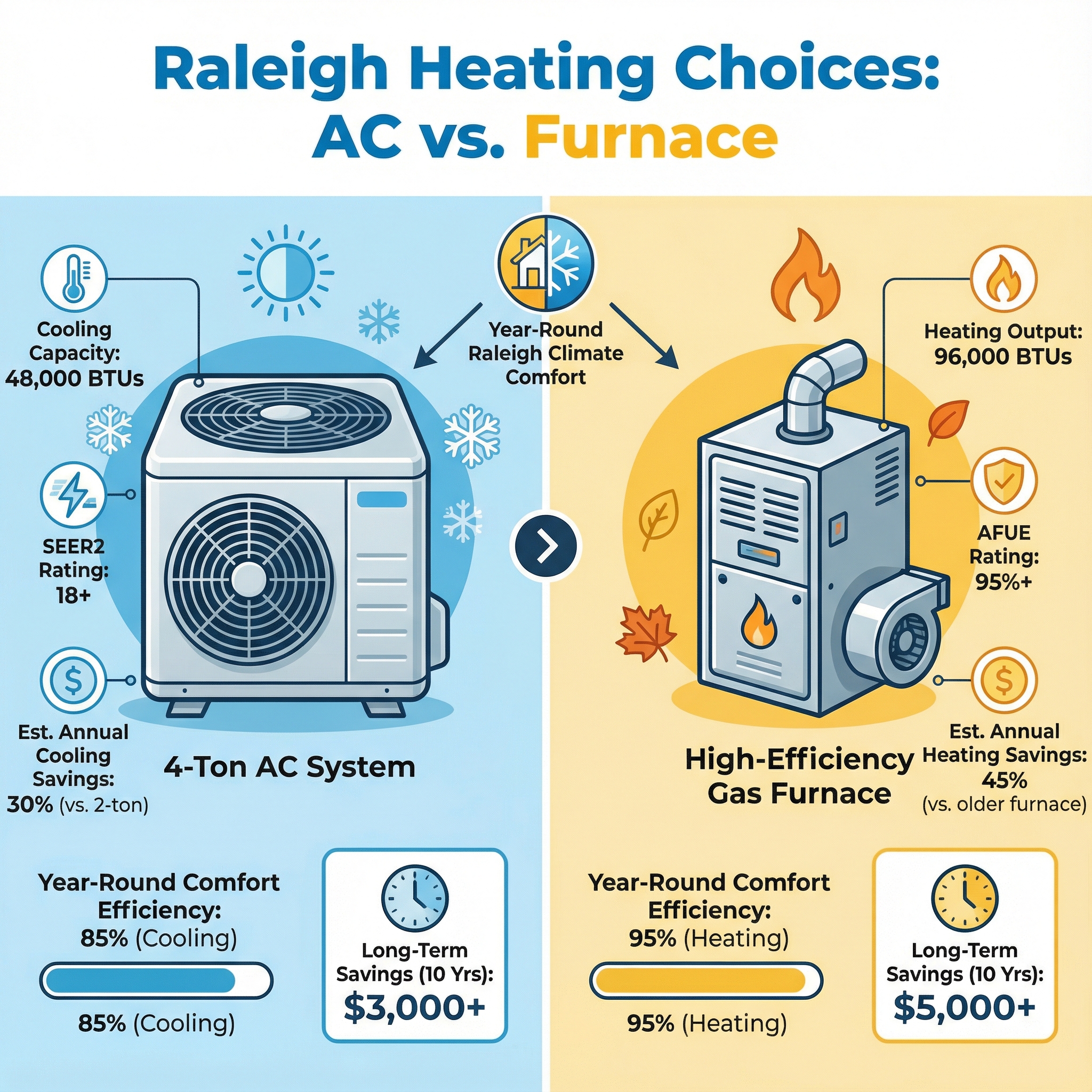
Raleigh summers are hot and humid, winters are mostly mild with chilly nights, so a system must cool hard, remove moisture, and heat efficiently without overshooting. A common fit for many households is a traditional split system: a 4 ton central air conditioner, about 48,000 BTU per hour of cooling capacity, paired with a high efficiency gas furnace. When correctly sized and maintained, this combo handles peak heat, controls humidity, delivers steady and affordable heat when temperatures dip, and supports cleaner air through consistent filtration.
This article explains when a 4 ton capacity makes sense for a Raleigh area home, how AC efficiency ratings (SEER2) translate into comfort and summer electric bills, and how furnace efficiency (AFUE) maps to winter gas costs. It also covers why proper load calculation, ductwork quality and sealing, and smart humidity control shape indoor air quality, maintenance expectations, and long term operating costs, helping the equipment perform efficiently and last longer.
Is a 4 Ton Air Conditioner the Right Size for Your Raleigh Home? Key Benefits and Use Cases
Based on 30 plus years in HVAC, we typically see a properly designed 4 ton central AC paired with a gas furnace fit many Raleigh homes around 2,000 to 2,500 square feet. That capacity, roughly 48,000 BTU per hour, helps keep multi room, two story layouts comfortable during long, humid summers and has headroom for peak heat waves.
- Cooling and heating balance: A 4 ton AC handles muggy days, and the gas furnace delivers quick, reliable heat during cold snaps. Furnace output is consistent regardless of outdoor temperature and ties in well with existing ductwork.
- Efficiency that affects bills: Higher SEER2 on the AC and higher AFUE on the furnace translate to lower utility use. Target about 16 plus SEER2 and 90 percent or higher AFUE for noticeable savings over code minimum or legacy 80 percent furnaces.
- Smoother comfort with staging: Two stage or variable speed compressors and ECM or variable speed blowers run longer at lower speed, which is quieter and removes moisture more effectively. Think cruise control, steady and gentle instead of stop and go, reducing hot and cold spots and sticky air.
- Air quality potential: A 4 ton system can support larger filters and continuous low speed circulation for better particle capture without a big energy penalty.
- Maintenance and lifespan: With pre season service and filter changes every 1 to 3 months, central AC commonly lasts 12 to 17 years and furnaces 15 to 20 years, provided warranty requirements are followed.
- Upgrades and value: Modulating furnaces, smart thermostats, and duct sealing or resizing can sharpen comfort and efficiency. While upfront cost is higher than base models, correct sizing and higher efficiency often reduce lifetime operating costs.
Raleigh Climate & Regulatory Context: Why Humidity, Codes, and Refrigerant Rules Matter
Raleigh sits in IECC Climate Zone 4A, a mixed humid profile with long, hot, very moist summers and generally mild winters with occasional cold snaps. That humidity means cooling must handle latent load, not just air temperature. We see oversizing a 4 ton AC lead to short cycling and sticky rooms even when the thermostat reads setpoint. A proper Manual J and attention to sensible heat ratio are critical. Variable speed or two stage compressors with ECM blowers, plus dehumidify on demand controls, keep runtimes longer and moisture in check.
Regulatory rules shape equipment choices. In the Southeast region, split ACs at or above 45,000 Btu per hour require 13.8 SEER2 minimum, smaller capacities must meet 14.3 SEER2. Heat pumps carry 14.3 SEER2 and 7.5 HSPF2 nationwide. Non weatherized gas furnaces can still be 80 percent AFUE today, but a 95 percent minimum takes effect in 2028. Beginning with 2026 models, many systems shift from R 410A to A2L refrigerants like R 454B or R 32, which require code compliant installation per UL 60335 2 40 as North Carolina updates its codes.
How Manual J, S and D Calculations Determine Proper Equipment and Duct Sizing
Manual J calculates your home's heating and cooling loads, Manual S matches equipment to those loads, and Manual D designs the ducts to deliver the right airflow. Think of it like a trip plan: J sets the destination, S picks the vehicle, D maps the route. In our experience at Budget Heating (BudgetHeating.com), correct sizing and airflow are vital in humid Raleigh.
- Insist on a written Manual J for Raleigh design weather. Provide plans, R-values, window specs, orientation, leakage or blower-door, occupants, internal gains, and duct locations.
- Verify the load supports about 48,000 Btu/h; confirm SHR and latent capacity suit Raleigh humidity.
- Manual S: pick high SEER2/EER2, two-stage or variable speed. Match the indoor coil. Size the furnace to the heating load or consider dual fuel.
- Manual D: inspect, seal, insulate, and pressure-test ducts. Confirm returns, target cfm per ton, and external static pressure meet manufacturer limits.
- Humidity and controls: set blower ramps, enable thermostat dehumidify, program realistic temp and RH, and use a smart thermostat for staging.
- Safety and quality: pull permits, verify combustion air and venting, add CO detectors and condensate overflow; commission and document airflow, static, charge, temps, thermostat setup, and combustion tests; maintain MERV 8 to 13 filters, annual service, compare lifecycle cost, and register warranties or rebates.
When a 4 Ton AC + Gas Furnace Is Not the Best Choice: Tradeoffs, Myths and Alternatives
We see 4 ton systems work beautifully in the right homes, but in Raleigh's humid climate bigger is not automatically better. If a Manual J load calculation points lower, oversizing can short cycle, miss humidity targets, and cost more to run. Think of it like wearing boots two sizes too big, you move, just not comfortably.
- After envelope upgrades: If you have added air sealing, insulation, or better windows, the load often drops. A smaller two stage or variable speed system can improve comfort and humidity control while reducing run costs.
- Duct limits: A 4 ton unit needs substantial airflow. Undersized or leaky ducts raise static pressure and noise and reduce capacity. Fix ducts first, or select a smaller capacity that matches available ductwork.
- Lower gas use goals: If heating hours are modest or you want to trim gas consumption, a heat pump or dual fuel setup can be a better fit than a large gas furnace.
Do not rely on legacy SEER labels. Compare SEER2 to SEER2, with mid teens SEER2 a solid Raleigh baseline. Premium ratings only pay off with correct sizing, proper charge and airflow, and well configured staging or variable speed controls.
Typical Home Sizes, Layouts and the NREL Example: When 4 Tons Match the Load
In Raleigh, a representative NREL case shows how house size and envelope quality drive tonnage. A 2,000 square foot home built to conventional standards produced a Manual J cooling load of about 52,100 Btu per hour, which points to a 4.0 to 4.5 ton system. That is when a 4 ton air conditioner typically matches the load.
After envelope upgrades, better insulation, air sealing, and windows, the same home's design load fell to roughly 23,300 Btu per hour. A 2 ton system was then adequate. Right sizing with a tighter envelope can lower upfront costs for the AC, furnace, and ductwork, and can deliver about a 10 percent operational efficiency bonus.
Energy use followed suit. Annual cooling dropped from about 3,808 kWh to 1,790 kWh, a savings near 2,018 kWh, or about $182 per year at 9 cents per kWh. In a heat pump heating scenario, use fell from about 12,641 kWh to 4,677 kWh, saving about 7,964 kWh, or roughly $717 per year. If a 4 ton unit is truly required, stepping from 13.8 SEER2 to 16 SEER2 can cut cooling about 14 percent, and to 18 SEER2 about 23 percent.
SEER2, AFUE and Real World Efficiency: What Raleigh Homeowners Should Target
SEER and SEER2 rate cooling efficiency over a season. SEER2 is a newer, stricter test, typically 4 to 5% lower. SEER2 is like MPG, higher means fewer kWh. For a Raleigh 4 ton system the minimum is 13.8 SEER2. Moving to 16 SEER2 trims cooling about 14%, and 18 SEER2 about 23%.
AFUE measures how much furnace fuel becomes heat. High efficiency models are about 90 to 98% AFUE. AFUE does not change SEER2, but the blower, ducts, airflow, and charge set real world results. In our experience at Budget Heating (BudgetHeating.com), Raleigh homes do well at 16 to 18 SEER2 with a 95%+ AFUE furnace. On a tight budget, 13.8 to 15.2 SEER2 with 90 to 92% AFUE can be smart if installation is dialed in.
Safe Operation and Maintenance: Owner Tasks, Professional Work, and Recommended Cadence
Safe operation of a 4 ton central AC with a gas furnace starts with clear owner upkeep, licensed technical work, and combustion safety practices.
- Filters: Check monthly and replace every 1 to 3 months. Use the correct size and a MERV 8 to 11 filter, arrow toward the blower.
- Clearances and light cleaning: Keep 2 feet around the condenser and 5 feet above it clear. With power off at the thermostat and outdoor disconnect, lightly hose the outdoor coil, vacuum grilles, and verify the condensate drain flows.
- Controls and cues: Test CO detectors monthly, replace batteries as needed, set the thermostat to the correct mode, and shut the system off if you notice odd noises, smells, ice, or water.
- Refrigerant: Leaks, charging, and any work with A2L refrigerants like R 454B or R 32 require EPA 608 certified technicians.
- Electrical: Recurring trips, failed capacitors or contactors, control boards, and thermostat wiring.
- Gas and combustion: Any gas odor, unstable flames, soot, ignition failures, venting issues, or gas piping work.
- Mechanical and drainage: Motors, compressors, coils, heat exchangers, airflow balancing, and persistent drain clogs.
Install CO detectors on each floor and near bedrooms. If an alarm sounds or symptoms appear, evacuate and call emergency services and a licensed technician. Do not alter flue or intake piping. Schedule two tune ups yearly, a spring AC service and a fall furnace service.
Ductwork, Airflow and Installation Quality: Why Distribution Makes or Breaks Comfort
A 4-ton system only delivers capacity if air can move. Supply and return ducts must be sized and routed per Manual D, with leakage sealed using mastic or UL 181 tape. Target 350 to 400 CFM per ton, so 1400 to 1600 CFM for 4 tons. We routinely see returns choke output, so multiple low resistance paths keep noise and static in check. Variable speed helps only when ducts are right.
- Measure total external static pressure and compare to blower tables, aim near 0.5 in. w.c., set blower.
- Verify airflow with a flow hood or traverse, balance registers, set 350 to 400 CFM per ton.
- Check coil temperature split around 18 to 22 F, then fine tune charge after airflow is correct.
- Seal leaks with mastic, fix kinks, use long radius elbows, add returns as needed, and use low resistance filters.
Next Steps for Raleigh Homeowners: Manual J, Multiple Quotes and Informed Decisions
In Raleigh, a right sized 4 ton AC with a gas furnace delivers dependable comfort when a Manual J supports it, ducts are sealed and balanced, and humidity control is planned. Your next moves: order a Manual J, get a duct inspection, and request two itemized quotes that include full commissioning.
We know this is a big decision. With 30 plus years in HVAC and U.S. based phone support, our team will help you choose with confidence.
- Get a Custom Quote: Manual J, duct review, matched equipment.
- Talk to Our Team: U.S. based phone support from real HVAC pros.
- Shop Central AC and Gas Furnaces: 4 ton options from major brands, Affirm available.
 Cooling
 Heating
 Learning Center
 Money Saving Tips
 Product and Brands Insights
 Buying Guides
 State by State