




 heating
 money saving tips
How Much Does a New Furnace Cost in 2026? Quick National Snapshot
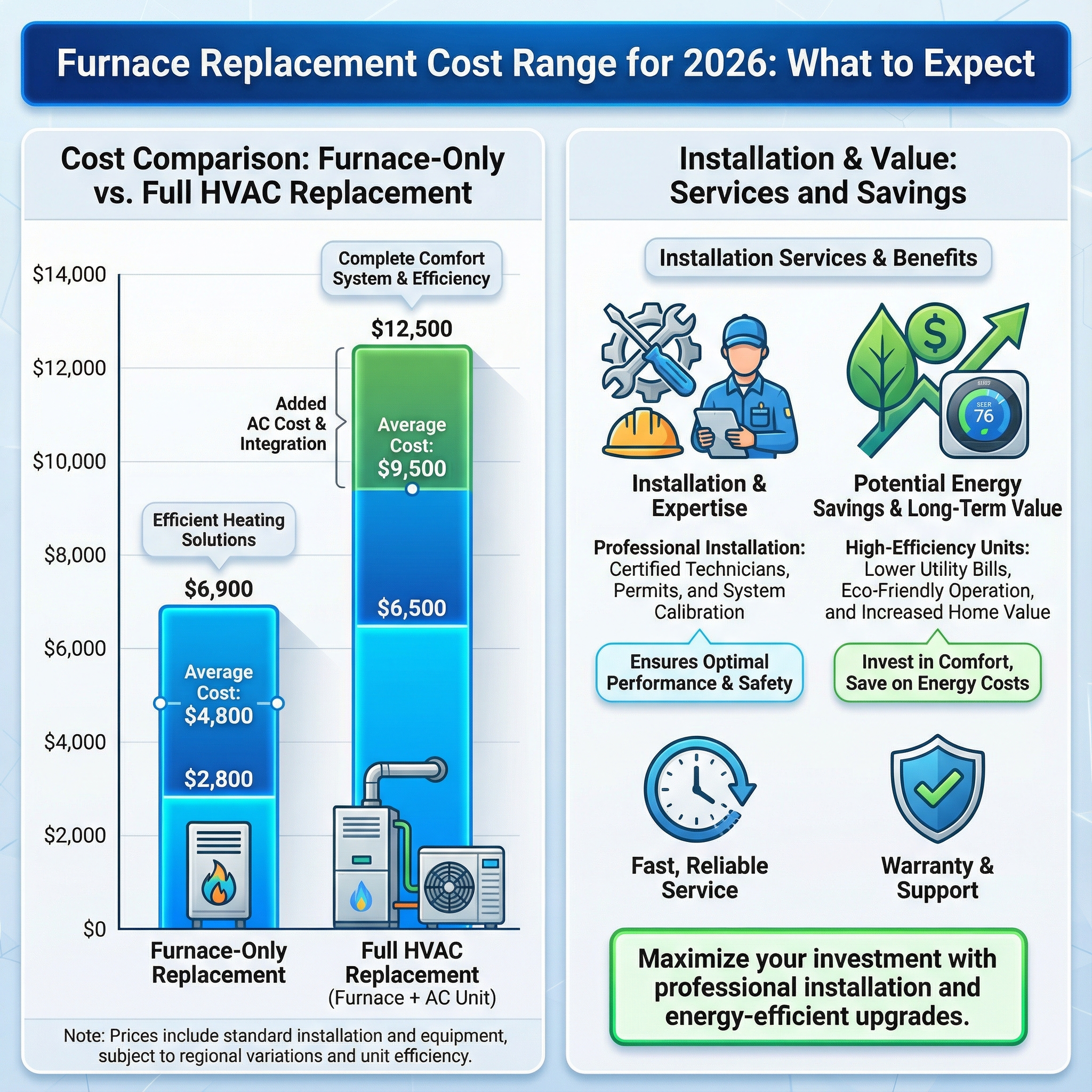
Planning a furnace replacement in 2026? Expect average installed costs around $4,800, with most projects landing between $2,800 and $6,900. Because your heating system directly affects winter comfort, monthly energy bills, indoor air quality, and useful system life, it pays to understand the factors behind the price.
In our experience working on thousands of systems over three decades, prices move with a few key drivers: furnace size and fuel type, efficiency rating, brand tier and warranty, installation complexity such as venting or duct adjustments, and the local labor market. Cold-climate homes often opt for higher capacity or efficiency, while straightforward swaps in accessible spaces typically sit at the lower end of the range.
Treat national averages and ranges as high-level planning guardrails, then refine based on your home, climate, efficiency goals, and local labor market. Think of the range like a map, useful to orient your budget, but your address, comfort goals, and installation details determine the exact route and final cost.
2026 Furnace Price Snapshot: Low, Average, and High End Installed Costs
Based on decades of hands-on installs and nationwide fulfillment, here is what most homeowners should plan for in 2026. These are installed price bands that reflect common real-world scopes, site conditions, and equipment tiers.
- Furnace only: many installs fall between $2,824 and $6,882. Lower totals usually mean a straightforward changeout. Higher totals reflect premium efficiency, larger capacity, or added accessories.
- Furnace + AC together: commonly $5,000 to $12,500, with project averages near $7,500. Bundling can trim labor and permit overlap compared with separate jobs.
- AC only: about $3,900 to $8,000 installed.
If you are weighing broader HVAC configurations, typical installed ranges look like this:
- Split systems: $3,800 to $7,500
- Duct free mini splits: $2,000 to $14,500
- Hybrid systems: $2,500 to $10,000
- Packaged heating and air: $10,000 to $14,000
Savings potential: higher efficiency can reduce operating costs enough to offset part of the upfront price. High AFUE gas furnaces may cut fuel use by up to about 30 percent versus much older models. Modern heat pumps can trim combined heating and cooling energy by up to roughly 50 percent in some homes. For cooling alone, stepping from 15 SEER2 to 20 SEER2 can save around $200 per year in high-rate states, and incentives up to $2,000 may further shorten payback. Actual savings depend on your climate, utility rates, and run time.
Cost by Furnace Type: Gas, Electric, Oil and Propane, What Drives the Price
In our field work, fuel or power source sets both upfront and lifetime cost, since it dictates equipment, venting, and utility bills. In cold regions with natural gas, a gas furnace usually delivers the lowest operating cost, with added needs for gas piping and safe venting.
- Electric: Simplest install, no flue or gas line, often the lowest upfront price. Operating cost rises in cold climates with high electricity rates, so it suits mild regions or homes without gas.
- Oil or propane: Common where gas lines are absent. Storage tanks, periodic deliveries, and specialized venting and service raise equipment and installation cost, and fuel price swings affect lifetime expense.
- Heat pumps: A strong alternative. Air source and cold climate models provide heating and cooling efficiently, worth considering when electricity pricing and local incentives make sense.
How Size and Efficiency Affect Price (BTU Capacity & AFUE / SEER2 Ratings)
AFUE (Annual Fuel Utilization Efficiency) measures the share of fuel converted to heat, like miles per gallon for heating. Typical gas furnaces run around 80% AFUE for basic models up to about 98% for top-end condensing units.
Cooling efficiency is measured in SEER or the newer SEER2. By 2026 the baseline SEER2 and EER2 levels rise, with most split systems expected at least about 17 SEER2 and 12 EER2. Higher SEER2 reduces summer electricity use, which lowers cooling bills.
Capacity matters for price and comfort. Larger BTU ratings increase equipment cost, yet oversizing creates short cycling, more noise, uneven rooms, and added wear. In our experience at Budget Heating (BudgetHeating.com), matching BTUs to a proper Manual J load is the right starting point so the selected capacity fits the home.
Efficiency tiers shape operating cost. The fuel savings from higher AFUE are straightforward:
- Replacing a roughly 60% AFUE furnace with 80% cuts fuel use by about 25%.
- Moving from 60% to 90% saves about 33%.
- Going from 90% to 97% trims roughly another 7%.
Right-sized capacity controls upfront equipment cost, and higher efficiency reduces ongoing utility spend. Pair both with a Manual J load calculation to get predictable comfort and bills.
Regional & Regulatory Factors That Move Prices (Northeast, Midwest, South, West)
Regional climate and labor shape what is stocked and what it costs. Colder Northeast and Midwest markets lean on larger, higher AFUE furnaces, while parts of the South favor heat pumps. High-wage metros with strict permitting see higher installs. In the Puget Sound area, typical furnace projects run about $4,500 to $10,000, and many jurisdictions are pushing electrification. Regulatory context also moves prices: there is legal uncertainty around the DOE Consumer Furnace Rule, and pending and final standards affect model availability and timing. DOE has set about a 95% AFUE minimum for most non-weatherized gas furnaces in 2028, so choosing 95% or higher in 2026 helps future proof. ENERGY STAR proposals near 97% could push the market toward ultra-high-efficiency condensing units.
Installation Costs: Labor, Materials, Permits and Typical Markups
Final bids are shaped by more than the furnace or coil. A 2026 replacement quote typically bundles permitting, removal and disposal of the old unit, the new furnace and required accessories, venting or flue work (PVC for condensing units), gas and electrical connections, condensate management for condensing furnaces, start-up and commissioning, and warranty registration. It is like swapping a fridge versus remodeling the whole kitchen, access and scope decide the price.
- Installation scope and difficulty: access, attic or crawlspace work
- Duct repairs or resizing
- New flue or venting
- Gas-line or electrical upgrades
- Condensate pumps, drains, or safety pans
- Permits and inspections
- Seasonality and local labor rates
Premium brands, extended warranties, variable-speed blowers, and advanced controls can raise equipment price and often carry higher markups, while improving comfort and reliability. In our experience at Budget Heating (BudgetHeating.com), high-cost metro areas, union labor, and peak-season demand consistently push quotes above national averages, because contractors price in local labor and code complexity.
When Repair Makes Sense, and When You Should Replace Your Furnace
In our field work, repair is reasonable when the unit is younger than 15 years, has a single, isolated fault, and energy bills are stable. Replacement is smarter when the furnace is 15+ years, breaks often, bills creep up, or there is a major failure like a cracked heat exchanger.
- Typical repair costs: thermostat $100-$300+, ignitor $300-$400, blower motor $450-$1,500, heat exchanger $2,000-$3,000. The last two often push replacement on older units.
- A few realities: rebates are not guaranteed in 2026; total cost beats sticker price; the highest AFUE may not pay back in mild climates; bigger is not better, and poor ducts waste performance.
- When a furnace is not ideal: mild climates favor high-efficiency or cold-climate heat pumps; electrification goals fit a hybrid heat pump plus furnace; bad ducts point to ductless mini-splits.
How to Get Accurate Quotes: What Questions to Ask HVAC Contractors
To compare like-for-like bids and avoid surprises, use this checklist when requesting quotes.
- Load calculation and design: Will you perform a room-by-room Manual J and share the report? If ducts are changing, will you include Manual D, and select equipment with Manual S instead of rules of thumb?
- Written scope: Provide a written bid with model numbers, AFUE or SEER2, and line items for ductwork, venting, gas, electrical, thermostat, permits, removal and disposal, labor, and all commissioning tasks.
- Commissioning you should expect: Commit to combustion analysis with CO measurements on combustion appliances, static pressure testing, temperature rise verification, blower tuning, and provide copies of commissioning data and warranty registrations.
- Paperwork and protections: Show active license and insurance, state who pulls permits and schedules inspections, and list the routine maintenance required to keep warranties valid.
This process keeps bids precise, ensures proper sizing, and documents performance on day one.
Hidden or Add On Costs: Ductwork, Zoning, Thermostats, Venting and IAQ
We often see leaky or undersized ducts cripple new systems. Schedule a duct inspection and static pressure test, and budget for sealing, repairs, or added returns. High efficiency furnaces may need PVC venting and a condensate drain or pump, and flue rework can add cost and complexity. Confirm gas line sizing and electrical circuits early, including shutoffs, sediment traps, and surge protection. Smart thermostats typically run $100 to $300 plus install. Zoning, humidifiers, UV lights, and better filters add wiring and parts, but improve comfort and IAQ.
Bottom Line & Next Steps: Budgeting, Incentives, Warranties and What to Do Now
Across U.S. markets in 2026, most furnace-only installs are a mid thousand dollar project, refined by home size, duct condition, fuel type, and regional labor. Higher efficiency equipment, AFUE and SEER2, often costs more upfront but lowers operating expense and may be needed for incentives, which are local and must be verified with documentation; always follow local code and manufacturer guidance for safety.
Practical next steps: decide repair or replace based on age and condition, insist on a proper load calculation with a duct assessment, compare multiple detailed bids with model numbers, AFUE or SEER2 and full scope, then confirm rebates, parts and heat exchanger terms, labor coverage, and the maintenance needed to keep warranties valid, ideally with a service plan.
- Get a Custom Quote from our team, wholesale pricing with free shipping options and Affirm financing
- Talk to Our Team by phone for U.S. based technical support and 30+ years of HVAC experience
- Shop Furnaces, Heat Pumps and Ductless Mini Splits from factory authorized brands with full warranties
 Cooling
 Learning Center
 Product and Brands Insights
 Buying Guides
 State by State
 HVAC Systems