




 learning center
Understanding BTU: The Single Number That Shapes Your Comfort
BTU, or British Thermal Unit, is the amount of energy needed to raise one pound of water by one degree Fahrenheit. It is the core unit we use to size furnaces, air conditioners, and heat pumps. Think of BTU like the sizing on a pair of shoes: get it right and everything fits, go too small or too large and every step is uncomfortable.
The right BTU capacity shapes comfort and cost all year. It balances summer cooling and winter heating, keeps humidity in check, and influences energy bills and equipment lifespan. An undersized unit runs almost nonstop as it struggles to reach setpoint. An oversized unit starts and stops too quickly, known as short cycling, which leads to uneven temperatures, poor dehumidification, and unnecessary wear. Proper sizing helps the system run steady, maintain even comfort, and avoid wasted energy. That single number sets realistic performance expectations before any equipment is installed.
Why BTU Matters: Capacity, Not Efficiency (And What That Means for Your Home)
BTU is best understood as size, not efficiency. It sets how much heating or cooling a system can move in a given time. Efficiency is separate, shown by SEER or EER for cooling, HSPF for heat pumps, and AFUE for furnaces. Think of capacity as the size of a bucket, and efficiency as how little water you spill while filling it.
In our experience, sizing starts with a rough per square foot estimate to narrow the field, then a proper load calculation that accounts for insulation levels, window area and orientation, local climate, and occupancy patterns.
- Stabilizes room temperatures, fewer swings from cycle to cycle.
- Reduces hot and cold spots across the home.
- Improves humidity control, especially in humid climates.
- Maintains rated efficiency, avoiding short cycling and oversizing losses.
- Cuts wear and utility costs over time.
BTU vs Watts and SEER: How BTU, SEER2 and EER2 Work Together
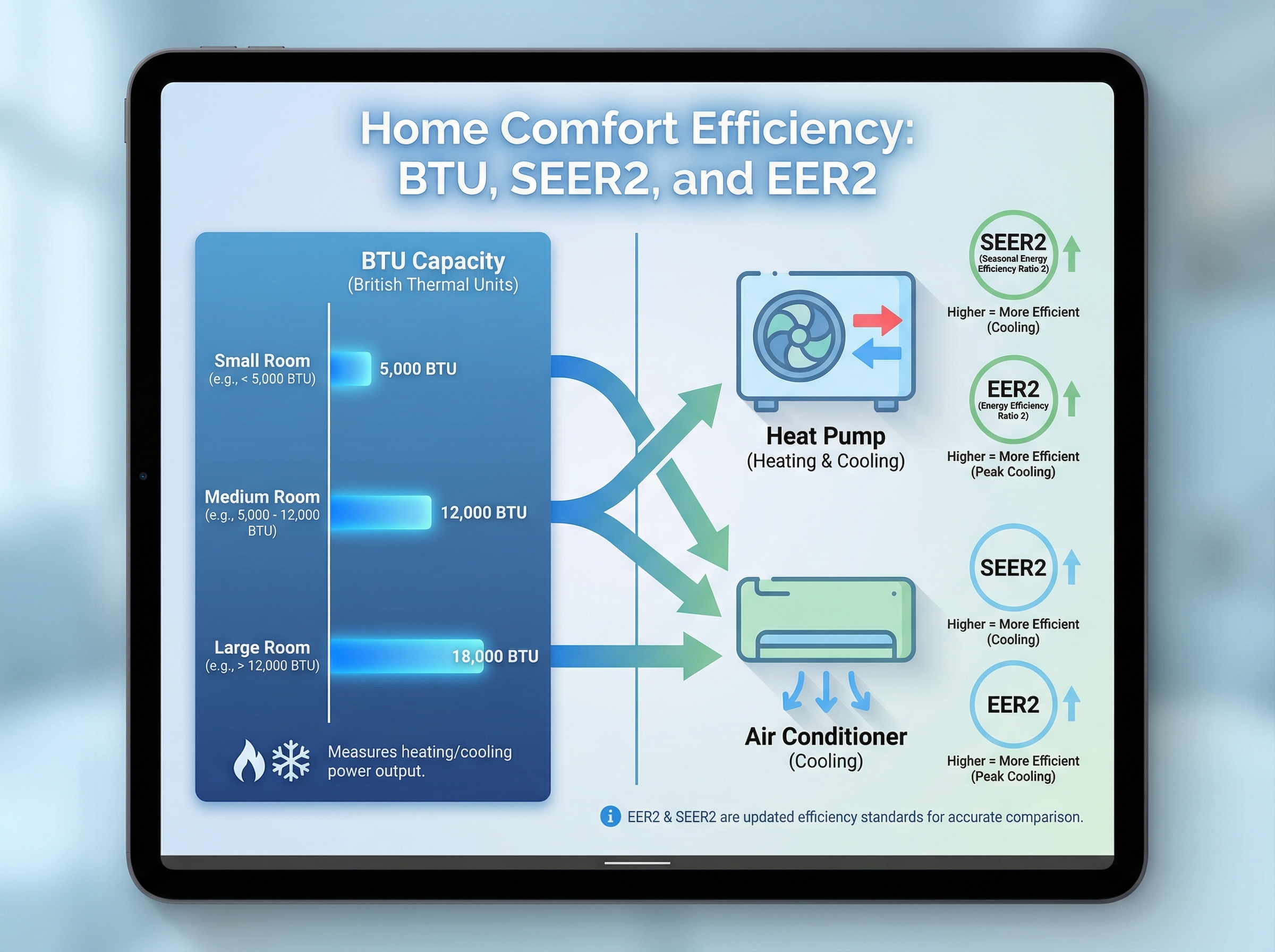
BTU is capacity, the amount of heat an AC or heat pump can move each hour. Watts are the electrical input. Efficiency tells how much cooling you get per watt-hour. We separate the two on every spec: BTU says how much heat is moved, efficiency metrics like SEER2, EER2, HSPF2, and AFUE show the energy it takes over time.
SEER vs SEER2: SEER is seasonal BTUs per watt-hour. SEER2 uses the 2023 DOE M1 test with higher static pressure, so the same unit usually posts a lower number. Always compare SEER2 to SEER2, not to legacy SEER.
EER2 is a snapshot at a fixed test point, useful for hot-climate peak checks. Typical ranges: most splits run about 14.3 to 16.0 SEER2 as standard, with premium systems high teens to 20 plus. Think of BTU as payload and SEER2 or EER2 as miles per kWh.
Common Sizing Mistakes, Limitations, and Better Alternatives
BTU alone is not a compass. We regularly see these missteps:
- Bigger is better is a myth. Manual J sizing is superior. Oversized units short cycle, miss humidity control, waste energy, and add wear.
- Undersized systems run nonstop, miss peak setpoints, use more energy, and stay muggy.
- Room size is not enough: ceiling height, solar gain, ducts, insulation, and climate drive loads.
- More BTUs do not mean higher efficiency. SEER or EER does, and oversizing can raise bills.
- Closing vents raises static pressure, increases leakage, and cuts efficiency.
- Dirty filters restrict airflow and can foul coils.
- Refrigerant should not need periodic top offs. If it does, there is a leak.
- Lowering the thermostat does not cool faster.
Better alternatives: air seal and insulate instead of upsizing leaky homes, repair undersized or leaky ducts, choose two stage or variable speed equipment or add a dehumidifier or ERV in humid climates, and in very cold areas use a cold climate heat pump with backup heat. Higher SEER alone will not overcome poor design or installation.
Energy Efficiency & Running Costs: SEER2, EER2, HSPF2 and Your Bills
SEER2, EER2 and HSPF2 describe how much cooling or heating you get per unit of electricity. Think of them like MPG for comfort, higher numbers mean lower fuel costs. To translate ratings into dollars, look at your seasonal load and power rate, then divide load by efficiency to get kWh and multiply by your rate.
For illustration, a 57.6 million BTU cooling season at $0.14 per kWh costs about: 13 SEER 4,430.8 kWh, $620 per year. 14 SEER 4,114 kWh, $576. 16 SEER 3,600 kWh, $504. 18 SEER 3,200 kWh, $448. Moving from 14 to 16 SEER trims roughly 12 to 15 percent, and 14 to 18 SEER about 20 to 25 percent.
Payback depends on more than the sticker rating. Correct BTU sizing, quality installation, airtight ducts and your local electricity rate determine whether a pricier high efficiency unit earns its keep. In our experience at Budget Heating (BudgetHeating.com), oversized or poorly installed equipment can erase expected savings, while a right sized setup often pays back faster in hot, high cost markets.
How to Calculate the Right BTU Capacity: From Quick Estimates to Manual J
Start by deciding what comfort means in your home. Set summer and winter temperatures and what relative humidity you can accept. These targets drive the numbers you will see later.
Next, gather room-by-room details. Good measurements make good results, like using a tailored suit instead of off-the-rack.
- Square footage of each room and ceiling height. Rooms taller than 8 feet typically need more capacity.
- Insulation levels in walls, attic, and floors.
- Windows: count, size, orientation, glazing type, and any exterior shading.
- Local climate and design temperatures for your area.
- Occupancy and internal heat gains from lighting and appliances.
Use a rough per-square-foot rule only as a quick ballpark. It is a sanity check, not a sizing method. In our experience at Budget Heating (BudgetHeating.com), those shortcuts can mislead when windows, insulation, ceiling height, or climate vary from average.
Finish with a professional load calculation. Ask a contractor for a room-by-room Manual J to determine heating and cooling loads, then a Manual S to select equipment that matches those loads. If you are using ductwork, request Manual D or an equivalent duct design to verify airflow capability and account for duct losses. This sequence keeps you from oversizing or undersizing, and aligns the system with how your home is actually built and used.
Typical BTU Recommendations (Quick Rules and When to Adjust for Climate)
Per-square-foot rules are useful as a first pass, like using a shoe size chart before a fitting. We treat them as ballpark only. Climate matters: in hot, humid Zone 2, cooling often lands around 45 to 50 BTU per square foot, with heating around 35 to 40 BTU per square foot in similar conditions.
Adjust these quick rules when conditions shift. High humidity reduces sensible cooling effectiveness, so in very hot, humid rooms it is common to bump cooling capacity by about 10 to 20 percent. Ceilings taller than about 8 feet add air volume, so increase capacity accordingly. Keep in mind that these are screening numbers, not a substitute for a room-by-room load calculation.
Sizing Common Units and Regulatory Thresholds: Window ACs, Portables, Central Systems
BTU sizing plays out differently by unit type. For window ACs and portables, match the room load closely so the unit can run steadily, pull moisture, and hit its ratings. Oversizing causes short cycling and leaves comfort on the table, like wearing shoes a size too big. Furnaces are also BTU sized for the space, and avoiding oversizing helps prevent short cycling and temperature swings.
Central cooling adds a regulatory layer. Since 2023, regional minimums vary: Northern states require 14 SEER, about 13.4 SEER2. In the Southeast and Southwest, rules hinge on certified capacity. The 45,000 Btu/h breakpoint can change which efficiency rules apply, where systems under 45,000 may need around 15 SEER, and some Southwest areas add EER2 floors for high-heat performance. Verify local SEER, SEER2, and EER2 requirements and labels so a capacity choice does not push you into a noncompliant or lower-efficiency option. Proper sizing prevents short cycling and helps systems reach rated performance.
Practical Tips to Boost Comfort Without Oversizing: Humidity, Fans, Insulation and Maintenance
Improve comfort by letting the system run as designed, then stack small fixes that help it along. Focus on humidity, airflow, insulation and steady maintenance.
- Humidity control: keep indoor RH near 40 to 60 percent, set the fan to Auto so coils can wring out moisture. For tighter control, use variable speed or two stage cooling, an ERV or HRV, or a whole home dehumidifier.
- Ducts and airflow: seal leaks, insulate ducts in unconditioned spaces, balance registers, and verify blower airflow in CFM per ton matches manufacturer specs.
- Controls and IAQ: use a thermostat that supports multi stage or variable systems, choose MERV filters your system can handle without high pressure drop, add dedicated fresh air ventilation if needed.
- Fans and insulation: run ceiling fans, improve attic insulation and weatherstripping, and shade sun hit windows and the outdoor unit with proper clearance.
- Maintenance: replace filters every 1 to 3 months in peak seasons, keep outdoor coils clear, confirm proper refrigerant charge, and schedule annual tune ups. This preserves rated BTU capacity and efficiency.
- Site and verification: check electrical capacity and condensate and line set details, then request post install readings, airflow, charge, and temperature split.
Actionable Next Steps: Measure, Calculate, and Choose the Right BTU for Year‑Round Comfort
BTU is the sizing backbone. Start with a simple per square foot estimate, then refine with a professional Manual J so capacity matches your insulation, windows, climate, and occupancy for comfort and efficiency all year. The right number prevents short cycling in summer and strain in winter.
We know this choice carries real stakes. With 30+ years and 200,000+ orders fulfilled, our team will help you prioritize the right SEER2, EER2, HSPF2, or AFUE for your region.
Gather room measurements, window counts, ceiling heights, and occupancy, then request Manual J and Manual S from your contractor. We will translate that into the correct BTU, verify duct and installation details, and set a maintenance plan so your system delivers its rated capacity.
- Get a Custom Quote: fast sizing help and an itemized equipment list.
- Talk to Our Team: U.S. based phone support for real answers today.
- Shop Heat Pumps, ACs, Furnaces, and Ductless Mini Splits at wholesale pricing with free shipping and Affirm financing options.
 Cooling
 Heating
 Money Saving Tips
 Product and Brands Insights
 Buying Guides
 State by State
 HVAC Systems