





 hvac systems
 learning center

Understanding Air Handlers: Why They Matter for Comfort, Cost and Indoor Air Quality
An air handler, sometimes called an AHU, is the indoor circulatory system of HVAC. It regulates and moves conditioned air through ducts, so it directly shapes how even rooms feel, how well humidity is managed, how clean the air stays, and how much energy the system uses. When the air handler is well matched to the space and set up correctly, airflow is consistent, filtration works as intended, and the rest of the heating or cooling equipment does its job efficiently.
This guide explains what an air handler does and what to look for when choosing, operating, and maintaining one. Here is what will be covered:
- Purpose and major components
- Types and how each operates
- Sizing principles for proper airflow
- Installation and setup essentials
- Maintenance routines and basic troubleshooting
- Energy efficiency and the regulatory context
- Practical next steps for planning a project
What Is an Air Handler (AHU)? Definition, Role and Key Benefits
An air handler is the indoor unit that moves, conditions, and distributes air through a building's ductwork. Inside the cabinet are a blower, coil, filtration rack, and controls that work with a heat pump or AC to deliver the right temperature and airflow. Think of it as the central hub that pulls air in, filters it, adds or removes heat and moisture, then pushes it back out evenly to each room.
- Consistent comfort: steady airflow and better temperature balance
- Cleaner indoor air: deeper filter options capture more particulates
- Humidity control: pairing with the coil and smart blower speeds
- Energy efficiency: ECM motors and tight cabinets reduce waste
- Quieter operation: insulated cabinets and variable speed settings
- System longevity: less short cycling, cleaner components
When choosing an AHU, consider capacity to match the outdoor unit, blower type and speed control, filter size and MERV allowance, coil compatibility and refrigerant, sound ratings, dehumidification modes, zoning compatibility, available space and orientation, and climate needs such as electric heat kits.
Key Components of an Air Handler: Blowers, Coils, Filters and More
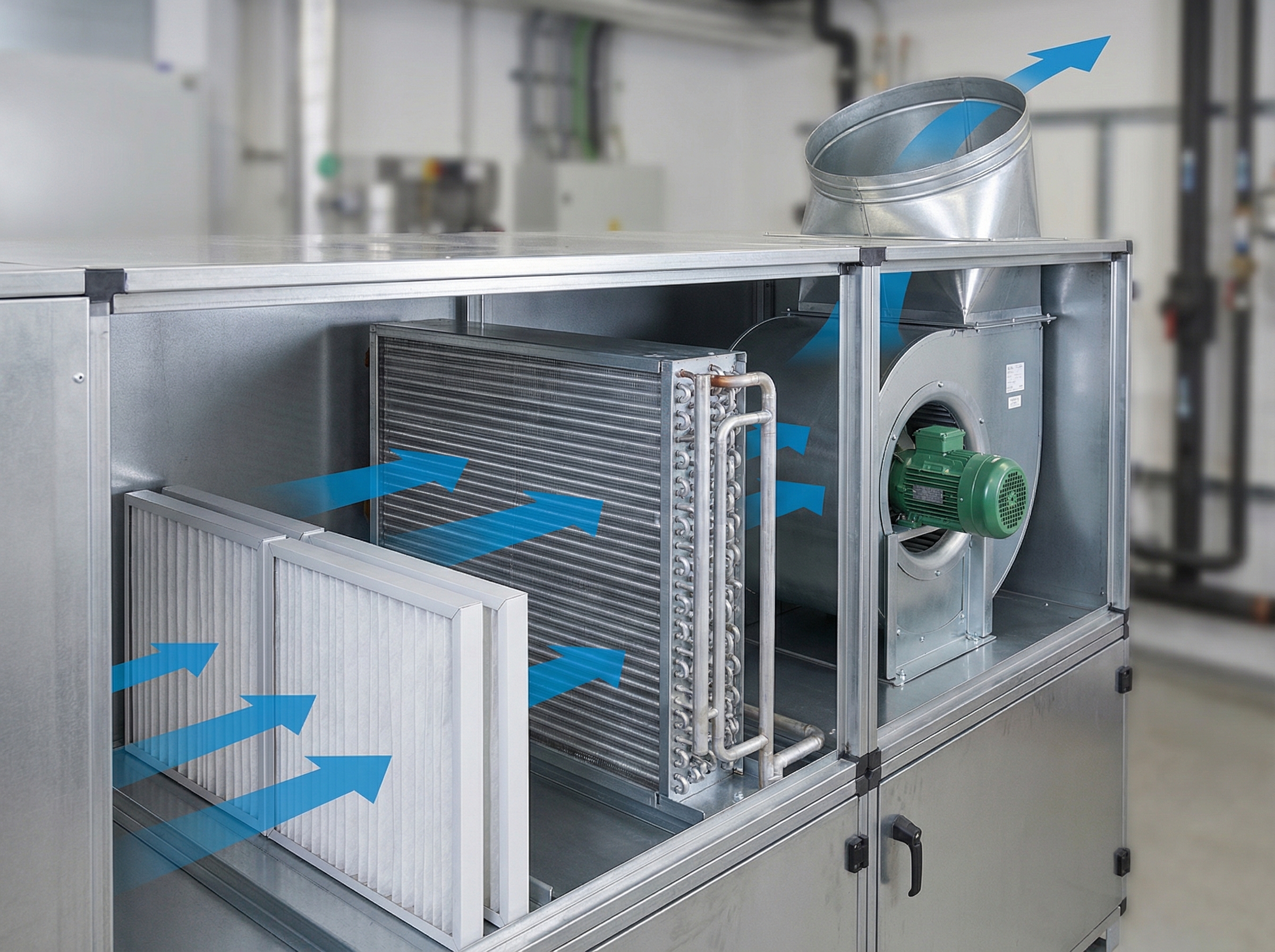
Picture the air handler as a well organized box: air enters, gets conditioned, then leaves for the ducts. Here are the parts that make that happen and where they fit in the sequence.
- Return connection: the intake from the home's return duct or plenum, where room air enters the unit.
- Filter rack: sits at the intake to catch dust and protect the coil and blower, usually with easy access for changes.
- Heating and cooling coils: refrigerant or hot water flows through these finned coils to absorb or add heat.
- Blower or fan: the mover of the system, typically a direct drive motor that pulls air through the coil and pushes it to the supply.
- Supply connection: the outlet to the supply plenum or ducts that distribute conditioned air.
- Dampers: adjustable blades that regulate or balance airflow, sometimes used for fresh air mixing.
- Humidifier or dehumidifier options: add ons that adjust moisture levels for comfort and wood protection.
- Controls: boards, sensors, and thermostat wiring that manage blower speed, safeties, and coil operation.
- Condensate pan and drain: captures moisture from cooling and routes it safely to a drain, often with overflow protection.
- Cabinet and sound attenuation: insulated panels, gaskets, and liners that reduce vibration and noise while sealing airflow.
Types of Air Handlers: Residential, Commercial, Packaged, Rooftop and Split Units
Air handlers fall into a few clear families. Think of them as different body styles on the same chassis. Residential models are compact and quiet for closets, attics, or basements. Commercial units are larger, built for higher airflow and multi zone service. In our experience at Budget Heating (BudgetHeating.com), the right pick depends on space and service access.
- Residential: multi position, pairs with split systems, ideal for single family homes.
- Commercial: higher static and CFM, common in offices, schools, healthcare.
- Split units: indoor air handler plus outdoor condenser or heat pump, flexible placement.
- Packaged units: all in one cabinet outdoors or on a pad, saves indoor space.
- Rooftop units: packaged for roof mounting, popular for retail and low rise offices.
Controls & Airflow Strategies: VAV, CAV, ECM Blowers and Smart Thermostats
In CAV, the blower delivers steady airflow while capacity is managed by staging. VAV varies airflow to match load, like a dimmer instead of a switch, boosting comfort and room balance. PSC blowers are single speed. ECM variable-speed motors hold target cfm, ramp gently, and can run low to trim humidity. Zoning uses motorized dampers to send air where needed and works best with ECM and smart thermostats that support dehumidify or ventilation calls. Fan Energy Rating limits fan power, so modern units lean on ECM and proper duct design to keep external static under control.
How an Air Handler Works: Airflow, Coils and Heat Transfer Explained
Inside the cabinet, everything starts with airflow. The blower creates a pressure difference that pulls return air in, moves it across the coil, then sends supply air back to the rooms.
- Airflow path: air is drawn through the return and filter, swept evenly across the coil face, then pushed into the supply plenum and ducts.
- Coil heat exchange: in cooling, refrigerant in the coil absorbs heat; when the coil surface is below the room air dew point, moisture condenses and drains. In heating, the coil gives heat back to the airstream.
- Right airflow rate: most systems target about 350 to 450 CFM per ton. Too low raises static pressure, risks coil icing, and hurts capacity. Too high can reduce dehumidification and increase noise.
Sensible heat is the temperature change you feel and see on a thermometer. Latent heat is moisture removal. A cold coil that is below dew point wrings moisture from air, like water droplets forming on a glass of iced tea.
Coil and refrigerant must be matched to the outdoor unit and metering device so superheat and subcool are in range. In our experience at Budget Heating (BudgetHeating.com), most comfort complaints trace back to mismatched coils or airflow and static pressure outside design, often above 0.5 in. w.c.
Air Handler vs Furnace vs Air Conditioner: Which One Does What?
Think of the system as a team. The air handler is the indoor partner you already know. A furnace creates heat by burning gas or oil, then uses its blower to push air through ducts. An outdoor air conditioner only cools, while a heat pump outside can heat and cool by reversing refrigeration. A furnace can share ducts with an AC. An air handler typically pairs with a heat pump or AC in all electric homes.
Common misconceptions and mistakes we see: calling an air handler just a fan, mixing unmatched indoor and outdoor units that never hit rated efficiency, and skipping annual service that leaves coils dirty and airflow low.
When an air handler is not the best choice: homes without ducts often do better with ductless mini splits, very cold climates may favor a gas furnace, and large commercial buildings usually need packaged rooftop or central systems.
Sizing an Air Handler: Manual J/S, CFM Targets and Ductwork Considerations
Proper air handler sizing is a process, not a guess. Start with the building load, select equipment to match that load, then verify the system can actually move the air the equipment needs. Think of the ducts as the roadway and the blower as the traffic flow. If the road is narrow, you will not hit your target speed.
- Require a Manual J load calculation and a Manual S equipment selection. Size the air handler to the load, not to the existing nameplate.
- Set airflow targets by capacity. Typical design is 350 to 450 CFM per ton. Confirm the chosen air handler and tap settings can deliver that airflow once installed.
- Confirm AHRI-matched equipment. The indoor coil, outdoor unit, refrigerant type, and metering device must be compatible to achieve rated capacity and efficiency.
- Check the filter rack size and MERV tradeoffs. Higher MERV catches more, but increases resistance, so rack area and media depth matter.
- Assess ducts with Manual D before committing. Look for sizing, layout, and restriction issues that would choke airflow.
- Measure total external static pressure on the existing system to understand the real resistance the new air handler will face.
- Plan service and access clearances, electrical disconnects, and safe, code compliant condensate routing and overflow protection.
- Document final performance after startup, including total external static pressure, delivered CFM, and supply-to-return delta T.
Energy Efficiency, Regulations and Upgrades: SEER2, ECM Motors, and Heat Recovery
SEER2 is the current U.S. efficiency metric. The M1 procedure raises external static pressure and airflow setpoints, so ratings better reflect ducted operation. Regional SEER2 minimums apply, and proper air handler and coil matching is required. New equipment uses A2L refrigerants. Codes such as ASHRAE, IECC, and Title 24 in California shape the limits. FER and fan power caps have pushed efficient blowers.
In practice, stepping from SEER2 15 to 20 can trim cooling energy by up to 33 percent under test assumptions. ECM blower motors cut fan electricity and improve low speed comfort. Heat recovery on ventilation can reduce heating or cooling loads. Installed costs vary, and published savings are directional. Payback depends on climate, runtime, energy prices, and installation quality, which mirrors what we see in the field.
Conclusion: Choosing, Maintaining and Optimizing Your Air Handler
Air handlers drive comfort, indoor air quality, energy use, and system life. Choose AHRI matched equipment, verify airflow and static pressure, prefer variable speed blowers, and insist on documented installation and commissioning. Keep homeowner tasks monthly, filter changes plus visual and condensate checks, and leave electrical, refrigerant, and internal service to a pro. Schedule annual service, twice yearly in heavy use climates, and call right away for leaks, burning smells, ice on the coil, breaker trips, or sudden weak airflow. If you are weighing options, our team with 30+ years in HVAC can help you get sizing, matching, and commissioning right the first time.
- Get a Custom Quote for an AHRI matched air handler package, with wholesale pricing and Affirm financing.
- Talk to Our Team by phone for real, U.S.-based technical support before you buy.
- Shop Air Handlers and matching coils or heat pumps, with fast shipping and many systems shipping free.
 Cooling
 Heating
 Money Saving Tips
 Product and Brands Insights
 Buying Guides
 State by State