




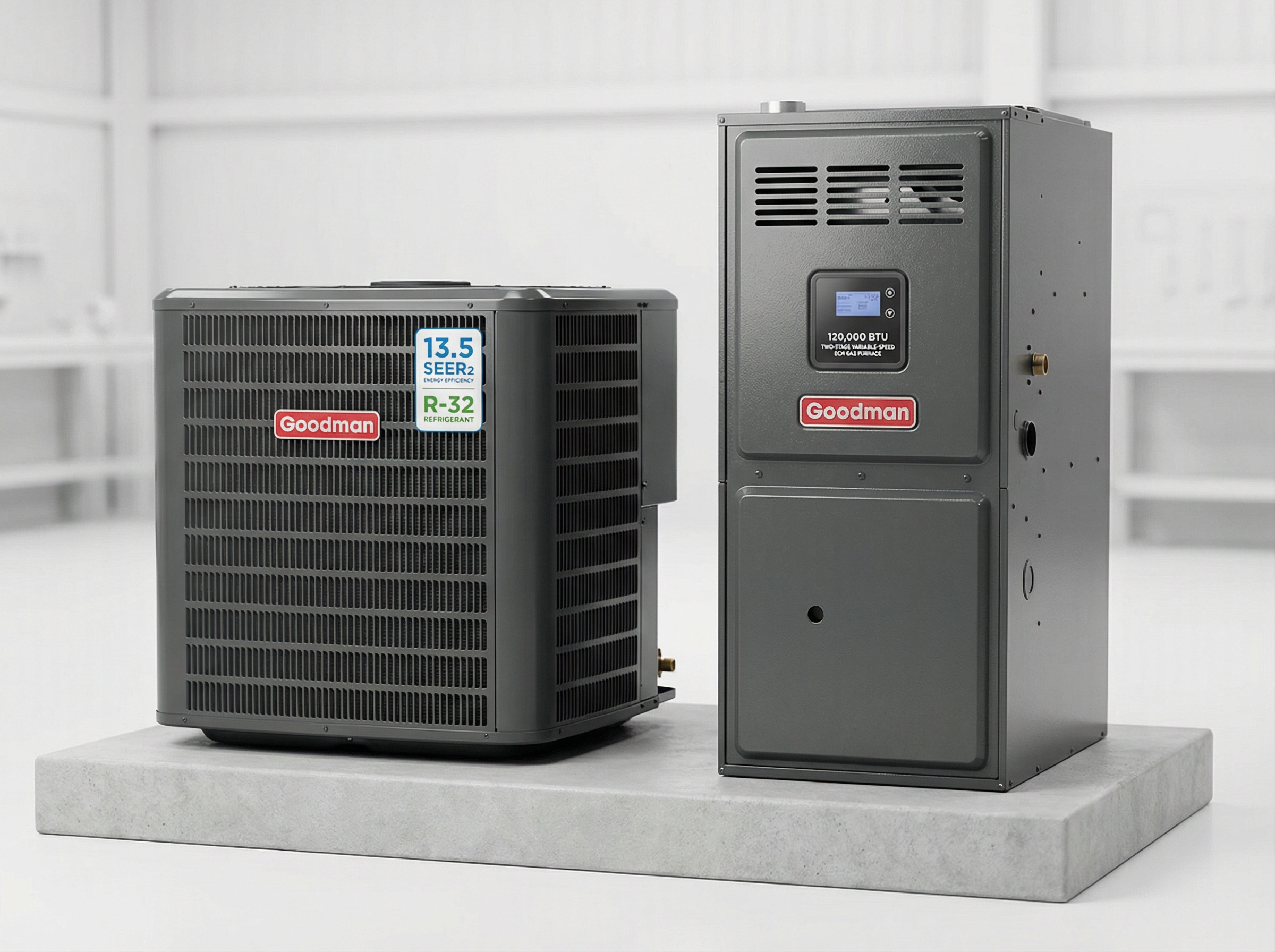
Goodman 4 Ton 13.5 SEER2 + 120,000 BTU Furnace (R 32): Overview
This matched system pairs a 4 ton, 13.5 SEER2 condenser with a 120,000 BTU two-stage, variable-speed ECM gas furnace using R-32. In our field experience, it fits larger homes or colder regions that need strong heating capacity with steady, quiet airflow. Expect cooling costs about 20 to 35 percent lower than an older 10 SEER setup, plus smoother winter comfort from staging and ECM control. We outline where it makes sense by climate and size, installation and code notes for A2L refrigerant, maintenance expectations, and practical buying guidance.

Quick Specs & Sizing: What 4 Tons (≈48,000 Btu/h) and 120,000 BTU Mean for Your Home
4 tons equals about 48,000 Btu/h of cooling. In many homes, that lines up with roughly 2,000 to 2,500 sq ft under average construction and climate. The 120,000 BTU figure usually refers to heating output, common for larger heat losses or colder regions. Treat these as starting points, not final answers. Proper sizing comes from a Manual J load calculation, which tallies room by room factors like insulation, window area, orientation, air leakage, occupants, duct layout, and local weather. It is like tailoring a suit, precise measurements prevent short cycling, uneven rooms, and high bills.
Top Features: Two Stage Furnace, ECM Blower, Durable Coil and R 32 Benefits
A two stage furnace paired with an ECM variable speed blower works like cruise control for your home, holding steadier temperatures, running quieter, improving room to room circulation and helping with humidity control by favoring low stage operation.
The indoor coil is all aluminum with a factory installed TXV, a UV protected thermoplastic drain pan and a galvanized cabinet. Compact depth and single panel access make attic or closet service faster and cleaner.
Goodman integrates an ECM blower, a self diagnostic control board and an outdoor scroll compressor. In practice these tools guide technicians to the fault, trimming service time and cost.
R 32 refrigerant adds environmental and performance upside: far lower global warming potential than R 410A (about 675 vs roughly 2000), single component chemistry for simpler charging and recovery, strong heat transfer that often boosts efficiency by 5 to 10 percent, and typically a lower refrigerant charge. It is A2L, mildly flammable, so proper handling and code compliant installation are required.
Ownership value is solid, with common coverage such as Lifetime heat exchanger and 10 year parts or unit replacement when registered online, while labor and refrigerant are typically excluded.
Energy Efficiency Explained: What SEER2 Is and How 13.5 SEER2 Compares
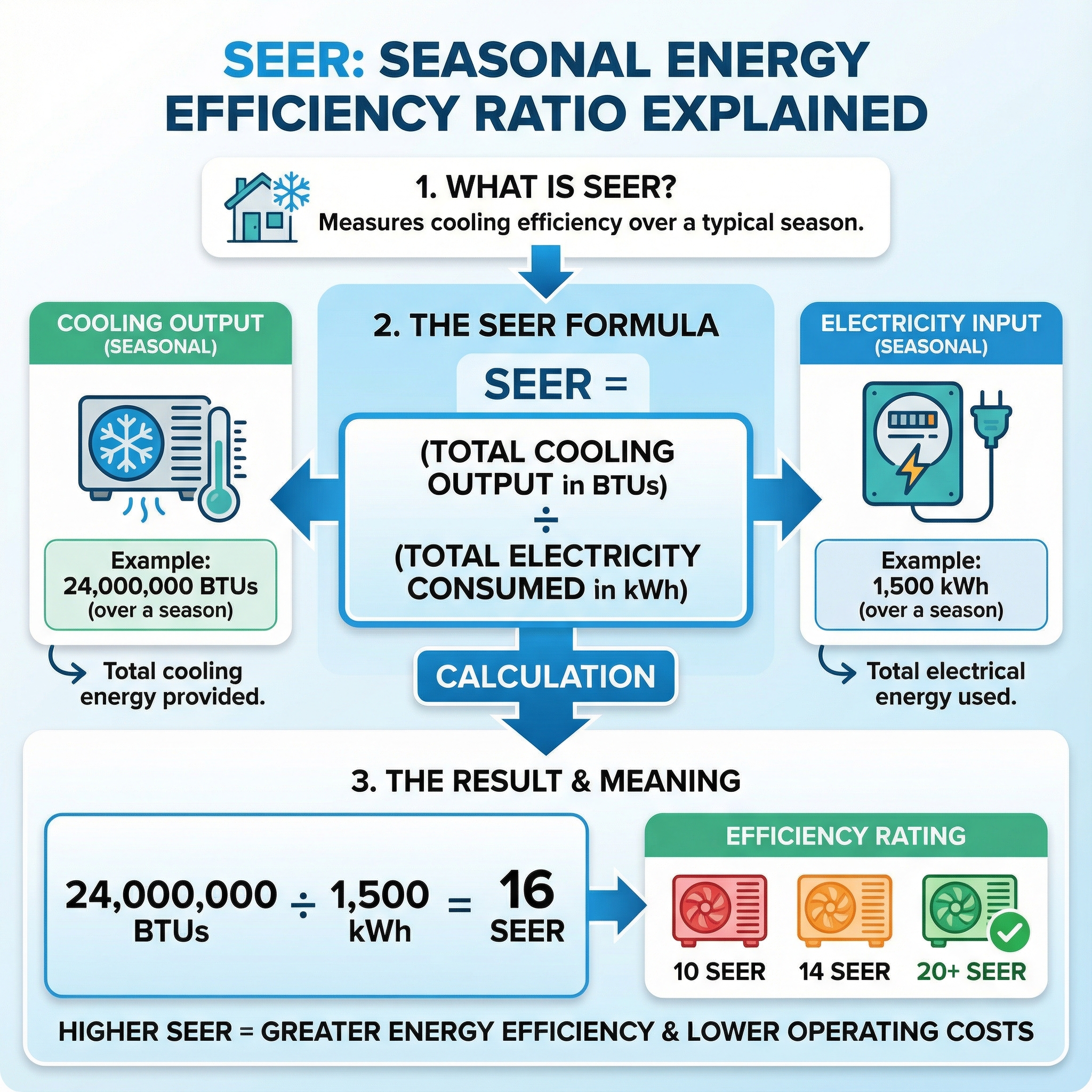
SEER2, short for Seasonal Energy Efficiency Ratio 2, is the DOE post 2023 efficiency metric that uses stricter, more realistic test conditions, including duct static pressure. The goal is to reflect how equipment performs in an actual home, not just a lab. Think of it like timing a run outdoors with a small backpack instead of on a treadmill. Because the test is tougher, SEER2 values are numerically lower than the old SEER for comparable hardware.
A 13.5 SEER2 unit is roughly comparable to about 14 to 14.2 on the legacy SEER scale. That places it in the entry or value tier, not a premium high efficiency model.
Typical market bands today: entry or value about 13.4 to 14.3 SEER2, mid tier about 15 to 17 SEER2, premium variable speed about 18 to 20 plus SEER2. In our experience at Budget Heating (BudgetHeating.com), the shift to SEER2 mainly recalibrated the label so buyers can compare equipment under one realistic yardstick.
Installation, Compatibility & Pre Purchase Checklist: Sizing, Ductwork and R 32 Rules
- Manual J: confirm 4 tons and 120,000 BTU. Use an AHRI matched condenser, coil and furnace to preserve ratings and warranty.
- Electrical: furnace 115V 1 phase 60 Hz, verify nameplate. Condenser on a dedicated 208/230V circuit with disconnect. Check panel capacity.
- Gas and venting: verify gas line sizing, shutoff, drip leg and regulator. For 80% AFUE use proper B vent or a lined chimney and provide combustion air.
- R 32: A2L qualified installer, lineset size and length per spec. Replace or flush old lines, pull a deep vacuum, then verify charge by superheat and subcooling.
- Layout and costs: upflow or horizontal, coils approved for upflow or downflow. Installed cost includes labor, permits, line sets, electrical, duct transitions, pad, disconnect, thermostat and any R 32 leak detection hardware.
Performance Deep Dive: Heating Output, Controls and Airflow Expectations
In our experience, a 120,000 BTU two-stage furnace delivers balanced comfort when paired correctly. It is offered from 80% to 96% AFUE: 80% suits milder climates or budget replacements, while 96% variants reduce winter fuel use substantially in cold regions. Use a compatible two-stage thermostat to let the unit modulate stages smoothly, like a dimmer switch instead of a simple on-off light. Installers should set blower CFM for both heating and cooling and tune fan or dehumidification profiles for the space.
For a properly matched 4-ton application, plan on roughly 1,600 to 2,000 CFM of supply airflow, depending on design. Confirm the indoor coil is R-32 compatible, use a well-sealed filter cabinet, and select a MERV level suited to the home so airflow and filtration stay in balance.
Noise, Durability and Maintenance: Real World Behavior and Care
In real homes, expect a steady outdoor fan hum and a smooth indoor airflow. New rattles or whooshes usually point to loose panels, debris, or icing. Longevity hinges on solid installation, site conditions, and consistent care.
- Homeowner tasks: replace or inspect filters every 1-3 months, keep 2-3 ft clearance around the outdoor unit, power off then gently rinse the condenser coil, check condensate drains, and test smoke and CO detectors.
- Professional tasks: handle all R-32 A2L refrigerant work, electrical connections/whips, gas piping and combustion tuning, install leak detection and the integration kit, and perform any refrigerant or leak repairs.
- Schedule: do monthly basics, plus pro service twice yearly, spring refrigerant and coil checks, fall combustion, venting, and heat-exchanger checks.
- Condensate and commissioning: use trapped, sloped drains, secondary pan and float where needed, and document manifold pressure, combustion analysis, temperature rise, blower amps, and R-32 charge verification.
- Safety: if a refrigerant leak is suspected, shut the system off, ventilate, avoid ignition sources, and call a licensed contractor. Never remove service panels or attempt gas or refrigerant repairs.
Installation & Compatibility: Ductwork, Line sets, Permits and R 32 (A2L) Rules
Before installation, confirm local code acceptance for R 32. As an A2L refrigerant, it requires updated safety practices that many jurisdictions formalize, often including approved leak detection in specified applications, equipment and refrigerant labeling, and installer qualifications specific to A2L handling.
Regional efficiency rules also matter. For split ACs at or above 45,000 Btu/h, the North minimum is about 13.4 SEER2, the Southeast and Southwest require about 13.8 SEER2, and the Southwest adds EER2 thresholds. Gas furnaces are moving toward 95% AFUE minimums in 2028, and some areas require low NOx models or limit new gas service.
- Manual J load calculation and an AHRI matched system.
- Ductwork fit and unit orientation, upflow or horizontal.
- Electrical circuit, breaker and wire sizing.
- Gas line sizing and venting path, if applicable.
- R 32 qualified technician and correct line set size and length.
- Replace line sets, or properly flush and pressure test existing ones.
Verify required mechanical, electrical and gas permits and inspections. Keep the AHRI certificate, product manuals and the installer’s commissioning report, then complete online equipment registration to secure warranty benefits.
Limitations, Common Myths and When Not to Buy This Goodman Package
This 13.5 SEER2, 4 ton R 32 package is entry tier, good for low upfront cost, but not ideal when:
- Cooling hours are long and hot, annual kWh and bills climb versus 15-18+ SEER2 systems.
- Heating loads are high, an 80% AFUE furnace can cost more to run than a 96% AFUE, which uses roughly 20% less fuel.
- You are in Southeast or Southwest regions with 13.8 SEER2 minimums, many new installs will not comply.
Better fits: mid or premium SEER2 models, higher AFUE furnaces, or cold climate heat pumps where electrification is a goal.
Common myths: SEER is not SEER2, 4 ton is not a safe rule without Manual J, furnace BTU does not set AC tonnage, R 32 is lower GWP not a downgrade, oversizing hurts dehumidification, warranties often cover parts not labor.
Conclusion & Final Recommendation: Is This Goodman 4-ton (13.5 SEER2) + 120k Furnace Right for You?
If your priority is lower upfront cost, straightforward reliability, and you live in a moderate climate, this Goodman 4-ton, 13.5 SEER2 R-32 split paired with a 120,000 BTU gas furnace is a practical, value-driven choice. It meets Northern SEER2 minimums, but it sits below higher efficiency tiers, so plan for higher electricity and possibly gas spend compared with premium options.
We know choosing between first cost and long-term utility bills is not simple, especially when rebates and noise expectations are in play.
With 30+ years in HVAC and thousands of Goodman systems matched and shipped, our team can verify sizing, AHRI matches, and code items, then confirm this package or steer you to a higher SEER2 or AFUE alternative if it pencils out.
- Get a Custom Quote: proper sizing, AHRI-matched equipment, accessories, and delivered pricing.
- Talk to Our Team: U.S.-based phone support for straight answers and installer coordination.
- Shop Gas Furnace + AC Packages: Goodman and comparable systems at wholesale pricing, free shipping on most orders, Affirm financing available.