





 learning center
How to Choose the Right BTU Rating for Your Home Office
Choosing the right BTU rating for a home office is the difference between a workspace that stays cool and focused and one that is muggy, noisy, and costly to run. BTU measures how much heat an AC removes each hour, think of it as the size of the bucket carrying heat out. In our field work, small offices with PCs, monitors, and sunny windows overwhelm undersized units. Too many BTUs and the unit short cycles, wastes energy, and leaves air clammy. Right sizing improves comfort, humidity control, costs, and equipment life.
Quick Rule of Thumb: How Many BTUs per Square Foot?
For fast sizing, we start with about 20 BTU per square foot for a typical, reasonably insulated room. Think of BTU like the fuel your room needs to stay comfortable. Use a range of roughly 20 to 35 BTU per square foot: lean toward 20 in shaded, well insulated rooms in mild climates, and toward 35 in hot, sunny spaces, rooms with lots of electronics, or poor insulation. This gets you in the right ballpark before fine tuning for ceiling height, window area, and occupancy. It is a starting point, not a full load calculation.
Measure & Calculate: A Simple BTU Calculator for Your Office
Think of BTUs like cooling horsepower. Here is a simple way to size a single office.
- Measure the room: length times width for square footage. Note ceiling height.
- Compute a starting point: square footage times about 20 BTU per square foot.
- Ceilings above 8 feet: increase capacity, since there is more air to condition.
- Cross-check with product coverage: for example, a 6,000 BTU unit commonly covers about 250-300 square feet. Your result should be in that ballpark.
In our experience at Budget Heating (BudgetHeating.com), this quick math lands close for standard offices with typical windows and a few workstations. It is not meant to capture unusual heat gains.
Bring in a pro for a Manual J load calculation if your space has atypical loads, like large west-facing glass, many computers or servers, or if it is an attic or garage conversion. Manual J factors in sun exposure, insulation, ventilation, and internal equipment so you avoid an under or oversized system.

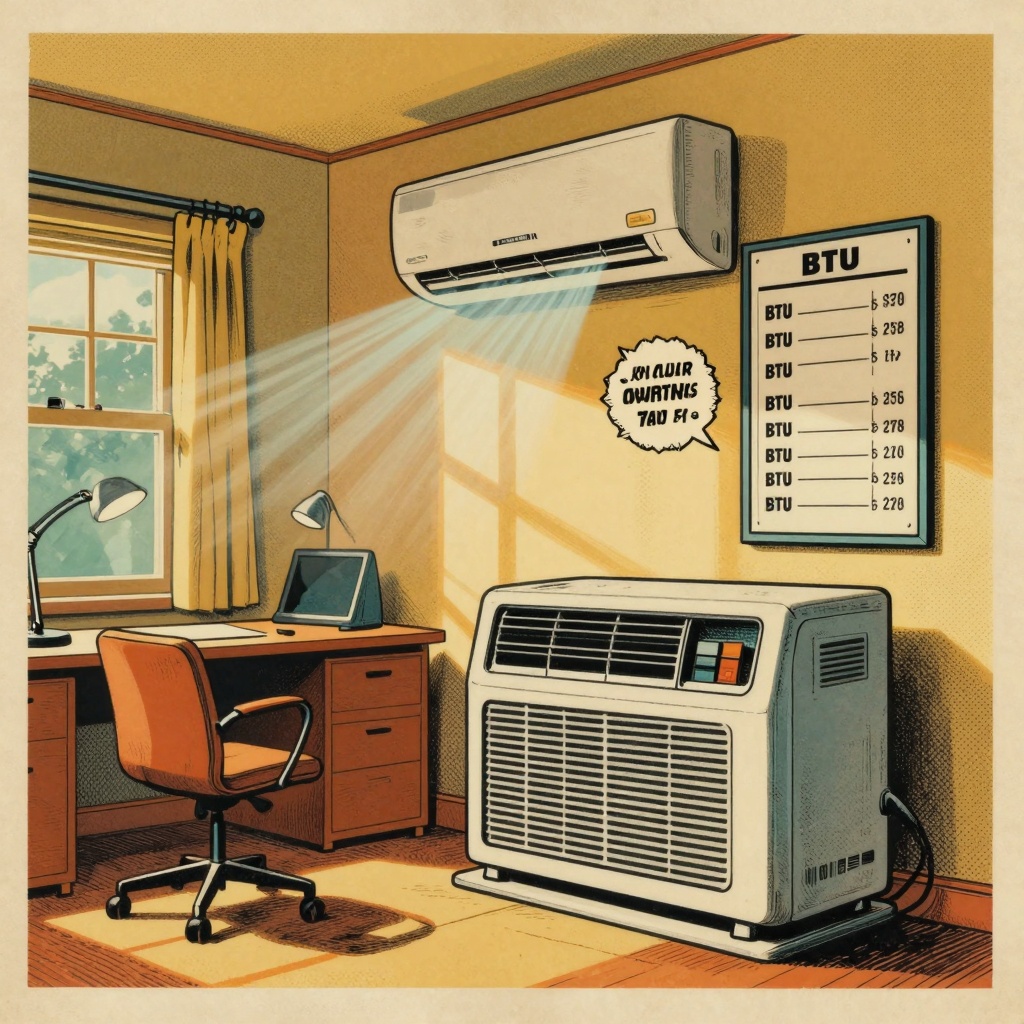
BTU Chart: Common Home Office Sizes and Recommended BTU Ratings
Match your room size to a practical starting BTU. These baselines work well for typical home offices, then fine tune for sun exposure and heat from computers or lighting.
- 100 to 150 sq ft: about 5,000 BTU
- 150 to 250 sq ft: about 6,000 BTU
- 250 to 300 sq ft: about 7,000 BTU
- 300 to 350 sq ft: about 8,000 BTU
- 350 to 400 sq ft: about 9,000 BTU
- 400 to 450 sq ft: about 10,000 BTU
Real room examples: a 10×12 ft office, roughly 120 sq ft, lands near 5,000 BTU. A 12×15 ft office, around 180 sq ft, fits about 6,000 BTU. A larger 15×20 ft office, around 300 sq ft, typically needs 7,000 to 8,000 BTU, with the higher end chosen for sunnier rooms or spaces with more equipment.
Maintenance, Safety & Lifespan: Keep Your Office AC Running Well
Handle the basics, let pros tackle the risky parts. Doable tasks: measure and plan sizing, clean or replace filters monthly in heavy seasons, vacuum dust from grills and accessible coils, keep 2 to 3 ft clear around outdoor condensers, and inspect and clear condensate drains. For window or portable units, follow the manual: use support brackets, tilt as directed, vent outdoors with the supplied kit, and plug into a grounded receptacle, not an extension cord.
Safety counts: high voltage, pressurized refrigerant, fall hazards, and mold from blocked drains are real risks. Schedule annual professional maintenance on central and mini split systems to check charge, electrical connections, coils, blowers, and drainage. Call a licensed tech for installs, any refrigerant work, new circuits or breakers, duct design, structural mounting, or permit jobs. Consistent care, like oil changes for a car, preserves efficiency and slows depreciation.
Factors That Change Your BTU Needs: Sun, Ceiling Height, Occupants & Equipment
Baseline sizing assumes an average room with 8 ft ceilings and modest sun. In real homes and offices, the biggest swings come from sun, room volume, and internal heat sources.
- Climate and sun exposure: South or west facing rooms with strong afternoon sun in hot regions often need more BTU per square foot to stay comfortable.
- Room characteristics: Higher ceilings increase the air volume to be cooled. Poor insulation, air leakage, large unshaded windows, and attic or garage conversions typically require stepping up capacity.
- Occupants and equipment: People and electronics add heat. Plan roughly 600 BTU for each regular occupant beyond two. Offices with multiple high draw computers, servers, or dense equipment racks may need an additional 1,000 to 3,000 BTU.
If you size without these factors, equipment can short cycle or struggle during peak weather, which hurts comfort and efficiency.
Choosing the Right Unit: Window, Portable, or Ductless Mini Split for Your Office
For a home office, start with the BTU load, then pick the format that fits your space and noise tolerance. Window or through-the-wall units are common, relatively low-cost options for single rooms. Choose the closest size at or just above your adjusted BTU need. Portable ACs can work when a window or wall installation is not practical, but they must be vented outdoors and are generally less efficient than a matched window or a mini-split. Ductless mini-splits are efficient and quiet, ideal when you want low noise and steady comfort. For small offices, look at 5,000 to 9,000 BTU and size to your adjusted calculation. In our experience at Budget Heating (BudgetHeating.com), mini-splits suit long days on calls, window units fit tight budgets, and portables cover temporary setups or spaces you cannot modify.
When Portable ACs and 'Bucket' Units Fall Short: Honest Tradeoffs and Better Alternatives
Portable and bucket ACs are convenient, but they are often less efficient, noisier, and weaker at dehumidification than window units or mini-splits. That makes them a poor choice for hot, humid climates, or offices needing tight humidity control. They also struggle in large rooms or spaces with many people or heavy electronics. In those cases, a properly sized window unit, ductless mini-split, or central AC performs better. If those are not allowed, use a portable as a stopgap, vent it correctly, and size for the adjusted load.
Energy Efficiency, SEER2/EER2, and Running Cost Estimates for Office ACs
We treat SEER and SEER2 as cooling miles per gallon. SEER2 and EER2 are the new DOE ratings, so check SEER2 on the label. Many ductless or single room systems must meet regional minimums near 14.3 SEER2. Aiming around 16 SEER2 usually improves long term economy. Example: replacing SEER 10 with SEER 13 cuts energy about 23 percent, and SEER 16 about 38 percent, for the same load.
Correct BTU sizing unlocks those savings. Oversized units short cycle and lose dehumidification, which erodes efficiency. Undersized units run longer and can negate gains. Estimate running cost by pairing the rating with hours of use and your local kWh rate.
Quick Decision Guide: Pick the Right BTU for Your Home Office
Most home offices fit a narrow BTU band: up to ~150 sq ft about 5,000 BTU, 150 to 250 sq ft 6,000 to 8,000 BTU, 250 to 350 sq ft 8,000 to 10,000 BTU. Bump size for strong sun or weak insulation, add ~600 BTU per person beyond two, plus 1,000 to 3,000 BTU for heavy electronics. Start with 20 BTU per sq ft, choose a correctly sized window, portable, or mini split with solid SEER2 or EER2, and consider a Manual J for tricky rooms. Our U.S.-based team sizes systems daily and can confirm your pick.
- Get a Custom Quote for your room
- Talk to Our Team by phone for live sizing help
- Shop Ductless Mini Splits at wholesale pricing
 Cooling
 Heating
 Money Saving Tips
 Product and Brands Insights
 Buying Guides
 State by State
 HVAC Systems