





 cooling
 learning center
What Is BTU in Air Conditioning? A Clear, Short Answer
A BTU is the amount of heat required to raise 1 pound of water by 1 F. In air conditioning, we use it almost exclusively as BTU per hour (BTU/h), which tells you the cooling capacity: how much heat the system can remove in an hour. Think of it like the size of a bucket, the bigger the BTU/h number, the more heat it can carry out of a space in the same time.
BTU/h is a capacity metric, not a measure of electricity use or efficiency. A higher BTU/h unit can remove more heat, but that number alone does not tell you how much power it will draw or how efficiently it runs. This matters for sizing and comfort because the BTU/h rating is the reference point for matching an air conditioner to the heat your space gains. When the capacity aligns with the load, the system can keep temperature steady and comfortable without relying on the BTU/h number to predict energy consumption.
What Does 'BTU' Stand For? (The Name and What It Means)
In HVAC, we use BTU on nameplates and spec sheets because it abbreviates British Thermal Unit, the historic title for the unit of thermal energy used across our industry. Think of it like miles on a speedometer: the label tells you the scale the numbers are using. When you see 36,000 BTU on a condenser or 80,000 BTU on a furnace, the BTU tag simply identifies the measuring yardstick, not a brand or model feature. It keeps sizing and comparisons consistent on equipment, literature, and building codes.
How BTU Relates to Cooling Capacity (Including 'Tons' Explained)
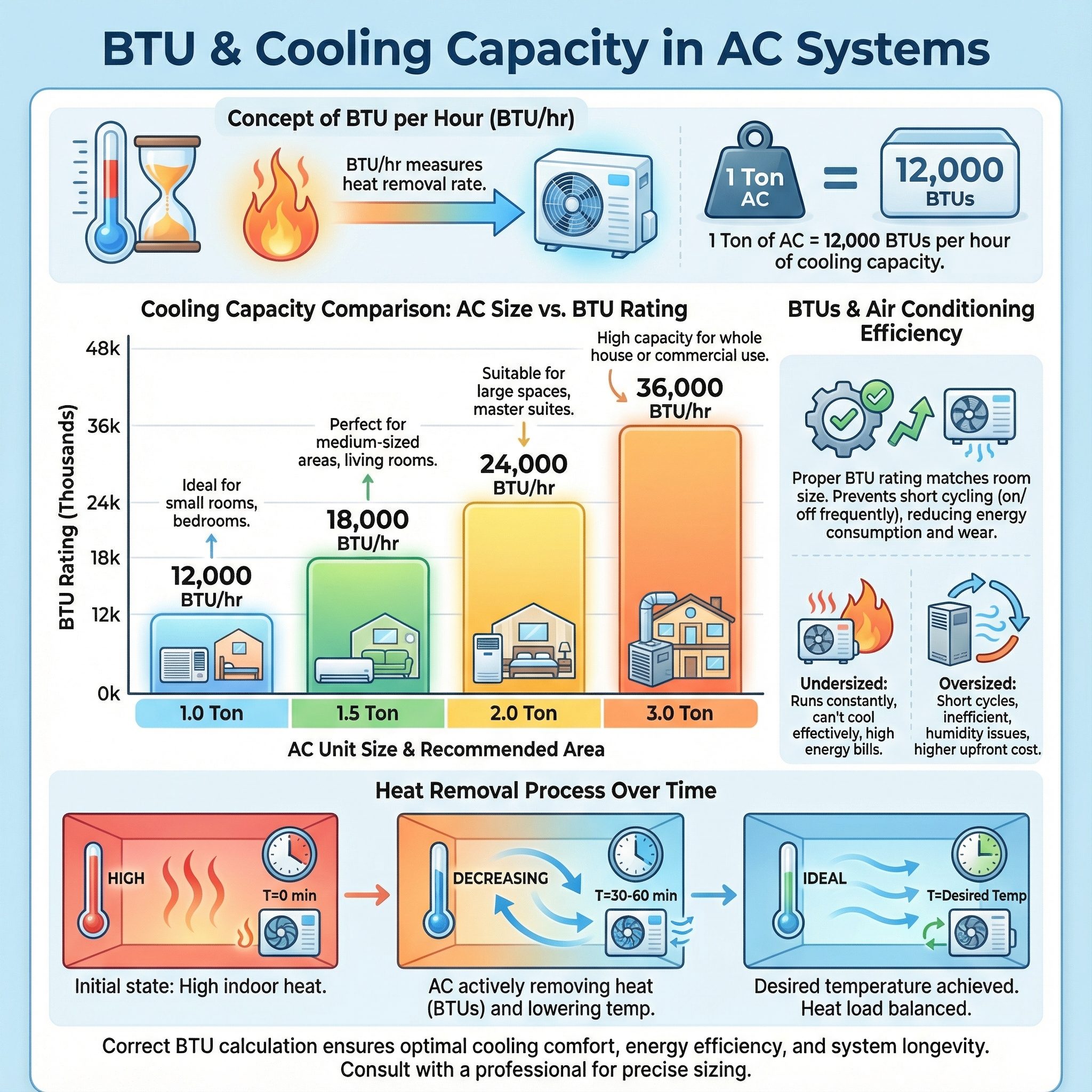
In everyday HVAC sizing, capacities are often presented in tons. A ton is simply a shorthand for BTU per hour, and one ton equals 12,000 BTU per hour. We treat tons like 12,000 BTU per hour building blocks, added until they match the cooling load.
- 1 ton: 12,000 BTU per hour
- 1.5 ton: 18,000 BTU per hour
- 2 ton: 24,000 BTU per hour
- 2.5 ton: 30,000 BTU per hour
- 3 ton: 36,000 BTU per hour
- 4 ton: 48,000 BTU per hour
- 5 ton: 60,000 BTU per hour
To translate, divide BTU per hour by 12,000 to get tons, or multiply tons by 12,000 to get BTU per hour. For example, 30,000 BTU per hour aligns with a 2.5 ton system, and the reverse math brings you right back to the same capacity.
How Many BTU Do I Need? Room-by-Room Sizing Guide
Start with a quick check: many homes land in the 20 to 35 BTU per square foot range. Treat that as a ballpark, not a decision. Ceiling height matters because you are conditioning volume, not just floor area. A room with 10 ft ceilings has about 25 percent more air than an 8 ft room and may need more capacity. Adjust for internal gains too. Add about 600 BTU for each extra occupant beyond two in a room, and kitchens often need an additional 4,000 BTU for cooking loads.
The right answer comes from a Manual J load calculation. Manual J is a room-by-room math model that considers your climate, insulation, window size and direction, shading, air leakage, internal gains, and layout. Think of it like a tailored suit rather than off the rack. It determines the BTU each space needs and the total system size so equipment runs efficiently and comfortably. In our experience at Budget Heating (BudgetHeating.com), a proper Manual J prevents oversizing that leads to short cycling and poor humidity control.
- Measure each room's square footage and note ceiling height, including vaulted areas.
- Mark layout: open plan or compartmentalized, and identify adjacent spaces.
- Record window sizes, directions, and shading, plus door counts to outside or garages.
- Note insulation levels if known and any signs of air leakage.
- List typical occupancy and special uses, add 600 BTU per extra person, add 4,000 BTU for kitchens.
- For multi-room or multi-zone choices, use room-by-room loads, not a single house average.
- For central systems, ensure ducts can deliver about 350 to 450 CFM per ton so the coil hits its rated BTU per hour.
Use the square foot rule to sanity check, then rely on Manual J to select the actual equipment and airflow.
Common BTU Ratings for AC Units (Window, Portable, Split, Central)
BTU on an AC label tells you how much heat it can move per hour. Here is how typical categories stack up so you can map a model number to real expectations.
- Window and many portable units: small room band around 5,000 to 12,000 BTU/h.
- Ductless mini split systems: roughly 6,000 to 36,000 BTU/h.
- Central split systems: commonly 18,000 to 60,000 BTU/h, about 1.5 to 5 tons.
For whole-home ballparks, think about capacity milestones: about 24,000 BTU for roughly 1,000 sq ft, 36,000 for about 1,500 sq ft, and 48,000 for about 2,000 sq ft. Actual needs vary with your home's envelope and climate. In our experience at Budget Heating (BudgetHeating.com), correct sizing always starts with how the house is built and where it sits, then the equipment category that best fits the plan.
Factors That Affect Required BTU: Insulation, Windows, Sun, Occupancy and More
Even two homes with the same square footage can need very different cooling. Climate sets the stage: hot humid areas need careful right sizing to maintain dehumidification, hot dry climates are mostly about sensible heat and solar control, and colder regions often balance summer cooling with winter heating priorities.
- Square footage and ceiling height determine total air volume to condition.
- Insulation level and air sealing curb heat gain from outdoors.
- Window area, glazing performance, orientation, and shading drive solar load. South and west glass can act like a space heater in the afternoon.
- Attic and roof traits, including color and ventilation, influence attic temps that bleed into rooms.
- Infiltration from leaky doors, ducts, or chimneys adds unwanted outdoor air.
- Occupancy, lighting, and appliances add internal BTUs.
- Duct design and condition matter: leakage, poor insulation, or high static pressure reduce the BTU/h that actually reaches rooms.
We often see local quirks, like urban heat islands or coastal breezes, tip the balance. The right capacity depends on the whole picture, not a ton per square foot shortcut.
Why Oversizing and Undersizing Are Problems: Honest Tradeoffs and When Not to Upsize
Oversized systems drop the thermostat quickly, then short cycle. That on-off pattern leaves moisture behind, so rooms feel cold but clammy, comfort is uneven, and parts see more wear. You also pay more upfront and often over a system's life in repairs. Undersized systems run long or continuously, may miss the setpoint on hot days, struggle with humidity, and keep the compressor under sustained stress. Hidden costs add up: supplemental window units, higher seasonal bills, and shortened equipment life.
When a system struggles, capacity is not always the fix. Common culprits are ducts, airflow, refrigerant charge, or installation defects. Address delivery issues first rather than jumping in BTUs. In humid climates, a properly sized variable-speed system or a dedicated dehumidifier will control moisture better than a larger unit. Other cases where upsizing is the wrong move:
- High solar gain or poor envelope: add shading, air sealing, insulation, or window films.
- One or two hot rooms: balance ducts, add returns, or consider zoning.
- Short heat waves: a right-sized system plus sensible load fixes beats permanent oversizing.
Converting BTU to Other Units (Joules, Watts, kW and More): Formulas You Can Use
Think of these like miles to kilometers for HVAC. Energy: 1 BTU ≈ 1,055 joules. Power or rate: 1 BTU per hour ≈ 0.293 watts, so 1 watt ≈ 3.412 BTU/h. Scale that up as needed: 1 kilowatt ≈ 3,412 BTU/h and 10 kW ≈ 34,120 BTU/h. To compare with a ton rating, use the BTU/h relationship you already know. Quick use: watts × 3.412 gives BTU/h, BTU/h × 0.293 gives watts, and BTU × 1,055 gives joules. These are the constants we use when matching equipment specs, sizing, or translating nameplate data, and they keep apples to apples across brands and efficiency metrics.
Does BTU Tell You How Many Degrees You'll Cool? (BTU vs. Temperature)
We see this misconception often: BTU is the rate of heat removal per hour, not a promise of a fixed drop in room temperature. A higher BTU unit pulls heat out faster, but the actual degree change depends on the room's air volume, the heat it gains from people, appliances, sun and infiltration, and how long the system runs. In practice, capacity sets the pace, while the space and conditions decide the finish line. BTU does not translate directly into degrees Fahrenheit.
Summary: How to Use BTU Wisely, Sizing, Efficiency, and Next Steps
Right-size the BTUs, then pair that capacity with the right efficiency. SEER and SEER2 tell you how many cooling BTUs you get per watt-hour, so for the same 18,000 BTU size a higher SEER2 uses less power. Upgrading from SEER 10 to SEER 16 can trim annual cooling costs by about 35-40% in a hot climate. Expect older systems around SEER 8-10, modern baselines near 14-16, and premium 18-20 plus. Since 2023 the DOE uses SEER2, EER2, and HSPF2 with regional minimums, the North is about 13.4 SEER2 while the Southeast and Southwest set tighter thresholds tied to certified BTU per hour.
To actually deliver the rated BTU per hour, size with Manual J, confirm ducts and airflow, and meet local efficiency minimums including sensible and latent needs. Fix delivery problems before changing capacity. Preserve performance with homeowner maintenance: replace filters every 1-3 months, keep the outdoor unit clear, gently rinse coils, and flush the condensate drain each season. Leave refrigerant, electrical, and control work to licensed HVAC pros.
Choosing size, SEER2, and installation details can feel complex. Our team pairs the right BTUs with the right airflow and efficiency every day, backed by 30+ years in HVAC, 200,000+ fulfilled orders, and U.S.-based technical support.
- Get a Custom Quote tailored to your home and climate
- Talk to Our Team by phone for fast, practical answers
- Shop Central AC, Heat Pumps, and Ductless Mini Splits
- Ask about wholesale pricing, free shipping on many systems, and Affirm financing
 Heating
 Money Saving Tips
 Product and Brands Insights
 Buying Guides
 State by State
 HVAC Systems