




Propane vs Natural Gas Furnace: Which Is Right for You?
Choosing between a propane and a natural gas furnace is a site specific call. Both deliver efficient, reliable heat, but the better fit depends on what is available on your street, how you use heat, and your budget over time. Here we spell out the tradeoffs: fuel cost per BTU, installation and venting, tank or utility access, maintenance, emissions, and resilience during outages. We share what we look for on real jobs so you can map the pros and cons to your home, not a generic chart.

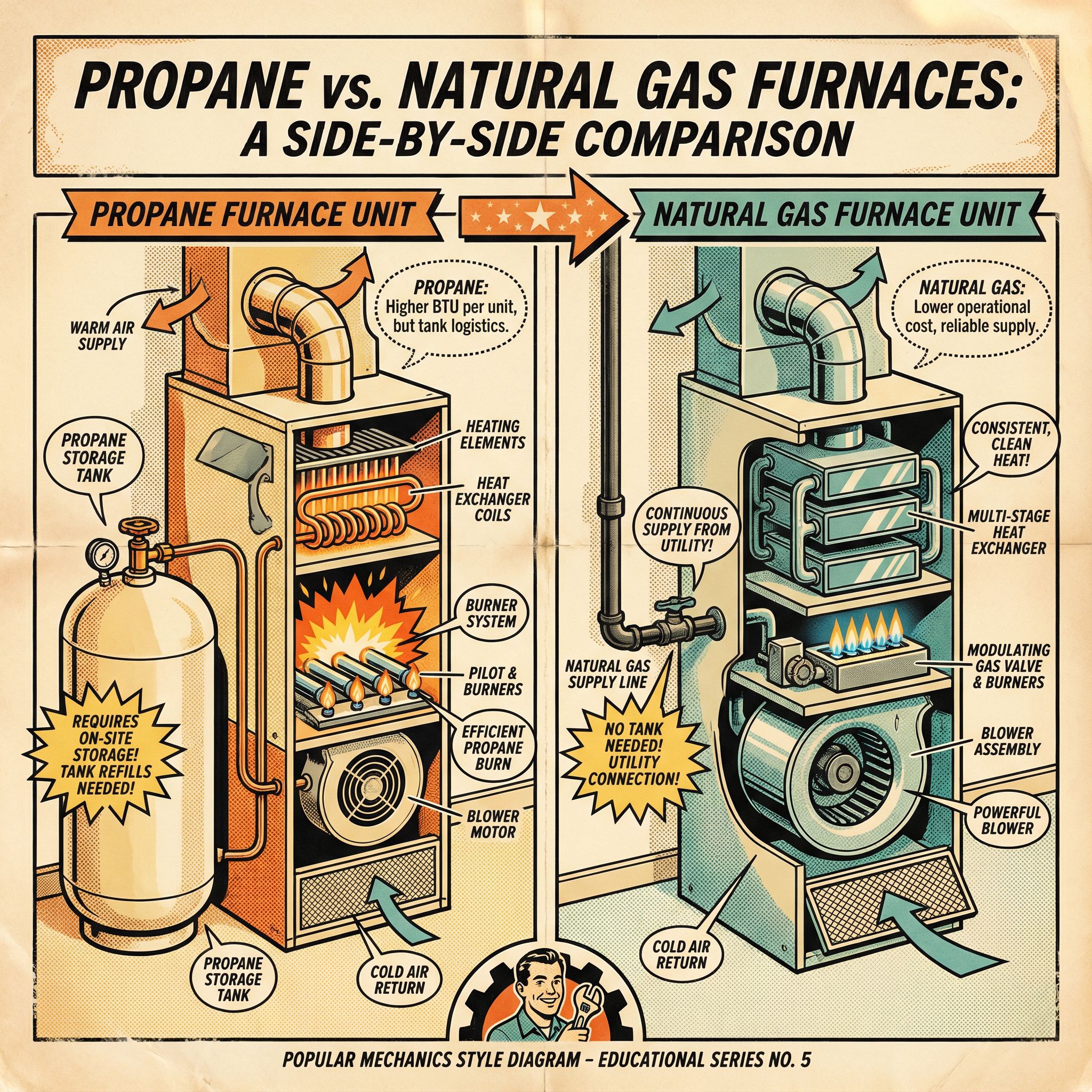
Quick comparison: Propane vs Natural Gas at a glance
- Convenience and reliability: Natural gas is continuous pipeline supply, no tank checks. Propane needs deliveries, but on-site storage adds resilience.
- Flexibility and autonomy: Propane works almost anywhere a truck can reach. Natural gas ties you to the utility and removes delivery chores.
- Cost outlook: With affordable pipeline access, natural gas is usually the lower long-term cost. Propane can be competitive, but pricing swings more and includes delivery logistics.
Rule of thumb: if pipeline service is available and you want set-and-forget, pick natural gas. If you lack pipelines or want fuel independence, pick propane.
How propane and natural gas furnaces work: AFUE, SEER differences, and what efficiency really means
Gas and propane furnaces work the same way: a burner heats a heat exchanger, flue gases vent outdoors, and a blower moves warm air through the ducts. AFUE is the efficiency that matters for furnaces, the percent of fuel turned into heat over a season. An 80% AFUE unit wastes about 20% of the fuel. A 95% unit wastes about 5%. Upgrading from 80% to 95% trims fuel input for the same heat by roughly 16% (0.80/0.95 ≈ 0.84).
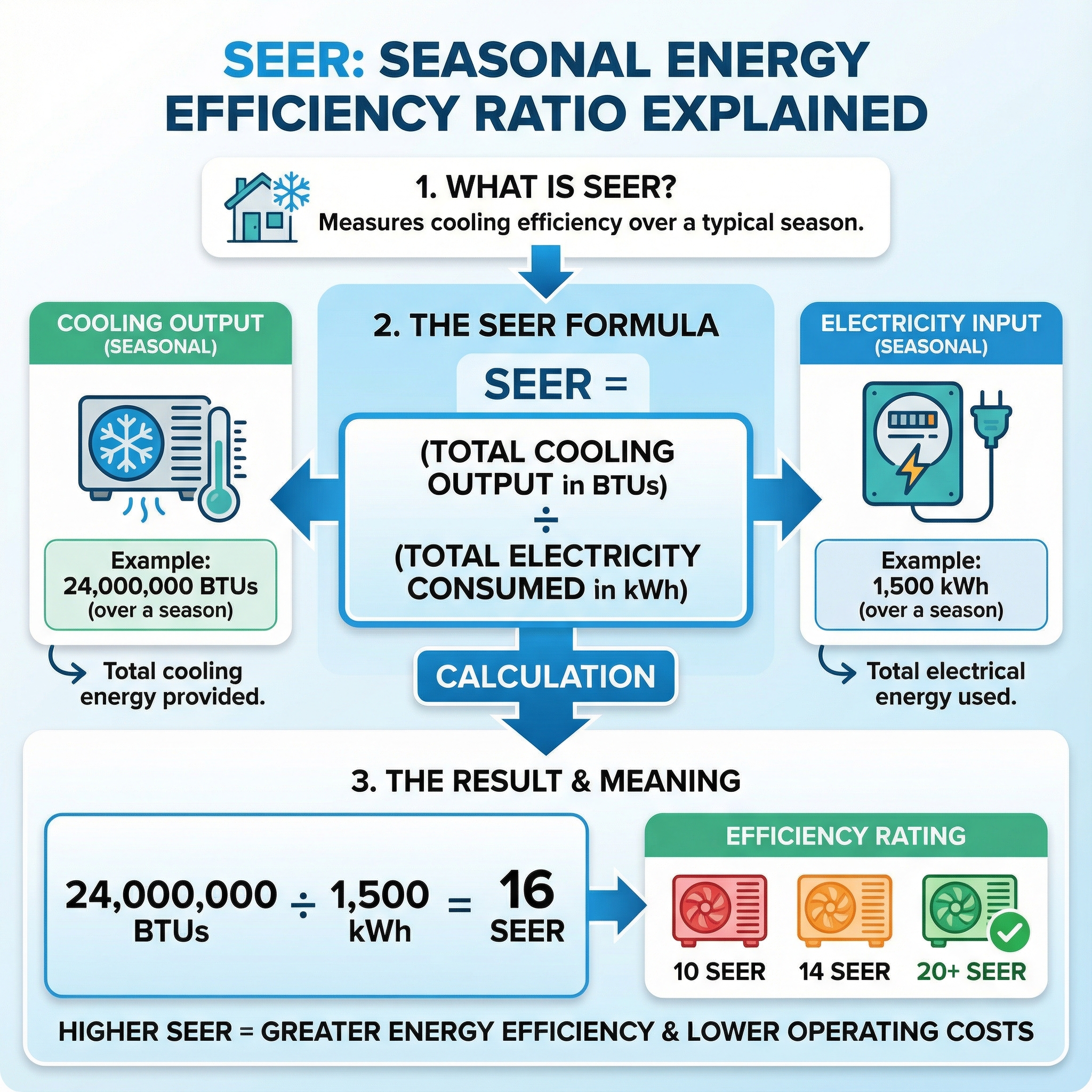
SEER or SEER2 rates cooling equipment, air conditioners and heat pumps. It does not apply to furnaces. For winter performance, compare AFUE so you are looking apples to apples.
Both fuels support condensing, high AFUE designs, so efficiency is about appliance design and installation quality more than fuel choice. In our installs, two stage or modulating burners and variable speed ECM blowers often improve comfort and part load efficiency. Standards are tightening, with DOE activity targeting a 95% AFUE minimum and the market already pushing many models to 95% or higher.
Cost comparison: how to calculate fuel price, operating cost, and total ownership
With 30+ years in the HVAC industry, we compare propane and natural gas by converting both to cost per BTU, then adding ownership costs. That keeps the math apples to apples.
- Collect local prices: natural gas in dollars per therm or per CCF, propane in dollars per gallon.
- Convert to delivered heat cost. Notes: natural gas ≈ 100,000 BTU per therm, propane ≈ 91,500 BTU per gallon. Formula: (price per unit ÷ BTU per unit) ÷ AFUE × 1,000,000 = dollars per million BTU delivered.
- Example at 95 percent AFUE: $1.50 per therm natural gas ≈ $15.8 per MMBTU delivered. $2.50 per gallon propane ≈ $28.8 per MMBTU delivered.
Because the fuels have different energy content and billing, a given furnace uses different volumes. Dollars per BTU after AFUE is the true comparison.
- Equipment cost and expected lifespan
- Utility hookup or on site tank purchase or rental
- Venting or condensate changes for high efficiency units
- Annual fuel spend from the MMBTU math
- Maintenance, filter changes, and likely service call costs
Fuel availability & infrastructure: choosing by location, urban, suburban, rural, and off grid
Start with what is in the street. In metro and many suburban neighborhoods with a utility main, natural gas usually wins for convenience and operating cost, with little day to day involvement. In rural or exurban areas without a main, delivered propane with an on site tank is the practical gas choice and supports off grid resilience. For propane, match tank size to load and refill cadence: 250 gallons light duty, 500 most homes, 1,000 large or long intervals. Choose lease or own, check code setbacks and placement, enable remote monitoring, and ensure year round truck access. Where a main exists, include tap fees and trenching, not just fuel cost per BTU.
When propane or natural gas may NOT be the best choice: honest tradeoffs and better alternatives
From years of field work, we see clear cases where propane or natural gas is not the best fit for primary heat:
- If your home already has economical utility natural gas available, extending pipeline service typically delivers the lowest ongoing cost. Choosing delivered propane in this case can be a poor long term play.
- If you dislike managing fuel levels and delivery schedules, propane's logistics are a headache. Pipeline gas behaves differently on reliability than a tank that can run low during cold snaps.
- In areas that require very high AFUE condensing equipment, venting, drains, and space constraints can complicate a gas retrofit. The added install work can outweigh the benefit.
Better fits in these scenarios include staying with utility natural gas where available, shifting to a high efficiency heat pump, using a cold climate heat pump in northern zones, or choosing a dual fuel setup that pairs a heat pump with gas or propane for resilience and cost control.
Common mistakes to avoid:
- Comparing fuels on price per gallon or per therm without normalizing to cost per BTU and AFUE.
- Assuming pipeline gas and delivered propane have identical supply reliability.
Myths to skip:
- Propane is always more expensive. Cost per BTU and AFUE drive the real answer.
- Natural gas is automatically best. Availability matters.
- Propane is unsafe. Modern systems have layered safety features when installed and maintained.
- Propane cannot be efficient. Many propane furnaces reach 90 percent plus AFUE.
- Propane is only for grills. It commonly heats whole homes.
Conversion & compatibility: Can a natural gas furnace run on propane and vice versa?
Often yes, but only if the manufacturer offers a listed conversion kit and the work is done by a qualified technician. Conversion is not a DIY task. It involves changing burner orifices and the gas valve regulator, setting manifold pressure, and verifying safe combustion with instruments. Think of it like re jetting a carburetor, fuel and air must be precisely balanced. In our experience at Budget Heating (BudgetHeating.com), conversion makes sense when an approved kit exists and the furnace is in solid condition. If no kit is available or the unit is near end of life, a dedicated fuel model is the better choice. For natural gas connections, confirm utility availability, tap in and meter fees, trenching, and any required service or pressure upgrade. Local permits and inspections typically apply.
- Will you use a manufacturer conversion kit?
- Will you adjust orifices and regulators and perform combustion testing?
- What is the total conversion cost versus a replacement unit?
Installation, maintenance, and expected service life - what to plan and budget for
Start with a Manual J heat load calc to right size the furnace. Before install, seal ducts, size returns, confirm gas line and regulator capacity for the BTU load, and verify electrical circuits. Pick staging level and consider a variable speed ECM blower. Pull permits and meet AFUE and venting codes. In our experience at Budget Heating (BudgetHeating.com), budget yearly pro care: clean burners and heat exchanger, verify gas pressure, check venting, test ignition and flame sensor, and record combustion and CO. Service life mirrors install quality and upkeep.
Venting, combustion safety, and routine maintenance (including odor and CO guidance)
We start with venting. Non condensing furnaces use metal flues to a chimney. Condensing 90%+ units vent in PVC through a sidewall or roof and need a condensate drain, often with a neutralizer. Keep combustion air clear, do not crowd the unit.
- Change or clean filters, keep registers open, maintain clearance.
- Propane: check tank level and fittings visually, leave fuel work to the supplier.
- Install and test CO detectors on every level.
- Smell gas or CO alarm? Evacuate, avoid switches or flames, call supplier or 911 from a safe place.
Conclusion: How to pick the best furnace for your home (and next steps)
The right choice is site specific: fuel access, long term operating cost, available infrastructure, and your risk tolerance. Where a pipeline exists, natural gas usually wins; for rural or off grid homes, propane is the practical path. Comfort and emissions depend more on furnace design, correct sizing, and installation quality than the fuel itself. Run local fuel prices with a simple cost per BTU check, request a Manual J, and ask contractors the tough questions. If you want a second set of eyes, our team is ready.
- Get a Custom Quote: we match equipment to your home, wholesale pricing, many systems ship free, Affirm financing available.
- Talk to Our Team: call our U.S.-based support for straight answers from techs with 30 plus years in HVAC.
- Shop Gas Furnaces: natural gas and propane models from Goodman, Rheem, Bosch, and more.