




Why Geothermal Heat Pumps Deliver Smarter Heating and Cooling
Geothermal, or ground-source, heat pumps use the earth's relatively steady subsurface temperature to move heat into or out of a building. Think of a refrigerator, but serving the whole home and capable of heating and cooling. Because they transfer heat rather than create it by combustion, they avoid the losses that come with burning fuel and they achieve much higher seasonal efficiencies than basic air-source systems or furnaces.
The result is steady comfort in all seasons, quiet operation since most components sit indoors, and cleaner indoor air because there is no on-site combustion. The indoor unit typically lasts about 20 to 25 years, and the buried loop can often serve 50 years or more, which supports a lifecycle view of cost. Upfront investment is higher, yet the combination of superior efficiency, durability, and low noise means the value compounds over time. If you want reliable performance without the swings of outdoor air, geothermal makes the physics work in your favor.
How Ground-Source Heat Pumps Work: Components and the Refrigeration Cycle
Ground-source heat pumps move heat using a sealed refrigeration cycle. Refrigerant evaporates at low pressure, like a sponge soaking up heat, then the compressor lifts its temperature and pressure. Next it flows through a condenser, releases that heat to the conditioned side, and an expansion device drops the pressure so the loop repeats. Pressure and phase changes drive heat through the circuit. Most equipment is indoors with the ground loop buried. That loop exchanges heat with relatively stable ground or water, keeping entering temperatures consistent, and it either supplies heat to the evaporator or accepts heat from the condenser.
- Compressor
- Evaporator
- Condenser
- Expansion device
- Reversing valve
- Ground or water loop
The reversing valve redirects refrigerant paths to switch modes. In heating, the indoor side acts as the condenser and the loop side acts as the evaporator, pulling heat from earth into the home. In cooling, the roles swap, rejecting indoor heat into the loop. In our experience, that single valve is what enables one system to both heat and cool with the same core components.
Energy Efficiency: COP, EER/EER2 and Real-World Year Round Performance
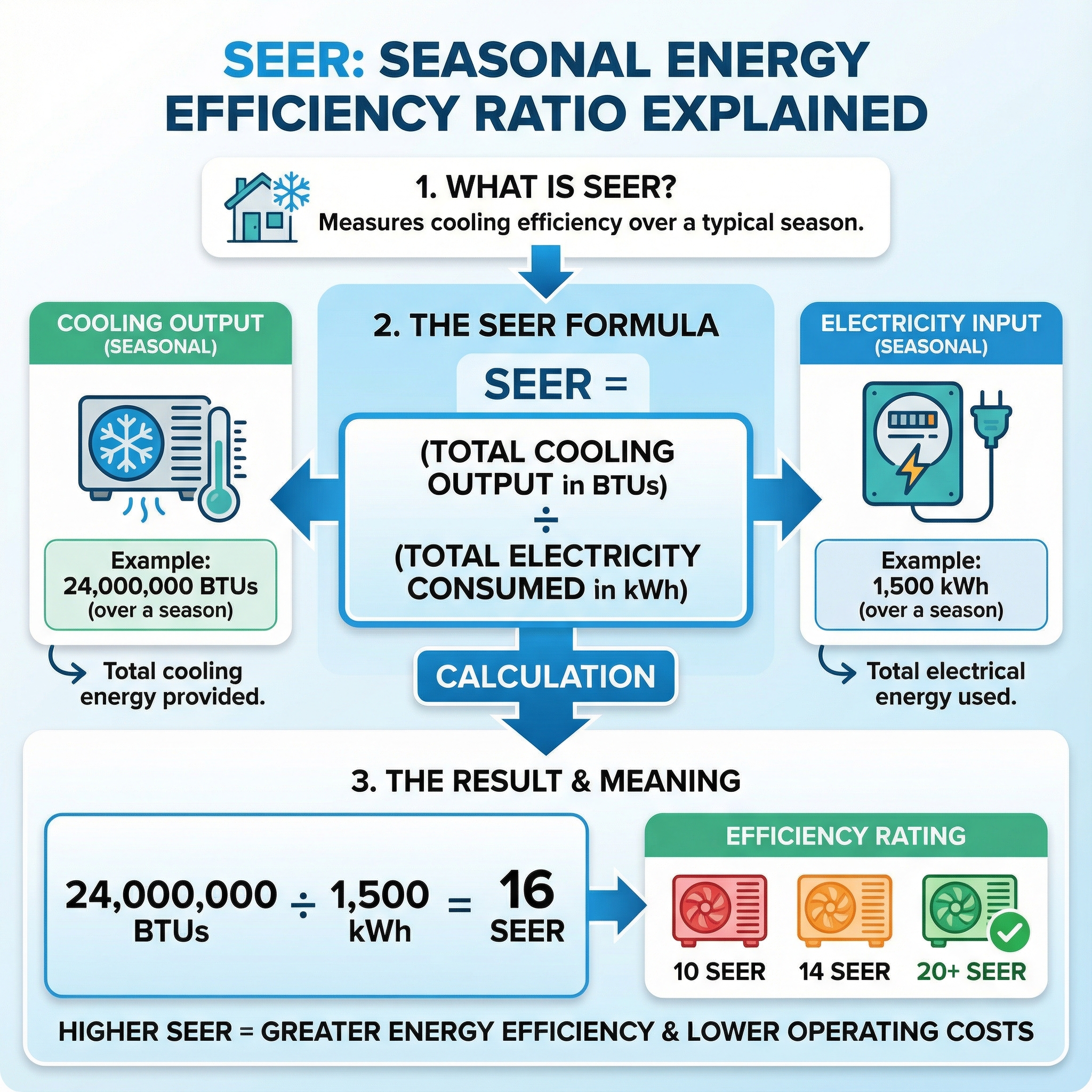
For geothermal systems, we use COP for heating and EER or EER2 for cooling, not SEER. COP is heat delivered per unit of electricity, like miles per gallon for heat. Typical geothermal COPs are 3.0 or better. In cooling, legacy EER ratings commonly land around 20 to 30, with EER2 appearing on newer labels.
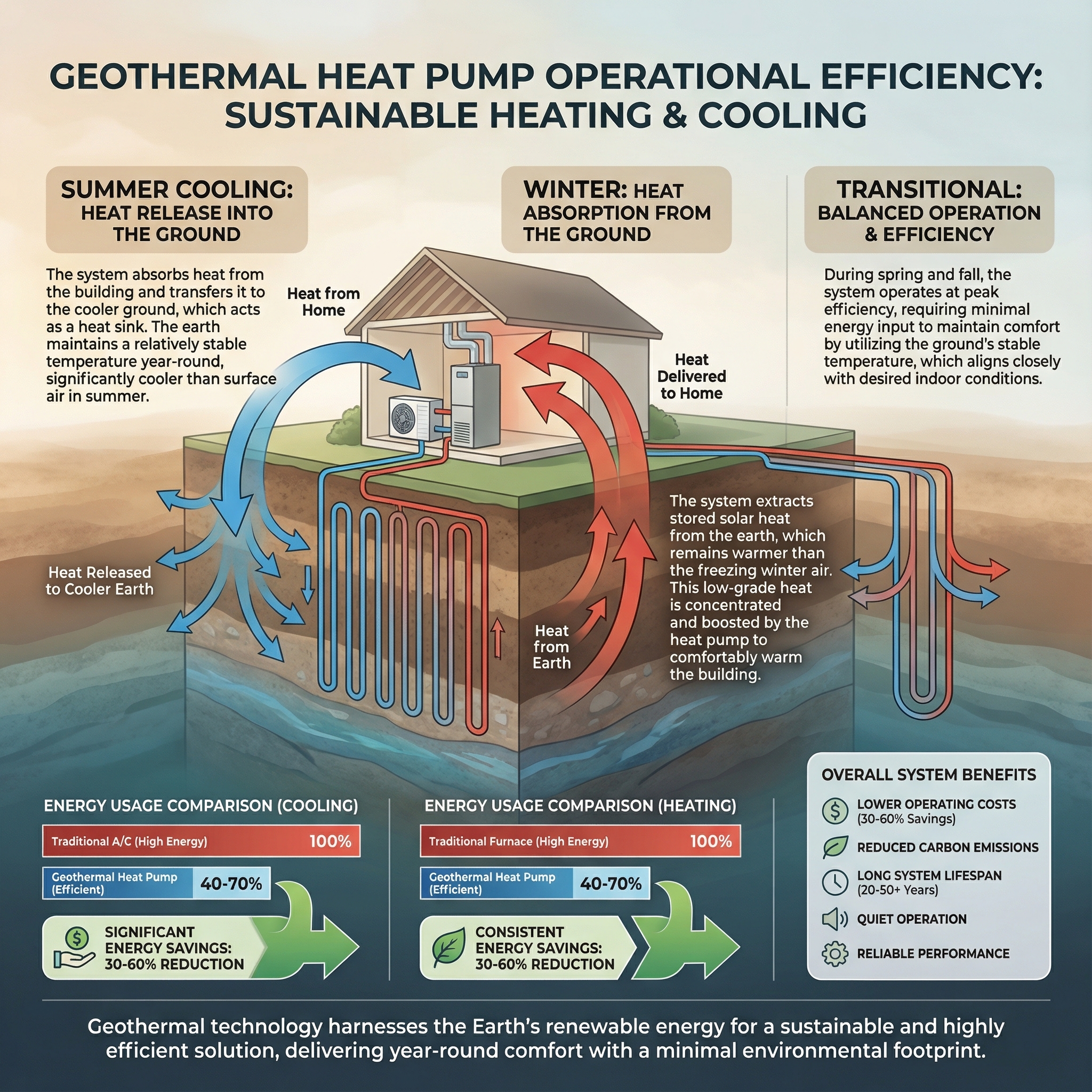
On bills, those efficiencies often cut total energy use about 30 to 60 percent versus conventional systems, and some installs reach roughly 65 percent. Because the ground loop is steady, performance holds year round, not just on test days. With a desuperheater, reclaimed heat can make domestic hot water, reducing water heating costs by as much as 60 percent while the unit is running.
Geothermal vs Air Source and Conventional HVAC: Comfort, Noise and Year Round Reliability
Compared with air-source heat pumps and gas furnaces, geothermal keeps comfort and sound levels in a different league. With the heat exchanger buried, there is no outdoor condenser buzzing, and indoor temperatures stay even instead of the hot-blast, cool-slump cycle many furnaces create. No on-site combustion means cleaner indoor air. Because ground temperatures are stable through the seasons, geothermal efficiency stays high and predictable during heat waves and cold snaps, where air-source equipment typically works harder and burns more energy, and furnaces are either on or off. For climates that see deep freezes, we often pair geothermal in a dual-fuel setup with an existing furnace that only steps in on the rare extreme night. In our experience at Budget Heating (BudgetHeating.com), this approach delivers quiet comfort all year, and it fits best in new builds or major retrofits where lifetime cost and comfort lead the decision.

Geothermal Heat Pumps vs Geothermal Power Plants: Different Uses, Different Temperatures
We often see confusion between electricity producing geothermal power plants and ground source heat pumps for buildings. Power plants tap very high temperature underground reservoirs to spin turbines and make electricity. Heat pumps work at much lower temperatures, using steady ground or water and a refrigeration cycle to move heat into or out of a building. Think of the plant as a generator, and the heat pump as an efficient mover. This matters for emissions: heat pumps move heat instead of burning fuel, so on low carbon electricity they can sharply cut CO2, while power plants are a separate path for renewable electricity.
When Geothermal Is Not the Best Fit: Honest Tradeoffs and Better Alternatives
Geothermal delivers excellent comfort, but it is not always the right fit. Three myths trip people up: it never pays back when lifecycle cost and incentives shorten payback, it cannot handle cold when design and staged auxiliary heat cover peaks, and the habit of judging only by upfront price.
- Tight sites and hard drilling. Small lots, setbacks, or heavy subsurface rock can make loop fields impractical or very costly. Air-source heat pumps or high efficiency mini-splits fit better here.
- Short ownership horizon. If you expect to sell soon, the higher installed cost may not pencil out. Pick an air-source heat pump or conventional system for quicker payback.
- Water and permitting barriers. Open-loop designs may be blocked by permits, water quality, or discharge limits. Use closed-loop only if allowed and practical, otherwise standard HVAC is simpler.
In very cold regions, expect staged backup heat. Where peak combustion heat is essential or fuel is cheap, gas furnaces or hybrids win.
Installation Costs: How Site, Loop Type and Drilling vs Trenching Drive Price
In our experience, the bulk of the upfront spend is the loop field, like pouring the foundation for a house. Typical installed residential ground-source systems land around $15,000 to $35,000, roughly 2 to 3 times a conventional HVAC install, driven mostly by drilling or trenching and the permits tied to them.
- Loop type: vertical bores, horizontal trenches, or pond or lake loops, each with distinct equipment and labor profiles.
- Depth or length: deeper bores or longer trenches add rig time, grout, pipe, and disposal hauling.
- Soil and rock: bedrock, cobble, or ledge slows drilling; loose sands or fill may need shoring.
- Groundwater: can improve heat transfer, but can trigger well-construction rules and dewatering plans.
- Available land: small or landscaped lots favor vertical, open acreage favors long horizontal runs.
- Local permitting and utilities: fees, inspections, setbacks, and locates affect schedule and total price.
The right loop for the site keeps performance stable and avoids paying for unnecessary earthwork.
Operating Costs, Typical Savings and Payback Examples
For most homes, geothermal systems operate for roughly $100 to $200 per month, depending on house size and your local electric rate. That replaces both the furnace fuel and the outdoor AC spend, so total energy bills typically drop.
What to expect on savings:
- Overall energy bills: about 30 to 60 percent lower.
- Heating portion: roughly 30 to 70 percent lower.
- Cooling portion: roughly 20 to 50 percent lower.
Think of geothermal like switching to a high mpg vehicle for your house. In our experience at Budget Heating (BudgetHeating.com), these ranges hold up across varied climates when systems are correctly sized.
Payback and lifetime economics: many projects see simple payback in about 5 to 10 years, with some stretching to 15 depending on incentives, energy prices and how long you own the home. The equipment's long service life and fewer replacement cycles improve total cost of ownership.
Quick math examples:
- If your current utilities average $300 per month, a 40 percent reduction saves about $120 per month. Annual savings: about $1,440.
- At $500 per month, a 50 percent reduction saves about $250 per month. Annual savings: about $3,000.
Incentives, Rebates and Tax Credits: Federal and Local Programs to Lower Your Cost
In our experience, incentives can take a real bite out of upfront cost and shorten the time to break even. Start with federal investment tax credits available under current clean energy policies. Then layer regional offers and utility rebates. Common places to check include:
- Utility rebates: PGE, LADWP and similar providers often post seasonal geothermal or HVAC electrification rebates.
- State and regional portals: EnergizeCT, plus state or provincial energy offices.
- International examples: New South Wales level incentives for eligible properties.
Availability and amounts vary by jurisdiction and project details, so confirm terms before committing. Fold verified credits and rebates into your lifecycle math, since they often cut simple payback and strengthen the overall investment case.
Is Geothermal Right for You? Next Steps, Installer Checklist and What to Ask
Geothermal works best when design and site are aligned. Before committing, run a site feasibility, complete an energy audit and envelope improvements, then solicit 2 to 3 bids from IGSHPA accredited or experienced installers with an ACCA Manual J. Ask for itemized proposals separating equipment and loop work, confirm loop design, antifreeze, pump specs, model numbers, AHRI rated COP and EER at design conditions, and require commissioning tests for pressure, purge, flow and temperature. Secure written parts, labor and loop workmanship warranties, an as built loop map, an operations manual, and an annual maintenance plan. You handle filter changes, a pro checks flows, pressures, refrigerant and antifreeze concentration.
It is a big decision, and our team can help vet bids and verify incentives up front so you install with confidence.
- Get a Custom Quote: multiple detailed quotes with loop sizing and modeled operating costs.
- Talk to Our Team: phone support to review designs and rebate eligibility before you buy.
- Shop Geothermal Heat Pumps: compare AHRI rated models that fit your load and loop.