





 How Much Does It Cost
Air Conditioning Costs by Climate: An Annual Expense Analysis
Air conditioning costs are shaped first by where you live. Cooling season length, humidity, and peak temperatures determine how hard your system works, and that drives annual expense. Think of climate like the incline on a treadmill, the steeper the incline, the more energy and wear you rack up. After decades helping homeowners in every U.S. climate zone, we have seen how these factors change yearly costs even when two homes look identical on paper.
This analysis compares annual air conditioning costs across U.S. climate zones and puts real numbers to climate-driven differences. We look beyond the electric bill to include routine maintenance, likely repair risk, and replacement timing. We also show how ownership choices, such as efficiency rating, system capacity, staging and ducted versus ductless, shift costs over time. Use this to benchmark your current spending, set an annual AC budget based on your zone, and prioritize upgrades that lower total cost of ownership, whether that means improving efficiency, tightening the envelope, or right-sizing equipment for your climate.
Why Climate Zone Drives Your Air Conditioning Bill
Cooling costs are mostly about how many hours your system runs. Climate sets that baseline through temperature, season length, and humidity. We quantify it with cooling degree days, a count of how far and how long outdoor temps sit above a comfort point. Think of it as tally marks for how much cooling the weather demands. More degree days mean more runtime. In hot humid regions, moisture removal adds latent load, so the unit runs longer even at the same temperature.
Homes fall into four climate types: hot humid, hot dry, moderate or mixed, and cool. The first two produce the highest degree day totals, with hot humid adding the extra humidity workload. That is why typical annual electricity cost bands differ by region: southern households sit in the higher band, midwestern areas land mid band, and western or milder coastal zones tend toward the lower band.
- Identify your climate category to set realistic expectations.
- Factor humidity into your estimate, not just temperature.
- Use regional cost bands as a benchmark for operating costs.
How We Estimate Annual AC Costs (Methodology & Assumptions)
We use a simple core equation: annual cooling kWh multiplied by your local electricity rate equals energy cost. It is the same idea as gallons times price at the pump. We derive kWh from your home's calculated cooling load and the equipment's SEER2 rating, using regional code-minimum as the baseline for comparisons. Unless noted otherwise, we assume the system is properly commissioned with correct airflow, refrigerant charge, and duct static pressure.
- Gather home specifics: square footage, insulation levels, window orientation, and duct condition or leakage.
- Require Manual J for load, Manual S for equipment selection, and Manual D for ducts to avoid oversizing or poor airflow.
- Estimate annual cooling kWh from the load and SEER2, then multiply by your local cents per kWh.
- Add routine maintenance, expected minor repairs, and equipment depreciation to reach total ownership cost.
- Account for daily behavior: setpoint choices, smart setbacks, and pre-cooling strategies.
- Do a final cost check using your climate band and local rate to confirm the estimate.
This approach lets any homeowner reproduce the math and understand what is driving the dollar figure.
Typical Cost Components: Energy, Maintenance, Repairs, and When AC Isn't the Best Choice
From years of field experience, total ownership cost breaks into four buckets: energy, routine maintenance, periodic repairs, and eventual replacement. Energy is usually the largest share. Non-energy costs, when averaged over the equipment life, typically land in the low hundreds of dollars per year. Duct design and condition affect both energy and repair costs because poor airflow increases strain on components.
- Setting the thermostat very low does not cool faster, it only runs longer. It is like pressing an elevator button twice.
- Closing supply vents raises static pressure and wastes energy, and can aggravate duct leaks.
- Oversized systems short cycle and leave humidity behind.
- High SEER cannot deliver if installation or ducts are flawed.
- Continuous fan in humid climates can re-evaporate moisture into the home.
Safe homeowner tasks: replace filters, clear outdoor debris, verify thermostat settings. Professional-only: refrigerant handling, electrical diagnostics, deep cleaning and adjustments. An annual professional tune-up is recommended, and service should be scheduled if performance drops or operation seems unusual.
AC is not always the best choice: mostly unoccupied homes, very mild climates with few cooling hours, or budget-limited retrofits. Alternatives include targeted zone cooling, a ductless minisplit for key rooms, or addressing envelope upgrades before a full system.
Hot Humid Climates: Annual Expenses, Humidity and Dehumidification Needs
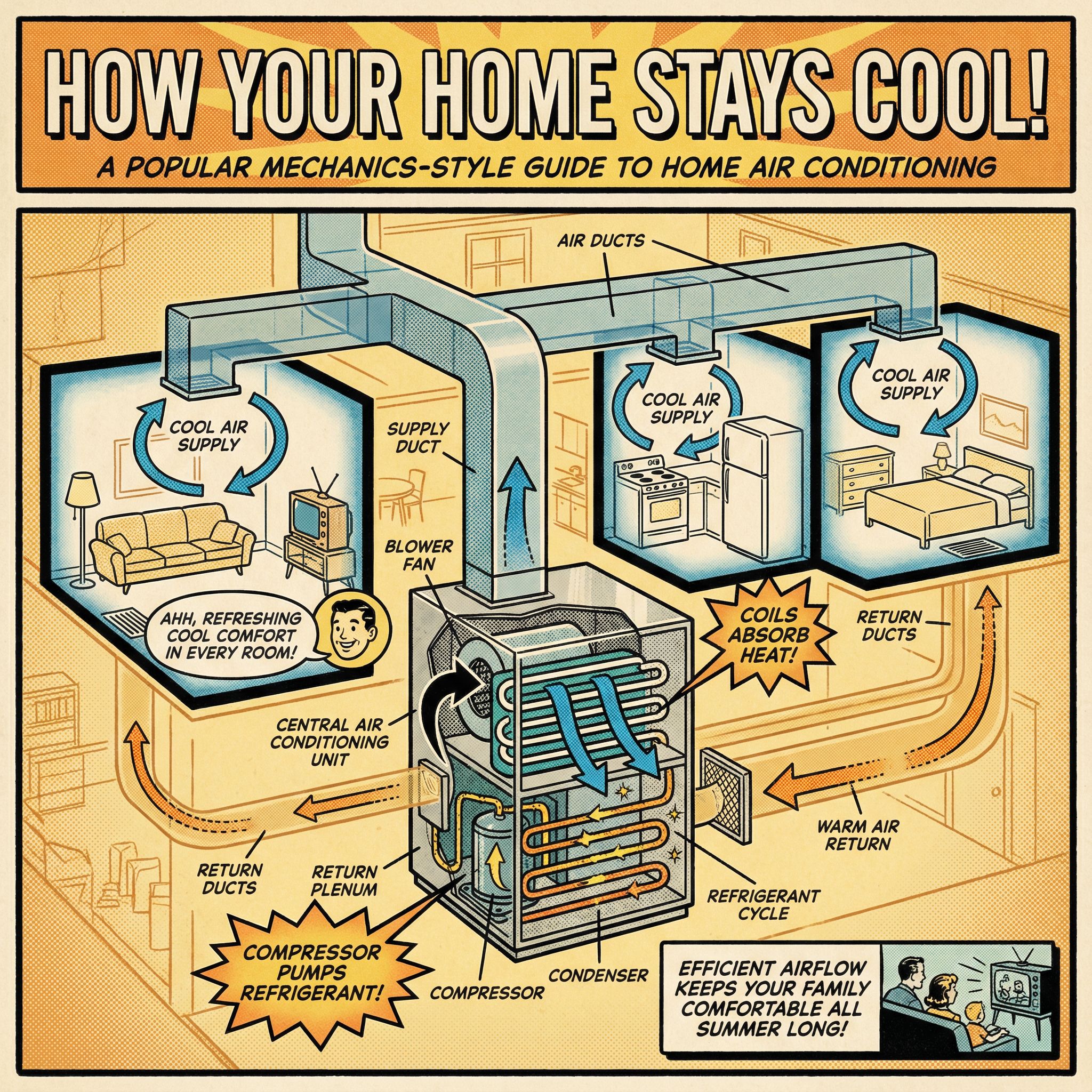
Hot humid homes face long cooling seasons and heavy moisture loads. Annual air conditioning use typically falls around 4,000 to 6,000 kWh, which often translates to roughly 800 to 1,500 dollars in electricity. Those numbers reflect more than heat removal. High indoor moisture forces the system to run longer to pull water out of the air, not just drop temperature. Think of the coil as wringing out a sponge, the wetter the air, the longer the wring. That extra runtime makes latent capacity crucial, the system's ability to remove humidity while maintaining comfort and efficiency.
- Use Auto fan mode. Continuous fan can re evaporate water from the coil and raise indoor humidity.
- Prioritize dehumidification capable equipment. Two stage or variable speed systems run low and steady for superior moisture removal.
- If humidity persists, add a whole home dehumidifier to manage latent load without overcooling.
Hot Dry Climates: How Low Humidity Changes Running Costs
In hot-dry regions the air holds little moisture, so cooling is almost entirely sensible load. We see systems sized and run to remove heat, not humidity, which shifts cost control toward blocking solar and conductive gains. Annual AC use typically falls around 3,500 to 5,500 kWh, and bills swing most with sun exposure and envelope quality rather than dew point. Reduce indoor heat gain and your compressor simply runs fewer minutes per day. That is why practical upgrades that reduce heat gain tend to yield the biggest savings.
- Shade windows, especially west and south, to cut solar load.
- Upgrade the envelope: tighter sealing and better-insulated, lower-gain windows reduce runtime.
- Where appropriate, consider evaporative cooling. In dry air it can deliver comfort with far less electricity, though water use must be considered.
Mild & Coastal Climates: Lower Run Time but Key Local Factors
Milder and coastal areas usually see shorter AC run times, thanks to ocean moderation and fewer extreme heat hours. Annual use often lands around 1,500 to 3,000 kWh, which keeps bills lower.
Local variables still matter. Microclimates can swing results: a foggy shoreline, a sunny inland pocket, or a hillside can change runtime and comfort needs. Electricity rates also drive the bottom line. The same 2,400 kWh per year will cost much more in high-rate states like California and Hawaii than in lower-rate regions.
Part-load performance is critical here because most cooling happens at light load. Favor systems that modulate efficiently, and consider zoning or a ductless unit for the main occupied rooms. In our experience at Budget Heating (BudgetHeating.com), variable-speed heat pumps and mini splits excel in these conditions.
Cool & Seasonal Climates: When AC Is a Minor Expense
In cooler northern zones, we often see annual cooling use land in the 500 to 1,500 kWh range. That usually translates to a small electric line item, often well under a few hundred dollars per year. In other words, AC is a minor expense compared to heating. Putting top-dollar into ultra high SEER equipment here is like buying a race car for short trips across town: the gain exists, but the payback is slow.
In these climates, mid-tier efficiencies that are properly sized and installed tend to be the smart buy, with targeted upgrades such as tighter ducts, better airflow, and modern controls delivering more practical comfort and value.
Energy Efficiency (SEER2/EER2): Ratings, Regional Rules, and Payback
SEER and SEER2 describe how much seasonal cooling you get per unit of electricity, higher numbers mean fewer kWh. EER2 is another efficiency metric used in some regional rules. Think of SEER2 as miles per gallon for cooling.
Today, modern mid-tier systems often land around 15 to 18 SEER2. Federal regional minimums since 2023 vary: North 13.4 SEER2; Southeast and Southwest 14.3 SEER2, with the Southwest adding EER2 requirements. In our experience at Budget Heating (BudgetHeating.com), these baselines shape what is stocked and permitted locally.
Efficiency upgrades translate directly to bills. Moving from an older 10 SEER unit to about 16 SEER, roughly 15.2 SEER2, typically trims annual cooling energy by about 35 to 40 percent, which can be around 243 dollars per year in a general scenario and roughly 576 dollars in hot climates. Higher SEER usually costs more upfront, with the fastest paybacks in hot regions and slower returns in mild areas.
- Match equipment to your climate and usage
- Confirm an AHRI matched system certificate
- Request Manual J, S, and D documentation
- Check local code, compliance paths, and rebates
- Compare like-for-like, line-item bids
Conclusion: Summary of Expected Annual Costs by Climate & Practical Next Steps
Annual AC cost is driven by where you live, the equipment, your home, and your habits. From our 30+ years outfitting homes nationwide, mild regions usually spend in the low hundreds per year, moderate climates in the mid hundreds, and hot humid areas often several hundred to over a thousand, especially with higher electricity rates. Key drivers include cooling degree days, SEER or SEER2 and EER2 with proper installation, envelope and duct integrity, thermostat strategy, and utility pricing such as TOU.
If you are budgeting or planning an upgrade, cooling demand is likely to rise, so efficiency and envelope improvements gain value over time. We were the first to sell HVAC online and have fulfilled 200,000+ orders, and our U.S.-based team can size, select, and quote the right system and controls to lower your annual spend. Common wins: a right-sized high efficiency AC or heat pump, tighter insulation and ducts, smart thermostats or zoning, better shading and attic heat control, routine maintenance, and TOU or demand-response enrollment.
- Get a Custom Quote: Right-sized options with wholesale pricing, many systems ship free, financing with Affirm.
- Talk to Our Team: Call our U.S.-based specialists for real answers and phone support from experienced techs.
- Shop Heat Pumps & AC Systems: Goodman, Rheem, Bosch, and Gree in stock, fast shipping from PA and TX.
 Cooling
 Heating
 Learning Center
 Money Saving Tips
 Product and Brands Insights
 Buying Guides
 State by State
 HVAC Systems