




 learning center
What's Going On with HVAC Systems in 2026? An executive overview
2026 is a pivotal year for HVAC: new regulations, environmental goals and faster technology rollout are changing what homeowners buy and how contractors work. We have watched upgrades accelerate from the lab to job sites, and that pace is reshaping expectations on comfort, control and maintenance.
Why it matters is simple: choices made now affect daily comfort, indoor air quality, equipment reliability and lifespan, and monthly energy bills, so planning matters. Think of it like choosing a vehicle for a long road trip: pick wisely at the start and the ride is smooth, skip the homework and every mile costs more.
This guide explains what is changing, what stays consistent, and how to align a purchase or replacement plan with your home, timeline and budget. We outline the big shifts at a high level, clarify common terms you will see in product listings, and map the decision points that matter for owners and installers. Expect clear, unbiased explanations you can use to compare options confidently, without hype or jargon.
The big picture: what's driving rapid change in HVAC in 2026

Rapid change in HVAC is driven by policy, economics, and technology. Policy changes, including new federal and state efficiency minimums and refrigerant phase-outs, are forcing redesigns. Economics are shifting as incentives and utility programs reshape lifecycle costs, pulling buyers to higher efficiency systems. Adoption is uneven: markets with updated codes, aligned incentives, and trained contractors move fastest. Technology is rising too: digitalization is now expected in new installs, with smart thermostats, connected diagnostics, and predictive maintenance. We see HVAC becoming a connected platform, like moving from a flip phone to a smartphone.
Electrification and the rise of heat pumps: what homeowners and contractors need to know
Variable speed heat pumps, including cold climate and VRF options, have moved from niche to mainstream. In new construction they are replacing many gas furnaces, and in retrofits they are taking a growing share.
Heat pumps come in two main flavors. Ducted central systems tie into existing or new ductwork. Ductless mini splits serve single rooms or whole homes with multiple indoor heads. Both can be the primary heating and cooling source, but success depends on correct sizing, detailed commissioning, and verification that the selected model maintains output in the coldest weather you expect. In our experience at Budget Heating (BudgetHeating.com), treating load calculations and commissioning as must haves avoids most comfort complaints later.
Judge the choice by lifecycle economics, not sticker price. Higher upfront cost often brings lower monthly bills, fewer emergency calls, and longer service life. Pair the equipment with a whole home approach, air sealing, insulation, and better windows. Reducing the load lets a smaller, more efficient heat pump run in its sweet spot, like a cyclist maintaining a steady cadence instead of sprinting and coasting.
Smart HVAC: IoT, connected thermostats, predictive maintenance and grid integration
Modern smart ecosystems, thermostats, room sensors, zoning and connected diagnostics, coordinate equipment so it runs only as hard as needed. That lowers utility bills, smooths temperature swings and surfaces early faults before failures. In our experience, monitoring and predictive maintenance catch small issues, like a drifting sensor, long before emergency calls, so fixes are earlier and cheaper.
Systems are also becoming grid interactive. New equipment is built to be demand response capable using standards such as CTA-2045 and OpenADR. When the grid is stressed, the utility can modulate operation, for example nudging setpoints or staging a compressor, similar to dimming a light instead of switching it off. Homeowners who enroll often receive bill credits, and the gentler operating profile can reduce lifecycle costs. Connectivity makes this seamless through the thermostat or a plug-in communication module, enabling reliable participation without constant user intervention.
Market outlook and honest tradeoffs: costs, labor, supply chain and when a heat pump isn't the right choice
Higher efficiency, 2026 ready equipment typically carries about a 10% upfront premium. With incentives, many households see simple payback on that premium in roughly 3 to 4 cooling seasons, and qualifying federal tax credits can reach $2,000. Over the lifecycle, smart and grid interactive systems often deliver lower monthly bills, fewer emergency repairs, and potentially longer equipment life. Headwinds remain: retrofit complexity in older homes, uneven grid capacity in some regions, and shortages of installers trained on A2L refrigerants. Older R 410A systems can keep running, but repair and refrigerant costs may climb as parts and refrigerant become scarcer. Low GWP refrigerants generally match performance, A2Ls are mildly flammable and manageable with code compliant practices, and evolving rules affect equipment selection, installer training, and long term costs. Adoption will be fastest where incentives, updated codes, and workforce training align, and programs vary by region and utility.
- Very cold, off grid homes without a suitable cold climate unit or backup: consider gas furnaces or hybrid systems.
- Historic or highly constrained homes where ducts are impractical and costs spike: consider high efficiency packaged gas or staged envelope upgrades.
- Areas with weak grid capacity or limited incentives: consider phased upgrades plus insulation and air sealing first.
New refrigerants and regulatory shifts: the 2026 phase out and the move to low GWP A2L blends
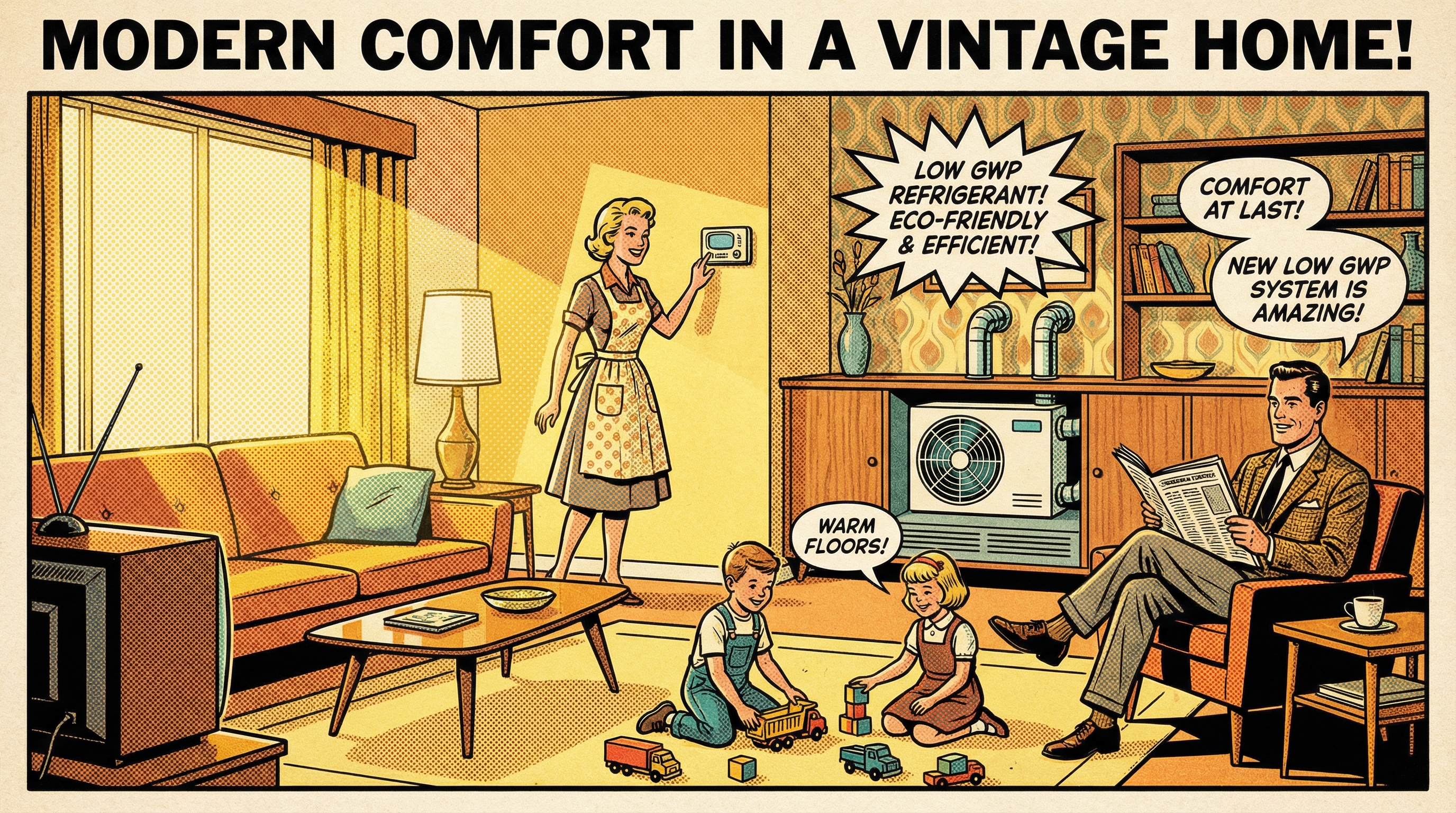
Starting January 2026, many new central AC and commercial systems must use lower GWP refrigerants, moving the market away from R 410A. The most common residential replacements are R 32 and R 454B, both A2L, mildly flammable and lower GWP. Refrigerants are not interchangeable, systems must use the refrigerant specified by the manufacturer, no retrofit or recharge with a different blend.
Manufacturers have updated components, charge limits, service procedures and safety instructions to suit A2L chemistry, and by 2026 R 32 and R 454B equipment is broadly available as product lines stabilize. Installers must follow new codes covering flammability precautions, ventilation, leak detection and component compatibility, with A2L specific training increasingly required. In our experience at Budget Heating (BudgetHeating.com), code reviews and training signoffs are becoming standard on A2L installs. Think of this like moving to a new fuel, the equipment and the rules both change.
Energy efficiency, SEER2/EER2 and the push toward net zero buildings
SEER2 and EER2 are the updated efficiency yardsticks for air conditioners and heat pumps. Think of SEER2 like miles per gallon across the whole cooling season, while EER2 is the snapshot at a fixed condition, usually peak heat. These newer tests better capture real ductwork and fan pressures, so the ratings align with what homes actually experience.
By 2026, SEER2 labeling is standard practice and baseline split systems often sit in the mid 14 SEER2 range. Regional minimums still apply, for example the U.S. Southeast commonly requires about 14.3 SEER2. Incentive thresholds tend to sit higher, steering many buyers toward 17 SEER2 and 12 EER2 or better for split systems, and roughly 16 SEER2 and 11.5 EER2 for packaged units.
Because heating and cooling account for roughly 48% of a typical home's annual energy use, efficiency upgrades move the needle. Stepping from about 14.3 SEER2 to 17 SEER2 can trim cooling energy roughly 15 to 20 percent. Larger jumps, such as 15 to 20 SEER2, can save about 200 dollars per year in hot, high kWh regions. Those avoided kilowatt hours reduce utility bills now and shrink a home's carbon footprint, aligning everyday replacement decisions with the broader push toward net zero buildings.
Indoor air quality in 2026: filtration, ventilation and humidity control after the pandemic
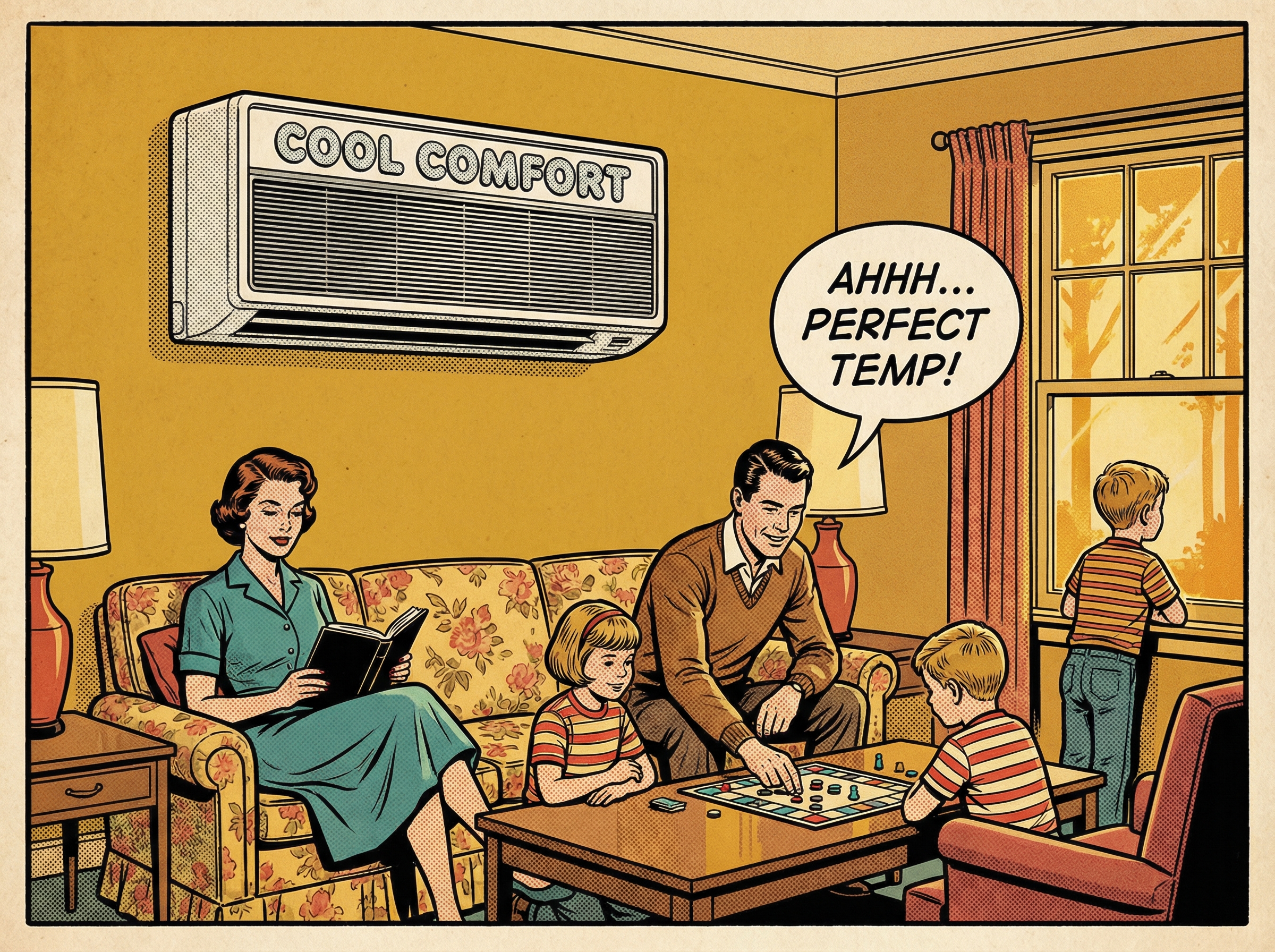
In our field work since the pandemic, we see modern HVAC integrating higher performance filtration, tighter ventilation control and programmable IAQ features, so comfort and efficiency upgrades can clean the air.
Filtration: target MERV 11 to 13 when the blower and ductwork can handle the added resistance. Pair that with mechanical ventilation, especially in tighter homes. HRVs exchange stale air for fresh while conserving heat, good for cold dry climates. ERVs also transfer moisture, better for humid or very dry regions where you want to temper humidity. Think of it as a controlled fresh-air valve instead of cracked windows.
Humidity: Variable-speed equipment wrings out more moisture at low speed; in humid climates a dedicated whole-home dehumidifier protects comfort and mold prevention. Maintenance matters: inspect filters, condensate traps and drains regularly, and schedule annual service to verify airflow and ventilation rates.
How homeowners should prioritize HVAC upgrades in 2026: checklist and what to ask a contractor
Planning early pays off. From what we see in the field, use this order of operations for a smooth 2026 upgrade.
- Replace vs repair: if your system is 10 to 15 years old or needs major repairs, plan a replacement to capture 2026 efficiencies, low GWP options and incentives.
- Design and documentation first: require Manual J load calculations, Manual S equipment selection and Manual D duct design. Ask for an AHRI matched certificate and an itemized proposal listing SEER2, EER2 and HSPF2 values.
- Ductwork and airflow: test and seal with mastic, insulate ducts in unconditioned spaces and verify total external static pressure. Target roughly 350 to 450 CFM per ton when applicable. Leaky ducts waste capacity like blowing through a cracked straw.
- IAQ and controls: pair upgrades with MERV 11 to 13 filtration where acceptable, add ERV or HRV where needed and use a smart thermostat that supports utility demand response.
- Refrigerant and installer: choose equipment designed for R-32 or R-454B and confirm the installer is trained for A2L systems and local code requirements.
- Commissioning: insist on nitrogen purge during brazing, deep vacuum below 500 microns, weighed-in charge and documented airflow and static pressure readings.
- Permits and warranty: ensure permits are pulled, A2L clearances are met, warranties are registered and you receive service records and manufacturer paperwork.
- Homeowner vs pro tasks: you handle filters, basic cleaning, drain checks and thermostat settings. Licensed technicians handle refrigerant, electrical, combustion and code critical work.
Questions to vet contractors locally:
- Will you provide Manual J, Manual S, Manual D and AHRI documentation?
- Which refrigerant will be installed and are your technicians A2L trained?
- How will you verify duct leakage, airflow and total external static pressure? What CFM per ton do you target?
- Which rebates or tax credits apply and who prepares the paperwork?
- Which commissioning steps will you perform and will I receive the reports?
When comparing local bids, favor proposals that show airflow numbers, commissioning steps and full SEER2, EER2 and HSPF2 listings up front.
Action plan: 5 steps to future proof your HVAC system in 2026 (and next steps)
By 2026 HVAC is shifting to electrified, higher efficiency, low GWP systems with smart controls. Plan now with trained pros to ensure safety, compliance and lifecycle value. We have 30+ years in HVAC and have supported 200,000+ orders with U.S. based phone help.
- Audit: Manual J and a duct test.
- Plan: replace at 10 to 15 years to capture incentives.
- Specify: 17+ SEER2, demand response, R-32/R-454B ready, A2L trained crew.
- Prep: improve envelope, seal ducts, size for humidity.
- Commission: correct vacuum and charge, docs, warranty, semiannual tune ups.
Contact a licensed, A2L trained contractor for Manual J/S/D and an AHRI matched quote, then reserve federal or local rebates while funds last.
- Get a Custom Quote
- Talk to Our Team by phone, U.S. based support
- Shop Heat Pumps
 Cooling
 Heating
 Money Saving Tips
 Product and Brands Insights
 Buying Guides
 State by State
 HVAC Systems