





Should You Get a Mini Split for a Basement Apartment?
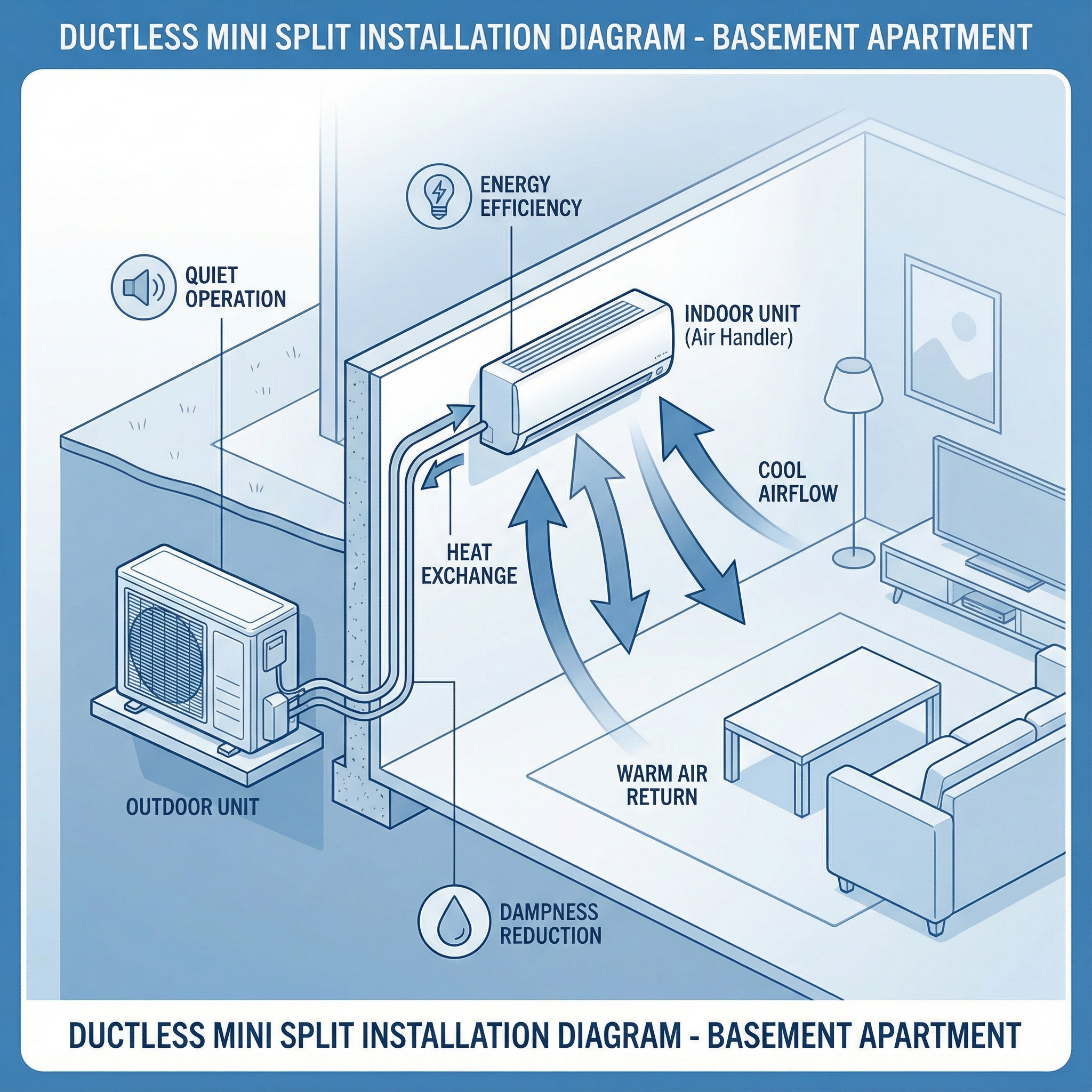
Basement apartments are often cool and damp in summer and chilly or musty in winter due to limited sunlight, below grade walls, and constrained airflow. A ductless mini split can be a smart retrofit since it targets one zone without tying into old ductwork. It is a compact heat pump for a specific space, pairing an outdoor unit with a quiet wall unit indoors, and typically needs only a small wall penetration for refrigerant lines and wiring.
Heat pumps do not create heat, they move it, like a refrigerator in reverse. In cooling they pull heat out; in heating they bring heat in from outdoor air. Moving heat is usually more efficient than electric resistance or burning fuel.
Going ductless helps indoor air quality by avoiding duct leakage, dust, and potential mold in ducts. This article will show when a mini split makes sense for a basement apartment and which practical steps deliver reliable, comfortable results.
How Ductless Mini Splits Work: Components and the Refrigeration Cycle (Quick Overview)
In the field, we see the same core pieces doing the heavy lifting: an outdoor compressor, an outdoor coil, an indoor evaporator coil housed in the wall or ceiling head, and a reversing valve. The refrigeration cycle is simple at a high level. The compressor raises the refrigerant's pressure and temperature, sending hot refrigerant through one coil where heat is released to the surrounding air. After an internal pressure drop, the refrigerant reaches the other coil cold, where it absorbs heat. The reversing valve flips the refrigerant direction, so those two coils trade jobs for heating or cooling, moving heat rather than creating it.
Modern mini splits pair that cycle with an inverter driven, variable speed compressor. Instead of hard on and off bursts, the compressor modulates to match the room's load. That means longer, lower power run times, fewer temperature swings, and quieter operation. In practical terms, the system ramps up quickly when you need it, then settles into a steady cruise to maintain comfort efficiently.
Benefits of Installing a Mini Split in a Basement Apartment
Mini splits suit basement apartments because they condition only the space that needs it, not the whole house. That targeted approach avoids duct losses, like turning on a lamp in one room, not the whole home. One heat pump delivers both heating and cooling, eliminating space heaters or window units.
In our experience, zoned control is the big win. The basement gets its own thermostat, so a tenant dials in comfort and you can set setbacks when it is empty. Installation fits basements where extending ducts is costly or impractical, common in finished conversions and older homes. Year round comfort turns the basement into real living area and supports property value and tenant appeal.
Basement Challenges to Consider (Humidity, Insulation, Layout and Ventilation Limits)
Basements carry quirks that matter for mini-splits. We often see damp conditions, and if drainage, vapor barriers, or bulk water issues are unresolved, conditioning alone will not stop mold or musty odors. Mini-splits recirculate indoor air only, they do not supply outdoor ventilation air, so many jurisdictions require a separate HRV or ERV for habitable spaces. Think of the unit as a high-efficiency fan coil, strong at heating and cooling the room it sees, not at bringing in fresh air. Standard models also lose capacity in severe cold; as a primary heat source in very low outdoor temperatures you need a cold-climate model or backup heat.
- Extreme cold without a cold-climate unit or backup heat.
- Homes already well served by central ducts where extending is practical.
- Basements with active water intrusion, fix sources first.
Alternatives: gas furnace or robust central HVAC for whole-house loads, plus envelope repairs or dewatering, and dedicated ventilation with an HRV or ERV.
Sizing a Mini Split for a Basement: BTUs, Ceiling Height, Manual J and Avoiding Oversize
Basements rarely match upstairs loads. Skip rules of thumb. Get a Manual J for the basement only. Manual J totals heat loss and gain from construction, infiltration, windows, and internal loads, then gives the BTUs needed for cooling and heating.
Collect inputs: square footage, ceiling height, insulation and window details, appliances, electronics, laundry, and typical occupancy by area. Decide if one zone serves the space or if a bedroom needs its own head, then choose wall, cassette, or slim duct.
With per zone capacity set, verify the model's performance tables at design temperatures for cooling and heating. Oversizing drives short cycling, poor humidity control, and jumpy temperatures. Basements have low sensible loads, so right sizing keeps moisture and comfort steady.
Installation Options: DIY vs Professional, Permits, Electrical, Line Sets and Placement
For a basement mini split, some tasks are DIY friendly: mounting the indoor head, drilling the small wall penetration for the line set, setting a condenser pad, and routing the condensate with proper slope. The rest is best left to licensed pros. Electrical code typically requires a dedicated circuit, correct breaker and wire size, and an outdoor disconnect within sight of the condenser. Mechanical and electrical permits are common, and inspectors will check clearances, support, and insulation details.
Any work that opens the refrigeration circuit, charging, reclaiming, leak testing, or pulling a deep vacuum, must be performed by an EPA Section 608 certified technician. Longer line runs, pressure testing with dry nitrogen, evacuation, and charge adjustments are pro territory. Verify line set length and elevation stay within the manufacturer limits, protect and insulate the lines, and plan discreet routing.
Place the indoor unit on an interior or suitable exterior wall with clear airflow and a clean condensate path. Set the outdoor unit on a stable pad or wall bracket, maintain listed clearances, avoid snow or flood zones, and position to reduce noise.
- Request the Manual J load.
- Confirm capacity at local design temperatures.
- Ask who handles permits, electrical, and refrigerant work.
- Clarify warranty and service support.
Top Brands & Reliability: What to Look For (MrCool, Mitsubishi, Daikin, Fujitsu and Cold Climate Options)
Start with proven names: Mitsubishi, Daikin, Fujitsu, and DIY-friendly MrCool. Compare warranty length and local service network. In cold regions, pick models with documented low-ambient heating, often called hyper-heat, and check capacity tables at 17 F and 5 F. Check indoor dB ratings and controls, from remotes to Wi Fi. For rentals, look for setpoint limits or lockouts. In our experience at Budget Heating (BudgetHeating.com), clear low-ambient data prevents surprises.
With regular care, many mini-splits run about two decades. Homeowners should wash filters, dust grilles and louvers, and keep the outdoor unit clear. Pros handle refrigerant and electrical checks, coil cleaning, and condensate drains to preserve lifespan.
Costs, SEER SEER2 Rules, Rebates and Operating Expenses
SEER measures seasonal cooling efficiency, SEER2 is the updated 2023 procedure. Higher numbers mean less electricity, like miles per gallon for cooling. Current DOE regional minimums apply, and for ductless systems the 2025 rules raise floors to about SEER 16 in Northern regions and SEER 17 in Southern and Southwestern regions.
Typical mini split tiers: entry mid teens SEER2 equivalents, mainstream SEER 18 to 21, premium 25 to 30+. High SEER inverter systems can cut operating costs in hot climates and long run hours, but savings scale with annual hours of use.
Installed cost depends on capacity, chosen efficiency, single zone versus multi zone, line set length and routing, and whether you need a condensate pump or added ventilation.
Rebates often come from utilities or states, plus federal 25C tax credits, and many require SEER or HSPF thresholds or ENERGY STAR. In our experience at Budget Heating (BudgetHeating.com), including efficiency ratings on quotes speeds approvals. Note the ongoing refrigerant shift from R 410A to A2L options like R 32 or R 454B, and confirm local code requirements.
Dehumidification, Ventilation and Mold Prevention: Making a Mini Split Work in a Damp Basement
Inverter mini splits shine in basements because they modulate, running long and low to pull latent moisture steadily. Think of it like a sponge staying in contact longer, which dries better than quick dabs. Right sizing matters: an oversized unit short cycles, drops temperature fast, and leaves humidity behind.
Condensate must leave the space reliably. Use a continuous gravity drain to an approved drain point whenever possible. Where gravity will not work, specify a dependable condensate pump. Insulate refrigerant lines to stop sweating, and install any required traps exactly as the manufacturer specifies. Poor drainage invites leaks, odors, and mold, so verify slope, secure connections, and test operation at startup.
Basements are inherently damp. Address exterior water control and envelope issues first, then let the mini split manage remaining load. Mini splits do not provide outdoor air, so plan a separate HRV or ERV where code and IAQ require it.
Decision Checklist: Is a Mini Split Right for Your Basement Apartment? Next Steps
For most basement apartments, a ductless mini split is an excellent solution if it is correctly sized, professionally installed, and paired with proper moisture control and separate ventilation. It delivers efficient, quiet, zoned heating and cooling, strong dehumidification when properly sized, and independent tenant control without adding ductwork. Compared with window units, PTACs, or the invasive cost of new ductwork, a well designed mini split typically offers better comfort and lower operating costs.
If you are weighing the decision, run this quick checklist: commission a Manual J load calculation, select a model with appropriate SEER or SEER2 and cold weather performance for your climate, require a condensate drainage plan, arrange separate mechanical ventilation if needed, obtain permits and a dedicated circuit, and schedule commissioning and periodic professional maintenance.
Ready to move forward? We can help you secure a professional load calculation, a written installation quote, and confirm incentives to lower your net cost before you buy.
- Get a Custom Quote
- Talk to Our Team by phone for real technical guidance
- Shop Ductless Mini Splits
- Check local rebates before purchasing
 Cooling
 Heating
 Learning Center
 Money Saving Tips
 Product and Brands Insights
 Buying Guides
 State by State
 HVAC Systems