





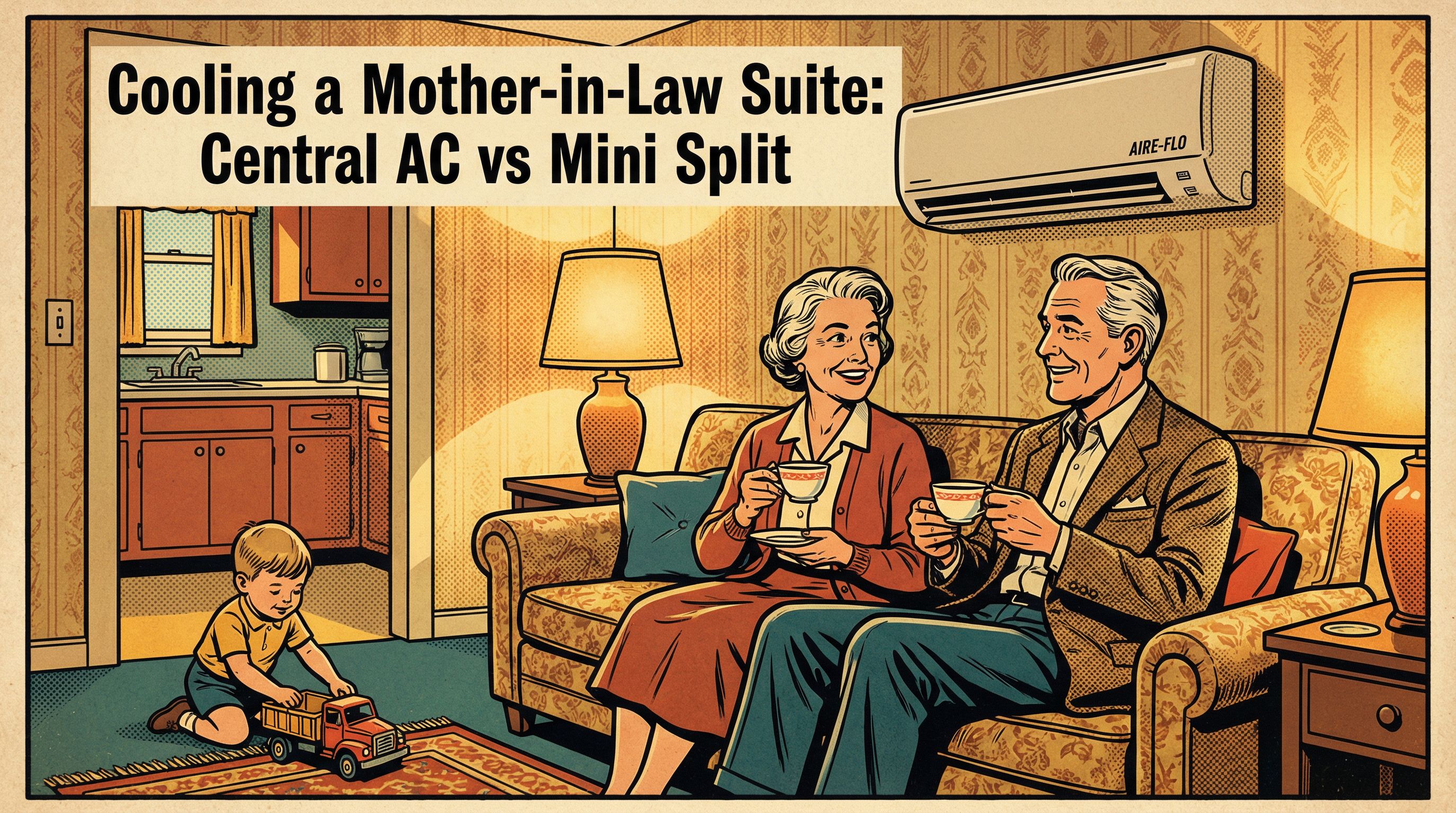
Cooling a Mother in Law Suite: Central AC vs. Ductless Mini Split, What to Expect
Building or converting a mother in law suite raises a key question: extend your central AC or install a dedicated ductless mini split? This choice shapes comfort, monthly bills, indoor air quality, installation complexity, and the life of your existing equipment. With 30 years in HVAC, we frame the decision around three checks: the new room's load, your current system's spare capacity, and the need for independent temperature control. In this guide we compare upfront cost, operating cost, comfort zoning, IAQ, noise, and reliability, then explain when each path makes the most sense.
Assess the Suite: Use, Layout, Duct Access, and Sizing Checklist
- Use: full time or occasional, and if it needs its own schedule.
- Existing AC: list age and SEER, have a contractor run Manual J.
- Manual J, our standard: room by room inputs, square footage, insulation, window area and orientation, ceiling height, internal gains, climate. Size correctly to avoid short cycling and poor dehumidification.
- Ductwork feasibility and sizing: confirm space for supply and return, leakage, insulation, spare capacity, and static pressure. Size for target cfm with a clear return path.
- Layout and utilities: indoor unit location, condensate route, electrical capacity.
- Pricing: itemized quotes, warranties, and available rebates.
How Central AC Works for an In Law Suite: Pros, Limits, and When It Makes Sense
Central AC uses ducts to move cooled air to rooms and pull warm air back. To serve an in law suite, you add supply runs and a return path. The system still operates to satisfy the main thermostat, usually in the primary living area. It is like one light switch controlling several rooms.
Pros: unified look, shared filtration, quiet operation. Limits: limited independent control unless you add zoning hardware, and running a whole home system to cool a single suite can waste energy when occupancy is limited. Central favors whole home over targeted conditioning.
It makes sense to extend central AC when the suite is part of a well planned duct design, the existing equipment has verified spare capacity, ducts can be routed without major compromise, and the homeowner prefers single system operation with a cohesive aesthetic.
How Ductless Mini Splits Work and Why They Fit Many Suites
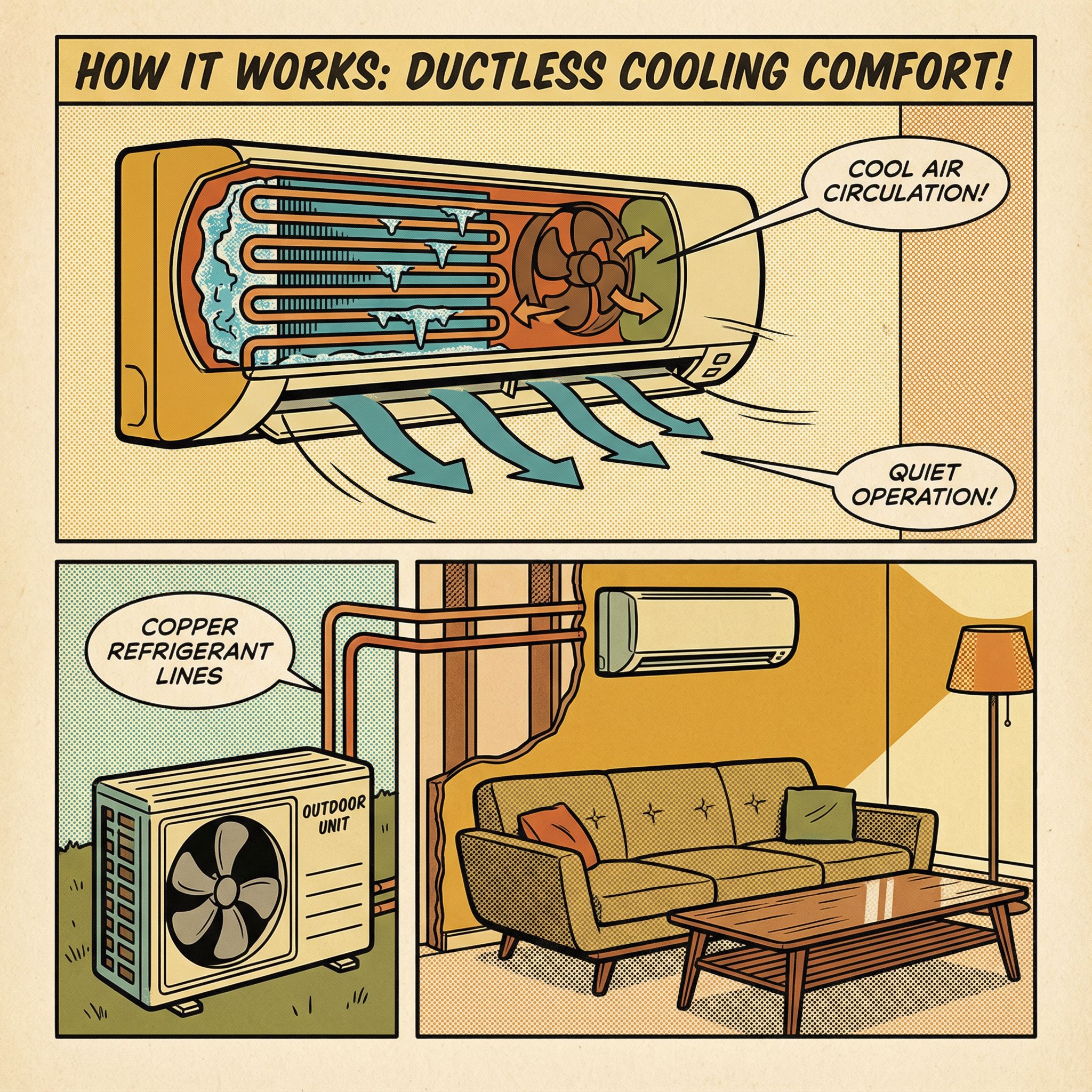
Mini splits move energy with refrigerant, not big ducts. An outdoor unit with an inverter compressor pumps refrigerant through small lines to one or more indoor heads, then back again, like a simple loop of bloodstream for your home. Each head has a coil and quiet fan that absorbs or releases heat to the room, and variable speed operation matches output to actual demand.
Because the refrigerant goes straight to the room, long duct runs are eliminated, so typical duct losses disappear. You condition only the space that is occupied, and each head has its own thermostat for precise, independent control. For finished or detached suites, installation is usually less invasive: a small wall penetration, a mounting bracket, and a condensate path. The tradeoff is visibility, since the head sits in the room.
Zoning is built in, since every head operates independently. Choose single zone, one outdoor to one indoor head, for a single suite, or multi zone to serve several rooms. Many mini splits are heat pumps, providing both cooling and heating.

When Neither Option Is Ideal: Limitations, Tradeoffs and Better Alternatives
Not every space is a good match for a quick duct extension or a basic mini split. We routinely see a few patterns where either choice disappoints, and a different approach is smarter.
- Very cold climates: Mini split heat pumps can lose capacity in deep cold. They often need backup heat or a gas furnace to carry the load. In extreme cold, a gas furnace or another reliable heating source is the better primary option.
- Main system already maxed out: Extending ducts without verifying spare capacity can strain the blower and coil, hurting comfort in the whole house. When the central system is tapped out, a simple extension or a low end mini split is not ideal. A dedicated, properly sized system is the safer route.
- Special-use rooms: Treating a garage apartment, sunroom, or studio like a standard bedroom ignores higher gains from windows, appliances, and occupants. Design to the real load, not the floor area label.
- Cost myths: Mini splits are not always more expensive overall. Upfront price alone can mislead, since operating costs and duct work changes can shift the math.
Cost Comparison: Equipment, Installation, and Operating Costs for a Suite
Mini split equipment often costs more per ton, but skipping new ducts and rebalancing often lowers total project cost. In our experience at Budget Heating (BudgetHeating.com), high SEER minis typically pay back in 3 to 5 years.
Operating costs tilt the scale. Central 12,000 to 18,000 Btu units draw about 3,000 to 3,500 W per hour, while comparable mini splits draw roughly 800 to 2,000 W. On a $1,500 yearly cooling bill at a 10 SEER baseline, 14 SEER saves about 30 percent ($450), 18 SEER about 50 percent ($750), and 22+ SEER about 65 percent (~$975).
Switching from a low efficiency central system to a dedicated ductless mini split typically cuts cooling costs by about 30 to 65 percent. The avoided duct work can keep the upfront spend close to a central extension for a single suite, while lowering monthly bills noticeably.
Energy Efficiency, SEER2 Ratings and Heat Pump Options for a Suite
SEER and SEER2 measure seasonal cooling output per unit of electricity, think of them as miles per gallon for air conditioning. In 2023 the DOE moved the industry to SEER2, EER2 and HSPF2, raised regional minimums for split system AC and heat pumps, and applied nationwide heat pump minimums to mini split heat pumps.
Ductless mini splits commonly reach 20+ SEER, while typical ducted systems land around 14 to 20 SEER. A higher SEER or SEER2 rating cuts kWh use, and skipping ducts avoids the losses that sneak out of attics and chases, so suite cooling costs drop in real terms. In our experience at Budget Heating (BudgetHeating.com), that combination makes a strong case for a mini split in a suite, especially when you want zoned comfort or do not have existing ducts. Central AC still fits if you already have efficient, tight ductwork.
Installation, Permits, Refrigerant Rules and Retrofit Considerations
On additions or ADUs, extending existing ducts typically triggers permits plus Manual J, S, and D checks. Inspectors often want load verification and proof the supply and return changes keep airflow balanced. In lived-in homes, a duct extension can mean opening walls or ceilings, adding returns, and rebalancing the system. By comparison, a mini-split usually needs only small line-set penetrations, which keeps disruption low, like fishing a cable through a wall instead of rebuilding it.
Regulatory shifts also matter. Under the AIM Act and 2023 changes, many areas are moving to lower-GWP A2L refrigerants such as R-32 and R-454B. These rules influence allowable charge limits, permitting steps, and installer practices. Confirm what your local code requires for A2L equipment before deciding between a central extension or a new mini-split.
Maintenance, Reliability and Troubleshooting Tips for Suite HVAC
Central AC: replace return filters every 1 to 3 months, keep grilles clear. Mini-split: wash indoor filters monthly, keep heads unobstructed. Keep outdoor coils clean. Schedule annual pro inspection and coil cleaning. Do not DIY refrigerant or electrical work, duct changes, or charging. These must be handled by certified technicians. Call for ice on lines, condensate leaks, tripping breakers, odd noises, or sudden performance drops. With care, expect 10 to 20 years; mini-splits avoid duct issues that can shorten central performance.
Quick Recommendation and Next Steps: Choose, Quote, and Install the Best Fit
For a standalone or newly added mother in law suite, a dedicated ductless mini split is usually the better fit: simpler in finished or detached spaces, independent control, and higher efficiency for single zone cooling. Extending central AC only makes sense when ducts and spare capacity are confirmed and the suite is truly integrated into the ducted design. We know this can feel like a close call, and we can help you validate the path.
Next steps: get a Manual J, confirm local code and refrigerant rules, request itemized quotes, compare SEER/SEER2 and warranties, and plan condensate, electrical, and maintenance before you commit.
- Get a Custom Quote
- Talk to Our Team by phone for fast guidance
- Shop Ductless Mini Splits
- Shop Central AC Equipment
 Cooling
 Heating
 Learning Center
 Money Saving Tips
 Product and Brands Insights
 Buying Guides
 State by State
 HVAC Systems