





Are portable AC units worth buying? A quick snapshot
Thinking about a portable AC for quick, DIY cooling, maybe to tame a hot bedroom, attic office, or garage? Before you buy, compare portable units to ductless mini-splits because your choice affects everyday comfort, monthly energy bills, indoor humidity and air quality, and how long the system will last.
We keep the scope tight here, just portable floor units versus ductless mini-splits, not window units or full central systems. We will weigh five things that matter day to day: how evenly and quietly a room cools, what it costs to run, how well moisture is handled, what it takes to install, and expected service life.
The bottom line in brief: most portable units fit smaller spaces and short-term use, they sit in the room, make more noise, and often cost more to operate. Mini-splits deliver zoned comfort with higher efficiency and a much longer service life, and once installed they are quieter and more consistent. If you need a fast, temporary fix, a portable can work. If you want long-term comfort with lower bills, a mini-split usually wins.
Quick answer: when a portable AC makes sense (and when it doesn't)
We use a simple rule of thumb: pick a portable AC when you need temporary, low commitment cooling for a small space. Pick a mini-split when you want reliable, energy efficient, quiet, long term comfort and you are willing to invest more up front. Portable units shine for renters, short-term or seasonal needs, spot cooling a single room, and quick setups you can move between spaces. They are handy for occasional use, like a garage workshop or a room that is used intermittently.
Start by defining your goal and time horizon. If you need relief for a few weeks or a single season, a portable is the practical choice. If you expect daily use for multiple seasons, or want both cooling and heating with better efficiency and lower noise, a mini-split is the smarter long-term path.
How portable air conditioners work: why the hose and indoor compressor matter
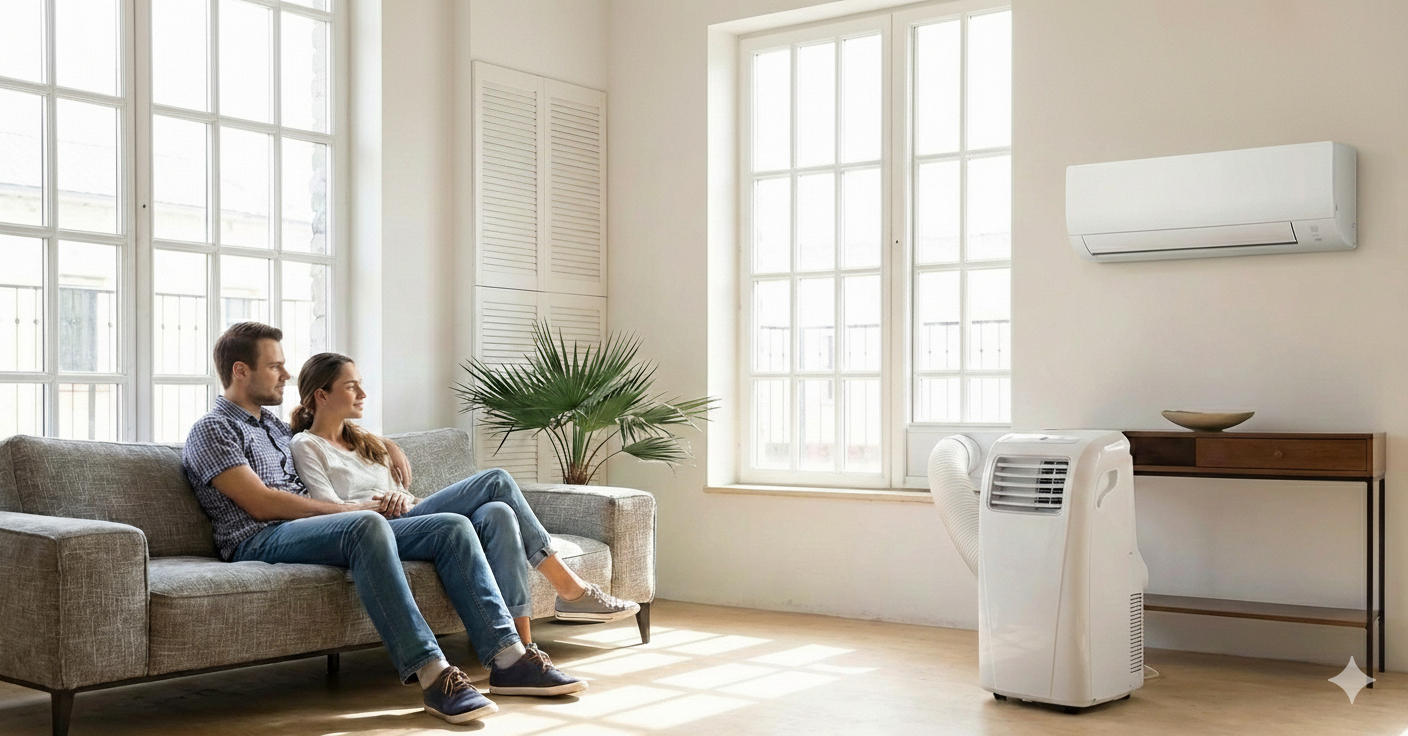
Portable ACs put the compressor and fan in the room and exhaust heat through a window kit and hose. In single-hose designs, some conditioned air is expelled outdoors, which pulls warm air in through cracks and other rooms. It feels like cooling with a window cracked, so net capacity drops. Dual-hose models bring in outside air for the condenser and send it back out, which reduces this effect.
Many portables use fixed-speed compressors that cycle on and off, creating louder starts and more noticeable temperature swings than inverter systems.
Plan on an operable window or vent, floor space, and visible hoses. Most are cooling only, with some electric-resistance or light supplemental heat, not a heat pump replacement. Ratings use DOE SACC and EER or CEER, not SEER2, so listed BTU values appear lower under realistic test procedures.
How ductless mini-split systems work (and why that matters for comfort & efficiency)
Ductless mini-splits separate the indoor air handler from an outdoor compressor and condenser. A sealed refrigerant loop moves heat between the two, so the system transfers heat rather than pushing indoor air outside, which avoids the exhaust-air penalty common to portables. Many models are heat pumps, so the same equipment cools in summer and heats efficiently in winter while managing sensible cooling and dehumidification effectively.
The outdoor unit uses an inverter-driven compressor that modulates output like a dimmer switch. Instead of fixed on or off operation, it ramps up or down to match the load, which holds steadier temperatures, trims noise, and boosts part-load efficiency compared with fixed-speed portables. In our experience at Budget Heating (BudgetHeating.com), that gentle modulation is what makes rooms feel comfortable and dry on muggy days.
Getting those results depends on professional installation. Correct system design, line-set routing and insulation, nitrogen pressure testing, deep vacuum evacuation, and accurate refrigerant charging all require an EPA-certified HVAC technician. Improper installation can reduce efficiency or even affect warranties. As of 2023, split-system efficiency is rated under SEER2, EER2, and HSPF2, and many mini-splits meet or exceed regional minimums and may qualify for ENERGY STAR and other incentives.
Tradeoffs and when a portable AC is not the right choice
Portable ACs handle short-term, spot cooling well, but they are not ideal in every setting. They occupy floor space, the hose and window kit stay visible, and that can reduce usable area and block a view. Because the compressor sits in the room, noise concentrates where you sleep or work, which can be disruptive.
- Very hot and humid climates: Portables often struggle with latent load if condensate handling is not ideal. A ductless mini-split offers steadier dehumidification and more dependable comfort.
- Bedrooms and home offices: Indoor compressor noise can interrupt sleep and calls. A mini-split or a quiet window unit is usually a better fit.
- Whole-home or long-term cooling: Treating an entire home with one or more portables is inefficient and clumsy. Consider central HVAC, a multi-zone mini-split, or a properly sized window unit for semi-permanent use.
- Cold climates needing heat: For dependable heating in extreme cold, use a gas furnace or a cold-climate heat pump rather than relying on cooling-only portables.
In short, portable units shine for temporary, small-room, or occasional needs. For steady comfort, look to mini-splits, window units, or central systems.
Cooling performance & BTU sizing: how to pick the right capacity
Measure the room, then factor sun exposure, window area, ceiling height, occupants, and electronics. A west-facing den with big windows needs more BTUs than a shaded bedroom of the same size.
Portable ACs run about 8,000 to 14,000 BTU and suit a single modest room. Past roughly 300 square feet they struggle. Cooling multiple rooms with portables means multiple units, adding cost, noise, and floor clutter.
For mini-splits, we recommend a Manual J room by room load calculation. It quantifies each room's heat gain and sets the capacity per zone, clarifying single-zone versus multi-zone. Correct sizing avoids short cycling and keeps temperatures stable on the hottest days.
Maintenance, lifespan & safety: what upkeep looks like for each option
Portable ACs need frequent care: clean filters every 2 to 4 weeks, vacuum grilles, and keep 12 inches of clearance to prevent airflow restriction and icing. Manage condensate by emptying the tank regularly or using a supported continuous drain hose, since poor drainage risks leaks, mold, and water damage. For safety, plug into a grounded outlet, never use extension cords, and call an electrician if breakers trip or cords overheat. Typical lifespan is 5 to 8 years, with performance fading over time.
Mini splits need monthly filter cleaning, outdoor unit debris removal, and periodic tune ups that check refrigerant pressures, electrical connections, and condensate drains. With proper care, service life commonly reaches 15 to 20 years.
Do not open or recharge sealed refrigerant systems, use an EPA certified technician. Call a pro for suspected refrigerant leaks, frequent breaker trips, persistent indoor water leaks, ice on coils, or after flood damage.
Energy efficiency & operating costs: SEER/EER explained and what you'll pay to run them
SEER and SEER2 for split systems and EER or CEER for portables measure how much cooling you get per unit of electricity. Think of them like miles per gallon for air conditioners: the higher the number, the less energy you use for the same comfort.
Ductless mini splits commonly land in the mid teens to high 20s, and premium models can exceed 25 to 30 SEER. Portable ACs usually cluster around 7 to 10 EER or CEER. Because energy use is inversely related to efficiency, professional ductless systems typically use substantially less energy than portables, and about 30 percent less than comparable window units. Portables are also held back by fixed speed compressors and single hose designs that pull conditioned air out of the room.
What does that mean for your bill? Using a high SEER mini split as the primary cooler usually results in significantly lower electricity costs over its life compared to relying on a portable. In our experience at Budget Heating (BudgetHeating.com), customers who upgrade from a 9 EER portable to a 20 plus SEER mini split report noticeably smaller summer power bills.
Typical use cases, cost examples & payback scenarios
Portables suit renters, short stays, or tight budgets. They cool a room quickly, add noise and clutter, and typically last 5 to 8 years. Mini-split heat pumps fit long-term owners who want efficient, quiet, year-round comfort with higher upfront cost and 15 to 20 year life.
Across a full lifecycle, low portable purchase price can be offset by higher energy use and multiple replacements, often exceeding one properly sized mini-split. High-efficiency mini-splits often qualify for ENERGY STAR, utility rebates, and federal or state tax credits, improving payback. In our experience, incentives often tip the scale.
Zoning: portables create cheap, movable zones, one unit per room. Mini-splits provide permanent zones with individual indoor heads and advanced controls.
- Manual J load calculation
- Proposed SEER2 and HSPF2 with estimated operating cost
- Total installed cost and timeline
- Warranty terms
- Incentive eligibility and who files paperwork
Conclusion & practical recommendation: should you buy a portable AC or a mini-split?
For short stays, renters, or spot cooling, a portable AC can be a practical stopgap. For multi-year comfort and lower bills, choose a ductless mini-split.
Use this simple rule: temporary or occasional need, buy a well sized portable and plan for condensate and frequent filter cleaning. Long term need, get a Manual J mini-split quote, check rebates, then compare lifetime energy cost.
We have helped thousands match systems to real homes, and our U.S.-based team can guide you in one call.
- Get a Custom Quote
- Talk to Our Team by phone or chat
- Shop Portable ACs or Shop Ductless Mini-Splits
 Cooling
 Heating
 Learning Center
 Money Saving Tips
 Product and Brands Insights
 Buying Guides
 State by State
 HVAC Systems