




Why Cooling Warehouses Is Different: Stakes, Scale and What This Guide Covers
Cooling a warehouse is not like conditioning offices or retail. You are moving air across a huge volume, dealing with frequent door openings, tall racking that disrupts airflow, and process heat that shifts by the hour. Get it right and you reduce energy use, protect moisture sensitive inventory, stabilize temperatures for staff comfort, and extend equipment life.
This guide is for facility managers, operations managers, HVAC engineers, building owners, procurement leads, and contractors. We cover the decisions that matter at warehouse scale, including equipment selection, proper sizing, air distribution, controls, and maintenance planning, along with the tradeoffs behind each choice.
- Define needs and constraints: occupancy type, operating hours, design temperature and humidity setpoints, moisture sensitive goods, and door operation frequency.
By the end, you will understand why warehouses require different strategies than offices, how to minimize hot and cold zones, and how to balance comfort, inventory protection, and total cost over the life of the system.
Key Cooling Challenges in Large Warehouses: Volume, Stratification, Internal Loads and Dock Doors
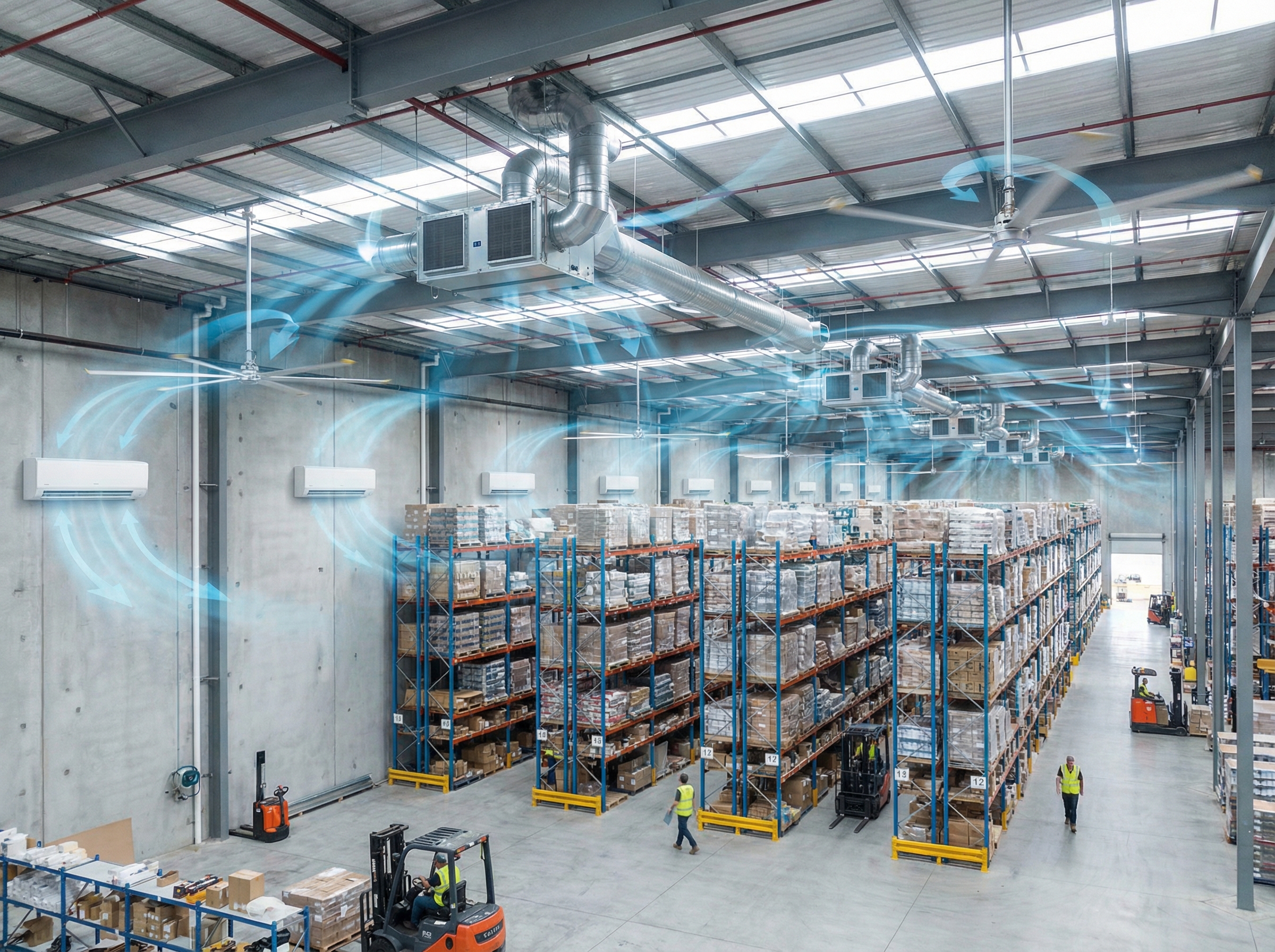
Cooling a tall warehouse is like trying to chill a cathedral. The issue is not only square footage, it is cubic volume. Heat rises and stratifies at the roof while workers feel warm at the floor. Internal gains from lighting, conveyors, forklifts and charging stations add steady load. Dock doors spike infiltration, bringing hot, humid air that undermines setpoints. We treat HVAC as an integrated system, which means right sizing from engineering calculations, active destratification, zoning by activity, and tightening the envelope at docks and walls.
- Myth: Size by square feet. Correction: Size by volume, air changes and internal gains.
- Myth: Ceiling height does not matter. Correction: Plan for stratification and use HVLS or destrat fans.
- Myth: Insulation is optional. Correction: Envelope upgrades cut peak load 10 to 25 percent.
- Myth: Internal equipment heat is minor. Correction: Meter it and zone around it.
- Myth: Doors only affect comfort briefly. Correction: Use dock seals, air curtains and dedicated make-up air.
- Myth: One big unit is best. Correction: Multiple zones improve control and resilience.
Locate sensors at working height, provide ventilation without overcooling, and maintain coils and filters. Routine service can trim energy 5 to 15 percent and avoids costly breakdowns.
Understanding Cooling Load and Converting to Tons: The Q = U × A × ΔT Approach
We size cooling from physics, not guesswork. For each wall, roof, window, and floor, calculate Q = U × A × ΔT using local design weather in a load tool such as Carrier HAP, Trane TRACE, EnergyPlus, or an equivalent. Add internal gains from people, lighting, appliances, and required ventilation. That sum is the design load for the space. It is like getting a suit tailored to your body, not buying by T shirt size.
Convert the result to equipment tonnage by dividing BTU/hr by 12,000. Example: 30,000 BTU/hr is about 2.5 tons. We then sanity check only: roughly 1 ton per 400 to 600 sq ft. Require diversity factors and manufacturer part load performance data, IEER or EER, in the submittal. Avoid oversizing, which drives short cycling, weak humidity control, and higher operating costs.

Centralised vs Decentralised Systems: Tradeoffs, When Not to Use One-Size-Fits-All, and Better Alternatives
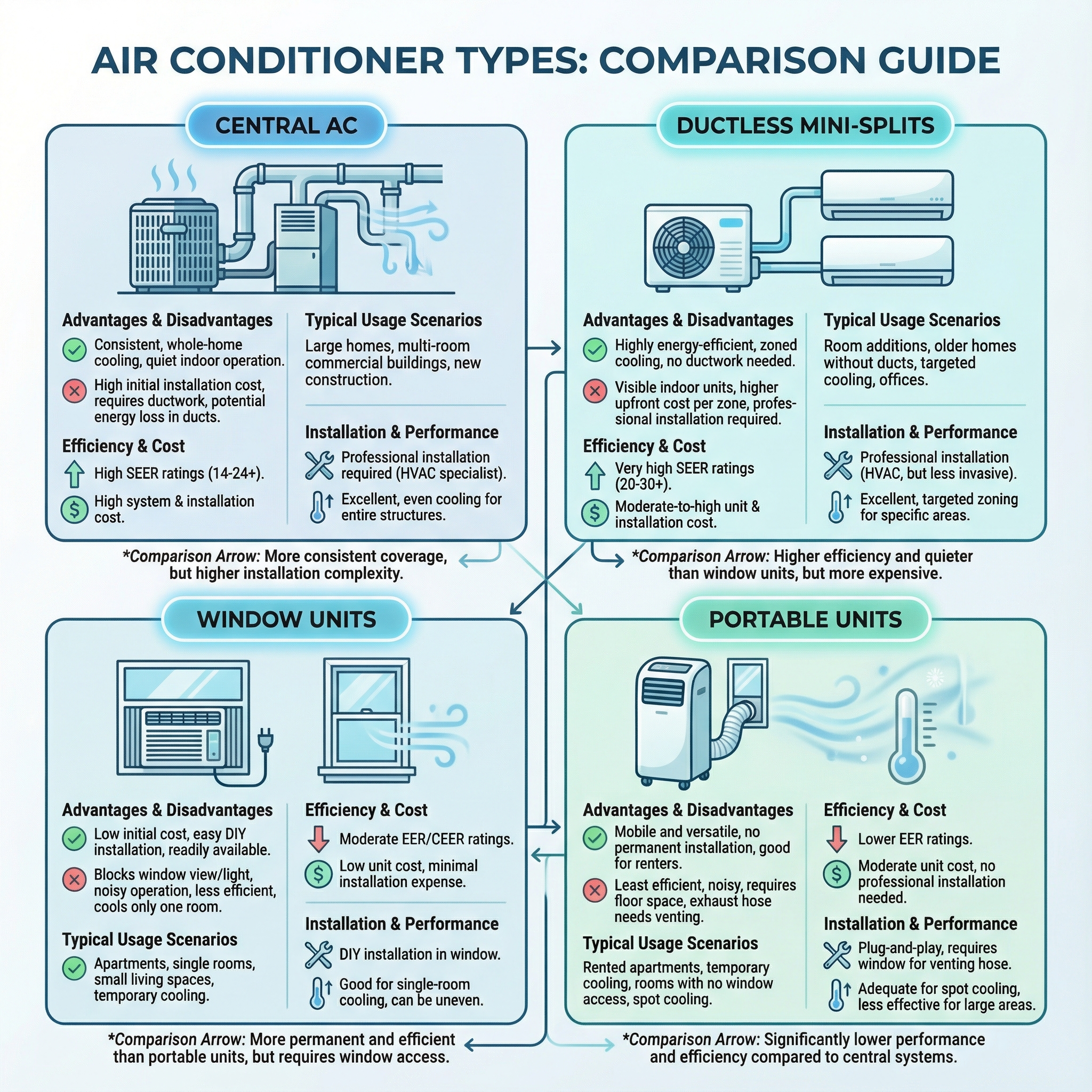
We start with a simple framework: budget over first cost and lifecycle, flexibility for future tenant changes, roof space and structural capacity, and safe service access. Centralised plants or banks of rooftop units suit big roofs with good structure and easy crane access. Split and VRF suit tight roofs, tricky structural limits, and frequent reconfigurations. Chilled water excels where long pipe runs are practical and a central room is available.
- Very large, uniform open-bay warehouse: Centralised rooftops or a chilled-water plant usually win on installed cost per square foot and maintenance efficiency. Alternative to avoid: many small splits that add filters, ladders, and scattered drains.
- Mixed-use speculative building with varied tenant needs: Decentralised VRF or packaged splits provide independent metering and quick build-outs. Alternative to avoid: a single central plant that locks every suite to the same schedule.
- Hot, dry, low-humidity sites: Evaporative or hybrid systems can outperform compressor-heavy central systems. Alternative to avoid: oversizing DX-only central gear for peak that rarely occurs.
Define zones by use, such as offices, docks, and mezzanines, then pair with a BMS or smart thermostats, setback schedules, and overrides to match actual occupancy.
Controls & Monitoring: DOAS, HVAC Monitors, Zoning and Smart Sequences to Cut Energy Use
We design control sequences that let equipment loaf instead of sprint. A BMS or smart thermostat drives demand-controlled ventilation, modulating a DOAS to meet required outdoor air volumes, often through an ERV or HRV to reclaim energy. Fans and pumps run on VFDs, compressors stage or vary capacity, and supply-air reset trims setpoints as loads drop. Economizers bring in free cooling when outdoor conditions allow. Zoning reduces overlap between heating and cooling. Monitoring CO2 and RH against defined targets, plus supply temperature, static and filter pressure, catches issues early, and clear makeup air plans with MERV filtration and CO/CO2 safety keep performance on target.
System Types for Warehouses: Rooftop Units, Centralised Plants, VRF, Ductless and Evaporative Options
Start with climate and ventilation. RTUs serve large bays and, in mixed climates, pair well with economizers and destrat fans. Centralised plants suit big sites and process loads, while VRF or ductless fit offices and spot zones. In our experience at Budget Heating (BudgetHeating.com), outside air strategy is the hinge of warehouse comfort.
- Hot dry: Evaporative or hybrid cooling is efficient, but added moisture limits use near moisture sensitive goods.
- Hot humid: Use DX with a dedicated outdoor air system. DOAS sets ventilation and humidity, the main system handles sensible load.
- Mixed or cold: Mixed favors RTUs with economizers and destratification. Cold needs freeze protection with hydronic coils or low ambient heat pumps.
- High ventilation: DOAS paired with RTUs, VRF, or central handlers keeps airflow and control stable.
Selecting Components & Safe Maintenance: Compressors, Coils, Fans and What Owners Can Do
From field experience, compressors, coils, and fans should be selected as a matched set that meets the specified capacity, airflow, and control strategy. After install, require commissioning with TAB, functional testing of fans and economizers, and verification of control sequences at part load and near full load.
Plan maintenance readiness early: define filter intervals, ensure safe access, schedule periodic coil cleaning and sensor calibration, and confirm O&M manuals and training are delivered.
- Owner tasks: replace filters on schedule, clear outdoor debris, check for blocked coils and drains, note unusual sounds.
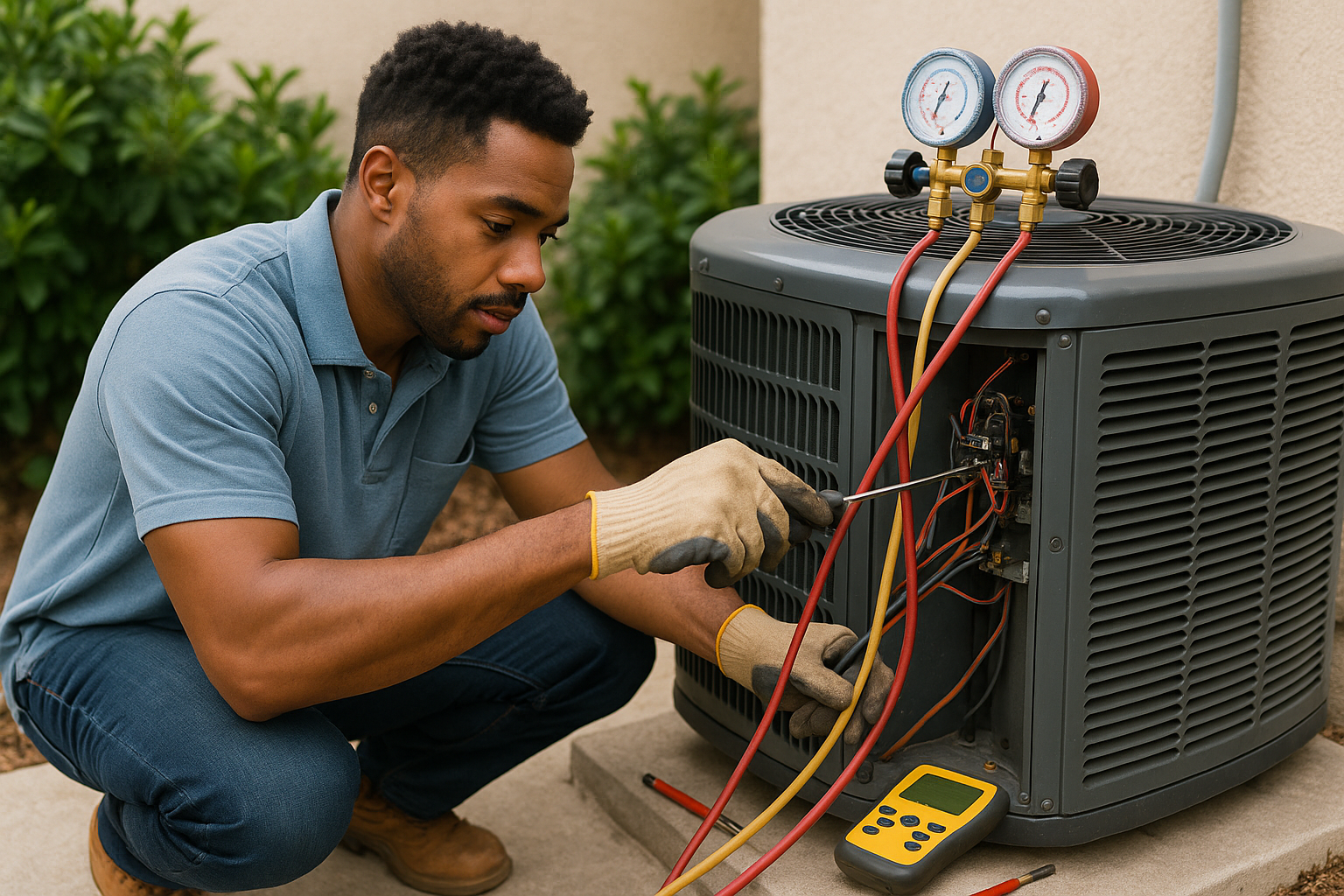
- Licensed pro tasks: electrical diagnostics, refrigerant work, gas and combustion service, structural or installation changes.
- Safety cautions: isolate power, avoid refrigerant exposure, prevent CO risks, use proper fall protection.
- Weekly: quick visual and sound check.
- Monthly: filter check and debris clearing.
- Quarterly: coil inspection and basic cleaning if safely accessible.
- Biannual professional: full service and sensor calibration.
- Immediate technician needed: persistent odors, water leaks, icing, or flooding.
Airflow Management and Distribution: Preventing Hot Spots, Using HVLS Fans and Dock Door Strategies
We start with the envelope: add insulation and air sealing, especially on metal buildings. Document clear height, racks, skylights and leak points. Set supply CFM and duct sizes, select high throw diffusers to reach past shelving, and provide low resistance returns and relief. Run HVLS fans at low speed for destratification, pulling heat down to people. At docks, limit infiltration with air curtains, tight seals and leveler skirts.
Energy Efficiency, Sizing Economics and Contractor Selection: SEER2/EER2, Payback and What to Ask Contractors
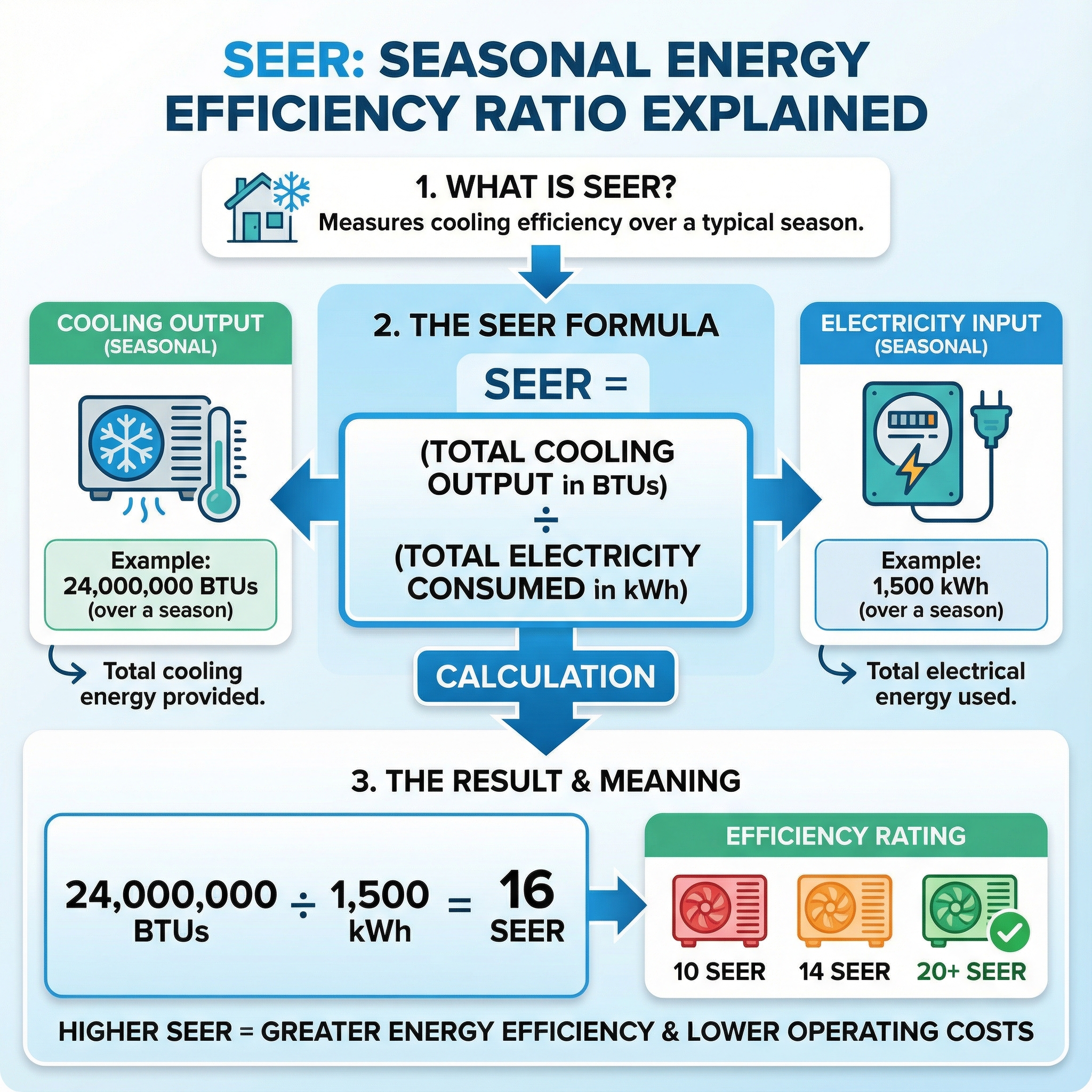
SEER2 applies to light commercial and residential split systems, EER2 and IEER are the key metrics for rooftop and package units. Think of SEER2 as miles per gallon across the whole cooling season, while EER2 captures full load efficiency and IEER captures part load where most systems actually run. Regional minimums under SEER2 vary and differ for units under 45,000 Btu/h versus 45,000 Btu/h and larger, so confirm your climate zone requirements.
Sample savings: moving from 13 SEER to 18 SEER cuts seasonal kWh roughly 1 minus 13 divided by 18, about 28 percent. If a site uses 20,000 cooling kWh per year, that is about 5,600 kWh saved, roughly 670 to 1,100 dollars annually at 0.12 to 0.20 dollars per kWh. Double the load, roughly double the savings. Proactive maintenance can trim another 10 to about 30 percent. Installed HVAC budgets typically land around 6 to 18 dollars per square foot. Higher efficiency can shorten payback when hours and utility rates are high, and it often lowers lifecycle costs by reducing runtime and wear.
In our experience at Budget Heating (BudgetHeating.com), strong bids include both efficiency and documentation. Ask for:
- Stamped load calculations and code compliance by climate zone, including EER, SEER2 and IEER, plus heat pump or electrification options and incentives.
- Equipment submittals with part load performance, duct and diffuser layouts, and control diagrams.
- A commissioning plan with training, and a budget and phasing plan for scalability in speculative buildings.
Implementation Checklist: How to Choose and Commission an Efficient Warehouse HVAC System
Treat warehouse HVAC as an integrated system shaped by building, climate, and operations. Start with accurate loads and ventilation, right-size equipment, zone wisely, manage stratification, use controls like BMS, demand ventilation, and economizers, tighten the envelope, then commission and maintain with discipline.
- Confirm setpoints, special inventory needs, and operating schedule.
- Document envelope, docks, and local climate.
- Map zones and heights, plan destrat fans and airflow.
- Specify right-sized equipment, controls, sensors, and commissioning tests.
You are balancing comfort, product protection, and energy cost. With 30+ years and 200,000 orders, we validate design and commissioning and get results fast. Ready to turn options into a plan?
- Get a Custom Quote
- Talk to Our Team by phone or chat
- Shop Commercial HVAC Equipment, with free shipping zones and Affirm financing