




Can Your Air Conditioning System Effectively Control Building Humidity?
Central air conditioners do remove moisture whenever they cool, because warm indoor air passes over a cold evaporator coil and water condenses and drains away. Dehumidification is a byproduct of cooling, not a guarantee of steady humidity control. Keeping indoor relative humidity in the comfort and mold control range, roughly 40 to 60 percent, depends on equipment sizing and selection, installation quality and airflow, controls, maintenance, the local climate, and indoor moisture sources.
In this article we set expectations clearly. We explain how AC dehumidification works, where its limits show up, and when the AC alone will struggle, for example with oversized systems, short cycles, high latent loads, or mild rainy days. We also cover when extra equipment makes sense, like whole-home dehumidifiers, variable speed air handlers, smarter thermostats with humidity logic, or reheat strategies. Think of the evaporator like a sponge that works only when it stays cold long enough. We finish with practical next steps you can apply right away.
How Air Conditioners Remove Moisture (Sensible vs. Latent Cooling)
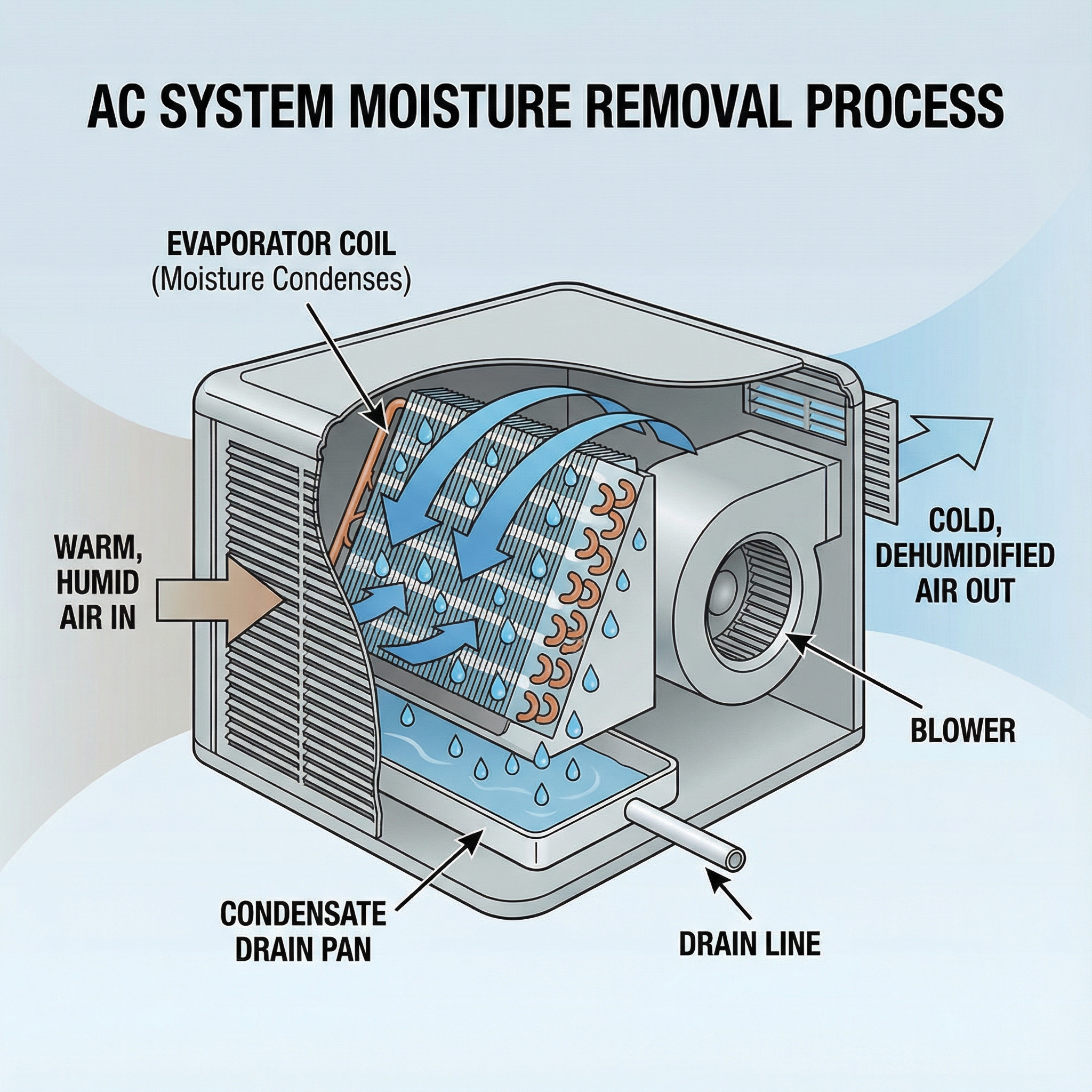
When warm, humid indoor air passes over the cold evaporator coil, the coil surface temperature drops below the air's dew point. Water vapor then condenses on the coil and drips into the condensate pan and drain line, much like moisture forming on a cold glass. That is the dehumidification step built into standard air conditioning.
Cooling has two jobs happening at once. Sensible cooling is the drop you feel on a thermometer, the air temperature going down. Latent cooling is the moisture removal, water vapor turning into liquid on the coil. Both occur in the same pass across the evaporator, and how much you get of each depends on how the system is operating at that moment.
This moisture removal happens whenever the system is running and the coil is sufficiently cold. Longer, steady run cycles keep the coil cold and maximize moisture removal. Short, frequent starts and stops reduce the time the coil spends below the dew point, so less water condenses overall. In practice, consistent runtimes improve comfort because the unit can lower temperature and pull out humidity more effectively.
When an AC Can Keep Your Home Comfortable: Key Performance Factors and Warning Signs
A right sized central AC with adequate runtime can keep indoor relative humidity in the comfort band of about 40 to 60 percent in many homes when outdoor humidity is moderate. Think of it like a sponge that only works while it is soaking. Very short run times with frequent cycling usually mean poor moisture removal.
In our experience at Budget Heating (BudgetHeating.com), steady, several minute cycles that bring temperature down smoothly are a good sign. Watch for warning signs that your AC is not keeping up:
- RH that stays above roughly 60 percent
- Window condensation
- Musty odors or visible mold
- Air that feels cool but clammy
If you see these, your system may be oversized, improperly set up, or facing conditions that require supplemental dehumidification.
System Sizing, Short Cycling and Other Reasons Your AC Fails to Dehumidify
We often see homes that hit the thermostat setpoint yet feel clammy. The usual culprit is oversizing. An oversized unit cools the air so quickly that it shuts off after brief runs. The coil needs steady, sustained operation to get cold enough to wring moisture from the air. Think of the coil like a sponge that needs time to soak up water. Short cycles keep that sponge barely damp, so temperature drops but humidity lingers.
Other issues can overwhelm even a correctly sized system:
- Duct leakage and infiltration: Leaky returns or supplies in attics, garages, or crawlspaces pull in hot, moist outdoor air, raising the latent load and undoing dehumidification.
- High internal moisture generation: Frequent hot showers, heavy cooking, many occupants, wet basements or crawlspaces, and unvented dryers can add moisture faster than the AC can remove it.
Controlling sources and run time is central to reliable humidity control.
Why Humidity Control Matters: Benefits, Common Misconceptions and Mistakes
Effective humidity control boosts comfort by reducing sticky air, improves indoor air quality by curbing mold, dust mites, and musty odors, protects wood, trim, floors, and electronics, and cuts overcooling so compressors cycle less and last longer. Common pitfalls: not all AC systems dehumidify equally, variable speed compressors, zoning, and integrated humidity control typically beat simple single stage units. Closing supply registers raises static pressure, reduces airflow, and weakens moisture removal. Filters matter, dirty or mismatched filters starve airflow and hurt latent control. Fast cooling is not proof of good drying, oversized units tend to short cycle. SEER or SEER2 rate efficiency, not humidity performance. Cranking the thermostat low and poor thermostat placement can also reduce runtime and dehumidification.
Design & Equipment Choices That Improve Dehumidification
Great dehumidification comes from design choices that favor latent removal without sacrificing comfort. In our experience at Budget Heating (BudgetHeating.com), the right setup consistently beats trying to fix humidity after the fact. Here is what to specify or ask your contractor to implement:
- Manual J and Manual S: Insist on proper load calculation and equipment selection so the system meets both sensible and latent loads at design and part load conditions.
- Airflow and SHR: Have the blower configured for appropriate cfm per ton and pair the coil so the Sensible Heat Ratio targets more latent capacity when needed.
- Thermostat humidity control: Use a smart thermostat or humidistat with a dehumidify mode that can lower blower speed, lengthen cycles, or stage equipment to hit a humidity setpoint.
- Variable speed or VRF equipment: Modulating capacity and blower speed keeps the coil cold longer with fewer on/off cycles, which improves moisture removal.
- Tight envelope and ducts: Air seal the building and seal or insulate ducts to cut infiltration and reduce the latent load your AC must handle.
SEER/SEER2, Regional Rules and What Efficiency Means for Humidity Control
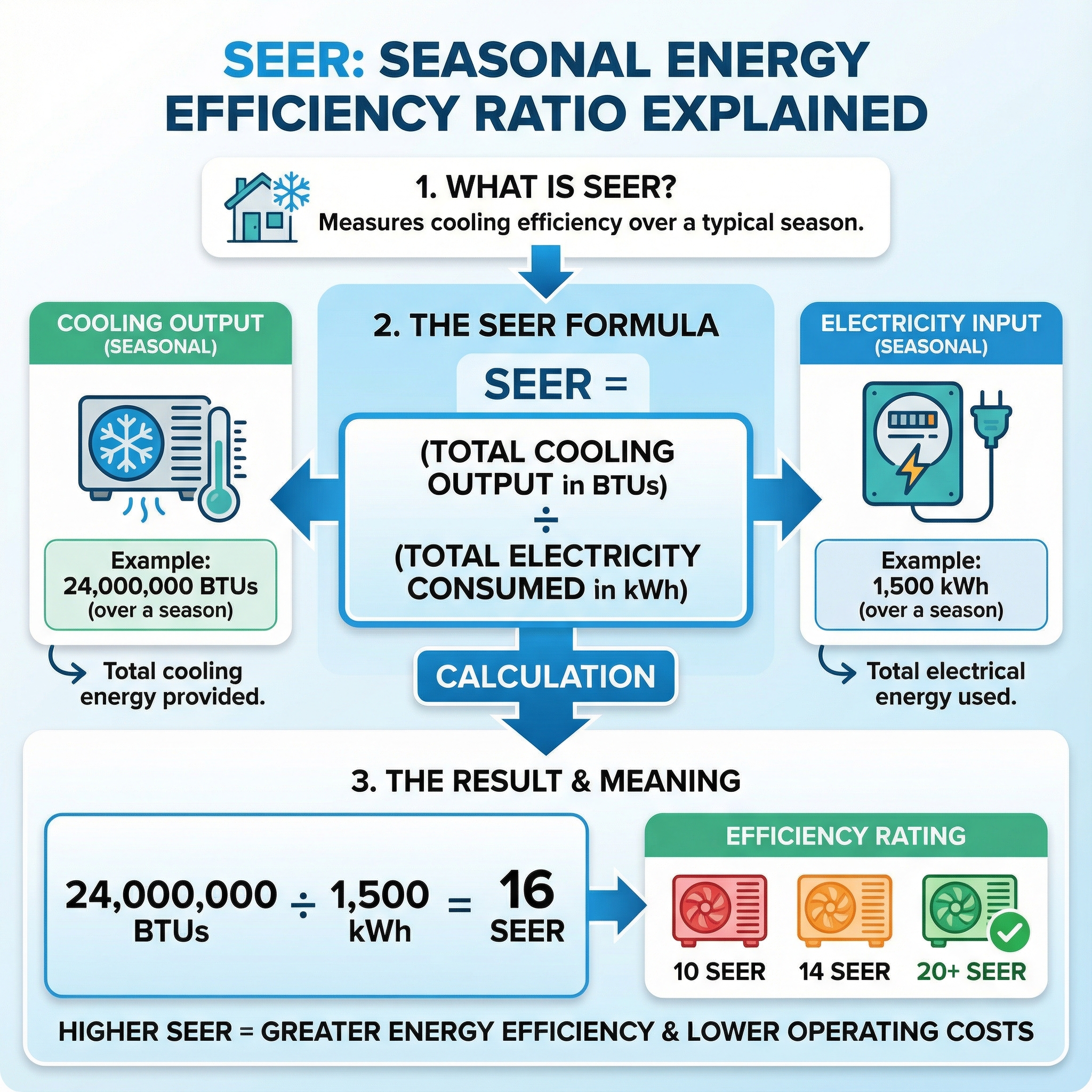
SEER and SEER2 rate how efficiently an air conditioner delivers seasonal cooling. Higher numbers mean fewer kilowatt hours per unit of cooling and typically lower operating costs. In 2023 the test moved to SEER2, with region specific minimums. Northern states are roughly 14 SEER2 minimum, while the Southeast and Southwest require higher ratings and, in some cases, EER2 limits for peak performance. Keep in mind, SEER2 is a lab rating of the equipment only, not your duct system, so duct leakage or poor design can erase gains.
Efficiency alone does not promise dry air. Moisture removal depends more on sensible heat ratio, coil design, airflow, runtime behavior, and controls. Think of the coil like a sponge. It needs enough contact time to wring moisture from the air. Very high efficiency can reduce runtime, which may leave rooms clammy if the system is oversized or airflow is too high. Hot humid regions need strong latent capacity and sometimes a dedicated dehumidifier, while hot dry regions focus on sensible cooling. A 20 SEER2 unit can be about 43 percent more efficient than a 14 SEER2 model, so bills drop over long cooling seasons, but variable and multi speed systems cost more upfront. In our experience at Budget Heating (BudgetHeating.com), codes set the floor for efficiency, not for humidity performance.
When an AC Alone Isn't Enough: Tradeoffs and Better Alternatives
Air conditioning mainly chases temperature. In some homes, that is not the same as controlling moisture. We routinely see three situations where a conventional AC will not keep indoor humidity in check without discomfort or wasted energy:
- Mild but humid weather, shoulder seasons: with little or no cooling call, the system barely runs, so RH drifts above 60 percent. Better choice: a whole-home dehumidifier tied into the ductwork, or a room unit for a single problem area.
- Hot-humid climates or homes bringing in outdoor air: the AC may need deep overcooling to dry the air. Better choice: a dedicated outdoor air system to dry and temper ventilation air, or controlled HRV/ERV ventilation to treat incoming air first.
- Damp zones or short cycling from an oversized unit: basements stay clammy even when upstairs is cool. Better choice: dedicated dehumidification sized for the space.
Consider dedicated dehumidification when indoor RH sits above about 60 percent, you must overcool to feel dry, or specific areas remain damp despite cooling.
Maintenance, Settings & a Practical Checklist to Improve Dehumidification
Use this practical checklist to improve moisture removal, like dialing in a bicycle's gears so effort matches terrain. Start by confirming you actually have a humidity issue, then move through safe maintenance and settings before calling a professional.
Homeowner checklist
- Measure and confirm: place inexpensive hygrometers in a few rooms, log temperature and RH, and note condensation, mold, or musty odors.
- Thermostat: set the fan to Auto, not On. If available, enable dehumidify modes or humidity targets.
- Airflow basics: replace or clean filters every 1 to 3 months and keep supply and return vents unblocked.
- Condensate awareness: look for leaks or standing water near the indoor unit. Light preventive cleaning of an accessible drain line can help.
- Ducts: seal and insulate ducts in unconditioned spaces to reduce warm, moist air infiltration.
- Outdoor unit: maintain about 2 feet of clearance. If rinsing the condenser, shut off power and use a gentle garden hose.
- Reduce moisture sources: run bath and kitchen exhaust fans vented outdoors, vent the dryer outside, fix plumbing leaks, and cover exposed earth in crawlspaces.
- Safety: disconnect power before opening panels, beware sharp fins, never handle refrigerant or gas work, and keep carbon monoxide alarms working.
Professional tasks
- Verify and correct airflow in CFM and set blower speed for latent removal.
- Refrigerant charge checks, leak repair, and electrical diagnostics.
- Deep coil cleaning, and repair of condensate pans, traps, and float switches.
- Diagnose persistent humidity and size or integrate a whole home dehumidifier.
- Any gas or combustion work.
Bottom Line: When Your AC Can - and Can't - Control Building Humidity (and What To Do Next)
Yes, a central AC can manage humidity, provided it is designed, sized, installed, controlled, and maintained for the building's latent load. It removes moisture whenever it cools by condensing water on a cold evaporator coil, but results hinge on adequate runtime, coil temperature, airflow, duct leakage, ventilation strategy, internal moisture sources, and thermostat or fan settings. In hot humid climates, during mild damp weather, or in homes with high moisture loads, dedicated dehumidification or treated outdoor air is often required.
If indoor RH sits above about 60% even with normal cooling, check the basics: verify sizing and airflow, keep filters, coils, and drains clean, set the fan to Auto, reduce moisture sources, and seal ducts. When that is not enough, our U.S.-based team can pinpoint the cause and recommend variable speed equipment or whole home dehumidification. After 30+ years and 200,000+ orders, we know how to get this right.
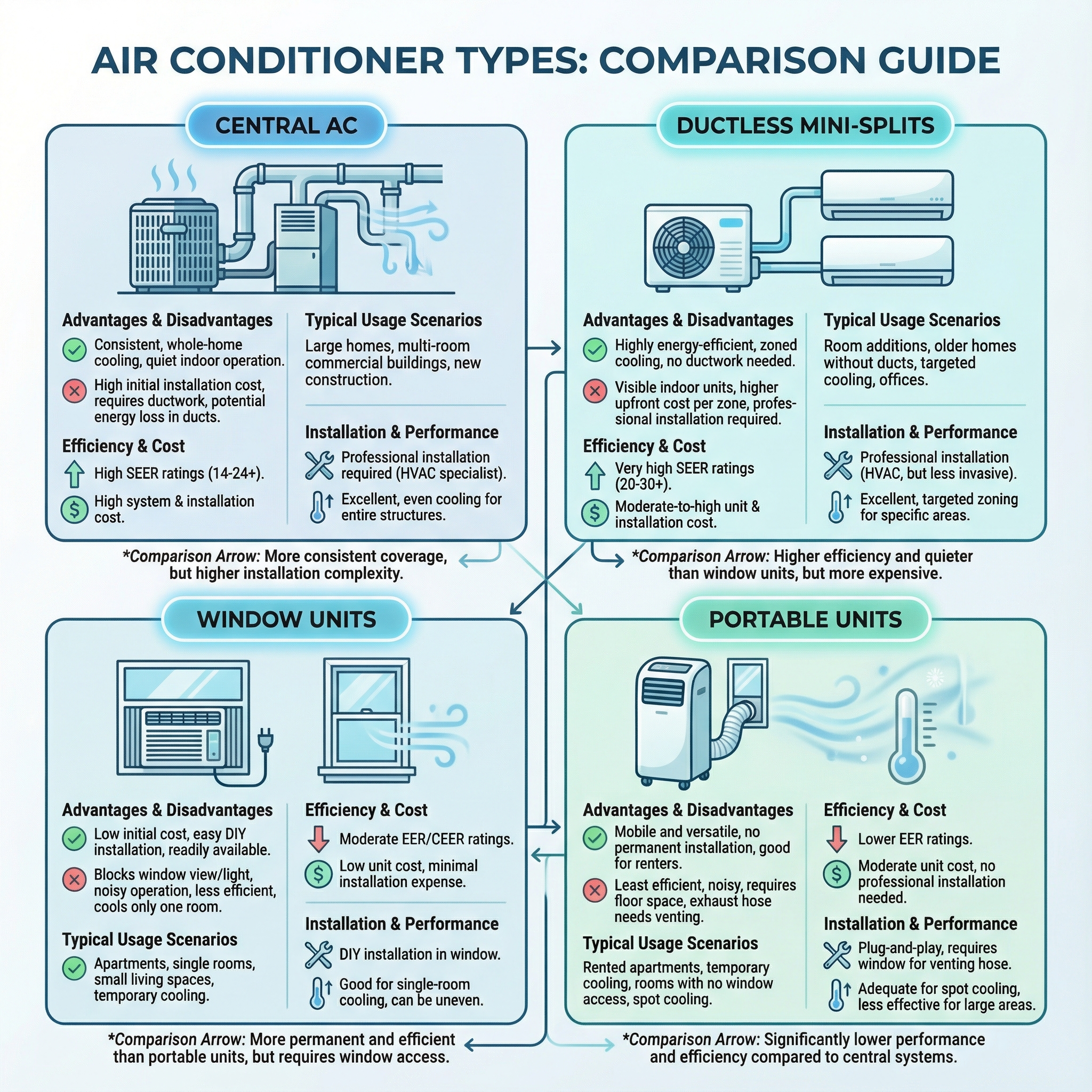
- Get a Custom Quote for right sized AC, heat pump, or dehumidification.
- Talk to Our Team by phone for a quick humidity assessment.
- Shop AC, Heat Pumps, and Ductless Mini Splits at wholesale pricing, many systems ship free, financing with Affirm.